Mind the Gap

This post originally appeared here as “Second-Class Baptism” on 22 November 2012. 

         In the fall of 2005, I was an exchange student from Yale Divinity School to Westcott House, a member of the Cambridge Theological Federation in Cambridge, England. It was quite an awakening for this Lutheran. Despite knowledge of some of the rifts in the Episcopal Church (USA), I had very little awareness or comprehension of the major theological divides in the Church of England. In the wake of the recent decision (11/20/12) by the General Synod of the Church of England not to ordain women as bishops, I have recalled learning about those divides, specifically through a speech I heard that semester. 

            During my time in Cambridge, I went to an event sponsored by Women and the Church (WATCH) to hear speakers arguing for the ordination of women as bishops. One speaker, whose name is lost to my memory, gave a carefully constructed and passionate speech about baptism and vocation within the church. She noted that if we do not believe women are qualified and gifted by God for leadership at any and all levels, why do we bother to baptize them? I have never forgotten that sentence, which was so stunning that the room was silent for several seconds afterwards.

            Even with disparate understandings and beliefs about baptism, most Christians agree that the washing rite reveals God’s claim on an individual and, simultaneously, a welcome of that individual into the corporate work of the church on earth. What happens to that second part when we baptize someone, but tell her that because of her sex organs- the Church will interpret how God is using her? What does it mean to pour the water, make the sign of the cross, and say, “But because of your sex, you’re only fit to carry the cross of Christ this far, in this way, and with these provisions?”

            Furthermore, when the Church places provisos for leadership based on sex, gender identity, sexual orientation, race, or other biological circumstance, we presume a kind of certainty and zeal in speaking for God that should make us pause. Throughout history, people have been quick to use the name of God as the seal of approval on whatever preferred course of action was believed to need pursuing. This often occurred through the same kind of biblical gymnastics that still occur today- a little limbo under the inconvenient verses, a vault over the stories that are contradictory, a lovely ribbon-dancing floorshow with the few verses that, out of context, support exactly the argument one is trying to make.

            If the Church of England was honest about its history, its theology, and its current struggle to remain relevant in today’s society, perhaps the voting would have gone differently. Perhaps if the space were made for lament over the rifts in the modern church and, in the next breath, prayers for the future were offered, maybe the voting would have gone differently. Maybe if we could point out that shortly after Peter and Andrew left their nets, they were joined by Mary of Magdala, Joanna, and Susanna in following Jesus- we might be able to have the conversation that nothing about the image of ministry or mission in the Bible at all resembles the way most churches and denominations are structured today. Maybe then things would go differently. 

            The main conversation that must happen, though, is the one around God’s ability to equip, regardless of biology. Either we believe that the Holy Spirit blows where She wills or we don’t. Either we believe that God is more powerful that human weakness (present in all) or we don’t. Either we believe that Jesus broke down social and gender barriers in community and communion or we don’t. Either we wrestle with our human limitations in comprehending the expansive nature of God’s mercy, call, and creative purposes or we get used to our efforts failing as God says, “Oh, no, you don’t.”

          The failure of the General Synod to pass, by just six votes, a measure allowing for the ordination of women as bishops is not a sign of failure on the part of either side. It is a sign that there is a gap between the understanding of the gift of baptism and the Church’s willingness to allow all people to live into that gift. That space creates an unholy chasm into which many gifts will fall and go unused because of the pain in this construction: “You are a child of God, but here’s exactly what that looks like.” When a significant church body, like the Church of England, says to women, “Your skills are useful this far and no further,”- what most women and girls hear is this: “God loves you as you are, but would love you more if you were a man.” If that is the case, why, and into what, are we baptizing women? As they say on the London tube (subway), “Mind the gap, please.” 

Hemmed in Thanksgiving (Sermon 11/18)

Isaiah 6:1-8
            There are many details in this story that can be distracting. Who was King Uzziah? What exactly does a seraph look like?  Why is Isaiah’s call to be a prophet happening six chapters in, instead of in chapter 1? All of these are good questions, but not ultimately what this short passage is about.
            Isaiah is in the holy of holies, inside the innermost part of the temple. He is a having a vision or an experience, where the shapes on the Ark of the Covenant are slowly transformed until they are no longer carvings, but are revealing to him the activity that happens around the throne of God.
            When Isaiah says, “Woe is me…” This is not a Charlie Brown-kick-the-dirt kind of grousing. It’s a gulp of terror. To see God, in Hebrew Scriptures, is to know that you are about to die. No one sees the face of God and lives. Isaiah has nothing to offer; yet what happens next isn’t based on what he can bring. It’s based on what God can do and how Isaiah responds.
            God’s attendants come and purify Isaiah, giving him a real experience of forgiveness and grace in the presence of God… mercy when he expected to die, absolution without a sacrifice or offering, righteousness on God’s terms (not human definitions). Thus, Isaiah is so moved that when God converses with the heavenly host: Who will go for us? Whom shall I send?– Isaiah pipes up, “I’ll go! Send me!”- even before he knows what he will be asked to do or say.
            Isaiah is so grateful for his life and for grace, that he’s willing to undertake a task from God- the details of which he does not know, but if he thought for a minute about prophetic history, he’d probably offer someone else’s name instead. Isaiah realizes that God does not abandon unclean people, but makes them holy, makes them ready, and invites them into the work that needs to be done. He says, “Send me”, not because he is an amazing prophet, but because he recognizes the grace in being involved in God’s work in the world.
            How much of God does Isaiah see? Certainly not God’s face or even God’s hands- these are not visible. Isaiah only gets a view of God’s feet: “The hem of God’s robe fills the temple.” Only God’s feet… but it is enough. This experience, God’s feet and hem, an encounter with forgiveness, is enough to move Isaiah to gratitude and to action.
            In the coming week, most of us will be considering the things for which we are grateful. We will listen to others around us say for what they are thankful. Almost in the same breath, as we speak of gratitude, we will think of new things that we want or perceive that we need. What if we stopped and just thought about the hem of God’s robe? What if we became absorbed, like Isaiah, in a vision of God’s activity in the world, in our communities, in our lives? And what would happen if we realized that all we are grateful for, all that we are able to perceive is just the hem of God’s robe?
            It’s not the whole picture. It’s not even half. The grace that we are able to comprehend is just the tip of the iceberg. And yet it is enough. It is enough for us to know just this much and to not die. Let this be your Thanksgiving thought: all that you can think of to list as blessings in your life barely begins to list all that God has done for you.
            So it is for all people and all creation. Having received more, and costlier, grace than we can comprehend through Christ, may God’s Spirit move our thanksgiving beyond “thank you” to “Here I am. Send me” – a thanksgiving response to the grace of in being involved in God’s work in the world.
Amen. 

Grace: Motivator or Excuse? (Sermon 11/11)

Jonah 1, 3-4
            I do not love the last line of the hymn “O Zion, Haste”: “Let known whom he has ransomed fail to greet him/ through your neglect, unfit to see his face.” That makes me itchy all over, in part because I think salvation is not my job. I don’t save people. Jesus has saved people. Isn’t that the point of grace? That it’s available to all people and we don’t work for it.
            Yet what is grace, saving grace, costly grace, grace that comes from death and resurrection, if I don’t know about it? What does it mean to me? Furthermore, what does it mean to the person who knows, but doesn’t think it is worth talking about every day? What does it mean to the person who knows about grace, who believes grace is amazing and true, but not quite amazing and true enough to risk anything for it? What does grace mean to the person who loves benefitting from it, but not enough to take a message of grace to people who ache for grace, people in a place like Ninevah?
            The story of Jonah has a very specific function in the Hebrew Scriptures. We tend to narrow it down to the part about the big fish, sometimes forgetting how Jonah ended up in that place anyway. A few people say the conversion of a whole city is a bigger miracle, especially with such a lousy sermon, “Forty days more and Ninevah shall be overthrown.” We could talk about resisting God’s call in our lives, but that’s not why the story of Jonah is important or why it lasted for years and years, even to us today.
            Jonah is written down in this very critical time period in the Hebrew scripture history, when things are going okay for the Israelites. With a righteous leader and the exile far off enough into the future as to be unpredicted, the Hebrew people can live for a moment into what it feels like to be “chosen people”.
Basking in God’s favor, as they see it, however, they are doing nothing to communicate the message of one God- creator and redeemer of all- to the people around them. They have forgotten that this is for what they have been chosen: to carry the message of Adonai to the world. They love the idea of a gracious and merciful God, as long as the grace and mercy are for them. Not the others nearby and certainly not the others far away.
Jonah has no interest in taking a message of grace to Ninevah, a city full of non-Hebrews, a city of infamous iniquity. Why should they get the grace he knows God will provide? So he goes in the opposite direction to Tarshish and, when that plan seems foiled, he’d rather die by drowning than go to Ninevah.
Why should Jonah go? If God will be gracious in the end anyway, why does it matter if Jonah goes or not? Why are you here this morning? At some point, we all have to decide if grace is an excuse or an motivator? Are we using the grace of God, the grace we believe that applies to all, to relieve us of responsibility? Are we skipping the third verse because we know that people will still get to see Jesus- no matter what we do?
Or is grace our motivator? Are we motivated by joy in our salvation? Are we stirred up in knowing that God intends something better for the world now, as well as the world to come? Not only that, but God chooses to use us in the bringing about of those improvements? Are we moved enough by the idea of grace to embrace a call to good works?
By hearing the story of Jonah, the Hebrew people of the time were reminded that God’s gift of grace to them was not to set them above others, but to bring them into the midst of a world that truly needed to hear about the one God- maker and redeemer of all.
The last couple sentences of Jonah are my favorite in the whole of the Bible. Then the Lord said, “You are concerned about the bush, for which you did not labor and which you did not grow; it came into being in a night and perished in a night. And should I not be concerned about Nineveh, that great city, in which there are more than a hundred and twenty thousand people who do not know their right hand from their left, and also many animals?”
They reveal God’s sense of humor and God’s boundless love for all. Furthermore, Jonah’s whole story reveals God’s intention to use each of us to share that love and the message of repentance and grace. For me, I have to consider these lines with the last line of that hymn. Even if I believe that people receive grace through the faithfulness of Christ, there is still work for me to do… for you to do… so that people may see a face of Christ in this life.
Are you moved enough by the gift of grace to go to Ninevah? To do the very last thing that you want to do? Grace is not simply for heaven later, it is to prevent feeling like hell is on earth now. Each of us has a call and gifts to help people experience the presence of Christ with them today.  That’s why we’re here, not to simply see friends, have communion, and check off church for a week. We gather to be recharged so that we can go out and publish glad tidings… tidings of peace… tidings of Jesus… redemption and release. 

Election Day Prayer: Recessional

Recessional

God of our fathers, known of old,   
   Lord of our far-flung battle-line,   
Beneath whose awful Hand we hold
   Dominion over palm and pine—
Lord God of Hosts, be with us yet,   
Lest we forget—lest we forget!

The tumult and the shouting dies;
   The Captains and the Kings depart:   
Still stands Thine ancient sacrifice,
   An humble and a contrite heart.
Lord God of Hosts, be with us yet,   
Lest we forget—lest we forget!

Far-called, our navies melt away;
   On dune and headland sinks the fire:   
Lo, all our pomp of yesterday
   Is one with Nineveh and Tyre!   
Judge of the Nations, spare us yet,   
Lest we forget—lest we forget!

If, drunk with sight of power, we loose   
   Wild tongues that have not Thee in awe,   
Such boastings as the Gentiles use,
   Or lesser breeds without the Law—
Lord God of Hosts, be with us yet,
Lest we forget—lest we forget!

For heathen heart that puts her trust   
   In reeking tube and iron shard,
All valiant dust that builds on dust,
   And guarding, calls not Thee to guard,   
For frantic boast and foolish word—
Thy mercy on Thy People, Lord!
Rudyard Kipling, 1897
Source: A Choice of Kipling’s Verse (1943)

Around the Edges (All Saints Sermon)

1 Kings 17:1-16
            A famous theologian once said, “You should preach with the Bible in one hand and the newspaper in the other.” That can be tough, because then in one hand I have stories of droughts and floods, wars and struggles between ruling parties, unexpected deaths, people struggling to make ends meet, and people longing for justice… and is that the hand that holds the newspaper or the Bible? Sometimes, it can be hard to tell one from the other without looking carefully and remembering what each one is supposed to do. The newspaper shows us a world that longs for God’s kingdom to come or has forgotten its promise. The Bible reminds us of the promise and shows us God’s actions through history, so that we have a foundation on which to base our hope in and expectation of God’s future actions.
            If the Bible were like other history books, today’s reading would be about Ahab’s reaction to the prophet Elijah. We would have a detailed account of the king’s comings and goings and how other, sycophantic “prophets” would have advised him, and (almost certainly) what Jezebel had to say about the matter. Yet, Israel’s history does not chronicle the kings as much as the people affected by the king and the king’s decisions. Remember that when Israel called for a king, the people were reminded that the Lord was to be their one leader and a king would come with some serious consequences for their national wellbeing.
            Thus, instead of learning more about Ahab, we get a story of Elijah fleeing for his life and a widow with a child, someone who is directly affected by the policies of the king. The first situation that is facing the widow is that she is a widow. Her source of income is gone. Her husband’s family, if still living, hasn’t taken her in to be with them. Her own family, if still living, would not be expected to do so. So she depends on the generosity of others, toward her and toward her son, so that they may live. She may be able to do little tasks in exchange for food or coin to make ends meet, but she certainly lives with very little extra and, consequently, very little participation in societal life.
            The second situation facing the widow (and her neighbors) is the drought. The writer of 1 Kings is careful to point out that the Lord says through Elijah that it will not rain for several years. The significance of this is not that the Lord wants people to suffer in a drought, but that the Lord wants them to remember who makes the rain. The Canaanite god, Baal, was thought to be the giver of rain. If it was dry, Baal was dead. If it rained, he was alive. But Elijah’s prophesy points out that it is the Lord God who is the giver of life. So now we have a situation where people are going to be tightening their belts and have less to give to the widow, whom God has commanded them to remember. We have a prophet who has angered a king who is clearly refusing to acknowledge the Lord as God (and the only God).
            Finally, the widow has a plan for how she and her son will die and here comes a prophet of the Lord, distinguished in some way that lets her know that he’s a holy man, who wants some of her last bits of food. Now, the widow is from the same region (Sidon) as Jezebel, so she is likely to be a worshiper of Baal. Yet she speaks to Elijah with the words he spoke to Ahab, “As the Lord your God lives…” Her circumstances are overwhelming and horrifying. If we were reading to this point in a newspaper article, woman struggling to make ends meet in bad times is confronted by a man who claims to speak for God who tells her to feed him… Who would root for her? Who would blame her if she closed the door on him? Who would say she should absolutely make him some food? Who would say, “The Lord never gives us more than we can handle” and expect her to bake that bread?
            Elijah promises her that she and her son will have enough food, throughout the drought, if she helps him. And so she did. Hooray! Faithful action pays off! It’s a heart-warming page 2 story!
            But not so fast, remember earlier in the story when the ravens feed Elijah? We’re all familiar with ravens- eating out of dumpsters and what’s been hit in the street. Who here would eat meat and bread brought to them by a raven? Even more so, in ancient Israel, ravens are nasty, unclean birds. You don’t eat scavengers, yet they are what God sends to keep Elijah alive. The unexpected birds are how God provides for the prophet.
Similarly, the widow, with all of the circumstances piled against her, should not be expected to provide for a prophet. There are better-favored people to do that, yet God’s provision for her allows her to have an expected role as a sustainer, as a provider, as a person whom God has not forgotten. The God she does not worship has not failed to provide for her and, furthermore, has not forgotten use her to the hope of others and for the hope of creation.
This is what it means to be a saint. It’s not about having great stories written about you or having powerful visions or heroic actions. It’s about faithful action, in spite of what else is happening, and it is about being the hope in God of the people around us. The people whose lives we remember today and the lives that the Spirit is shaping today are exactly this… lives that remember the people around them, lives that are structured by small, unseen remembrances, gifts, and help.
Sometimes we do have more than we can handle on our own. Sometimes life does pile up. It is not merely by our own determination that we survive, but by the help and support of others- who bring us bread, words of hope, silent companionship, refills of oil for our jars. This is what sainthood looks like… un-haloed, but still hallowed, unsung, but still a song, unremarked, but still remarkable.
It is work that happens through family and friends AND through outsiders and rejects (in this story, widows and ravens). This is how the Spirit moves-from all directions, expected and unexpected. This is how God reminds us who is in charge. This is how saints are made, how creation is renewed, and how Christ continues to make resurrection happen out of death in this life.
A famous theologian once said, “You should preach with the Bible in one hand and the newspaper in the other.” In one hand, I have stories of droughts and floods, wars and struggles between ruling parties, unexpected deaths, people struggling to make ends meet, and people longing for justice… and is that the newspaper or the Bible?
In the end, it doesn’t matter. Either way, the Holy Spirit is in these stories, breathing from the edges and from the middle, encouraging people (and sometimes animals) to actions that save and preserve life. It’s not the headline news, but it must be remembered. God is in charge, no matter what else happens, and, with that eternal truth, comes this corollary: the Spirit is still making saints. 

Sunday Prayer: All Saints

A reading from the Wisdom of Solomon (3:1-9)


 But the souls of the righteous are 
in the hand of God,
and no torment will ever touch them. 
In the eyes of the foolish they seemed to have died,
and their departure was thought to be a disaster, 
and their going from us to be their destruction;
but they are at peace. 
For though in the sight of others they were punished,
their hope is full of immortality. 
Having been disciplined a little, they will receive great good,
because God tested them and found them worthy of himself; 
like gold in the furnace he tried them,
and like a sacrificial burnt-offering he accepted them. 
In the time of their visitation they will shine forth,
and will run like sparks through the stubble. 
They will govern nations and rule over peoples,
and the Lord will reign over them for ever. 
Those who trust in him will understand truth,
and the faithful will abide with him in love,
because grace and mercy are upon his holy ones,
and he watches over his elect. 

A Statement of Faith for All Saints Day

We believe in God, who brings creation out of chaos, healing out of brokenness, light out of darkness, and life out of death.
We believe in Jesus Christ, God’s Son and our Lord.
Jesus came into the world for teaching, for healing, for reconciliation, and to announce the reign of God’s kingdom.
Though his work was opposed, even unto death, the Word of Life could not be silenced.
He was resurrected for the sake of all, including we who are gathered here.
We await his return in glory and we continually look for his presence in this life.
We trust this expectation is not in vain. 
We believe in the Holy Spirit, giver of the gifts of community, communion, and consolation.
The Spirit preserves our hearts in the midst of things we cannot understand and connects us to the cloud of faithful witnesses, who are our encouragement.
The Spirit shapes us as God’s people and gives us faith and courage to respond to the gifts of mercy, grace, and healing until we reach the place our faith moves from hope to revelation.
Amen. 

Amazing Grace

Today a visitor came to church, sat alone, thumbed through the hymnal before the service and during communion.

After the service, he asked someone to help him find the thing he’d found about confession. Several people, including myself, tried, but failed. He kept looking for nearly half an hour before he found it and signaled to me.

He had found this section of Luther’s Small Catechism:

What is confession? Confession consists of two parts. One is that we confess our sins. The other is that we receive the absolution, that is, forgiveness, from the pastor as from God himself and by no means doubt but firmly believe that our sins are thereby forgiven before God in heaven. 

He pointed this out to me and said, “Do you do this?”

“Do you mean, am I the person, the pastor, who would assure you of God’s forgiveness?”

“Yes.” He then went on to name some struggles and then said, “Can you, as the pastor, give me forgiveness?”

On a Sunday where we celebrate the priesthood of all believers, the work of God in ever-reforming God’s church, the gift of the Holy Spirit… on this festival day…

I looked at that man and said what he needed to hear, “Yes, I can assure you of God’s forgiveness. I will tell you that in the darkest of nights and the least certain of moments, that Jesus Christ is with you. I promise you that the Holy Spirit is always working to bring peace and comfort to your heart. Know that what I am telling you is true: there is nothing that you have done that will separate you from the love of God in Christ Jesus. God knows your confession. You are forgiven.”

He flinched a little as I raised my hand to make the sign of the cross, but then smiled as he received it, relief plain in his eyes.

Are you the one who can offer words of forgiveness as though from God’s ownself?

I am.

I can.

I do.

This is the gift of God’s reformation.

You Know Why They Built That Calf (Sermon 10/7)

Exodus 32:1-14
            It is said that when Augustine preached, in his role as the Bishop of Hippo, that he preached for two hours or so at the time. Within the length of his sermon, he would have smaller sermons that were directed at different people who might be gathered in the congregation. He would preach to people who were just hearing of the faith. He would preach to the catecumenate, the people preparing for baptism. He would preach to those feeling lost and to those who were a long time in the faith. Everyone sat through all of the sermons, absorbing the lesson aimed at them and the lessons that swirled over them.
I have been thinking about Augustine this week as this text of the Golden Calf turned over in my mind. There are at least six sermons here. All of them do not apply to all of you. I think I can cover three of them and keep my time under two hours.
            The first group to whom I will speak today are those who would consider themselves young in faith, those who still feel raw and uncertain. If you feel a little shaky about your Bible knowledge or confused as to why we do what and when, this is for you. You know why the idols were built.
            The story of the Golden Calf takes place after the Israelites have been freed from Egyptian slavery, after they have seen the violent death of Pharaoh’s army in the Sea of Reeds, after God has led them with a pillar of clouds by day and a pillar of fire by night, after they’ve received food from the heavens, and after the Israelites have been gifted with the Ten Commandments, which begin with “You shall have no other gods before me.”
            The Israelites did not make it to this place on their own, but each step has been an overwhelming confirmation of God’s presence with them and God’s guidance through their leader, Moses. Even though the Israelites know their history, each day is a new experiment in trust. They are totally dependent on God and God’s providence. While the goal of living by faith is their ideal, sometimes it requires too much.
            You may find yourself relating well to the Israelites in this situation, oh people of new faith. It turns out to be harder than expected. The glories of those first days of freedom and revelation are strengthening, but the need for new confirmation each day is tough. It is hard to say that to those around you, those who share your tent, those who sit around the table with you. But you must. The Israelites missed the chance to hold one another up when they grumbled to themselves and then despaired. Sometimes the constant re-telling of the stories of freedom and hope are what keep the flame burning until new wood, experience, confirmation, depth of wisdom in Christ, is added. For you receiving this first sermon, I encourage you to tell your story- share the breath of God that is in you. Let the Spirit be the wind that parts the waters of doubt for you and those around you and lets you pass through on dry land.
            The second sermon is for those of you who have been faithful for years. If you have heard this story as a child and as an adult, if you feel like the facts are familiar, if you are listening and making a to-do list in your head at the same time- this is the sermon portion for you.
            It is you, beloved second group who do much of the work of the church and, yet, are at the greatest risk of imitating the Hebrew people of this story. It is you who know the story so well who may overlook the two reasons the Golden Calf gets built. When the people lament that Moses has been gone too long, they gather around his brother, Aaron, and beg him to help them make an idol.
            If you remember, Aaron was Moses’s spokesman in front of Pharaoh. Aaron knows EXACTLY what has happened between God and the people. And yet, he collects up the jewelry, melts it down, and makes a golden calf- a common shape for worship in the Mesopotamian region. Representing food, milk, clothing, and potential livelihood, as idols go, the calf is not unreasonable. And yet, it is not appropriate for people who have been saved by the God of their ancestors and who are yet covered by the same promises made to those ancestors.
            The people may have made the idol because they needed a concrete image to worship. Perhaps the God of freedom who acted unseen was too much of a strain. Perhaps they were trying to make an image of this God and this is what they came up with. Regardless, Moses is up on the mountain receiving instructions for how to build the tabernacle, a place for God’s Spirit to dwell in the encampment, and down below the people are trying to make a concrete image to worship, from which to seek guidance, to praise for all that has happened to them.
            People of faithful years, this is too easy to do. We live in a world that craves newness and, in newness, concreteness. Our sports teams, our gadgets, our cars, our clothing, our patriotic idealism, our financial worries, our hobbies, our families, our work, our health, our church programs, our history, our future… these all can and do become our idols. They become the images that absorb our concentration, our energy, and our focus. The place where we push the most focus becomes our god. It may not be sparkly and shiny, but we can have it built and receiving the offerings of our time and our talents faster than we expect.
            What is the first thing you think of when you wake up? Is it your baptism in Christ? Is it the taste of communion? Is it the powerful conversation with your neighbor about God’s providence? As you go to sleep, were you praying? Was your prayer, “Lord, how will I get everything done tomorrow?” or “Lord, thank you for today”?
            We look down on the builders of the Golden Calf, but we often forget the idols that crop up around us- idols that demand our attention, our money, and our devotion. Oh, people of years of faith, beware the siren call of new things, of crammed schedules, of political promises and hope anchored in quicksand. Think on what is truth- the gifts of God in Christ, communion, community, and consolation. Dwell on these things and other idols will tarnish and crumble, because they cannot stand.
            Lastly, I will speak to you who have lived faithful lives of many decades. You know why the idols were built. The Israelites, in waiting for Moses’s return, believed that God had grown silent. Despite their earlier experiences, they found themselves without a prophet. They prayed and felt no answer. They wept and felt no consolation. They ate and they drank food from heaven and, yet, they felt empty.
            You, elders in faith, know this feeling. None of us wish to speak of this dark night of the soul, but you know of the words poured forth in grief, in anger, and in frustration that seemed to go unheard, because you have waited for a response that has not yet seemed to come. You feel a kinship with the Israelites, who lift their eyes to the mountain and say, “It is well and good for Moses to talk to the Lord, but what about me? What about what I have to say? What about what I need to hear?” You understand that sometimes idols are made, not because of disobedient nature or confusion, but out of the sheer need to hold onto something- grief, relief, memory, control.
            You, people in this third group, know too well what it is like to proceed through the valley of the shadow and to feel like the sun doesn’t always make down to where you are. And, yet, you have walked. You have walked through the silence, you have waded through the depths, you have remembered Egypt and you have said, “That was nothing.”
            And, in your walking, you have also become prophetic. You read this story and you know God didn’t change the plan. You know that God had no intentions of destroying the people of the promise again. Instead, you look at this Scripture through eyes of wisdom and you see God coaching Moses into his role as prophet. You see God stirring up fear and frustration in Moses until Moses is finally responding with the strength and the nerve that God knows is in him, “These are your people, Lord! The people you led out of slavery! Would you have others say that it was they would die in the wilderness? Would you have their children say that you are God who does not keep promises?”
            With decades of experience, you all see the God pulling Moses along because you’ve been there. You’ve been in the spot of negotiating with God on one side, only to realize you were handed a new and different task. And you’ve done this trick yourself. With your years of experience, you know that other idols crumble, but they remain tempting when it seems God is silent or, conversely, when it seems that all you can hear is God calling you into a new and scary place of relationship and prophetic living.
            People of Hope, whichever group you are in, you know why those idols were built. You have done it yourself and we will do it again. And yet, we know that we have a God who forgives, who relents, who comes among us in Jesus to show us, ultimately, that there is nothing this world can offer that cannot be trumped by what God gives- hope in the face of doubt, strength in the place of insecurity, freedom in the place of enslavement, life where death would have the last word.
            We all long for the concreteness of idols, but our hearts are made by God and long for God. Whichever you find yourself in today, here are words from St. Augustine to God, which could be from any of us: “Thou madest me for thyself and my heart is restless until it finds repose in thee.”
Thou madest me for thyself, and my heart is restless until it finds repose in thee.
No idol offers that kind of repose.
Amen.

God’s Plan, Our Choices (Sermon 9/23)


Genesis 15:1-6
            What is God’s plan? Many times, in some of the darkest moments of our lives, people (well-meaning people) tell us that God has a plan for our pain, that what has happened to us makes sense in a grand scheme, that we are not hurting in vain. Yet think about what that says about God: that God uses pain as a means to an end, to bring us where God wants us to be? That there is a long-range plan, full of illnesses and pains, which is how God is bringing the kin-dom into fruition? That the forces that oppose God, including cancer, chaos, and criminal actions, do not really have any power- though we go through the motions of renouncing them at baptism.
            If God’s plan for the world is down to the tiny details, what’s our part in it? Do we play a role? Are the encouragements in the creation story, the relationship that we see there between God, humans, and the rest of creation, is that a real relationship or just a backdrop while God moves us around according to a plan?
            If we take a look at Abraham’s story, we can see two things: one is God has a plan and two, people are participants in that plan. God’s plan for Abraham is no less than God’s plan for anyone of us- a future, hopes fulfilled, abundant life. God draws Abram out into the dark of the night and promises that, though currently childless, he will be a father to many generations. God has a plan for Abram’s future… including a name change, but God’s plan requires trust and faithful action on Abram’s part.
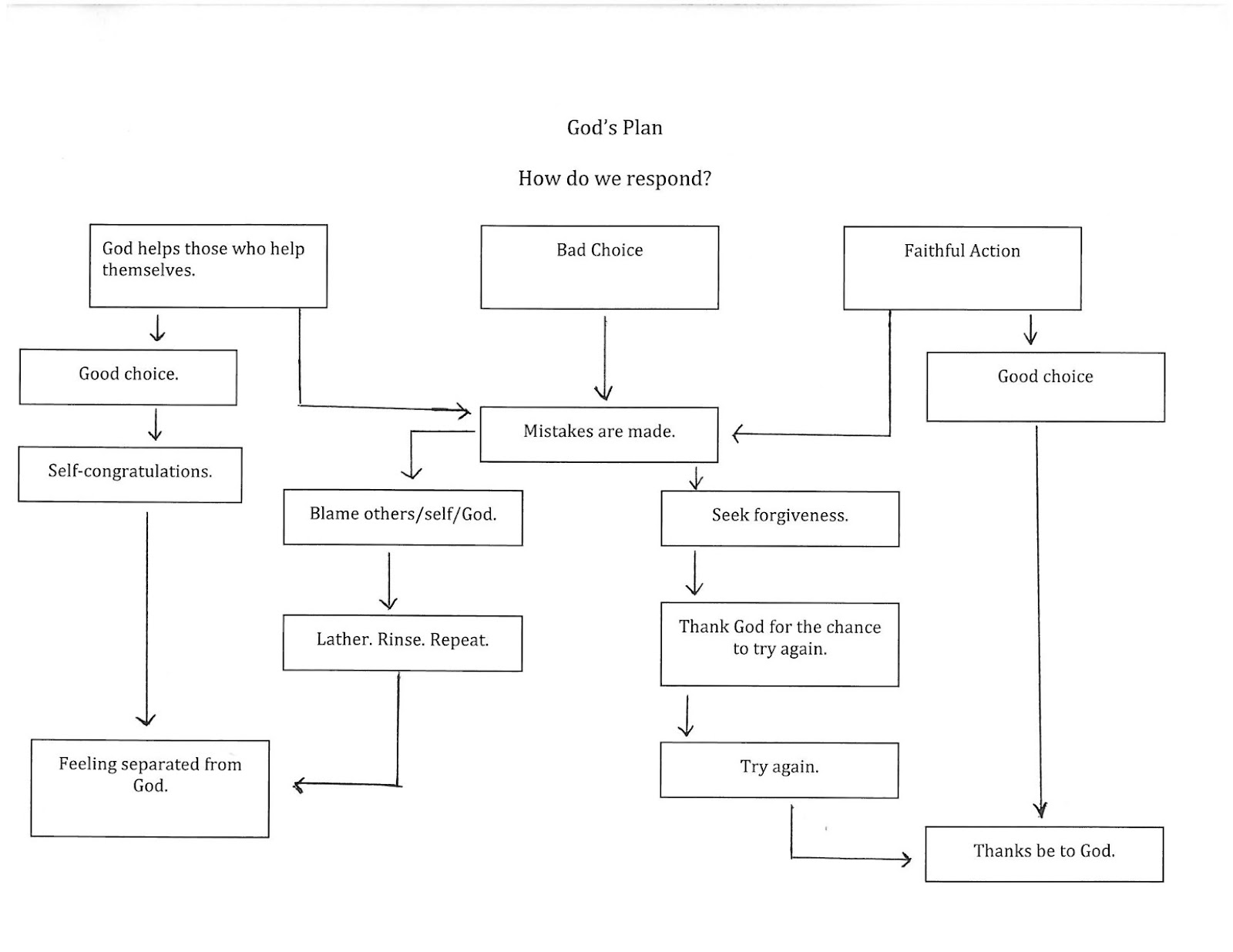
See chart above:
The chart moves from the idea that God has an over-arching plan, but we are called to respond, through the gifts of faith and free will. Consider the choices Abram/Abraham made. 
God helps those who help themselves: Hagar and Ishmael
Expedient Choice (ending up badly): Passing Sarah off as his sister
Faithful action: leaving homeland, creating Isaac, arguing on behalf of Sodom and Gomorrah, near-sacrifice
            Each of this situations arise from choices that Abraham makes, just like each of us find ourselves in situations because of our own choices. Occasionally, we find ourselves in situations, good or bad, because of someone else’s choices. As participants in God’s work in the world, as co-creators and communicators of God’s blessings (just like Abraham), we are continually called to think through who we are as people, as families, as a faith community, as a city/state/nation.
            The idea that God is micro-managing us and everything else leads to a kind of carelessness- a disregard for ourselves, for others, and for creation. The idea that God helps those who help themselves inevitably leaves someone out in the cold and, eventually, leaves many people feeling separated from God.
            Faithful living, on the other hand, is hard work. It comes from trust. Trust can only be based on a foundation of fulfilled promises, consistent action, and a reasonable expectation of future care. The Abraham story lets us see that we can only expect those things from God and not because of God’s reign in minutiae, but because God is the details of care, of peace, of justice, of community relationships.
            Because we see through scripture and through experience that we can trust God and that trust makes the foundation of our faith, which God graciously counts to us as righteousness. We get credit for the right response because of God’s history of faithful action to God’s people and through Jesus.
            God’s plan is always for creation in the way he explained it to Abraham- a plan for generations, a plan for descendants, a plan for a future hope and a fulfilled promise. God also graciously invites us into that plan, gives us the solid foundation of faith, and allows us the freedom of choice in how to respond. Do we deserve this? No. Did Abram deserve a special promise? Did Mary deserve to be chosen by God? It’s not about what we do, any of us, it is always about what God does. God’s plan always included the curious, the stubborn, the little, the lost, the least, you, and me. And that plan, into which you and I are invited, is always for hope, for justice, for blessing, for creation, for relationship, and for peace.
            Amen.