Dying For and Dying To (Sermon, Easter 3)

Acts 6:1-14, 7:44-60
            Once there was a church full of people who loved Jesus and who tried to love one another. They had the best of intentions in all they did, in worship and in serving others. They even hosted a food pantry of sorts with fresh food that was passed out so that all could eat and be satisfied.
            Of course, behind the scenes, things were less rosy. There were some who wished that church could be the way it always was. Too many changes made them upset. They felt that the congregation needed to slow down, heed what had always worked, and focus on their community.
            There were others who felt that innovation was needed, that the church needed to be more open and outward-focused. These people were interested in different styles of worship and new areas of service. They struggled with how slowly things seemed to change and were frustrated by their inability to change everything all at once.
            Then the leaders wanted to help, but were stretched in too many directions. Not all the homebound were being visited, not everyone who needed help was being seen, and when the leaders focused more on administrative tasks- the worship suffered. The community struggled to get things done, to get things right, and to get along with one another.
            This description, of course, is of the church in early Acts. The Christians who were from Jewish backgrounds had memories of the temple worship and a sense of tradition. They were the ones who had always “belonged” and they felt that honoring those traditions was critical to the future of the community that followed Jesus. The Hellenists, Gentile Christian who spoke Greek, were newer to the community, but were equal contributors. They showed up and volunteered and were truly dedicated. They felt that in return for their dedication- their families and relatives should receive the same considerations (like being a part of the distribution of goods).
            The apostles and leaders in the community wanted to be dedicated to teaching and preaching about Jesus, but when they get caught up in the other workings of the community- they aren’t able to study and pray in a way that leads to effective leadership. In order to remedy that situation, they divide up some of the tasks. In particular, seven men are appointed to head up the food distribution- the passing out of goods that everyone has brought together for the good of the order.
            Stephen is one of those seven. He is assigned to distribute food, but he cannot refrain from preaching as he does it. Instead of just handing out the bread and the fruit, he talks about why they are doing this and the motivation behind their community living. He makes some people very angry by pointing out how they are still ignoring the work of God in the world, just as people have done since the world’s beginning. He offends the wrong people and they kill him. He dies for and in the Lord. (And he does so with Saul looking on and approving.)
            Despite the struggles and divisions in the early church over all kinds of things, the Holy Spirit continued to work through them so that people continued to be brought to the faith. Yes, more of them died. Many more were killed for their faithful actions. It had little to with what they believed and lots to do with what they were willing to do to be a part of God’s work of justice and peace in their towns and cities. In order to live out the way of discipleship, some died for the faith and some died to their ideas of the faith.
            Everyone who decided to follow the way of Jesus had to let go of certain ideas, certain convictions, certain assumptions about the world, about other people, about life in community. They had to die- to perish the thoughts- so that the new life of Christ could grow in them. That new life comes with a lot of extra growth that needs much room.
           The community of Christ today is called to the same new life. What are we willing to die to so that the community of Christ will grow? Do we have the conviction of Stephen to continue to talk of Christ, even when it’s not officially our job and when it makes others angry? Are we willing to let go of the way things have always been so that things may become the way God is shaping them to be?
            What would you give up to see new people learning about the love and life in God? What about our life in Christ would you die for and what should you die to?
            We cannot expect that the God of renewal and reformation intends for the church to remain the same. We cannot hope that the Spirit of fire and water will leave things unaltered and unaffected by time and circumstance. We dare not rest on the idea that the Christ of healing and justice will allow us to sit back and organize our creeds while the world struggles in darkness.
            The life of faith is a life of action. A life of action has seasons of growth and seasons of dying. What in this community, in the larger church, in each of our lives is dying so that God’s new growth can spring forth?
            Despite the divisions, the arguments, and the deep grief over change, the early church worked forward in the Spirit to keep the way of life in Jesus the Christ alive and changing their world. We are called to no less of a life of action in discipleship. In fact, we are called to the very same life of healing, sharing, and working for justice. And the very same Spirit is at work in us… carrying us through deaths (of people, of ideas, of traditions) and bringing forth new and abundant life.
Amen.  

This sermon was inspired by this blog post by Jan Edmiston: http://www.ecclesio.com/2013/03/a-risky-invitation-jan-edmiston/. I’ve been thinking about this since I first read it- weeks ago. 

Miracles, Not Magic

Easter 1: Luke 24:1-12
            Who is missing in the gospel reading?
            Jesus…
            Where is he?
            How do you know?
            Where are the disciples? Not at the tomb.
 (Despite Jesus having told them.)
            The women go to the tomb and there are two men there, messengers, who tell them that Jesus is risen. That he is living- no longer entombed, but alive and out and about…
            They go back to tell the disciples what happened and the disciples shout, “Hallelujah” and build a church.  The disciples immediately fall to their knees and thank God. The disciples immediately get out a scroll and begin to put together the Apostles’ Creed.
            Or… instead… the disciples… the people who knew Jesus best, who knew best what he’d said, who’d loved him and had been praying for the events of the last three days to NOT be true. They said the women were full of … baloney. The English translators protect us from the weight of the Greek. It’s not that the disciples thought it was an idle tale… It is that they thought the women were crazy, delirious, insane and were feeding them a line of sugar.
            How is it that the disciples did not believe them? And, lest you hurry to defend Peter, some of the early translations of Luke don’t have verse 12. Many just end with “to them, it was b… an idle tale.”
            If the disciples were not able to believe right away, why do we expect that of ourselves?  Faith in the resurrection… of Jesus and of ourselves in Christ… faith in the resurrection is not magic. It’s a miracle.
            We who still feel the sting of death… who see pain the world… who wrestle with injustice… that we would believe in the resurrection is truly a miracle. That the church would last is a miracle. That people who sometimes are so aggravated with each other can embrace and say, “Peace be with you.” It’s a miracle.
That someone who watched their spouse struggle and die after a long illness can find love again… Miracle.
That someone can get out of bed again after the death of a child… Miracle.
That a child can be born one month, two months, three months, four months early and live and be well… Miracle.
That people in this room right now have survived cancer, divorce, miscarriages, broken hearts, heart attacks, major surgeries, deployments, discrimination, betrayal, unemployment, loss… and yet you are here… believing that forgiveness is possible, that hope is strong, that resurrection is true… Miracle.
            We are here now because eventually what seemed like an idle tale… became clearer, more obvious, more trustworthy, more inspiring, more believable. What is true is true… whether or not we believe it- however, sometimes we have to grow into that belief. We have to experience the miracle for ourselves. And it is a slow process.
            Easter is a season- not a day. We have to wrestle with the idle tale… test it… and keep our eyes open for where God is encountering us. Jesus was not in the tomb that first Easter. We do not know where he was until later that evening. But he was somewhere. He was then as he is now… encountering people in acts of kindness, acts of grace, acts of mercy… things are small miracles in themselves.
            You see, for God… a God that is all-powerful, all-loving, a God that is forgiving and merciful… raising Jesus from the dead was nothing. That is not hard. Helping us to believe in it… that’s work. That is the work that only God can do. Faith is a gift that only God can give. And that we would act on that faith… that we would show kindness… mercy… forgiveness… that work in us could only happen through the Holy Spirit.
            It is because of God’s work in helping us to believe in resurrection… of the body, of relationships, of creation… that we are able to work for justice, for healing, for equality, for release of captives, and for peace among people. It is because of God’s work in helping us believe that we are here today… doing things that look crazy… but are meaningful because of what we have been helped to understand is true. True today and forever. Miraculous today and forever.
            What if you don’t believe or you struggle with believing or even you sometimes wonder just a little? Does it mean God isn’t at work in you- that God hasn’t given you faith? Do you think God is done with you? The disciples… pillars in the faith… had to wrestle with what seemed like an idle tale. And Jesus met them, each in different ways, with forgiveness and healing. And, Jesus does no less with each of us as we live out our life’s Easter season in learning the truth of God’s work in the world.
            Faith in the work of God isn’t magic and it isn’t easy. It is a miracle and it is work. To make a body disappear- any magician can do that. To bring a body to life again- we know some ways that happens. To bring a body to life as a sign of hope and forgiveness, of renewal and future expectation, and to help people trust in that resurrection… that’s a miracle. The miracle of grace. The miracle of Easter.
Christ is risen.
He is risen, indeed. 
            

A Powerful Thirst

After this, when Jesus knew that all was now finished, he said, “I thirst”. John 19:28
        
        
         One of the hardest things to hear as a pastor is that someone has stopped eating and drinking. A person who stops eating, but will still take a little fluid is going to die, but still may have time. Once a person refuses fluid or no longer is awake enough to drink anything, we know that they will soon die. Being thirsty, wanting to quench that dryness, is a sign of life, a sign of being. We can go a while without food, but we cannot survive for long without liquid.
            When Jesus says, “I thirst”- we know that he is still alive. That Jesus, his body that is both human and divine, still has longing and need. He receives sour wine to drink, something that was foretold in the Hebrew Scriptures. Does that quench his need? Are his dry lips moistened? Is his aching throat soothed? Does he still thirst?
            What is Jesus thirsty for? Does he just want some water? Possibly. Probably. But he also has Living Water, as he told the woman at the well. The source of Living Water likely has a deeper thirst for more than just H20.
            On that cross, Jesus looked out at the crowd and saw deep needs- things about which he’d preached, circumstances he’d repaired, a creation that longed to be reunited with God, but was unable to keep up its end. Jesus saw all of this and he thirsted… he longed for justice, for peace, for wholeness in community, for grace and mercy among neighbors, for healing in families, for a reformation of the religious system.
            His spirit thirsted for wholeness in the world, just as his body longed for liquid thirsted for water or cool wine. This is how we know that he was still alive and that he is alive among us still because he thirsts. Our own thirsting is how we know that we are alive… alive in Christ.
            Not just our longing for water, but our longing for peace in our world, for justice in government, for equality among people, for a desire to honor tradition and to support innovation. We are to thirst for these things because that longing is part of what it means to be living in faith.
            To that thirst- the powers of the world will offer sour wine- discrimination based on race, sexual orientation or experience, gender, religious expression, ability, resources, or age. There is the sour wine of “deserve”, of “should”, of “not one of us”. All these things are sour wine… wine that humiliates and denigrates, that does not quench the thirst of the body or of the soul for the goodness of the kingdom of God.
            The Spirit has pure, clear Living Water… the power of Christ… to quench these thirsts, but who is the cup? Who can satisfy these longings? The person who carries the Living Water in the cup of their skills and their calling. If we are not thirsting with Christ, we are close to dying. To thirst is to be alive. Feeling and seeking to quench the thirst of the world is to be alive in Christ.
            Christ in our neighbor… our homeless neighbor, our gay neighbor, our neighbor of another color or race, our atheist neighbor, our fundamentalist neighbor, our neighbor without healthcare, our neighbor with a deployed spouse, our widowed neighbor, our neighbor with an unintended pregnancy, our neighbor in a wheelchair, our neighbor with a mental illness… Christ in that neighbor says to you… I thirst. 

Blessed is the One (Sermon)

Palm Sunday/ Feast Day of Oscar Romero
Luke 19:29-44
            So what does an assassinated Roman Catholic Archbishop have to do with Palm Sunday? It’s a good question. At the start of Holy Week, we are in a position for deep and serious reflection. On the one hand, we can enter this week with a misplaced sense of re-enactment- the idea that we are re-living the events of a certain week almost two thousand years ago.
            Sometimes the re-enactment is what we need. To re-imagine the sights, sounds, and smells. To place ourselves in Jerusalem and feel the strain of oppressed people. Sometimes that memory is what we need.
            However, there is another way to consider this week. It functions like a compass for our faith. The events of this week are our true North- they give us a sense of direction, a re-orientation to the landmarks of our faith. They put us on the right path.
            That is where our focus should be, even in the midst of re-imagining and re-enacting. Palms in our hands, we are poised to be re-acquainted with the direction of our faith and its purpose. The events that are coming are not meant to overwhelm us with sadness or even a sense of unworthiness. The events of this week are meant to overwhelm us with the way that light overcomes darkness, that life overcomes death, that the forces that oppose God do not win the battle or the war.
            When Oscar Romero became archbishop, he was appointed to that position, in part, because it was believed that his conservatism would keep him from siding with the poor who were rising up against the government. Both sides of this fight believed that he would not be involved. However, he watched a close friend get killed (shot) for trying to help the poor farmers and laborers, to end their oppression. Romero then realized that he could not remain silent. His understanding of Jesus meant that he had to speak out. He even worked to get his sermons on the radio for all to hear, sermons which frequently sided with the oppressed and called for the soldiers to end the killing of their brothers and sisters.
            Archbishop Romero spoke frequently that he knew he would eventually be killed, but he could not abandon the work to which God had called him, work of siding with the poor of El Salvador, work of giving voice to the voiceless. This is the work for which he was killed.
            That may not be the call for all of us, but each of do have a call- a call to carry the message of Jesus into the world And it is likely not something that makes us comfortable. It may not be as easy as we would hope. Nevertheless, our call into gospel living is clear… loving our neighbor, forgiving seventy times and then some, showing mercy to our enemies, working to end injustice against the poor and the disadvantaged, championing the cause of peace, and sharing what we have with all those around us.
            It’s tough work and it can be awkward, but that is why we are here- in Holy Week- pointed toward the events of feasting, betrayal, crucifixion, and resurrection.. We do not journey through this week to come out on the other side, relieved. We are on this trek of re-orientation so that we can be re-energized, knowing that we have been made right with God… and daring to go into the world proclaiming that death does not win.
            The call of today is not only the cry of “Hosanna”. It is also, “Blessed is the one who comes in the name of the Lord.” That one is the one who carries the God’s light into the world. On that first journey, it was a colt carried Jesus, the light of the world. The disciples were told to find the colt and to say, “The Lord has need of it.” As we look now for a way to carry light into the world, I say, “The Lord has need of you.”
            The Lord has need of you… to proclaim the significance of this week… to get ready for Easter joy… to live into a faith in resurrection… to trust in God’s presence as you live courageously into your calling. In our Wednesday night soup suppers, we have been talking about what it means to be church and what the future of this church is.
            The church is a place where we learn, together, how to live and how to die in Christ. That is the reason we exist. We learn and we live out what it means to be alive in Christ… now and forever. And this week, starting today… this week is our study week, our brush-up week, our re-focusing… because the other 51 weeks of the year are our exam.
            We are poised now, palms in hand, to revisit the journey to the cross and then to the empty tomb. We are resetting our faith compass and we are preparing for the work to which we are called. In the words of Oscar Romero, ““If we are worth anything, it is not because we have more money or more talent, or more human qualities. Insofar as we are worth anything, it is because we are grafted on to Christ’s life, his cross and resurrection. That is a person’s measure.”
            This is the grace we have received. And it’s not for nothing. It is so that we can carry Christ into the world. The Lord has need of you.
            Blessed is the one who comes in the name of the Lord. Hosanna.
Amen. 

That’s Not An Answer

Luke 13:1-9, 31-35
             Why do bad things happen to good people? Conversely, why do good things happen to people who seem evil? Why should a murderer have joy? Why should a gracious person experience deep grief? This is the question Jesus is confronted with in today’s reading. People want to know why God allowed the faithful Galileans to be killed.
            Jesus responds by asking if the people who were killed in the accidental falling of a tower were worse sinners and deserved to die. The questions that are being raised go all the way back to Job and beyond. We want to know why there is suffering in the world. We want to know why it comes to us and to those we love and to those we deem innocent.
            So, Jesus, ever helpful, answers these deep, heartfelt questions with a parable (everyone’s favorite). He speaks of a fig tree that is not producing fruit and the desire of the owner of the garden to cut it down, presumably to make space for a tree that will produce. The gardener gets the life of the tree extended by promising to rededicate effort to its growth for one more year.
            It is tempting to make a metaphor or an allegory out of this parable. To say that we are the tree(s), God is the owner, and Jesus is the gardener- bargaining for more time for us to produce fruit. However, that scenario pits the Father and the Son against each other, instead of seeing them work together out of love for all creation.
            Jesus does not say why bad things happen; he skips right over that question. We want the world to make sense- for bad things to happen to “bad” people or for bad things to happen as a direct correlation to bad actions. It is not so. God is in the center of all events, but not the immediate cause of all that happens. God is present in all pain and suffering, but not at the root of these things. Human freedom and freedom in the created order can, unfortunately, lead to pain and sadness. (What is freedom in the created order? It means that some things happen like the growth of cancer cells or natural disasters or freak accidents.)

            Knowing that God is present in all things, but not the cause of all situations, Jesus does not answer the questions that we ask, but instead gives us the direction and information that we need to know and to remember. Through the parable of the fig tree, Jesus reminds us that pain will happen to everyone. Everyone will experience loss. Everyone will make a bad decision and experience consequences, sometimes negative and sometimes not. Everyone will (most likely) die. And everyone will experience God’s judgment.
            Jesus is reminding his hearers- then and now- that there are things we do something about and things we cannot. For the fig tree, and for us, fruitlessness is not inevitable. Through the Holy Spirit, God is constantly shaping us… using the events that happen to us and around us to bring forth good things for our neighbors, our communities, our families, and… even for ourselves.
            God is with us as we weather life’s experiences, but then helps us to grow into the producers that we have the potential to be. When we reflect on God’s grace, then, we have to ask ourselves if and how we are producing love, joy, peace, patience, kindness, goodness, faithfulness, gentleness, and self-control. These things grow in us, by God’s help, and we are called to use them to mend the wounds in the world that are caused by bad choices, by poor use of freedom, by accidents, by the forces that oppose God and God’s good work.
            Instead of clearing up the mysteries of the ages, Jesus tells us that we are the answer to someone’s question. We are the answer to someone’s pain, to someone else’s inability to make ends meet, someone’s call for help, to the needs for justice, peace, and healing. Jesus reminds his disciples, his hearers, and those who would deride him that we can still produce this fruit without having all our questions answered.
            This is what it means to live in faith and to live together faithfully. Our life of faith is living together and living in the world until the time when we have all the answers, but the questions no longer matter. We are not brought together, we are not given faith, we are not believing for the answers. We are together, granted faith, and believing with the questions.
            Which does mean that we may become exasperated, on occasion with Jesus, with God, with the Spirit. We may yell. We may rend our clothing. But the difference between living in faith with doubt and not believing is revealed at the end of today’s reading. We can be with Herod, with the religious officials, with the people who demand answers or refuse reason, with those who reject Jesus. Or we can stand with Jesus, with the One who Saves, and say that we do not know all that we will know, but we know enough now, we trust enough now… to continue forward. We can say that we have received enough grace to sustain us into the next step. We can share with one another enough confidence that God is continuing to shape us, feed us, and nurture us into the producers of the fruits of the Spirit that the world so desperately needs.
            Jesus reminds us that, on this side of heaven, pain and death are going to happen. Judgment, God’s decisions toward us, is also inevitable. However, these things- separation, loss, and death- do not mean division from God. And they most assuredly do not mean inevitable unfruitfulness. The good news of God in Jesus the Christ is that God continues to use us for good, whether we know it or not. The world is changed through each of us, for Christ’s own sake. And we are gifted with the opportunities to be participants in God’s grace and creativity. We become co-workers and co-creators through the power of the Spirit.
            The Lenten season reminds us that the time to join with Jesus is now. We do so, invited by the grace we have already known. The promise of God in Christ to continue working in us so that we might bear fruit is the deepest measure of God’s grace. And while that grace does not answer all our questions, it helps us to live with our questions. The consolation of today’s reading is that we can live with questions and still live in faith.  

No Next Time

Luke 10:25-37
            The parable of the Good Samaritan is a summer story. I do not mean that it happens in the summer, though it might, but that we usually get it in the summer. Well, into the Pentecost season, we hear this familiar parable. However, now we are hearing it where it comes in the gospel- at the start of Jesus’ journey to Jerusalem. He and the disciples have just left a Samaritan village, where they were not well-received, and they are now on the journey that will end where? (At the cross)
            Why are they traveling to Jerusalem? Is it so that they can be near the temple for Passover? Is it so that Jesus can confront the religious authorities and bring about revolution as the Messiah? The journey begin far off, but with each encounter and each parable- Jesus and the men and women traveling with him get closer to Jerusalem and the events of betrayal and crucifixion.
            Here’s a question, though, for the start of their journey. Is what happens in Jerusalem inevitable? Does Jesus haveto be crucified? Does the purpose of his time in the flesh on earth culminate in the events of one dark Friday? If we believe that people have free will, given to us by God, then Jesus does not have to end up crucified. People could choose to recognize the Messiah, they could heed to urging of the Holy Spirit, they could be open to God’s work in the world. But in anger and fear, in rigidity to their expectations, in a desire to control God, many people will stand and say, “Crucify him! Crucify him!”
            Were there enough people to resist that? Maybe, but where were they? Many people who are in that Jerusalem courtyard believe they are good people. They believe they are people doing the right thing. Yet, when we look at it (and perhaps when others on the periphery looked at the crowd), we think they are very wrong. How could they think they were right to crucify Jesus?
            Where did they go wrong? Is it possible that the events in that courtyard start on the road to Jericho? Does denying Jesus in a story where well-intentioned people pass by a man dying in a ditch after having been robbed and beaten? The people who pass by have good reasons, you know. In the story, there are two people who pass by. Ostensibly, the priest and the Levite have very particular reasons for not stopping. If they touch blood or a dead body, they will be ritually unclean for a certain amount of time and, therefore, unable to perform their religious duties. It could have been a trap, set by the robbers, to gain additional victims from those who stop to render aid. The men may have been in a great hurry and trusted that any one of many others on a busy road would stop to help.
            Jesus offers these two examples because those listening to his story would have understood the religious reasons, but also known that carrying for others is supposed to trump religious minutiae. Then Jesus drops his bombshell for big effect, a Samaritan- one who is outside the laws of Moses and, thus, presumably outside the affections of God- is the one who does the right thing. A Samaritan is the one who genuinely has good reason not to stop and help a Jew, but who abandons all else, offers aid, and promises to return. (Speaking of, can you think of someone else unexpected who abandons their position, offers gracious aid, and promises to return?)
            One can always find a reason not to help. It’s just this time- when I’m so busy, when I’m not sure what to say, when things are tight, when I don’t want people to know how I feel about this, when I’m afraid… There are always good reasons for not acting this time (or ever), but are they good enough?
            The trouble with thinking that your reasons are good or that you’ve done enough is that the world keeps moving, the powers that oppose God keep working, and eventually… not stopping for someone, not speaking up, not heeding the Spirit’s urging… leads to standing in a courtyard with a crowd who are yelling, “Crucify him! Crucify him!” We wonder, “How did we get here?” and we tell ourselves it happened because Jesus came to die.
            But if he didn’t. If his death is the result of people’s actions, when did it start? It started when people wanted to pinpoint who deserves care, who deserves neighbor love… and who can be left in the ditch. It starts when people want to point out who “deserves help” and who made their own bed. It starts when there is a line drawn between people for any reason- for race, color, creed, habit, affection, or location.
            The Levite and the priest probably told themselves that they would stop next time. Next time. There’s always a next time. That’s one of the problems that Lent brings before us. Putting off caring for your neighbor, speaking up against injustice, making God a priority brings us right to the foot of the cross. In Lent, there is no next time. There is now.
            Now is the time. Now is when you stop. Now is when you call. Now is when you write. Now is when you reach out, stand up, speak to, lift high… There are no good reasons not to do so.
            The Lenten reminder that there is no next time is rooted in what we know is coming- not the death, but the resurrection. This is the season in which we reflect on what it means to be people whose decisions are not final. We like to think that the world hinges on what we do. Yet, all of history is in God’s own hands. “Crucify him” was not the last word, resurrection is. There is no next time because we are not waiting to receive God’s grace. It has already been poured out for us and on us. If we have already received, why should we wait to give?
            Recognizing Jesus as the one who saves the world does not wait for Easter. It doesn’t wait until we have more time, a better physique, or more money. It doesn’t wait until we are confronted with a clean-cut, sanitary, comfortable moral decision. Recognizing Jesus as the one who saves and is alive in us and in our neighbor… happens right now… with people all around us… all kinds of bodies, all kinds of needs, all kinds of grace.
            The road of the decision to crucify starts when people give small reasons for ignoring the needs of people in front of them and promise, “Next time.” God never says, “Next time” to us. Thus, it’s not a response that we should give to God.
Amen. 

Born that We No More May Die

I’m having trouble sleeping these days. Part of it is the late stage of being pregnant, but the other part is the pictures that keep running through my mind.
Not a picture of my friend
The first is picture of a friend of mine, her significant other and their baby, a baby who was stillborn last week, just before full-term. In the picture, she is clutching the baby, wrapped up, close to her chest and her SO is leaned over them both, his head touching hers and his eyes on the baby. It is a nativity to behold. 
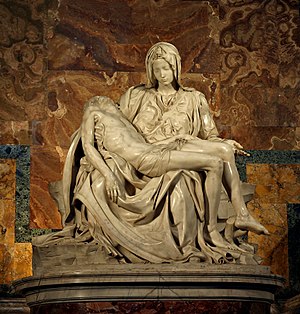
The second image is the Pietà, Michaelangelo’s to be specific. I keep thinking of this image in connection with the violent deaths of the children of Sandy Hook, Connecticut. It is likely that most of those parents were not able to cradle the bodies of their babies- stopped from doing so because of the cause of death and the condition of the bodies. Thus, I think of that image of Mary cradling the grown Jesus and remembering in her mind how she held him so many times before. I know those parents are remembering every moment they held their children. The other thoughts that are probably running through their minds are too hard for me to imagine. Not impossible to imagine, but too hard for me to consider and still let go of my own toddler and refuse to live in fear.
These images are not only interfering with my sleep, but they are marching into the forefront of my mind as I try to prepare for Christmas. One of the things that I wrestle with all the time, theologically and personally, is the connection between Christmas and Easter. More specifically, the connection between Christmas and Good Friday. I do not accept that Jesus was born, destined for the cross. I am not resigned to the idea that betrayal and crucifixion were inevitable. My faith is anchored, beyond the veil, in the trust that God is bigger than all things, was revealing that power before Jesus, and that the Messiah came into the world to be the clear sign of that power and a clear revelation of God’s expectations of creation.
Death, violent or otherwise, was never a part of God’s intentions for creation. With our scientific minds (and I love science), we understand a cycle of birth, decay, and death. Yet, our faith teaches that this is not preordained. We are not born to die. We are born for life. We are gifted with faith for abundant life. Somehow, in some way, the Christmas story is the heart of this truth- that God came into the world in an expected way, so that we might believe and live. When death tries to trump that truth, life wins. Love wins. Joseph does not stone Mary. The childhood illnesses that could have claimed Jesus’ life do not succeed. The devil’s temptations do not stand. The threats of detractors do not hold water. The cross and tomb are not the final word. Incarnation leads to not to crucifixion, but to resurrection. Life wins.
In this season of grieving, personal and public, for my friends, for people I do not know, for our world, I do believe that life wins. The story of God’s entrance into the world as one of us is not the beginning of that theme, but the powerful plot twist that no one expected and that surprises us still.
Every death, every stillbirth, every child, every 110-year-old, is a death that is too soon when it precedes God’s final renewal of heaven and earth. Yet these deaths are not the final word. That Word is God’s. The Word that has always been with God, indeed the Word that is God, is life. Life.
There comes a point where I don’t have anything else to say and so I have to stop talking. The grief is too real. The pain is too sharp. The explanations are weak or non-existent.
And still hope flickers.
And still we say, “Come, Lord Jesus.”
And still Life shines through the darkness. And the darkness cannot overcome it.

Dressed for Joy (Sermon 12/16)

Isaiah 61:1-11
How many of you know the adage, “Wear clean underwear, because you never know when you’ll be in an accident”? While I do not want to know how many of you follow that rule, I suspect many of you think about what you wear each day. Am I dressed or ready for the car to break down? Am I dressed or ready if I had to sit for a while and wait? Am I dressed and ready for walking around the store, getting gas, watching a toddler, changing a tire, having lunch with a friend?
This is a question I ask myself all the time. Especially as the number of clothes I have that fit begins to dwindle, I ask myself, “Is this what I want to be wearing for a hospital visit? For an emergency call? For pastoral authority in the office?” Sometimes I’m not dressed, or I don’t feel like I am, for what I need to do.
On Friday, after the initial shock of the news out of Connecticut, I was thinking about opening the church into the evening for prayers. When I decided to do that, I was wearing jeans and a sweater. A fine outfit for sitting in the office and writing a sermon, not what I wanted to be wearing when we were opening the church and I was talking with the people who came in and out all day. “I’m not dressed for this”- I kept thinking. What I really meant was- I’m not ready. I’m not prepared for this.
This is not the first time this has happened. Someone here once told me- it doesn’t matter what you’re wearing, just show up. Good advice, but I know I’m not the only one to whom this happens. How many of you felt overwhelmed this week- either by the season, by events, or by memories? How many of you have had a call during the day or in the night- for which you weren’t dressed, for which you weren’t ready?
Thus, in considering that the third Sunday in Advent is Joy Sunday, I don’t feel dressed for it. If we had colored candles, this would be the pink one (the others being blue or purple). Joy Sunday! And that’s what the task that the prophet Isaiah delivers to Israel and that is also communicated to us, as our task, through Jesus. It is our task to seek joy, to be found by joy, to communicate joy.
Isaiah says the role of the prophet, which is now the mantle that goes over all of Israel and extends to all who live by faith is this: The spirit of the Lord God is upon me, because the Lord has anointed me; he has sent me to bring good news to the oppressed, to bind up the brokenhearted, to proclaim liberty to the captives, and release to the prisoners; to proclaim the year of the Lord’s favor, and the day of vengeance of our God; to comfort all who mourn; to provide for those who mourn in Zion — to give them a garland instead of ashes, the oil of gladness instead of mourning, the mantle of praise instead of a faint spirit.  (61:1-3)
Do you feel dressed to do that? To declare the year of the Lord’s favor? To bring good news to the oppressed and to comfort all who mourn? Do you feel ready to proclaim joy?
Joy is not happiness. It is one of the fruits of the Spirit (love, joy, peace, patience, kindness, goodness, faithfulness)- not something we can produce ourselves, but something that God brings forth in us. Joy has the twinge of the fight, of how far it took to get there, it is hard earned and treasured. Joy is the light that shines in the darkness and shines that focused beam, making us aware of how dark things can be. How can we be ready for joy? How can we be ready to proclaim it? How do we dress for this?
The only way to be dressed for joy is to be clothed in Christ.  To be clothed in the experience of weeping at the death of a friend, to know betrayal, to have eaten good-bye meals, to have people turn away from grace, to feel forsaken… and to still taste resurrection, to still hope in return and restoration, to trust in the possibility of peace, to rest in the light of Love. 
The only way to be dressed for joy is to be clothed in Christ, clothing which comes with all of these experiences, the accessories of faith, if you will- the very real experiences of this very real life.  Joy is not the absence of suffering, but the presence of God.
            I cannot tell you why bad things happen. I cannot tell you that we will live to see the good that God will bring from some of the tragedies of our lifetimes. I cannot undo the exile of the Israelites and I cannot redo Friday with a different outcome.
            God is not the “why” of tragedy and devastation. God is the how- the how we get through it. God is the where- consoling to the grieving, receiving the dying, walking with the confused and afraid. God is the who- the One who made all things and loves all creation. God is the when- a mystery to us, but a promise of renewal and bringer of unexpected joy. God is the what- the what we shall wear, the what we shall say, the what we shall turn to.
            When there is no “why”, there is a Holy Who/Where/How/When/What that clothes us in grace, that dresses us in mercy, that accessorizes us with joy. We come as we are to God’s dressing room- the baptismal font, Holy Communion, a conversation with a friend, a time of prayer- and we are draped in Christ.
            What do you wear to do that proclaiming, to be a priest of the Lord, a minister proclaiming God’s favor (as Isaiah says you are)?
            (Make the sign of the cross). You wear the sign of the cross and…
There! You’re dressed for proclamation. You are wearing the promise of the Holy Spirit, the mark of Christ crucified and risen, the symbol of hope for the whole world. You will never be more ready to bear joy. You will not find anything that fits you better. There’s never been a more graceful fit, a closer fit, a more beautiful shape. The cross is the clothing we’ve got… its emptiness, its inability to be the final word, its attempt to stop the Word of Life… it is how God dresses us to go out into the world. The sign of the cross is our clothing for grieving and for rejoicing, for sorrow and for joy. The sign of the cross is our Christmas sweater, our Easter suit, our Epiphany workout clothes, our Pentecost learning outfit, our clothing for waiting, for hoping, for proclaiming.
            It is Advent and we wait. We wait for a great deal, including joy. But we’re dressed for it, when it comes. Saved and clothed in righteousness by Christ’s own faithfulness, we are dressed to heal, to share hope, to be a part of the work of the kingdom. In the midst of tragedy and hope, we are dressed, in the cross, to seek and to be found by joy. Amen.

Advent Ache (Sermon 12/9)

Joel 2:12-13, 28-29

            Here’s the funny thing about Christmas- the holy days, not the holiday- it’s the shortest church season we have. Even if Lent starts early, Epiphany is still longer than 12 days. Lent is forty days. The Easter season is fifty days. The season of Pentecost or Ordinary Time goes on past twenty weeks. Advent is four weeks. Christmas, as church season, is short.
            Many of us get tired of seeing the Christmas things all around us long before we show up to mark the birth of the Savior and our true expectation of God’s completion of that good work in Christ’s return. Christmas can get old before it gets here and yet we’re uncertain what to do with Advent. (How many have Advent wreaths in their homes?)
            Frankly, I’m feeling very Advent. I go into Safeway and I hear, “It’s the most wonderful time of the year…” Yet all I can think about is the number of suicides that have been in the news this week.
I enter Fred Meyer and hear: “I really can’t stay (Baby, it’s cold outside). I gotta go ‘way (But, baby, it’s cold outside).” Yet, I think about the people who call the church office every week asking for food assistance, for gifts for children, for rental help.
           
            I wait to get my oil changed and I hear, “Santa Baby, slip a sable under the tree… for me… been awful good girl.” I think about the people who use the Listening Post downtown and the volunteers there who hear powerful and overwhelming stories, every day of the year- not just in this season.
            I turn on the car radio and I hear, “’Come,’ they told me, Pa-rum-pa-pum-pum.” I think of the drums of war, the drums of greed, the drums of fiscal concern that are beating all around.
            I have an Advent ache and the Christmas music can’t drown it out. The short Christmas season is never long enough to overcome all of these less cheery realities that are currently part of this life.
So then I sit in my office and I turn to the reading for this week- four short verses from the prophet Joel. Thinking about Joel’s time frame, one might expect that the book would be full of rejoicing, but it’s not. Joel is writing to the Judeans who have returned to Jerusalem after the exile. There may be a few people who can still dimly remember earlier days, but most of the exiles are younger and have never seen the city. The temple ruins, the place the market once stood, the homes haunted by memories of what was before Babylon swept in and carried it all away… the most intense longing for Jerusalem did not prepare them for the return.
            And in those first days and first weeks of trying to reclaim, resettle, restore, no one wants to say how disappointing it all is. How it is not what they expected. How the triumphant return has not only fallen flat, but flat out sucks. They are expecting Christmas- actually, they are longing for the Messiah- but they are in a very Advent time.
            And, honestly, it is an Advent time for God. The people did not return thanking God. They didn’t speed over the hills and valleys, with their hearts in their throats in anticipation of worshiping in what was left of the temple. Some of them chose to stay in Babylon, to adapt to life there-including the religious practices of the new location. God’s waiting, too- waiting for people to heed the call of the prophets, to sing the songs of praise, to stop taking favor for granted, but to put it to use for making the world a better place.
            It’s the Advent ache. Things are not what we would hope for. We are not always what God would hope for. The longing of this season allows us to sit in silence with that and to express our longing for God’s answer to the problem, to the gap, to the divide. The longing of the season allows us to sit with God’s own longing hope for creation. The response to that hope came at the first Christmas…and comes again in all kinds of ways.            
            Our Advents hymns express this longing, especially some of the ones that are worked into our liturgy.
Consider: Come, thou long expected Jesus– “born to set thy people free- from our fears and sins release us- set our hearts at liberty…” (Charles Wesley) The verses of this song express our hope in all that Christ’s advent will bring- freedom, peace, rest.
Consider: O come, O come, Emmanuel– written as early as the 8th century (or maybe a little earlier). Based on the old “O antiphons” or verses that reflection Advent anticipation. The verses in Latin form an acrostic, a word out of the first letter of each verse, the word Erocras meaning, “I will be tomorrow”. The longing for Christ in the song is answered, mysteriously, by a response that Christ is coming.
Consider: Ososo,  or “Come now, O Prince of Peace”. This is a Korean hymn, written in 1988 for a world conference focused on attaining peace and reunification for the Korean peninsula. “Come now, Lord Jesus, reconcile all nations” has a very different feel when you are considering people who are separated from family members, from resources, from peace.
            These are songs of Advent, songs of longing, songs that say, “Things are not what we hoped for.” The answer we get, to our singing and our sighing, is “Return to the Lord, your God, for he is gracious and merciful, slow to anger, and abounding in steadfast love, and relents from punishing.” Return to the Lord… gracious and merciful… steadfast love… slow to anger…
            Christmas is a short season, in part because we live in an Advent world. A world that has received God’s body in its midst and still remains broken. A world that has seen (and still sees) miracles like no other. A world that has been gifted the outpouring of the Holy Spirit… and still cries for reconciliation, for peace, for grace. It’s not a sin to not be ready for Christmas. It’s a reality. It’s a real expression of where we are, who we are, and what we are asking God to do in the world. It is honest to look at the paper, the city, the news, the world, and say, “This is not what we hoped for.” It echoes what God also is saying to us.
            Advent means God has not let our hope die. Advent is a season for waiting in the Lord, for returning to the Lord, for hoping in the Lord. It is not yet time for “Good Christian friends, rejoice, with heart and soul and voice…” It is the season of “Come, now, O God of love, make us one body. Come, O Lord Jesus, reconcile your people.”
Amen. 

Advent Lions (Sermon 12/2)

Daniel 6:6-27
            Talk to me about the war on Christmas. How many of you are having a hard time finding Christmas decorations? How many of your family members have met you in back alleys to exchange cards, hoping to be undetected? Other than the icy roads, who was worried about coming here today? Has anyone been so deluged by Happy Holidays, Happy Hanukkah, or Kwanzaa commercialism that they just felt unable to get a word in edgewise for the Christmas holiday? Anyone?
            It is hard for me to listen to rhetoric about the “war on Christmas” and think about religious persecution around the world that happens today, both to Christians and non-Christians. It’s hard for me to listen to rants about the “war on Christmas” and to read about Daniel at the same time. Here is a story about real persecution and real faith. A story about a young Jewish exile, likely born in Babylon, never having seen Jerusalem… he serves under four kings, the first two of which change his name- not calling him by his Hebrew name Daniel, but by the Greek name- Belteshazzar. Daniel serves at the pleasure of the king and does not hold back from the obviousness of his true devotion to the one God.
            Daniel maintains a strict diet (see Daniel 1), interprets dreams (Daniel 3-5), and finally refuses to cave to pressure from jealous rivals and does not stop worshipping God (Daniel 6). This story is almost intimidating in Daniel’s faithfulness. He has no guarantee that God will prevent the lions from destroying him. God didn’t prevent the exile into Babylon. Daniel’s only comfort is in trusting in God’s faithfulness above all else- above the desertion of exile, above the power of King Darius, above the ferocious nature of the lions.
            When I think of what it means to live faithfully, under those kind of conditions, the much-discussed “war on Christmas” becomes unimpressive indeed. As we enter the season of Advent today, we are called to ponder what are the lions that face us? What is the exile we experience?
            We know that Christmas, the holy day (as opposed to the holiday), is not for another 22 days, beginning the evening of 24 December. Believing that God-with-us, Emmanuel, has already been born into world once, is present with us still, and yet will come again, what are we waiting for? The exile we experience is the space between what we believe is true and what we observe around us.
            We believe in the Prince of Peace and yet we do not see peace. We believe in the Spirit of Consolation and still we see many who are not consoled, grieving, anguished. We believe in the Creator of all that is seen and unseen and yet we see many who struggle- some because of their own decisions, some because of the actions of others. We believe a light shines in the darkness and the darkness has not overcome it, yet the darkness still seems very, very deep (and not just because it’s winter in Alaska).
            The lions that slink around us in Advent are both obvious and subtle. There are showy lions of commercialism, decadence, and acquisition. Their roars tempt us to place our hope in things that are shiny and promising now. Then there are the subtle, hungry lions of hopelessness, frustration, depression, and isolation. Their sneak attacks undercut our ability to stand false brightness of the holiday and leave us unprepared for the holy day. The war on Christmas isn’t some outside entity, but a struggle that happens within us and around us to undercut our waiting hope- emphasized this time of year, but lived out every day of the year.
            Our Advent exile- our time apart, waiting in hope- gives us the opportunity to fight off these lions, to dare to be a Daniel and to pray beyond the falseness of their promises. In this season of waiting, we are presented with the chance to exercise our faithfulness, our hope in God, our expectation of holiness, our trust in the promise of Emmanuel, God-with-us. And, like Daniel, our faithfulness only stands in the light- the undimmed light- of the One God who is the gifter, sustainer, and perfecter, who is Faithfulness itself.