The Gospel I Need to Hear (Sermon for 1/8/12)

Sermon for Epiphany 1, Text: Mark 2:1-22

          Sometimes I need a sermon myself. I don’t mean that I need one written for me because I’m tired or uninspired. I mean that I need to hear one.  Usually, I have four or five of you in mind and I hope that the Spirit speaks to all of you through the written and spoken words on Sunday. Yet, sometimes I ended up preaching the Word that I needed to hear and I hope something came to you as well.
            Today, as we look at the stories of people who meet Jesus, I felt like I should be honest about what I want to hear. Perhaps you have the same plea as you listen to these stories. We have a story of friends interceding, a paralyzed man walking, doubtful scribes, uncertain disciples, and adoring crowds. These are the people Jesus meets and it’s hard to decide which thread to follow. Healing, forgiveness, welcome, celebration, correction, renewal, restoration, resurrection- any and all of these are messages I want to receive. How about you?
            Pastor, speak to me of healing. I need to hear that miracles can still happen, that they do still happen, that they will still happen. I want to hear, again, that God heals through medicine  and through miracles and, sometimes through death, through death. Assure me, with sincerity, of the double significance of this gospel story. First, Jesus releases the man from the sins that plague and disturb him- a powerful symbol of the power and grace of God. 

          In order to prove that his power was of God, Jesus then healed his physical ailment, cured whatever bound him to his pallet. In the face of cancer and all manner of other illnesses, Preacher, tell me with confidence that the healing power of God in Jesus is not limited to a house in Capernaum, but that it transcends space and time and the bounds of our understanding. This is the gospel I need today.


            Pastor, speak to me of Epiphany- of a dawning light and a great understanding. In my daily life, I hear a lot of people talking and it all begins to sound the same. I remain hopeful, but cynicism and frustration curls the edges of my hope. I feel kind of like a Pharisee, because I just want something to make sense and to fulfill my expectations. Structure, continuity and tradition provide reliability and stability in chaotic times. A season of new understanding, of A-ha! moments, of bright inspirations is exactly what I need, but not necessarily what I want. 

          Preach to me about the meaning of Emmanuel- God with us. Remind me that there is nowhere I can go that God has not preceded me, nowhere that Jesus does not accompany me, nowhere that the Spirit does not receive me. This is the gospel I need today.
            Pastor, speak to me of sin and of release. Speak the hard truth about sin- about its power to separate us from our neighbors and to make us feel separated from God. Look me in the eye and tell me that sin is action and intention, both concrete and nebulous. Use words that are familiar, but help me understand in a new way that sin is the things I have done and left undone, said and remained quiet about, things I have given too freely and things I have withheld. 

            Now preach to me about release. I don’t want to hear about forgiveness only, about a formula or words that make things right. I want a powerful, truthful, toe-curling honesty about release- release from the fear of death, release from the captivity of sin, release from the mistakes of the past, release into the freedom of a new future in God. Speak to me of the release that is offered through Jesus, every day, every minute. Pastor, speak to me of amazing grace and do not stop. This is the gospel I need today.

            Pastor, speak to me of resurrection. I know that is the wrong season, that we have not yet trudged through Lent to the gleaming white of Easter morning. Nevertheless, I look at today’s gospel and its words of feasting and celebration. I read of new wineskins to receive new wine. This kind of new life makes me think of renewal. Remind me again that God has promised not to make all new things, but to make all things new. Could it be, Pastor, that resurrection happens within us before it happens to us? 

             Is it possible that God-with-us in the person of Jesus was bringing new life to Levi, to John’s disciples, to the outcasts, and even to the Pharisees before the tomb was thrown open? Help me to chew over the idea that spiritual resurrection comes before the resurrection of the body, but is just as important. Tell me in no uncertain terms that God was resurrecting through Jesus Christ long before Easter Sunday. Resurrecting faith, resurrecting community, resurrecting hope, resurrecting relationship. Tell me this is not a metaphor. This is the gospel I need today.
            Pastor, I like it when Jesus says, “I have come not to call the righteous, but the sinners.” I like that a lot, except that I would like to be a little bit righteous. Isn’t Lutheran theology that we are all righteous and sinners at the same time? So aren’t I a little bit righteous? Break it to me gently, one more time, that all have sinned and fallen short of the glory of God. Ugh. Again. All have sinned and fallen short of the glory of God. 

            Okay, I’m ready to hear that my perceptions of myself (and of others) fill up my wineskin and get in the way of the fresh wine that Jesus would put in there. Bring it on home, Pastor, and tie together the truths that I have to release what I think of myself and others, so that I can be open to the healing, the epiphanies, and the resurrection that God has in front of me. Not only that God has in front of me, Preacher, but that God is doing in me and around me. Not only in me and around me, but perhaps, Pastor, with God’s grace and gifts, through me and with me. Today, I am one of the people whom Jesus meets. This is the gospel I need today.
Amen. 

Friday Five: The A-ha! Moments

Over at RevGalBlogPals, kathrynzj spurs us along an Epiphany theme: 

This past holiday season is not one I will soon forget, but not for the reason some may think. Certainly, it was a busy one for those involved in the life of the church. The 1-2 punch of Christmas Eve and Christmas Day on a Sunday brought more than a few of us to our knees (or hopefully to a more comfortable napping position).

In the midst of the holiday season I had one of those moments where a path suddenly was made clear – A-ha! This experience has prompted me to wonder what some of your A-ha moments may be.

They can be mundane – a realization that you like/don’t like a certain food or that you really look good in that color you never had the guts to try. They can be sacred – a way to better pace your day clicks into place or finally a devotion or meditation practice that really works for you. They can be profound – the moment you realized he/she was the one (or wasn’t)or the moment you realized where your deepest passion could meet the world’s greatest need. 

Please tell us – what are five (more or less) of your ‘A-ha’ moments. Where have you had a moment of clarity?


1. From the time I was five, I really, really, really wanted to be President of the United States.  I played church, using the clothes hamper as a pulpit. People found their way to me to unburden themselves of problems. I was interested in what I would later figure out was family systems and developmental issues. Nevertheless, I really wanted to go into politics, which I perceived as an avenue for helping people. I went to many events around my state and outside it, designed for high schoolers were interested in politics, government service, and law. Then the Clinton impeachment dovetailed with my first class in psychology. Suddenly, I could see clearly what I wanted to do and where it wouldn’t happen: the White House. Not only was that not too likely to happen, but I didn’t have the drive to pursue that end through the means necessary to do so. I liked stories, forming relationships, and personal touches. “Hail to the Chief” will never play for me and I’m okay with that. A-ha!


2. A-ha #1 led to A-ha #2. When I transferred to a four-year college, I was majoring in psychology. I specifically picked a school that had a strong psych department, with an emphasis in developmental disabilities. In particular, Meredith College had an autism intervention program wherein students were trained and children were helped in reaching their highest level of functioning. I was (and am) very interested in this work. I had a client with whom I enjoyed working and I looked forward to taking on more. Then one day, after working for several weeks to get the client to use a spoon, I arrived to see him eating Cheerios with his hands. His very tired mother said, “I just didn’t want to fight with him about it today.” A-ha! came the epiphany. This work was exhausting and led to much frustration, with occasional bursts of hope and inspiration. I saw myself burnt out at 26. Yikes. I looked at my colleagues in the program and they didn’t have the same feelings. I realized this was not my vocation, for this time in my life, possibly ever. I finished with that client and never took another intervention rotation. I declared a second major in religion (with my first in psychology) and, well, the rest is history. I remain extremely interested in developmental psychology and read frequently about the new concerns, developing interventions, and the latest in disability issues. 


3.  A-ha! Sometimes you have nothing but good choices and God will be with you in which ever path you choose. I understand through physics that time moves both forward and backward, but as a human being- I live it forward and learn from it backward. When I was graduating from college, the path I thought I would take fell through in November. Then in late March and early April, I suddenly had three choices for my future: a position as a caretaker in a L’Arche community in Boston, a position assisting in a congregation in England through the Young Adults in Global Mission program of the ELCA, or a position, through Americorps, with KNOM Alaska Radio Mission in Nome, Alaska. I decided against L’Arche before I got to the final steps, but I was offered the other two spots within one week. A pastor told me that sometimes we get to choose from among blessings, part of free  will and part of God’s faithfulness to us and in us. A professor told me I should take the job I didn’t think I’d get again. So I moved to Nome, Alaska to be the Deputy News Director for KNOM (Yours for Western Alaska) from August 2002- July 2004. Two years in Nome changed my life. It was neither a better or worse choice than England. It was a different 
choice. 

4. I had a list of things I wanted in a life partner (in my case, a husband). When I met the man I eventually married, he was so many things I never expected or planned for. His career wasn’t what I would have picked, I wouldn’t have described him if you asked for physical characteristics, our meeting in a bar wasn’t my dream encounter. Yet he met what I really wanted and, more importantly, showed me what I couldn’t live without- so I married him. Those things I couldn’t (and can’t) live without were a real A-ha! 


5. My final A-ha! happens again and again. Within one’s sense of call to ministry, within seminary, within the process of call, no one tells you that you will eventually look up from presiding at the table or praying or the announcements and realize that you love the congregation you serve. I mean you LOVE them. In the moment that it happens, you will feel punched in the stomach because you will realize 1) the power they have to hurt you, 2) the hopes you have for them, 3) the hopes GOD has for them, and 4) like Moses, you will not likely be with them when they reach the Promised Land. Oh, it hurts! It burns! You will rejoice with, ache for, mourn among and swear about the flock for whom you pray. The only relief comes from knowing that you cannot save them and that’s not your job. The congregation I serve is a part of me in a way I cannot describe and that will not let me go. So I care for them and they care for me and we move forward together toward, God willing, more epiphanies. 

Books of 2011

In 2011, I read 155 new books. Here are my top 10 recommendations from what I read, in no particular order:

1. True Grit I read this book prior to seeing the movie and I’m glad I did. Matty is the center of the book and her nerve, strength, and determination makes her better than a classic heroine. The biblical references, the smart writing, and the sharp dialogue moved this book into one of my all-time favorites. Each time I re-read it, I find something new.

2. God’s Harvard: A Christian College on a Mission to Save America This is a history of Patrick Henry College and some of its recent attendees and alumni. The details of this story reveal the sense of call certain people feel, through their faith, into public service. That lifestyle then impresses itself into the kind of lawmakers Patrick Henry students support and that they wish to be. The details of this book, the personal stories, will remain with me for a long time to come.

3. Bossypants This was as funny and inspiring as I had hoped. I think many people expected this to be hilarious and were disappointed, but I found Fey’s dry observations and witty reflections about her life and work very enjoyable.

4. Unbroken I had not read very many stories about World War 2’s Pacific theater. This story of an American former Olympian turned POW in Japan was riveting, terrifying, and inspiring. It’s not just his survival that moves the reader, but the details of how people can treat other people.

5. The Friends We Keep This book made me think about God’s relationship with non-human animals in a new and different way. I reviewed it here.

6. Major Pettigrew’s Last Stand I don’t often read character-driven novels, but the gentle truth of this novel swept over me. It is about an elderly English widower as he comes to grip with the changing face and faces of his village and in his life.

7. The Blue Bear This is a provocative story of friendship and loss. Some recent Alaskan history may not be interesting to all readers, but the story of Lynn Schooler and Michio Hoshino is transformative in its ebbs and flows. 4 out of 5 tissues.

8. A Thousand Lives This book about Jonestown gave me the shivers. Jim Jones’s powers of manipulation were terrifying, even years removed. I reviewed this book here.

9. A Canticle for Leibowitz I know that I missed a lot reading this through the first couple times. Written in the 1960s, it projects into an apocalyptic future where the remainders of the 20th century- like grocery notes, blueprints, and letters- become the artifacts of religion.

10. Those Who Save Us The last book I completed this year was a novel novel. Told about a mother and a daughter, it follows a German woman who is in the Resistance, but also maintains a relationship with an SS officer so that she and her daughter can have food. Revelatory about the struggles and moral dilemmas people face in a time of war, the books also mulled over how lifelong grudges, community outsiders, and our ability to understand the actions of our ancestors and predecessors.

Advent Crossroad: Fourth Sunday in Advent

Fourth Sunday in Advent: Malachi 3-4 (Narrative Lectionary)
            
           This time of year I think a lot about the fact that I had two Jewish grandparents whom I knew and loved. I had four Jewish great-grandparents who died before I was born, whose parents came from Eastern Europe to escape the horrific persecution of Jews. From my Jewish grandparents came my mother who came to know and believe in Christ in her mid-twenties, but still shared with her children some of the celebrations of her youth- Chanukah, Passover, Sabbath.
            This time of year, when we all reflect on families, I think of the Chanukahs of my youth and I think about the people who came before my great-grandparents. My family tree with many branches cut short on one side because of the violence against Jews in Russia and Eastern Europe in the 19th and 20thcenturies. When I read stories of pogroms in ghettos and shtetls, I wonder if those were my distant cousins whose descendants the world will not meet, whom I will not meet.
            When I think of these people, my ancestors, who died because of their religious and cultural identity, I have wondered if I am betraying them. If I am not practicing Judaism (I am technicallya religious Jew, just not of the Jewish faith.), am I undermining their sacrifice?
            It’s not just this time of year that has me asking these questions, but our reading from Malachi. Malachi isn’t really a name, but a title meaning “Messenger of YHWH”. This emissary is bringing another message from God: “See, I am sending my messenger to prepare the way before me, and the Lord whom you seek will suddenly come to his temple. The messenger of the covenant in whom you delight — indeed, he is coming, says the Lord of hosts. But who can endure the day of his coming, and who can stand when he appears?”
            As I read Malachi, I think of all the stories we’ve heard from the Hebrew Scriptures. The story of Abraham and Sarah, of Joseph and his brothers, enslavement in Egypt and freedom with Moses, the giving of the law, the leadership of David and Solomon, the struggle to keep the faith in the midst of tribal warfare, and when kidnapped and taken to a strange land. Through these stories, the Bible points to God’s ultimate faithfulness despite human unfaithfulness.
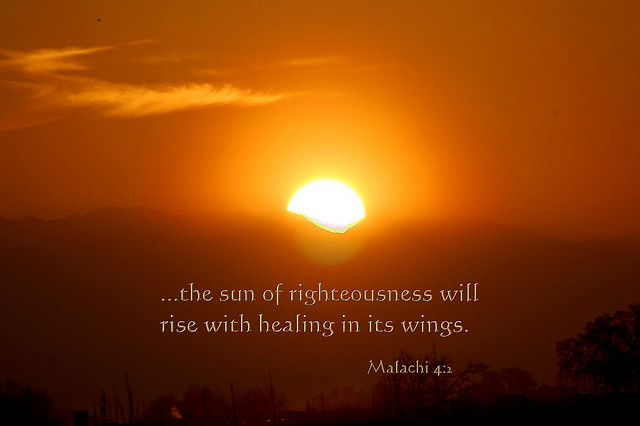
            And now we come to the end of the Hebrew Scriptures. There are other stories that didn’t make it into the regular canon, the agreed upon list of Bible books. There are events that happen after Malachi’s prophecies- the Chanukah story with the lamp oil that lasts for eight days is one such story. But here is a place of turning, a fork in the road, a split in the tree. At this place, we either continue to remain in Advent or we move on to Christmas. Malachi says, “But for you who revere my name the sun of righteousness shall rise, with healing in its wings. You shall go out leaping like calves from the stall. Lo, I will send you the prophet Elijah before the great and terrible day of the Lord comes.”
            For me, as much as I might wrestle with what it means to be Jewish in ancestry, I cannot remain in Advent. This is not the end of the written word of God for me. Somehow, through the Spirit, I have been brought to believe that the sun of righteousness has risen and that Son’s name is Jesus. I may have moments of doubt and of darkness, but I cannot dis-believe the experiences I have had in Christ. The encounters that I have had with Jesus in other people.  My understanding of the powerful reality that God was born onto the earth and knows fully what it means to human.
            Here at the end of Malachi, the branch of Christianity grows out the roots of the tree of Jesse, the Jewish roots of our faith. From this tree we receive our Savior. From this tree we receive the roots of baptism and of blessing bread and wine. From this tree, we receive the understanding of the cloud of witnesses of faithful people who encourage us onward on our journey. Until we are gathered around that manger in Bethlehem and share in Mary’s pondering and the shepherds’ rejoicing, we who believe in God are all Jews.
            But here we are as Christians, believers in Christ, standing at the Advent crossroad and there are two questions for us. The first is will Christ return today? There is still time. And if not, there is still tomorrow.
            The second question that we must ask at this intersection is, “What about God’s promises to Jews?” If we have been brought into faith through Jesus, but there remain some who received God’s promises- what happens to them? What happens to them?
            God happens to them. The oracle of Malachi begins, “’I have loved you’, says the Lord.” The book speaks of God’s election and how God will prepare God’s people to endure judgment and being made holy. Again and again, throughout Hebrew Scriptures, God goes the distance to uphold the promises that have been made between God and God’s people. God does not fail.
“I have loved you” is the banner of a God-created and God-given relationship.  God re-creates and sustains that relationship in the face of human struggle and failure. If no one can endure or stand in the day of the Lord’s appearance, then God will have to create and sustain that which can endure and stand. God will not fail.
            We are poised in a thin space between Advent and Christmas, a place where God meets creation, a place where God became creation. In this space we see backwards and forwards- history and future. It is only in this space that, just between waiting and birthing, we sit with the possibility and the mystery of what has been and what will be.
            There is a possibility that my ancestors might not have been killed and that I might still have become Christian. Who can say? But they were killed. Killed because of who they were and it is a great loss, but one that I cannot change. I do not forget them. I honor them by being honest in who I am and by holding fast to what I believe.
           
            And I believe in God’s work for the world in Jesus. I believe with Mary and Joseph, Abraham and Sarah, Joseph, Moses, David, Jeremiah, Josiah, Isaiah, Hosea, and Daniel in God’s promises from the beginning of creation. In God’s plans for hope and a future. In how God loves God’s people like a parent who lifts an infant to the cheek.
            God has not forgotten the promises made to my ancestors and yours. “I have loved you,” says the Lord. That love burns through all distinctions, all sins and all lies and leaves only what endures. God’s promises are all that can endure and, because of that covenant, God upholds those to whom life has been promised. Then. Now. Forever. God does not fail. 
Amen. 

Unexpected, Mysterious and Fun

I’ve been trying to think of what to say about this article from the New York Times, in which the author calls himself a “None”- meaning no religious affiliation. It’s not this designation that bothers me. I’m also not too upset when he goes on to comment on how many such Nones get turned off religion by religious people. Been there, seen that, had it happen to me.

Here’s the thing that gets me:

We are more religiously polarized than ever. In my secular, urban and urbane world, God is rarely spoken of, except in mocking, derisive tones. It is acceptable to cite the latest academic study on, say, happiness or, even better, whip out a brain scan, but God? He is for suckers, and Republicans.I used to be that way, too, until a health scare and the onset of middle age created a crisis of faith, and I ventured to the other side. I quickly discovered that I didn’t fit there, either. I am not a True Believer. I am a rationalist. I believe the Enlightenment was a very good thing, and don’t wish to return to an age of raw superstition.We Nones may not believe in God, but we hope to one day. We have a dog in this hunt.Nones don’t get hung up on whether a religion is “true” or not, and instead subscribe to William James’s maxim that “truth is what works.” If a certain spiritual practice makes us better people — more loving, less angry — then it is necessarily good, and by extension “true.” (We believe that G. K. Chesterton got it right when he said: “It is the test of a good religion whether you can joke about it.”)By that measure, there is very little “good religion” out there. Put bluntly: God is not a lot of fun these days. Many of us don’t view religion so generously. All we see is an angry God. He is constantly judging and smiting, and so are his followers. No wonder so many Americans are enamored of the Dalai Lama. He laughs, often and well.

This gets my dander up in a variety of ways. First, and you may read however much defensiveness you wish into this because I can’t stop you, I appreciate reason and science and I don’t check my understanding of either at the church door. I don’t expect anyone else too.

But I take my reason and science right in there with me and somehow, someway, somewhere… they encounter mystery. It’s not hocus-pocus or woo-woo, it’s something intangible, indescribable and desirable.  Mystery is not automatically irrational, it’s just inexplicable.

Truth isn’t what works. What’s true is true, regardless of our ability to believe it. All of which means that I could be wrong in what I believe. I could be a little wrong (this life could be all there is). I could be a lot wrong (see: Reformation, the). I could be going to hell (does that really need parenthetical explanation?).

When Eric Weiner says that God is not a lot of fun these days, I think he might be talking to the wrong people or listening to them. The loudest voices don’t speak for God. They speak for themselves or whoever is paying them. They don’t speak for me. Speaking for myself, I have a darn good time.

Being religious, for me, is full of surprises, moving moments, laughter, questions and
discussion. And I see lots of people around me having a good time as well. I saw people laughing together tonight as they distributed food. I heard clergy laughing today as they pieced together sermon ideas for this week. I heard children giggling through the Christmas story and I heard adults chuckling about how to tackle serious issues related to healthcare.

I’ve said the wrong words during church, choked on what I was singing when a spider jumped on music, forgotten major points of what I was going to say and even skipped elements of the service. Nothing happened. To me that’s not because there is no God, but because God isn’t worried about that.

I don’t think God’s worked up about perfect worship. Solemn faces. Pristine on-key singing. Regimented liturgical actions.

For me, my life of faith is on the edge, pushing the envelope, and skidding right up to the altar rail and thinking, “The Spirit led me back again! All right! We must be okay! Grace wins again!” Because I believe in a God of fullness, a fleshed out God who lives and breathes in all creation. The God who made me laughs, because I laugh and I am made in God’s image.

I believe this. I believe it is true, but my faith doesn’t make it true. It either is true or it isn’t. And I am living, whole-heartedly, like it is.

Which brings me back to mystery. Just because you can’t pick apart and explain every detail doesn’t make something unreal, dishonest or untrue. In age of science and reason, I think it’s good for all of us to know that there are things we cannot explain, we cannot fully grasp, we cannot totally control. That’s right. We’re not totally in control and it SUCKS to admit it.

Some things are mysterious. The pull and push of certain sounds, sights and smells can be unraveled and unraveled, yet still remain, in part, unexplained. And here’s where I think some Nones (not necessarily the author) and certain religious fundamentalists are singing from the same page. Everything has to have an explanation. Either it’s God or science. Having an explanation is about control.

Mystery. Learn to live with it. Learn to embrace it. Roll in it and let it wash over you. Babies in hay, stirring songs, sunrise, sunset, quiet nights, bustling cities, bread and wine and thou, fire, flower buds, blue skies, water, first words, last words, kisses, and amazing coincidences.

There will be some things you will never explain. This is most certainly true.

And you just have to laugh about that.

Father Knows Breast

Today I was at a sushi bar and a Dominican priest was seated one chair away from me. I knew he was Dominican because he had a white robe and a large wooden rosary- like other Dominicans I have known.

I wonder if I should greet him. Why? I’m not Catholic. He doesn’t know I’m clergy (no collar on today). He probably wants a peaceful lunch. I want a peaceful lunch.

I do not leave well enough alone. I ask if he is, in fact, Dominican. Yes, new in town (of several months). We know someone in common. We talk briefly about where we’re from. All good. No problems.

I’m reading from a Nook and he has a paperback by Wallace Stegner.

Him: We’re thinking about starting a Theology and Literature group. I’m checking out Stegner.
Me: (Trying to make a joke) So, not Father Greeley. (A Roman Catholic priest who is a prolific writer and some of whose novels are famously or infamously sexy.)
Him: No, not Father Greeley. Too many breasts.
Me: (Raising my eyebrows) Well, breasts don’t usually hurt people.
Him: No, but the breasts are all anyone can think about.
Me: Well, there are vows about that.
Him: Well, what are you reading there?
Me: (looking at my screen, open to a historical romance/novel): It’s full of breasts.

… and it kind of trailed off from there and we ate in silence.

I was fine with our conversation until he said, “There are too many breasts.” If he had said, “There’s too much sex.” That’s a different thing and, for me, it would have been putting men and women on an equal sexual plane. To say that there are too many breasts, though, and that the breasts are distracting was very irritating to me. Perhaps there is a preponderance of breasts in Greeley novels, but it never seemed that way to me. Yes, I’m reading into an encounter with a man I don’t know, but his response to me (focused on women’s bodies as distractors) seemed rooted in distaste. So was it women in general or just me?

I finished lunch first and so I attempt to offer an olive branch by saying, “It was nice to meet you. I hope you enjoy your time here. Happy Advent.” He murmured the pleasant responses and then I said, “Dominus vobiscum.” (Latin for “The Lord be with you”) I had hoped that he would respond, “Et con spirito tuo,” (and with thy spirit), to show a sense of shared history (in Christ) and collegiality in ministry. The thing is that in Catholic tradition, only the priest would normally say the phrase I spoke. And I did know that.

He looked at me and said, “Nice translation.”

Sigh.

Was I as nice as I could have been? No, I was not. I had hoped for a shared conversation with someone close to my age about what it means to live as a religious leader. I have not yet come to accept that this will never happen with someone who believes that my ministry is not valid (good, but not valid) and that, in any count, it exists outside the One True Church.

And there is something sad about a young man who has taken a vow of chastity, uttering the phrase, “But the breasts are all anyone can think about.” Does this come from sacrificing his own sexual desires for the sake of his vocational call? (Possibly) Does it stem from teachings that may still exist in some Catholic churches or seminaries about women, women’s bodies and female sexuality? (Possibly) Am I way off the mark? (Possibly)

The story that made me a little giggly at first now makes me sad because I feel the great divide between myself and a peer who will never see me as an equal. And it’s a loss to both of us to learn from one another and to the catholic Church as a whole that we are so divided.

The other thing that occurs to me, though, is that I need to wear my collar more often. I was just reading on the Miss Representation website about the absence of women in certain roles and jobs in society. For the most part, if you can’t see it, you can’t be it. Meaning young women often don’t consider careers in which women are less visible or non-existent.

My visibility as a called and ordained minister of the church of Christ matters because people need to see women in this role. Girls and boys need to see women clergy- in the pulpit and on the street.

And if you see my collar or stole and all you can think about is the breasts, that’s your problem.

Mary didn’t feed Jesus Similac.

Dominus vobiscum.

Like One Who Lifts an Infant to the Cheek


A Sermon on Hosea 6:1-6, 11:1-9


Who knows anything about Hosea (the book or the prophet)?

Hosea is a prophet in the Northern Kingdom, probably just a little more than seven hundred years before Jesus is born. The Northern Kingdom of Israel, remember, has more money, more tribes and more power, but it doesn’t have the Davidic line (the line of kings descending from David). During the time of Hosea’s prophecies, the Assyrians will come and conquer the Northern Kingdom and carry them off into exile.

One of the reasons we don’t get a whole lot of Hosea is because the book can cause a lot of indigestion. There are two main metaphors in the book: a husband/wife metaphor and a parent/child metaphor.

In that first one, the husband/wife metaphor, God is the faithful husband and Israel is the unfaithful wife, deserving of punishment- possibly death. While we can understand a metaphor of idolatry as adultery, we don’t always think about the fact that in ancient Israel, there wasn’t really any such thing as an unfaithful husband. Men controlled money, land, power and women’s lives. When we try to bring the metaphor forward into modern times, the language of faithfulness and unfaithfulness stands, but not the husband and wife language, which can get in the way of what prophet is using the metaphor to express.

How were the Israelites unfaithful? They didn’t honor their covenant with God, the God who had brought them out of Egypt and sustained them. By the time of Hosea, Israel had little religious cults that worshipped the Caananite ba’als. A significant portion of this worship involved fertility ceremonies- sacrifices, worship and sexual activity to ensure the fertility of the land, especially rain, safe planting and plentiful harvest.

We know that the Israelites should have trusted God to provide these things, but in an arid, desert climate- we can have a little sympathy for people who tried to hedge their bets so that they could have enough food.

After all, how many of us have ever said, “Knock on wood” or thrown some salt over our shoulder? Did we really think that would do anything? Then why do we do it? It’s something we’ve heard about and we think it can’t hurt to do it. Technically, if we trust God for and in all things, we don’t need little rituals like that. Furthermore, we shouldn’tperform little rituals like that. Same for the Israelites, but on a bigger scale.

Before I talk about the parent/child metaphor, I’d like to ask how many of you are afraid of God? I know we talk a strong and long line about God’s grace and mercy, but in the end how many of us still worry about God’s anger?

Here’s the thing, though. If we were going to be afraid of God, we shouldn’t be afraid of God because of who God is. We should be afraid because of who we are. We are to fear, love and trust God, but all of those emotions stem from knowledge that goes two ways… knowledge of God and knowledge of ourselves.

Lots of times, children get grouchy about the punishment their parents dole out, but there is a way to avoid punishment. What would that be? (Don’t do it in the first place.) This is the heart of the parent/child metaphor of Hosea. Israel deserves punishment for violating, for forgetting, for abandoning the rules of the covenant between them and God. God is tempted to wipe them off the map.

What stops God from doing this? Not a sense that the punishment would be too harsh, but the love that God has for them. Listen to those verses again:  

1 “When Israel was a child, I loved him,
   and out of Egypt I called my son.
2 But the more they were called,
   the more they went away from me.
They sacrificed to the Baals
   and they burned incense to images.
3 It was I who taught Ephraim to walk,
   taking them by the arms;
but they did not realize
   it was I who healed them.
4 I led them with cords of human kindness,
   with ties of love.
To them I was like one who lifts
   a little child to the cheek,
   and I bent down to feed them.
 5 “Will they not return to Egypt and will not Assyria rule over them because they refuse to repent? 
6 A sword will flash in their cities; it will devour their false prophets 
and put an end to their plans. 
7 My people are determined to turn from me. Even though they call me God Most High, I will by no means exalt them.
 8 “How can I give you up, Ephraim? How can I hand you over, Israel? 
How can I treat you like Admah? How can I make you like Zeboyim? 
My heart is changed within me; 
all my compassion is aroused. 
9 I will not carry out my fierce anger, nor will I devastate Ephraim again. 
For I am God, and not a man— 
the Holy One among you. 
I will not come against their cities.


I was to them like those who lift infants to their cheeks. I bent down to them and fed them.

What did I say before? If we were going to be afraid of God, we shouldn’t be afraid of God because of who God is. We should be afraid because of who we are. We are to fear, love and trust God, but all of those emotions stem from knowledge that goes two ways… knowledge of God and knowledge of ourselves.

Even though we don’t like to admit it, we know ourselves. We, like sheep, have gone astray and we will again. We could knock wood after each confession and assurance of forgiveness, to hope that we won’t need it again, but we know we will.

So we need the knowledge of God to bring us comfort. We are afraid because we know the judgment we deserve, but we trust in God’s goodness and mercy because of who God is and because of God’s compassion toward all creation. In the Hebrew Bible, knowledge isn’t only intellectual- head stuff. It’s in your gut, in your heart, in your body. Knowledge is knowing AND doing. Acting on knowledge brings relationship. God acts on God’s knowledge of creation and keeps God in relationship with all creation, because God will not break his end of the covenant.

We have to act on our knowledge of God. And this is what Hosea tries to impart to the Israelites (and to us) through his metaphors. God is the Holy Parent, bringing people into the world to share in creative love. As a parent teaches, so God gives us the Spirit to instruct us, shape us and help us become the people God means for us to be. God is a patient parent, who will allow mistakes, forgives them and knows there will be more. God’s love is unconditional, more so than even the best parents among us.  God’s love heals us, bringing wholeness and peace.


I led them with cords of human kindness,
   with ties of love.
To them I was like one who lifts
   a little child to the cheek,
   and I bent down to feed them.


God’s parental love always leaves the light of faith shining for us, drawing us back home. Amen. 

One Minute Writer: Teach Edition

If you were to teach as a career, what would you teach?


One of the reasons I haven’t considered hospital chaplaincy more seriously is because I love to teach. I think I would enjoy teaching religion- world religions, church and culture, Jesus (and Jesus figures) in film, modern religious movements.
…..


Above is all I could write in one minute, but it caused me to think back on some of the classes of my Religion degree (undergraduate) and remember how much I really enjoyed them.