Category Archives: Uncategorized

December Newsletter Article

“Comfort, oh comfort my people, says your God… A voice cries out: “In the wilderness, prepare the way of the Lord, make straight in the desert a highway for our God.” Isaiah 40:1, 3

“Of one hundred men, one will read the Bible; the [other] ninety-nine will read the Christian.” Dwight Moody, American evangelist and theologian

It’s the most wonderful time of the year, unless you’re on a budget, you’ve lost your job, you’re lonely, your diet is restricted, you’re over-obligated…How is it that in October- a simple Christmas sounds wonderful, but comes November 1st, we’re in a race to “survive” the season?

The thing is, even though we all know the story of Christmas, we forget the feeling of Christmas. Somewhere in the shopping, the hurrying, the traditions… we lose sight God’s call to us.

We are not called, at this time of the year, to point to the manger and say, “Hey, that’s what this is really all about.” We’re called to stop at the manger and linger. Think of the shepherds, trembling at the presence of a holy being among them. Think of Mary, carrying the person of God within her. Consider Joseph, walking in faith despite what people must have said about his fiancée. Remember the wise men, who believed the signs they saw and sought out the new King.

We live in a stressed and anxious time. People are afraid, not only people “out there”, but people in our own faith family. We are people of Hope… living with the hope of what God promises through Jesus and living with the faith of what God has delivered in Him as well.

People are watching us, you and me, to see if we retain our joy, if our steps reflect the hope we say we have. So consider the words of Isaiah and offer comfort to those around you- through your actions and your words.

For many people, this is one of the few times a year that they come to church or they think about faith. They look to people they know who are “faithful people” for examples and for leadership. That’s us. When we look to the manger, the world looks to us.

So, in this season of busy-ness, take a moment. Look at the manger. Look at it, ponder it in your heart, until you can look away and reflect the light of love that lies there to those around you. The baby that lies in the straw holds the hope and promise of God’s love and mercy for the whole world.

Waiting (Sermon- Advent 1)

Advent is certainly a season of waiting. Waiting in lines, waiting online, waiting on hold, waiting to go to the airport, waiting at the airport, waiting to start eating, waiting to see if someone else will volunteer, waiting to really sing Christmas carols (instead of humming them under your breath because you know it’s really Advent and we have 23 days before Christmas carols are appropriate).

All this anticipation, build-up and then… Easter has a nice big finish, an empty cross, an echoing tomb and Jesus in the garden, speaking to Mary Magdalene. Advent winds us up and then drops us, gently, but drops us… into the soft light of the manger, where we crowd in with shepherds, animals and everyone else who wants to see what the fuss is about.

We wait. We wait. We wait.

When people ask me what it is like to be a pastor, I usually figure out some way to relate it to work they understand- it’s teaching, public speaking, counseling, things like that. I was ordained to the ministry of Word and Sacrament, to preaching, teaching, pastoral care, and all the other things that just happen as part of this job. But in truth, I’m a professional waiter.

All the other tasks I do are placeholders, important tasks, but not as important as the waiting I do with you. When you call in the night, when you are grieving, when you are waiting for good news, when you anticipate bad news, when you go through life and wonder, “How did God allow this to happen? Why doesn’t God make that happen?” I wait with you.

I wait with you. For I have my own questions I long to have answered, my own life events that I worry about, my own desires I would like to see fulfilled.

But when I read, “Comfort, o comfort my people, says your God. Speak tenderly to my people that their penalty is paid. Every valley shall be lifted up, and every mountain and hill be made low; the uneven ground shall become level and the rough places a plain.” When I read those words, I get a kind of holy heart burn. And I long to bring comfort to you, notes of grace and hope in our time of stress and anxiety.

And when you read them, you too may feel that kind of burn, the push from the Spirit. For just like I think of you when I hear these words, you are called to be a pastor to the people around you- to offer them comfort- a message of hope.

What comfort can we offer? Waiting is our most human condition. We wait always, constantly, without ceasing. And it grinds on us, wearing us down, until we enter the numb monotony of constant motion and busy-ness. We even grow tired of waiting. So, how can we explain to others why faith matters when year after year passes without the return of the Christ?

Here is where the manger answers the longing of Advent with a boom. In the manger lies an infant who is fully human and fully divine. A baby who grow to be a man who will wait for his disciples to get the point, who will wait for his friend Lazarus to breath again, who will wait for children to come to him, who will wait for everyone to be fed, who will wait, in fear, to die for sins he did not commit.

God waited, through the time of the patriarchs and the time of the prophets, and then realized we could not wait any longer. So Jesus the Christ came to show us the face of God, the love of God, the nature of God and the patience of God.

When we wait in Advent during the church year, we’re actually speaking about the waiting that is our life. We bring the waiting and its attendant anxiety to the surface, our frustration with the delay, our fear of the day of the Lord, our gratitude for grace, our desperate inability to accept that grace.

We come to the manger and we breathe a sigh of relief. The celebration of Christmas stirs up the feel of liberation that can only come from knowing God’s sheer gift in His Son. The gift of light, love, peace, and mercy. The grace of the manger is the only thing that makes the grace of the cross possible. That’s what we hold too. That’s why our faith matters. We believe that God’s grace is sometimes all that helps us put one foot in front of the other as we wait.

And that grace is the comfort that we can offer the world. We are waiting for Christ to return, but in the meantime… we haven’t finished celebrating the first time he came. Come celebrate. Come celebrate with joy and anticipation. Celebrate with the whole church. Be comforted by faith in presence of the risen Christ in the world. Christ is with us. And we will continue to wait and celebrate, with Him through the Holy Spirit, until He comes again. Amen.

Monday, Monday….

My spirit, apparently, was so excited about my sabbath day today that it woke me up at 4:30 am. I tried my usual middle of the night routine, praying for people I know and trying to relax tight muscles. While it was good to pray for people, I’ve now been awake for nearly 3.5 hours.

So now I’m sitting in a coffee shop. I have six letters to write, a journal to write in, this book and this book to start reading and thousand of blog ideas in my mind. It IS my day off… so I try to diminish the level of work-related things I deal with or think about, but sometimes it’s unavoidable. Mondays, in general, tend to be a day of active prayer and contemplation for me.

So, I have some hot apple cider now and a toasted bagel. Monday, Monday… here I go…!

Thanksgiving

Thursday, 27 November, was Thanksgiving. I had two friends over to my house, plus my husband and I. It was the year of the slow-cooking turkey. We discovered our oven was about 50 degrees off, so the turkey took about 5 hours to cook. We ended up eating all the side dishes and then playing a game and then having turkey and dessert. It was good time.

In place of my usual Friday Five, I’m making a list of things that I am thankful for this year. It’s not a definitive list, but a list of the top things for which I feel extremely grateful.

1. I’m grateful for my husband, Rob. He’s such an amazing person, caring, smart and fun to be with all the time. This year is our first whole year together ever. Between school and Iraq, we’ve spent a lot of time apart, but we’ve finished 12 consecutive months (what would be the first months together in our marriage). There were some adjustments, but I’m so glad to have him in my life and I’m grateful for every day we have together.

2. I’m thankful for my ordination and my work. This year marked the culmination of all my theological training and I could still be waiting to see what would happen next. But due to the work of the Holy Spirit, a sensitive bishop and a church in need, I was called to the Lutheran Church of Hope. Once you have a call (in the ELCA), then you can be ordained. In a way, it was like getting married all over… but I’m very grateful for the chance LCOH took on me and for all that I am learning here. I enjoy my work in so many different ways and I am grateful, continually, for the privilege of what I do.

3. I’m grateful for my friends, Gloria, gena, Sonia, Rebecca… Their enthusiasm and laughter keeps me going. We share so much and even though we don’t see each other as much as we would like… we do have good times.

4. I’m grateful for Ivan, my dog. He’s a mess, but his smiling eyes, his waggy otter tail, his “crazies” and his snuggles are the closest thing to sheer grace in my life. Even if I have to leave him in the spare bedroom while I go to work, there is instantaneous forgiveness when I come home. Thanks be to God for dogs (and other pets).

5. I’m thankful for good health. I am able to use all my limb and I feel well most of the time. I had a pinched nerve in my back this year and it gave me a tiny glimpse of what constant pain must be like. I’m healed now and I am grateful, daily, for all that I can enjoy because of wellness.

There are so many more things… but suffice it to say…. I’m thankful!

Essential Passage #5 (Psalm 137)

Psalm 137 (NRSV)

By the rivers of Babylon—
there we sat down and there we wept
when we remembered Zion.
On the willows there
we hung up our harps.
For there our captors
asked us for songs,
and our tormentors asked for mirth, saying,
‘Sing us one of the songs of Zion!’

How could we sing the Lord’s song
in a foreign land?
If I forget you, O Jerusalem,
let my right hand wither!
Let my tongue cling to the roof of my mouth,
if I do not remember you,
if I do not set Jerusalem
above my highest joy.

Remember, O Lord, against the Edomites
the day of Jerusalem’s fall,
how they said, ‘Tear it down! Tear it down!
Down to its foundations!’
O daughter Babylon, you devastator!
Happy shall they be who pay you back
what you have done to us!
Happy shall they be who take your little ones
and dash them against the rock!

Oh, Psalm 137… so long neglected, so terrifying, so full of (real) human emotions. In the midst of the psalms of praise and psalms of lament, there are tucked a few psalms of anger and revenge. These psalms are usually edited for use in the lectionary or left out all together. My denomination’s last hymnal, Lutheran Book of Worship, went from Psalm 136 to Psalm 138, without so much of hint of what is between them. (All the more reason for Bibles in the pews.) The new hymnal, Evangelical Lutheran Worship, includes all 150… in their joyful, sorrowful, angry, pleading glory.

So, Psalm 137, you are one of the truest reflections of how we feel at different times in our lives. You are frightening in your truth. And you scare us in ways that are hard to name. You are not pretty and comforting, like your cousin 23. You are not soaring in praising like your close neighbor, 139. You are not creative and expressive in your praise for God’s deliverance, like your brother, 124. You are harsh and abrasive.

Psalm 137 pulls us in with the familiarity of its early stanza lament. Most of us can relate to the cries of captivity. Though we may not have been snatched from our homeland into slavery elsewhere, we may well have found ourselves wandering the unfamiliar landscape of depression, loneliness, doubt or despair and we feel enslaved. Our cries are full of longing. We pray for deliverance.

When we slide into the request for God to punish our enemies, it is still familiar territory (in a way). Certainly we might never ask God to kill the children of our enemies, but we have surely ground our teeth against someone who has opposed us, who angers us, whose way has overturned our wishes.

The thing is, we often think of the psalm as sample prayer, offered by people whose relationship with God was higher and better than ours. When we pray, say 23, we are using the ancient words in a hope that God will recognize the sentiment we offer… in connection to our faith ancestor long gone to a reward.

When we start to talk about dashing babies against rocks, there is a whole new and frightening dimension. Is this the kind of prayer we want God to answer? Is this the kind of prayer that comes from the Bible (that alleged book of peace)?

God does answer your prayer of anger, as God did for the psalmist. However, God may not always do what you ask. Prayer isn’t about submitting a wishlist (bless them, smite them, and something shiny for me would be nice); it’s about the conversation and the relationship with God.

So angry you could spit at someone… God can handle what you have say. Better to say it in prayer first, than to risk damaging a relationship or saying words you can’t take back. God already knows how you feel and speaking your angry to God (even if you’re angry with God) is the kind of prayer that the life of faith demands. It’s honest communication with your Creator, the one who actually does know you better than you know yourself.

If Jesus, who actually was God and man, can ask for a change of plans in the garden of Gethsemane, surely God can handle it if we express our deep frustration and hurt with our enemies or even with those we love.

The psalms are for everyone, in all times and places. Worried about death, there’s a psalm for it! Looking for how to praise God, there’s a psalm for it! Longing to see some revenge and to express anger, there’s a psalm for it!

Thanks be to God for a book that recognizes our humanness and affirms God’s love for us and relationship to us no matter what.

Mix and Stir Friday Five

Songbird from Revgalblogpals writes, “In a minor domestic crisis, my food processor, or more precisely the part you use for almost everything for which I use a food processor, picked the eve of the festive season of the year to give up the ghost. A crack in the lid expanded such that a batch of squash soup had to be liberated via that column shaped thing that sticks up on top.”

Can you tell this is not my area of strength?

Next week, I’m hosting Thanksgiving. I need your help. Please answer the following kitchen-related questions:

1) Do you have a food processor? Can you recommend it? Which is to say, do you actually use it?

I do own a Kitchenaid mixer with food processing attachments, similar to the one below, but in white. My now- husband got it for me the very first Christmas that we were dating. We lived in Nome and he had to make a trip into Anchorage for his job. He had heard me coveting (!) another woman’s and so he thoughtfully bought one for me and brought it back, in its huge box, on the plane. He gave it to me early so I could make Christmas treats with it. I was thrilled and he assured me that he wouldn’t always give me household related presents, unless I really, really wanted them.

Yes, yes, yes- I do use it. And, in a side note, it’s tough! My sister just inherited my grandmother’s. Mine has flown from Nome to Anchorage, from Nome to North Carolina and Connecticut to Eagle River. In luggage. It’s still ticking. (Is ticking bad for a mixer? Just kidding.)

2) And if so, do you use the fancy things on it? (Mine came with a mini-blender (used a lot and long ago broken) and these scary disks you used to julienne things (used once).)

I have the meat grinder attachment (use a lot), the food slicer attachment (used twice) and the pasta maker attachment (long to use, but remains untouched). I do use all the standard attachments as well (the mixing blade, the whisk and the dough hook).

3) Do you use a standing mixer? Or one of the hand-held varieties?

See above.

4) How about a blender? Do you have one? Use it much?

I do have a blender. It makes a lot of frozen drinks and smoothies. I have not yet integrated it into the cooking/ food preparation portion of the kitchen activity (except inasmuch as I need a frozen drink during food prep).

5) Finally, what old-fashioned, non-electric kitchen tool do you enjoy using the most?

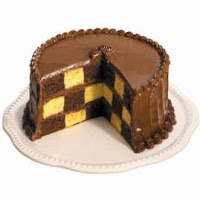
I have the Wilton rings to make checkerboard cakes that look like this.
It’s much easier to do that you think it would be. No electronics are required. This is probably the biggest bang for the buck dessert I can make (other than trifle, but that never looks as impressive).

Essential Passage #5 (Mark 9:14-29)

This basis for the Essential Passages series is here. (Click the red word)

Mark 9: 14- 29 (New King James Version)

And when He came to the disciples, He saw a great multitude around them, and scribes disputing with them. Immediately, when they saw Him, all the people were greatly amazed, and running to Him, greeted Him. And He asked the scribes, “What are you discussing with them?”

Then one of the crowd answered and said, “Teacher, I brought You my son, who has a mute spirit. And wherever it seizes him, it throws him down; he foams at the mouth, gnashes his teeth, and becomes rigid. So I spoke to Your disciples, that they should cast it out, but they could not.”

He answered him and said, “O faithless generation, how long shall I be with you? How long shall I bear with you? Bring him to Me.” Then they brought him to Him. And when he saw Him, immediately the spirit convulsed him, and he fell on the ground and wallowed, foaming at the mouth.

So He asked his father, “How long has this been happening to him?”
And he said, “From childhood. And often he has thrown him both into the fire and into the water to destroy him. But if You can do anything, have compassion on us and help us.”

Jesus said to him, “If you can believe, all things are possible to him who believes.”

Immediately the father of the child cried out and said with tears, “Lord, I believe; help my unbelief!”

When Jesus saw that the people came running together, He rebuked the unclean spirit, saying to it, “Deaf and dumb spirit, I command you, come out of him and enter him no more!” Then the spirit cried out, convulsed him greatly, and came out of him. And he became as one dead, so that many said, “He is dead.” But Jesus took him by the hand and lifted him up, and he arose.

And when He had come into the house, His disciples asked Him privately, “Why could we not cast it out?”

So He said to them, “This kind can come out by nothing but prayer [and fasting].”

It would be good for you to keep in mind now that the Essential Passages are based on things I think about! What’s essential for me might not be for you. That being said, I cannot say enough about this passage from Mark.

The cry of the father is one of the most poignant prayers in Scripture, “I believe, forgive my unbelief.” I love it in the older English: “I believe, forgivest thou my unbelief.” This is one of the best example of how the Holy Spirit intercedes in our prayers, simultaneously helping us with confession and in faith. None of us are able to believe as we ought on this side of the life of faith, but we are called to live into the faith God gifts to us.

Even when we feel faithless and lost, that faith remains active within us. Getting up from day to day requires supreme acts of faith, though we do not often see it that way. That’s the case for most of us. Yet, even for those who struggle with darkness and depression, opening one’s eyes for a moment requires the faith to believe that the world is still there.

With each breath, from day to day, the believer sighs, “I believe, forgive my unbelief.” How can we not, when we look at the world and wonder where God is, what God does and to whom God appears?

Secondly, the demon came out through prayer and fasting- meaning Jesus was prepared to handle the situation, but the disciples weren’t. Now, was Jesus able to (regardless of prayer and fasting) because He was the Son of God, but for the disciples-extra devotion was needed? I’m not sure, but there are other details here to examine as well.

It is important, crucial in fact, to understand that this was a spiritual demon- that the boy was experiencing the real presence of a force that opposed God. This demon had physical effects on the boy. We have no way of knowing if this was something we would recognize as a mental or physical disorder. Many, many people (especially children) are harmed or killed each year because well-meanig people try to cast demons out of them to cure them from schizophrenia, bipolar disorder, autism and other organic illnesses. Prayer is certainly needed in these cases, but we are called by God to embrace medical and scientific treatments that improve the quality of life for people who suffer in this way.

That being said, how often do we fast and pray for a situation we wish to see improved? During the election season? For a sick friend? During a time of crisis? In so doing, we may not receive the answer we seek, but we may (may!!!) come closer to understanding the will of God.

We probably would not read about this story in Mark if the boy had not been healed. This is not to say that we only get the stories where Jesus was “successful”, but we read the stories where people, like you and me, understood that something greater was at work than just a miracle worker.

The cry of the father and the frustration of the disciples (who were usually able to heal) are examples to us in the life of faith- calls to embrace our own limitations and to recognize how God makes up those limitations. We believe, forgive our unbelief. We act, forgive our inaction. We love, forgive our hatred. We accept your grace, forgive our resistance.


Use Your Talents (Sermon 11/16)

Zephaniah 1:7, 12-18; 1 Thessalonians 5:1-11; Matthew 25:14-30

History and church tradition tells us that Matthew, the writer of today’s gospel, was a tax collector. It’s hard not to wonder if he didn’t receive some kind of kickback or bonus from the 1st-century equivalent of the dental industry. Matthew’s phrase “weeping and gnashing of teeth” appears six times in the gospel, usually combined with someone being thrown into the outer darkness.

When this phrase occurs, it seems to overshadow everything else. We no longer hear the phrase “enter into the joy of your Master”. We forget Paul’s comfort to the Thessalonians, “God has destined us not for wrath, but for obtaining salvation…” With the story of the wedding feast, the bridesmaids and the talents, everyone immediately asks, like the disciples on the night of the Last Supper, “Is it me? Lord, is it me?”

Am I the one without the robe? Would I be a foolish bridesmaid, out of oil and out of luck? Am I the servant who buried the talent in fear? Will I be gnashing my teeth and wailing in the outer darkness?

For gospel, for good news, Matthew can certainly inspire fear in our hearts. This is hardly a time in world history when we need additional fear. Think for a moment about the servant with the one talent. A talent was equivalent to the wages of a day laborer for 15 years. That servant held in his hand all that he could hope to earn for the majority of his wage earning years. For a person in our time, working for $5.75 an hour, forty hours a week, fifty weeks a year for fifteen years, the equivalent sum would be $172, 500.

So the man received this huge amount of money and buried it. Out of fear of his master, maybe out of fear of losing the money- he couldn’t even bring himself to make a minimum savings plan and get a little interest. He did what he thought was the very safest thing and he was able to return to his master exactly what he was given.

But that wasn’t what the Master wanted. The two servants who were able to double their money entered into the joy of their master, but the other servant has his talent taken and then he is sent away.
The frustration of the master is not that this servant did not double the money, like the others, nor is it about not receiving even minimum interest. The master is angry because the servant did not risk anything. The servant was entrusted with a great sum of money, with a great responsibility and he sat on it.

For us, right now, this parable is not about money or about our gifts. It’s about fear. What are we afraid of? Because we too, like the servant, have been given a great responsibility. We have been given the task of bringing the gospel to the world, bearing Christ’s light to all people. We have heard the message of hope that comes to the world through Jesus- that our sins are forgiven and we are freed from the fear of death.

But still that fear lingers. And then it multiplies. In that fear, as Martin Luther would say, exists the old Satanic foe. But Luther also said this, “If grace is true, you must bear a true and not a fictitious sin. God does not save people who are only fictitious sinners. Be a sinner and sin boldly, but believe in Christ more boldly still. For he is victorious over sin, death and the world.”

God does not save people who are only fictitious sinners. Do we have any fictitious sinners here today? So then, we have all, at one time or another, taken our talent and buried it. We didn’t make the phone call we intended to, the donation we should have, the prayer we were asked for. We forget, we are afraid and sometimes we just do the opposite.

But God doesn’t. God has done exactly what was promised. We have been saved through no work of our own. As Paul says, “We are the children of light and children of the day…God has destined us… for obtaining salvation through our Lord Jesus Christ, who died for us, so that whether we are awake or asleep, we may live with him.”

So the love of God compels us to take our talents, whatever we have, and carry them into the world. The talents are multiplied through what we do in our daily lives, when we first remember, always, that we are true sinners and our God offers true grace. The work of the Holy Spirit moves through us- making our work holy as we do the things that we have been gifted to do.

And if what if we do sin? Then we will be forgiven. As quickly as you are able to think “Is it me, Lord?” when you hear about weeping and gnashing of teeth, you should just as quickly remember, “Nothing can separate me from the love of God.”

The parable of the talents reminds all of us that we have been entrusted with great gifts, the gifts of grace, forgiveness and truth. And there is a needy world around us, longing for all of those things. God’s work happens through our hands. How will that work of justice, healing and power get done? Through sinners. Like me. Like you.

So do not be afraid. Enter into the joy of your Master. Use your talents- all of them. In so doing, you will mess up, you will be a sinner, and so sin boldly. But believe more boldly still in Christ, in the power of the cross and in the truth that you are a child of God. And the children of God, sinners though they be, always have a place in Son. S-O-N. So says Matthew, Mark, Luke, John, Paul, Martin Luther… even Zephaniah.

But most importantly, so says Jesus.

Amen.

Friday Five- Remembrance Day


The Friday Five prompts come from this website.

Earlier this week the U.S. celebrated Veterans’ Day (11/11), known in many other countries as Remembrance Day. At this time last year I was commuting to a postdoc in Canada, and I was moved by the many red poppies that showed up there on people’s lapels in honor of the observance. The poppies simply honor the sacrifice and dedication of those who have followed their consciences by serving–sometimes dying–in the military.

This week’s Friday Five invites reflection on the theme of remembrance, which is also present in the feasts of All Saints, celebrated in many liturgical churches on November 1, and All Souls–known in Latin@ cultures as the Day of the Dead–celebrated in some the following day.

1. Did your church have any special celebrations for All Saints/All Soul’s Day?

My congregation had a special liturgy for All Saints and we lit candles in the front of the sanctuary, remembering those who have died. The number of candles was amazing because they serve as a reminder that loss occurs beyond our community and the way that we know each other. There were many candles.

2. How about Veterans’ Day?

We did not have a special service on Veteran’s Day. I was out of town on a clergy retreat. We had scheduled a special service for Sunday, 9 November (a healing service) and I regret, deeply, that within that service- we did not take a moment to recognize veterans. I think we shall remedy that this coming Sunday.

3. Did you and your family have a holiday for Veterans’ Day/Remembrance Day? If so, how did you take advantage of the break?

Again, I was out of town on Tuesday. My husband did have the day off from work and, I think, if we had been together- we would have spent the day enjoying each other’s company.

4. Is there a veteran in your life, living or dead, whose dedication you remember and celebrate? Or perhaps a loved one presently serving in the armed forces?

My husband is in the National Guard. He’s both a federal employee of the Guard (he works for them during the week) and in the Guard (the one weekend a month and two weeks a year). He flies cargo planes (C-23s). He spent 6 months last year in Iraq and we expect he will be re-deployed to the same location next year. He was a veteran before that deployment because of his time in the Army and locations in which he had previously served.

5. Do you have any personal rituals which help you remember and connect with loved ones who have passed on?

I have recently started wearing my paternal grandmother’s engagement ring. She died in September 2006 and I have missed her terribly. She was able to come to my wedding and gave me a pearl necklace to wear that day, which my grandfather had given her. She left me her engagement ring. For my own engagement ring, I picked something I could wear all the time and never worry about (no stone). Also, I have some political feelings about diamonds. However, I began to think about this ring recently and, having lost my other grandmother at the end of August, I was looking for something that would help me with how much I missed both of them.

I live in Alaska and all of my grandparents are buried on the East Coast. Occasionally, I think of them and I wonder if, wherever they are, they are thinking of me. At my ordination and installation as a pastor, I strongly felt the presence of both my grandmothers (neither of whom, on the surface, were fans of women pastors) strongly rooting for me. I know they are at the head of my cloud of witnesses.

Friday Five bonus (from me!): When I was in England, I was stunned when on 11/11 at 11:11 am, everything stopped for 2 minutes of silence. I was studying in a bookstore and the announcement came over the intercom that we would have two minutes of silence in honor of Remembrance Day (commemorating the signing of the armistice to end the First World War) and for all who sacrificed (and continue to do so). I was amazed and really moved at how still everyone became. I wish we would observe the occasion with the same solemnity in the United States. Veteran’s Day/ Remembrance Day is not political- it’s emotional. It’s about honoring the men and women who gave of themselves so that our lives could continue- without fear.

Don’t mind if I do

I just got back from a clergy retreat in this peaceful location. It was a very short retreat (or it felt that way), but I got some much needed rest and refreshment. I allowed my mind to wander and travel some paths it usually misses in my hurried daily mental jogging down the same roads most of the time.

A few weeks ago, a woman in my congregation with some developmental difficulties gave a great response when the bread was offered to her during Holy Communion. As I extended the Body of Christ to her and said, “The body of Christ, given for you.” She smiled and took the piece and said, “Don’t mind if I do.”

This response made me smile at the time, but it brings ever more joy to my heart when I think about it. As hard as I might work (as do those around me), there are times for holy rest. Not just the occasional retreat, but also in our day to day lives- Christ waits for us to come out of the pig pens (see the Prodigal Son story) of our stress and hurry and run down the road to His waiting arms. Yet He is with us in the stress, even when we feel alone.

The life of faith calls us to revel in the lightness of being forgiven and the gift that grace is truly meant to be. Salvation is ours, through Christ Jesus, and we don’t have to earn it or perfect it with our own power. Jesus says, “Come to me, all you who are weary, and I will give you rest.”

Don’t mind if I do.