
Category Archives: Uncategorized

Judgy Wudgy was a bear

Strive first for the kingdom of God and his righteousness, and all these things will be given to you as well. So do not worry about tomorrow, for tomorrow will bring worries of its own. Today’s trouble is enough for today. Do not judge, so that you may not be judged. For with the judgement you make you will be judged, and the measure you give will be the measure you get. Why do you see the speck in your neighbor’s eye, but do not notice the log in your own eye? Or how can you say to your neighbor, Let me take the speck out of your eye, while the log is in your own eye? You hypocrite, first take the log out of your own eye, then you will see clearly to take the speck out of your neighbor’s eye. [Jesus said, during the Sermon on the Mount], Matthew 6:33- 7:5

Jesus said to his disciples, “Occasions for stumbling are bound to come, but woe to anyone by whom they come! It would be better for you if a millstone were hung around your neck and you were thrown into the sea than for you to cause one of these little ones to stumble. Be on your guard! If another disciple sins, you must rebuke the offender, and if there is repentance, you must forgive. And if the same person sins against you seven times a day, and turns back to you seven times and says, ‘I repent’, you must forgive.” Luke 17:1-4

Do not speak evil against one another, brothers and sisters. Whoever speaks evil against another or judges another, speaks evil against the law and judges the law, but if you judge the law, you are not a doer of the law but a judge. There is one lawgiver and judge who is able to save and to destroy. So who, then, are you to judge your neighbor? James 4:11-2

On the heels of my last post, I felt the need to comment a little bit more about judgment in the Christian life. (Which is different than judgment in the Christian afterlife- though one may affect the other.) I loathe proof-texting, which is takes portions of the Bible that prove one’s point and disregarding texts that do not. In my own interpretive stance, I try to look at things through the lens of Jesus Christ and him crucified.

Frequently there is a struggle today in modern churches of all kind on judging and how we are to judge one another and one another’s behaviors. If we lived in Calvin’s Geneva, the laws of the land would echo the laws in the Bible and we would never be confused. Except that it seems that some people there were.

Whenever we take it upon ourselves to judge the theological soundness or spiritual health of our neighbor, we’re into dangerous and deep waters. So how can we uphold what we believe to be the truth (Honor your father and mother, so that your days may be long in the land that the Lord your God is giving you. (Exodus 20:12)) and what we know is sometimes reality (some parents do not treat their children well, to put it mildly)?

If we do know and believe that all sins are equal in the eyes of the Lord and that all have sinned and fallen short of the glory of the Lord, then we know that we each persist in sin. (Except me.) We do things that we know are not in keeping with God’s laws or the spirit of the laws or within the right behavior prescribed and described for us by Jesus.

How do we speak the truth in love, saying “I think what you’re doing is wrong. I want to help.” Who knows what is wrong? 1) Is the sin causing people to lose faith in Jesus? (Causing others to stumble) 2) Is the sin separating people from God, beyond by its definition and in reality interfering with their relationship of prayer, praise, confession and forgiveness and daily relationship?

Within history, there have been movements within the Christian community that caused rifts and still do. Some churches split on geographical lines during the Civil War. Some churches divided and remain divided over the ordination of women. Some churches don’t allow women to wear pants. Some Christians don’t drink caffeine or alcohol. Some churches reject people who are divorced.

When we can clearly see that someone’s actions are hurting other people or themselves, we are called, through a Biblical pattern, to intervene. We stand against free will when we have an intervention for an alcoholic, when we call the police during a domestic dispute, when we sit on the jury during a murder trial. Through God’s word and the laws of man, we are bound to stop things that hurt other people.

As a church, we walk a fine line of showing love, of using repentant posturing, of praying for our neighbors and of offering corrective actions. In deciding how to handle any matter, we not only look to the Bible, which gives instruction and framework, we also pray and consider how God is leading us at this very time.

If we believe that we can only receive instruction through the Bible, the implication can be that God is no longer speaking. If we disregard the Bible, the implication can be that it has no authority and we may mistake our own desires for the will of God, because we do not recognize God’s voice. If we disregard reason, the implication can be that God desires unthinking automatons. If we disregard faith, the implication is that God isn’t using us, but that we are forging ahead through our own knowledge of what is right, wrong and true.

Surely, there is a better way.

But strive for the greater gifts. And I will show you a still more excellent way.

If I speak in the tongues of mortals and of angels, but do not have love, I am a noisy gong or a clanging cymbal. And if I have prophetic powers, and understand all mysteries and all knowledge, and if I have all faith, so as to remove mountains, but do not have love, I am nothing. If I give away all my possessions, and if I hand over my body so that I may boast, but do not have love, I gain nothing.

Love is patient; love is kind; love is not envious or boastful or arrogant or rude. It does not insist on its own way; it is not irritable or resentful; it does not rejoice in wrongdoing, but rejoices in the truth. It bears all things, believes all things, hopes all things, endures all things.

Love never ends. But as for prophecies, they will come to an end; as for tongues, they will cease; as for knowledge, it will come to an end. For we know only in part, and we prophesy only in part; but when the complete comes, the partial will come to an end. When I was a child, I spoke like a child, I thought like a child, I reasoned like a child; when I became an adult, I put an end to childish ways. For now we see in a mirror, dimly, but then we will see face to face. Now I know only in part; then I will know fully, even as I have been fully known. And now faith, hope, and love abide, these three; and the greatest of these is love. 1 Corinthians 12:31- 13:13

Is that helpful? Maybe not. Is it easy? Definitely not.

But it’s better than a millstone around the neck.
Give me a head with hair

Daniel 3:27

And the satraps, the prefects, the governors, and the king’s counsellors gathered together and saw that the fire had not had any power over the bodies of those men; the hair of their heads was not singed, their tunicswere not harmed, and not even the smell of fire came from them.

Matthew 10:28-31

Do not fear those who kill the body but cannot kill the soul; rather fear him who can destroy both soul and body in hell. Are not two sparrows sold for a penny? Yet not one of them will fall to the ground unperceived by your Father. And even the hairs of your head are all counted. So do not be afraid; you are of more value than many sparrows.

1 Corinthians 11: 13- 16

Judge for yourselves: is it proper for a woman to pray to God with her head unveiled? Does not nature itself teach you that if a man wears long hair, it is degrading to him, but if a woman has long hair, it is her glory? For her hair is given to her for a covering. But if anyone is disposed to be contentious—we have no such custom, nor do the churches of God.

I had my hair trimmed yesterday and I spend most of the time talking with the stylist about how frustrated I feel with my hair. My husband likes long hair (great, let him grow some!) and I don’t mind it, but I think my hair looks better in the style it’s in now. I hate to grow my hair, only to wear it up all the time. When I go to a new stylist, I always say I have three hair rules: 1) no big bangs, 2) no mullets and 3) nothing that requires more than five minutes or more than one product. I know myself and I know the amount of time I’ll spend on my hair. None. (It probably looks like it, too.)

I do shampoo, condition, brush and occasionally blow dry. I ignore it for as much as I possibly can and then (about every 6 weeks) suddenly it’s all I can think about. I’m not an impulsive person, but I will do impulsive things with my hair. Perm it. Color it. Grow it (a looooong impulse). Cut it off. All, of course, in accordance with the rules.

So, yesterday, I started think about the Bible and hair. (Which is very different than thinking about the Bible and Hair.) Hair appears many times in the Bible, from descriptions of someone’s hair (Samson or the woman who washed Jesus’ feet) to injunctions about hair (don’t cut the corners) to God’s thoughts about hair (He knows how many you’ve got).

In some ways, the amount of discussion about hair is comforting. When God was with the three men in the fiery furnace, they weren’t smoking even a little. They came out with every hair in place. Since I’ve singed my own ends at least once lighting a gas grill, that’s a miracle. It serves to show that God is not only interested in the details of our lives, but that God is present in the details.

Often we think that we have to issue an invitation to God to encourage his involvement in our life. In fact, God is already present, active and inviting us to be as involved in what we do as He is. Many times, we float through life, without regard until we’re overwhelmed by life events. We wonder where God was, but God is with us all the time.

I’m not sure that it’s really important to God how I wear my hair. I do think it’s important to God, though, that I remember my hair is a visible portion of my body, which is a temple housing the Spirit. What I do with my hair reflects on me, which reflects on what people can or may think about a person who says they are a Christian.

There are many strong feelings about hair within Christianity. Ultimately, there’s no prevailing custom and we’re not called to judge one another on hair, but on… wait, how are we called to judge one another?


Epiphany v. Revelation

I was recently asked how epiphany differed from revelation. This excellent questions aims at the heart of our understanding of words and phrases in our everyday English and how they may have a different meaning within our life of faith.

Epiphany means manifestation. The season of Epiphany is when Jesus began to manifest his power on Earth as the Son of God. He was always the Son, but after his baptism- the power of the Spirit within him became more evident and particularly manifested (became visible) itself in the signs and miracles that Jesus did as he lived among us.
When we say, “I had an epiphany”- we often mean “Things suddenly became clear” or “All the pieces came together for me” or “I found the solution”. What had previously been absent was seemingly revealed. Therefore what we usually mean when we use the word “epiphany” is revelation.
Revelation means revealing or unveiling. We have the book of Revelation because John uses the phrase “The Apocalypse of Jesus Christ”. Apocalypse comes from a Greek word, apokalypsis, meaning to uncover. A revelation makes clear something that was previously unclear. We are suddenly able to see all the pieces fit together. The reason becomes clear. The solution becomes obvious. The plan is revealed. The end is revealed. (For some of you, the name of Revelation may seem ironic since for many people it seems to be anything but clear.)
A revelation reveals. What it reveals may yet be intangible or still difficult to understand. An epiphany makes tangible something that previously seemed ethereal or unreal. God seemed far away, but the promises of presence were fulfilled and made concrete in Jesus Christ. Hence, Epiphany. The early church (and the current church) struggle with right relationship, balance between right doctrine and right community spirit, and participation in the world- how will this play out, how do these things come together, what will happen- the answers to these questions are revelation(s).

Wining with Jesus

2 Epiphany (17 January 2010)

Isaiah 62:1-5; Psalm 36:5-10; 1 Corinthians 12:1-11; John 2:1-11

Why does John’s gospel begin with the story of the wedding at Cana? That question has always fascinated me. Is it to show that Jesus was a relaxed guy and enjoy a good glass of wine? To show that he respected his mother? We often consider this a miracle- water that becomes wine, but the gospel writer considers this a sign- something that points to who and what Jesus is.

So, just to summarize, Jesus has gathered his disciples and they’ve traveled to a wedding. Perhaps that of a mutual friend. Perhaps a relative of Jesus’. It’s a big enough event that Jesus’ mother is also there. And the wine has run out. A wedding was likely a three-day event and this celebration may be occurring even before the marriage has taken place, but as the bride and bridegroom are being prepared. Men and women were mostly separated at events like these. Jesus’ mother is concerned enough about wine running out before things have even really gotten started to cross from where the women are, preparing the bride, to where the men are preparing the groom.

She probably had to hunt through the jostling men, laughing and then stepping back in surprise to see her among them. Finally she gets to Jesus and she pulls him aside. You can almost hear his friends, howling, “Oh, Jesus. What did you do? You’re in trouble now.”

Jesus’ mother pulls him aside and says, “Jesus, the family is out of wine.” I can only imagine him blinking at her and saying, “What does this have to do with me?” Why would his mother come to him in the first place? Surely she, of all people, would know if his “hour had not yet come”, if he was not yet fully exhibiting his power as the Son of God, as well as the Son of Man.

But His mother knew who he was. She knew whence he came. It wasn’t just that Jesus was her oldest boy, with the sense of responsibility that comes with that position. She knew he had power. She believed in him. And you can imagine her looking at him. The mother stare. You are the Son of God, but I am your mother. And then she smiles, turns to the servants, says, “Do whatever he tells you”, turns and walks back to the women’s area.

And Jesus is left standing there, her appeal ringing in his ears, several servants waiting and wondering what he will tell them to do. It’s likely that His mother might have expected that Jesus would move among the friends of the groom, take up a collection and get some more wine purchased. However, that’s not what God had in mind. Jesus orders the large clay purification jars filled with water and someway, somehow that water is transformed into wine. Abundant, wonderful, quality wine. This is the first of Jesus’ signs and his disciples witness it and have faith in him.

Why is this the first sign? Probably because it comes out of a need, but not a crucial need. It’s not a healing or a casting out of demons or a resurrection. It’s a simple sign that could have gone unnoticed by many, many people there. Yet it pointed to God’s abundant grace in Jesus Christ. It revealed God’s power in Jesus and fulfilled the statement in John 1 that through Christ, “we have all received grace upon grace”.

The abundance of this story, it’s graciousness, stands, for me, in stark contrast to the images of Haiti we have seen in the past week. Destruction, devastation and death. People who had very, very little have now lost everything. And many are crying out, “How could this happen? How could God do this to us? What can we do now?” And there are some people who have rushed to answer the question, “How could God let this happen?” That question is often well asked, but less often well answered.

When we read about 120 gallons or more of excellent wine provided at a wedding, I wonder where the relief is for the Haitians? Where is their grace upon grace? The sign they need is not only the outpouring of compassion now, but for this not to have happened in the first place.

It is the major struggle of faith, the questions of good and evil, the question of why do bad things, terrible things, happen to good people, to faithful people. When we hear of new cancer diagnoses, tragic deaths, natural disasters, manmade disasters… we wonder how can this happen? Where are the signs of Christ now?

What can we do when we have those questions? Where do we take our fear and our grief? To whom shall we go? When you have those questions, when I have those fears and frustrations, it is time to consider Jesus’ mother. Not to ponder these things in our heart. We must be like in her in taking what we know about Jesus and showing it to him. We must grab onto the power we believe he has and demand that it be used. We must dare to leave comfort and fear and stretch out our hand and grasp his robe, claiming his healing.

First Corinthians says that within the Body of Christ there are many gifts, but it is God who grants those gifts and who uses them. No matter what our individual gifts are, together we are the Body of Christ and we know that other parts of the body are hurting, are wounded, are in need of healing.

When we are given the Lord’s Prayer, we aren’t granted the permission to prayer with timidness and nervousness, to mumble “Thy will be done” and hope it happens. We are given words through the Spirit and called into action by those words, through those words, with the Spirit. If we believe in Jesus, like his mother did, we are called to go to him, to implore him to do something, to bring the needs before him. We both say to him, “Something must be done” and “I will do whatever you ask of me.”

Faithful living doesn’t just keep a pew occupied or dutifully sing hymns. Faithful living means bellowing questions, like Job, stepping out of the boat like Peter, going to a strange land like Ruth, being like Jesus’ mother and saying, “I believe that you can do more.” It’s messy, frightening, breathtaking, sweaty and miraculous.

We do not believe that we have to act first. God always, always acts first. But we’re not waiting for that action. God has sent the Spirit so that we are able to say, “Jesus is Lord.” God turned the cross into a statement about truth and life. God feeds us, in the midst of fears and doubts, at His table.

And we’re called to respond to that movement with energy, with strength and with all our heart and soul and mind. Isaiah says, “For Zion’s sake, I will not be silent and for Jerusalem’s sake I will not rest.” So his voice challenges us to take up our call. For Haiti’s sake I will not be silent. For the sake of those with cancer, I will not rest.

Wrestle, wrestle, like Jacob wrestled. Say to your Savior, children of God, say to your Savior. They are out of wine. There is fear. There is pain. Fix it. I will do whatever you tell me. I will not let go until you bless me.

And do not expect anything less than grace upon grace.

For that is what has been promised.

Amen.

Miep Gies: Hider, not Heroine

Yesterday (Monday, 11 January 2010) Miep Gies died.

She was the last person remaining of the small group of people who hid the Frank family and others in an attic in Amsterdam during World War 2. We know of her, the Franks and the others through her discovery Anne Frank’s diary. She preserved the loose pages of the diary until Otto Frank, the lone survivor of the family and Anne’s father, returned after the war, claimed then and eventually published one of the best known books in the world.
Gies never particularly thought of herself as heroic. Yet when we read about her or Corrie Ten Boom (or the many others who hid Jews and other persecuted peoples at other times in history), we often think of them as heroes. And we ask ourselves, “Could I do that?” Would I risk my family’s health and safety, much less my own, to save someone else?
It’s a question worth asking. Yet in the asking- it’s always distant. Aren’t there people now, causes now, who could use your help? What are you willing to risk, to do without, to take a stand for- for them?
Matthew 25:31-45
31 ‘When the Son of Man comes in his glory, and all the angels with him, then he will sit on the throne of his glory. 32All the nations will be gathered before him, and he will separate people one from another as a shepherd separates the sheep from the goats, 33and he will put the sheep at his right hand and the goats at the left. 34Then the king will say to those at his right hand, “Come, you that are blessed by my Father, inherit the kingdom prepared for you from the foundation of the world;35for I was hungry and you gave me food, I was thirsty and you gave me something to drink, I was a stranger and you welcomed me, 36I was naked and you gave me clothing, I was sick and you took care of me, I was in prison and you visited me.” 37Then the righteous will answer him, “Lord, when was it that we saw you hungry and gave you food, or thirsty and gave you something to drink? 38And when was it that we saw you a stranger and welcomed you, or naked and gave you clothing? 39And when was it that we saw you sick or in prison and visited you?” 40And the king will answer them, “Truly I tell you, just as you did it to one of the least of these who are members of my family, you did it to me.” 41Then he will say to those at his left hand, “You that are accursed, depart from me into the eternal fire prepared for the devil and his angels; 42for I was hungry and you gave me no food, I was thirsty and you gave me nothing to drink, 43I was a stranger and you did not welcome me, naked and you did not give me clothing, sick and in prison and you did not visit me.”44Then they also will answer, “Lord, when was it that we saw you hungry or thirsty or a stranger or naked or sick or in prison, and did not take care of you?” 45Then he will answer them, “Truly I tell you, just as you did not do it to one of the least of these, you did not do it to me.”

A Star is Born

Matthew 2:1-12 (NRSV) In the time of King Herod, after Jesus was born in Bethlehem of Judea, wise men from the East came to Jerusalem, asking, ‘Where is the child who has been born king of the Jews? For we observed his star at its rising, and have come to pay him homage.’ When King Herod heard this, he was frightened, and all Jerusalem with him; and calling together all the chief priests and scribes of the people, he inquired of them where the Messiah was to be born. They told him, ‘In Bethlehem of Judea; for so it has been written by the prophet:
“And you, Bethlehem, in the land of Judah,
are by no means least among the rulers of Judah;
for from you shall come a ruler
who is to shepherd my people Israel.”

Then Herod secretly called for the wise men and learned from them the exact time when the star had appeared. Then he sent them to Bethlehem, saying, ‘Go and search diligently for the child; and when you have found him, bring me word so that I may also go and pay him homage.’ When they had heard the king, they set out; and there, ahead of them, went the star that they had seen at its rising, until it stopped over the place where the child was. When they saw that the star had stopped, they were overwhelmed with joy. On entering the house, they saw the child with Mary his mother; and they knelt down and paid him homage. Then, opening their treasure-chests, they offered him gifts of gold, frankincense, and myrrh. And having been warned in a dream not to return to Herod, they left for their own country by another road.

Today marks the celebration of Epiphany, the festival wherein we celebrate the magi or wise men coming to see and honor Jesus. (Read that passage again carefully: how many were there?)

One of the catchphrases that became popular a few years ago (after “Jesus is the reason for the season”) was “Wise men still seek him”. It’s a catchy phrase, makes a nice bumper sticker and serves as a reminder that looking for Christ is a journey that the faithful must undertake.

However, there is an implication that we, as people, (like the Wise Men), must do all the seeking. It’s important to remember that God acted first (in several ways). Jesus coming to earth was an act of God. A star to guide them was an act of God. The scribes understanding of the prophet Micah (5:2) was an act of God. The giving of wisdom, the understanding of travel, the beauty of the night sky… God, God, God.

In the season, our Epiphany must be that God always acts first, last and best. As the Alpha and Omega, God is the initiator of baptism, of wisdom, of life. When we realize that, our light bulb of faith burns more brightly and we’re able to seek God more truly and more fully. We’re able to recognize the face of Christ of those around us. We’re better able to live into our callings, vocations and avocations. We’re wise enough to know what we don’t know and what we can’t do.

Because we can see.

And because we have learned what we are looking for.

This Far By Faith


This year has been sparse in my blog. I stopped my posts about the 50 most essential Biblical passages, I hardly acknowledged any saint’s days and I never really commented on what was going on in my life.

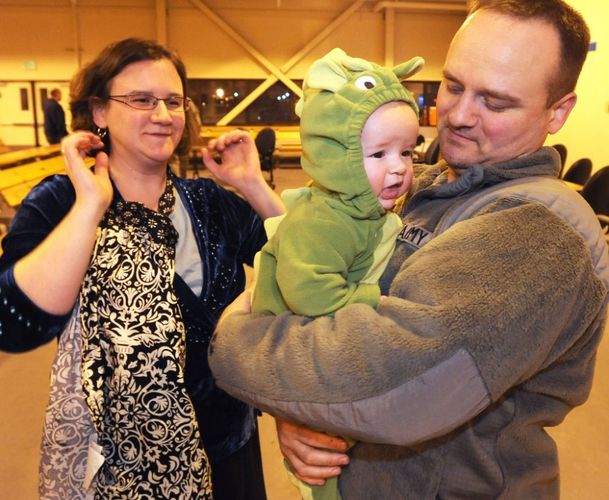
In the past 12 months, I spent 8 full months pregnant, my husband left for Iraq on Good Friday, I had a C-section, a very close friend left me right after my son was born (and hasn’t spoken to me since) and my husband missed the first four months of our son’s life.

When I am really having difficulty dealing with situations, I can’t even write about them. It takes almost all my energy to actually deal with what’s happening and so I can’t bring myself to put pen to paper (or fingers to keyboard).

Many people offered to help me and many people did help. There are several people without whose support- I might have pulled the covers over my head and refused to get out of bed.

Recently, someone suggested to me that I was trying to be perfect or that I might be depressed. I looked at the person carefully and said neither of those were the case. I recounted the tale of “The Canoe Trip of Near- Death”, in which my husband was swept out of the canoe, the dog nearly drowned, we got growled at by bears and I had to paddle on my own to save us all. My commentary how that related to the current situation was this, “I’m almost to shore. Please don’t push me out of the canoe now.”

And so, I’ve made it to shore. Not really by my own power, but by the grace of God and the support of lots of caring people. But sometimes there is nothing else to do, but keep paddling and hope the stream is clear around the next bend.

My husband is home safely. My son has made it through the most dangerous of the SIDS windows and is a fat, happy baby. My dog has survived the introduction of a new family member, being kicked off the bed and relegated to floor sleeping and reduced attention. And I have survived all of this. Some of the events hurt more than others (I’m not sure when I’ll be over my friend’s betrayal). Some of this will fade in time. And some of this will always be just what happened then.

In church, we lost some faces that I’m going to miss dearly. That adds to the pile.

However, I have survived to write again. No matter what I wanted in these situations, I couldn’t control much of them. So I just kept paddling.

And I’ll keep paddling right into 2010, which has no promises to be an easier year. And maybe there’s no such thing. They are what they are.

The main point is that, regardless of what a year brings or doesn’t, God remains. With us, far and near. Carrying us. Steering us. Captaining our boat- even if we’re sure we’re doing the navigating. Always.

Happy New Year.

A Poem

After Psalm 137

by Anne Porter

<!– (from Living Things) –>

We’re still in Babylon but
We do not weep
Why should we weep?
We have forgotten
How to weep

We’ve sold our harps
And bought ourselves machines
That do our singing for us
And who remembers now
The songs we sang in Zion?

We have got used to exile
We hardly notice
Our captivity
For some of us
There are such comforts here
Such luxuries

Even a guard
To keep the beggars
From annoying us

Jerusalem
We have forgotten you.

“After Psalm 137” by Anne Porter, from Living Things Collected Poems. © Zoland Books, 2006.

Pastor, Talk to me about…the Second Sunday in Advent

Malachi 3:1-4

1 See, I am sending my messenger to prepare the way before me, and the Lord whom you seek will suddenly come to his temple. The messenger of the covenant in whom you delight—indeed, he is coming, says the Lord of hosts. 2 But who can endure the day of his coming, and who can stand when he appears?

For he is like a refiner’s fire and like fullers’ soap; 3 he will sit as a refiner and purifier of silver, and he will purify the descendants of Levi and refine them like gold and silver, until they present offerings to the Lord in righteousness. F13 4 Then the offering of Judah and Jerusalem will be pleasing to the Lord as in the days of old and as in former years.

Luke 1:68-79

68 “Blessed be the Lord God of Israel, for he has looked favorably on his people and redeemed them. 69 He has raised up a mighty savior for us in the house of his servant David, 70 as he spoke through the mouth of his holy prophets from of old, 71 that we would be saved from our enemies and from the hand of all who hate us. 72 Thus he has shown the mercy promised to our ancestors, and has remembered his holy covenant, 73 the oath that he swore to our ancestor Abraham, to grant us 74 that we, being rescued from the hands of our enemies, might serve him without fear, 75 in holiness and righteousness before him all our days. 76 And you, child, will be called the prophet of the Most High; for you will go before the Lord to prepare his ways, 77 to give knowledge of salvation to his people by the forgiveness of their sins. 78 By the tender mercy of our God, the dawn from on high will break upon us, 79 to give light to those who sit in darkness and in the shadow of death, to guide our feet into the way of peace.”

Philippians 1:3-11

3 I thank my God every time I remember you, 4 constantly praying with joy in every one of my prayers for all of you, 5 because of your sharing in the gospel from the first day until now. 6 I am confident of this, that the one who began a good work among you will bring it to completion by the day of Jesus Christ.

7 It is right for me to think this way about all of you, because you hold me in your heart, for all of you share in God’s grace with me, both in my imprisonment and in the defense and confirmation of the gospel. 8 For God is my witness, how I long for all of you with the compassion of Christ Jesus.

9 And this is my prayer, that your love may overflow more and more with knowledge and full insight 10 to help you to determine what is best, so that in the day of Christ you may be pure and blameless, 11 having produced the harvest of righteousness that comes through Jesus Christ for the glory and praise of God.

Luke 3:1-6

1 In the fifteenth year of the reign of Emperor Tiberius, when Pontius Pilate was governor of Judea, and Herod was ruler of Galilee, and his brother Philip ruler of the region of Ituraea and Trachonitis, and Lysanias ruler of Abilene, 2 during the high priesthood of Annas and Caiaphas, the word of God came to John son of Zechariah in the wilderness. 3 He went into all the region around the Jordan, proclaiming a baptism of repentance for the forgiveness of sins, 4 as it is written in the book of the words of the prophet Isaiah, “The voice of one crying out in the wilderness: “Prepare the way of the Lord, make his paths straight. 5 Every valley shall be filled, and every mountain and hill shall be made low, and the crooked shall be made straight, and the rough ways made smooth; 6 and all flesh shall see the salvation of God.’ “

1. One of these things is not like the others. What’s up with the Philippians reading?

2. A psalm does not have to be a Psalm. Discuss.

3. What does John the Baptist mean to you?

Stranger! Stranger!

In Anchorage, there is a gentleman who visits churches and writes up his experiences for the Anchorage Daily News.

He recently visited our sister church, Central Lutheran. You can read his warm and positive review here.

When he visits churches, he looks for warmth and friendliness to visitors as well as an organized service, Bible-based preaching and meaningful music.

Do we offer these things? What kind of review would he give us? What kind of review would Jesus give us?