
Category Archives: Resurrection

Born that We No More May Die

I’m having trouble sleeping these days. Part of it is the late stage of being pregnant, but the other part is the pictures that keep running through my mind.
Not a picture of my friend
The first is picture of a friend of mine, her significant other and their baby, a baby who was stillborn last week, just before full-term. In the picture, she is clutching the baby, wrapped up, close to her chest and her SO is leaned over them both, his head touching hers and his eyes on the baby. It is a nativity to behold. 
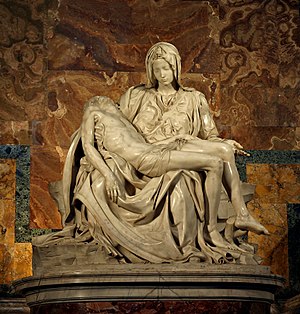
The second image is the Pietà, Michaelangelo’s to be specific. I keep thinking of this image in connection with the violent deaths of the children of Sandy Hook, Connecticut. It is likely that most of those parents were not able to cradle the bodies of their babies- stopped from doing so because of the cause of death and the condition of the bodies. Thus, I think of that image of Mary cradling the grown Jesus and remembering in her mind how she held him so many times before. I know those parents are remembering every moment they held their children. The other thoughts that are probably running through their minds are too hard for me to imagine. Not impossible to imagine, but too hard for me to consider and still let go of my own toddler and refuse to live in fear.
These images are not only interfering with my sleep, but they are marching into the forefront of my mind as I try to prepare for Christmas. One of the things that I wrestle with all the time, theologically and personally, is the connection between Christmas and Easter. More specifically, the connection between Christmas and Good Friday. I do not accept that Jesus was born, destined for the cross. I am not resigned to the idea that betrayal and crucifixion were inevitable. My faith is anchored, beyond the veil, in the trust that God is bigger than all things, was revealing that power before Jesus, and that the Messiah came into the world to be the clear sign of that power and a clear revelation of God’s expectations of creation.
Death, violent or otherwise, was never a part of God’s intentions for creation. With our scientific minds (and I love science), we understand a cycle of birth, decay, and death. Yet, our faith teaches that this is not preordained. We are not born to die. We are born for life. We are gifted with faith for abundant life. Somehow, in some way, the Christmas story is the heart of this truth- that God came into the world in an expected way, so that we might believe and live. When death tries to trump that truth, life wins. Love wins. Joseph does not stone Mary. The childhood illnesses that could have claimed Jesus’ life do not succeed. The devil’s temptations do not stand. The threats of detractors do not hold water. The cross and tomb are not the final word. Incarnation leads to not to crucifixion, but to resurrection. Life wins.
In this season of grieving, personal and public, for my friends, for people I do not know, for our world, I do believe that life wins. The story of God’s entrance into the world as one of us is not the beginning of that theme, but the powerful plot twist that no one expected and that surprises us still.
Every death, every stillbirth, every child, every 110-year-old, is a death that is too soon when it precedes God’s final renewal of heaven and earth. Yet these deaths are not the final word. That Word is God’s. The Word that has always been with God, indeed the Word that is God, is life. Life.
There comes a point where I don’t have anything else to say and so I have to stop talking. The grief is too real. The pain is too sharp. The explanations are weak or non-existent.
And still hope flickers.
And still we say, “Come, Lord Jesus.”
And still Life shines through the darkness. And the darkness cannot overcome it.

A Moveable Feast (Second Easter Service)

Mark 16:1-8
            Do you know why the date of Easter changes? It has to do with the cycle of the moon and the church calendar. Easter is the first Sunday after the first full moon after the vernal equinox. For the most part that means Easter falls somewhere between March 22 and April 25. Of course, and this is one of the best parts, the churches that use this date for Easter have what’s known as an “ecclesiastical calendar”, meaning the church occasionally has slightly different lunar dates than the astronomical calendar, kept by, well, astronomers. But for the most part, the formula has held true since 325 A.D. (for churches using the Gregorian calendar).
            Easter has earned a special name, since it does not have a fixed date. It is referred to as a moveable feast. Moveable feast. And all the dates that are coordinated with Easter’s date are also moveable feasts: Transfiguration, Ash Wednesday, Holy Week, Ascension, Pentecost, and Holy Trinity Sunday. All moveable feasts because their celebration is always a given number of days from Easter. (For example, Ash Wednesday is always the Wednesday before the sixth Sunday ahead of Easter.)
            Why am I talking so much about calendars? It’s actually not the calendar part I care about. It’s the name: moveable feast. It sounds like a picnic on the go, something that comes with us, that we can carry, that carries us. A moveable feast sounds like a banquet, a glorious table spread with all kinds of amazing foods. But when you’ve been really hungry or exhausted, a moveable feast is a shared crust of bread and the slug of liquid that makes you feel like you can keep going. Easter is both of these kinds of feasts.
            Mary Magdalene, Mary- the mother of James, and Salome were not in a feasting mood as they headed toward the tomb for that first sunrise service, a service of laying on of hands and prayer. They probably ate very little the day before, since it was the Sabbath and because they were probably still stunned from the crucifixion. At some point during that day, each of them quietly set aside ointments, cloths, spices in a little basket. Not a feast, just little odds and ends to tend Jesus’ body, to mend it, to commend it to God through washing and prayer. Tears pouring down their faces, they crept out of their houses at first light, before their families were awakened. Instructions were given to oldest daughters and daughters-in-law about the morning meal. And then the quiet slap of sandals on hardened dirt streets.
            The mother of James probably thought she was the only one, until Salome hurried to catch up to her. They both saw the figure of Mary Magdalene ahead of them and scurried to be by the side of that beloved apostle on the way. Still stunned by how abruptly it had all ended, the ringing of the hammer on the nails in their minds… the feel of Jesus’ body gone cold as they laid it in the tomb… the confusion as to where the disciples had gone… was it true about Judas… how will they move the stone. It was all too much. These women were not ready for a feast of any kind.
            But, ready or not, they arrived to hear of resurrection. They come with one task in mind, if they can accomplish it. That task proves worthless, all their planning, their grieved collection of materials. The task they came to do is moot and they are given another task, but it’s too much to absorb. We want to imagine them leaping in excitement and leaving the symbols of sorrow in their wake, a trail of spices, cloths, and broken perfume bottles leading to the empty tomb.
            They are stunned and afraid. What if this is a trick? What if Jesus’ body has been stolen? Do they go tell the apostles, who will doubtless come to the same conclusion and, possibly, accuse the women of knowing what happened? What do they do? Only minutes before they had a momentous task, honoring the body of Jesus. Now they have a different, monumental task… becoming the body of Christ. Carrying words as a balm, hope as the fragrance, faith as a spice. They nibble at the edges of this feast, easing the hunger of their grief.
            Why does the angel tell them to go his disciples and Peter? Is it because Peter is special, is elevated, or because Peter denied Jesus and it’s important to express plainly that he is still in the fold. He is still a sheep of Jesus’ own flock, a lamb of God’s own fold, a sinner who has now been redeemed. The messenger is clarifying for the women that there are no side tables at God’s feast, no people who wait for scraps in the kitchen, no one who will be turned away from the banquet of resurrection. Even Peter has a place at the Easter feast, when it reaches him through the witness of the women.
            That’s the thing about a moveable feast. It comes whether you’re ready or not. Whether you are in your own extended Lenten season, wrestling with crucifixion, lying in the tomb- unable to rise, the moveable feast comes. A moveable feast offers us hope until we can taste joy. A moveable feast offers expectation until we can drink from faith. A moveable feast fills us with courage until we are stuffed from encounter.
             
            Easter is the moveable feast that brings us the food for our souls when we need it and when we can receive it. Sometimes in April. Sometimes in September. Sometimes in December and January. The news of resurrection comes to us in our deep hunger and edges us into fullness, into renewal, into strength.
            Who would believe the story of three women who say they saw a heavenly messenger at the empty tomb of an itinerant preacher from the backwater of Nazareth? Who will listen to that story? Who will take their word?
            People who are hungry for forgiveness. People who thirst to believe God is still acting in the world. People who believe in the possibility of redemption. People who crave justice and peace. People smell the scent of equality and long to have their fill. People who have tasted of true freedom and want to revel in it again. That’s who will listen to their story. That’s who will believe them. People who are hungry for the feast of Easter. Hungry for it on the first Sunday after the first full moon after the vernal equinox. Hungry for it on the day after. And after that. And after that.
            Do you dare to believe that this is a moveable feast for you? That is for the person beside you and beside them? That this feast has moved from an empty tomb to Galilee to Judea to all of Palestine to the entire world? Do we dare to speak up and say this is a feast to which everyone is invited?
            Our hymns and our words mainly speak of Easter joy, but that first Easter (and maybe every one since) wasn’t about joy. It was about hope. The hope in the truth of the resurrection. The hope in the triumph of the God of life over the power of death. The hope of grace and forgiveness and the family of God. You may not always feel like feasting on first Sunday after the first full moon after the vernal equinox, but we can believe the feast is there.
The moveable feast of resurrection, of Easter is bound human limitations, then or now.
When is resurrection?
When is Easter?
Thanks be to God that the moveable feast of Easter is always right when the world needs it to be.
Amen. 

Ready or Not, Resurrection (Early Easter Service)

Mark 16:1-8
            What happens when you’re not in the mood for Easter? What if the smells are too strong, the colors too bright, the alleluias too loud? We are all a little used to people talking about not feeling the Christmas spirit, but who doesn’t want new life… who doesn’t thrill at the sound of the trumpet… who isn’t ready for resurrection?
            Sometimes our own Lent goes on beyond forty days. Sometimes, in our own lives, our own passion story, our own feeling of crucifixion… exposure and abandonment… is not over in a week or three days. Sometimes resurrection comes, but we are not ready to get up. We are not ready to tell the story.
            The women heading toward the tomb for that first sunrise service, a service of laying on of hands and prayer… those women were not prepared for resurrection. They may have spent the whole day before, the Sabbath day, longing to be at the tomb. Maybe it was too far too walk for the Sabbath or perhaps the work was not permitted. So each of them quietly set aside ointments, cloths, spices in a little basket. Tears pouring down their faces, they crept out of their houses at first light, before their families were awakened. Instructions were given to oldest daughters and daughters-in-law about the morning meal. And then the quiet slap of sandals on hardened dirt streets.
            The mother of James probably thought she was the only one, until Salome hurried to catch up to her. They both saw the figure of Mary Magdalene ahead of them and scurried to be by the side of that beloved apostle on the way. Still stunned by how abruptly it had all ended, the ringing of the hammer on the nails in their minds… the feel of Jesus’ body gone cold as they laid it in the tomb… the confusion as to where the disciples had gone… was it true about Judas… how will they move the stone. It was all too much. These women were not ready for resurrection.
            But, ready or not, they arrived to hear of resurrection. They come with one task in mind, if they can accomplish it. That task proves worthless, all their planning, their grieved collection of materials. The task they came to do is moot and they are given another task, but it’s too much to absorb. We want to imagine them leaping in excitement and leaving the symbols of sorrow in their wake, a trail of spices, cloths, and broken perfume bottles leading to the empty tomb.
            They are stunned and afraid. What if this is a trick? What if Jesus’ body has been stolen? Do they go tell the apostles, who will doubtless come to the same conclusion and, possibly, accuse the women of knowing what happened? What do they do? Only minutes before they had a momentous task, honoring the body of Jesus. Now they have a different, monumental task… becoming the body of Christ. Carrying words as a balm, hope as the fragrance, faith as a spice.
            Did they go to the disciples right away? Did they make a plan to meet later in the week and talk about what happened? Did they return to their respective houses, already moving with morning activity, and slip back into their routines, knowing things were different, but unsure how to put that difference into words?
            Knowing things are different, but unsure how to put that difference into words is the Easter story for most of us. Sometimes we receive the news of resurrection, but we’re trying to understand how it applies to us. How it makes us free. How it brings us restoration, hope, and faith.
            Stories of grief have to be repeated until understanding comes, until relief arrives, until a light shines in the darkness. The women probably met again… maybe that afternoon, maybe a few days later. They had to get ready for resurrection. Because it happened when they were unprepared. It happens in the same way to us.
            Whatever our state of belief, of grief, of celebration, Christ’s resurrection comes to us, comes to all creation, whether we are ready or not. And here’s the good news about resurrection… we cannot stop it, we cannot slow its work, we will not stem its grace or welcome. Ready or not, we have been swept into the stream of Easter hope. The Spirit keeps us floating until we are ready to swim.
           
Easter is here, but resurrection is still coming, still washing over us, still be absorbed in us so that, like the women at the tomb, we too may take on the task of telling the story and becoming the body of Christ.
Amen.

Hosanna! Save Us! (Sermon, Palm Sunday)

The premise of this sermon begins with the fact that the service was “backwards” for April Fools Day. We began with a benediction, flowed to communion, back through the service, concluding with confession. 

Mark 11:1-10
            How do I give a sermon backwards or upside down? Do I begin with the point I would close with and close with a pointed story? I’m not sure. On the best days, the Spirit works through the sermon to give us the food for thought and the faith that brings us to the table to receive, and commune with, the presence of Christ. Since we communed first today, I’m trusting that the communion that is in us and among us… is also opening us up to a new way of looking at this holy Sunday… Palm Sunday.
            Today’s gospel lesson is usually called the “Triumphal Entry into Jerusalem”. What makes it triumphant?
       The people greeting Jesus?
       Like a parade?
       Treating him like a king?
The crowd is shouting, “Hosanna! Hosanna!” What does that mean? Hosanna is actually a very April Fools kind of cry. It sounds happy, but it isn’t.  It doesn’t mean “Hooray” or “Cheers” or anything we could imagine yelling in a parade. Hosanna, in both Hebrew and the equivalent Greek, means “help us” or “save us”. So people are waving leafy branches and calling for Jesus to help and save them. They are expecting salvation from Roman oppression, from physical ailments, from the unbalanced temple system of the time.
Sometimes when we see pictures of Jesus riding on the colt, he looks like he has indigestion. It’s a strange look for someone who is receiving a parade in his honor, but it’s not so strange if we think about the message Jesus has been preaching and the upside and backwards expectations people have of him.
            Speaking of the colt, why do you think Jesus’ parade vehicle was a “colt that had never been ridden”? That probably wasn’t the smoothest ride he could have found. Many people point to a verse from the prophet Zechariah, “Rejoice greatly, Daughter Zion.  Sing aloud, Daughter Jerusalem. Look, your king will come to you. He is righteous and victorious. He is humble and riding on an ass, on a colt, the offspring of a donkey.” (Zech. 9:9) Jesus knew his Bible, the Hebrew Scriptures, and he could have been fulfilling this.
            Yet, there’s something a little further back that might also be a factor and goes hand-in-hand with the understanding of Jesus as a very different kind of king. When Solomon was crowned king, he rode to his anointing on his father David’s mule. (1 Kings 1:38-39) This symbolized Solomon’s succession to his father’s throne. Very frequently when new kings take over, they do so by re-fitting or re-claiming the symbols, possessions, wives, and residences of their predecessors- as if to clearly establish who is king now and who is not. People are greeting Jesus as a king in the line of David, but is he? Is it possible to be in the family of David, but to be a king in an entirely different way?
            Jesus rides on… a colt that has never had a rider. He’s coming into a kingship that has no predecessor. What did we sing this morning: “His is no earthly kingdom, he comes from heaven above. His rule is peace and freedom, and justice, truth, and love.” (Prepare the Royal Highway) By riding a colt with no previous rider, Jesus is revealing, perhaps too subtly, that what he brings is very different from what previous rulers have offered.
            Yet the crowds miss that. Most of the disciples don’t understand it. They’re too busy calling for salvation and they know exactly what they want that to look like.
            They know exactly what they want salvation to look like.
            April fools.
            This is one of the challenges of Holy Week- letting go of what we want salvation to be and allowing ourselves to be open to what it is. On Wednesday night, a few of us talked about the favorite moments of the week. It came up that Easter is supposed to help us not to be afraid of death. Someone responded, “I’m not afraid of death. It’s the dying part that I don’t like.”
            That’s so true for most of us. It’s the dying that we’re afraid of. And Holy Week has a lot of dying. The recollection of betrayal and false accusation and crucifixion causes us to tremble, but the dying begins here- with the palms in our hands. Dying well takes honesty. How honest are we ready to be?
            Are we prepared to be honest with the emotions we feel this week? The discomfort at being touched? The uncertainty at the story of the crucifixion? The sense of being overwhelmed or underwhelmed by a story that’s been told many times? Are we will to be honest that Jesus isn’t the king we’re expecting and sometimes we don’t like that?
            Are we prepared to die to the notion that our goodness, our right behavior, can save us or make us right with God? Are we prepared to be honest that we don’t always look for Jesus in other people and we do not always let people see Jesus in us? In this Holy Week, are we prepared to die, within ourselves and in our actions, to our prejudices, to our blind spots, to our fears, to our insecurities? Are we prepared to crucify injustice, anger, judgment, and mistrust? Are we prepared to cry, “Hosanna to the King of Kings”, and mean it? To mean, “Save us, Jesus, save us from ourselves, from our possessions, from our efforts to control.”
            Something must die to make way for rebirth. And the dying is scary. But this week is all about dying… in particular, dying so that we might live
           
            Who can help us with that? To whom shall we cry, “Hosanna! Save us!”?
The Jesus who came to us at the table… the Jesus whose death brings the possibility of resurrection… and resurrection brings the promise of new life.
            Are you ready for Holy Week? Are you ready to remember? Can you be open to the dying that makes way for new life? Are we prepared to ponder the different kind of king that Jesus is and the different kind of life to which we are called… or will we hold back… hold back and have the joke be on us?
            Jesus, you are king forever. We would never betray you or your call to us. April Fools.
           
Hosanna. Hosanna. Hosanna.
Amen.