Category Archives: questions

Deck Chairs

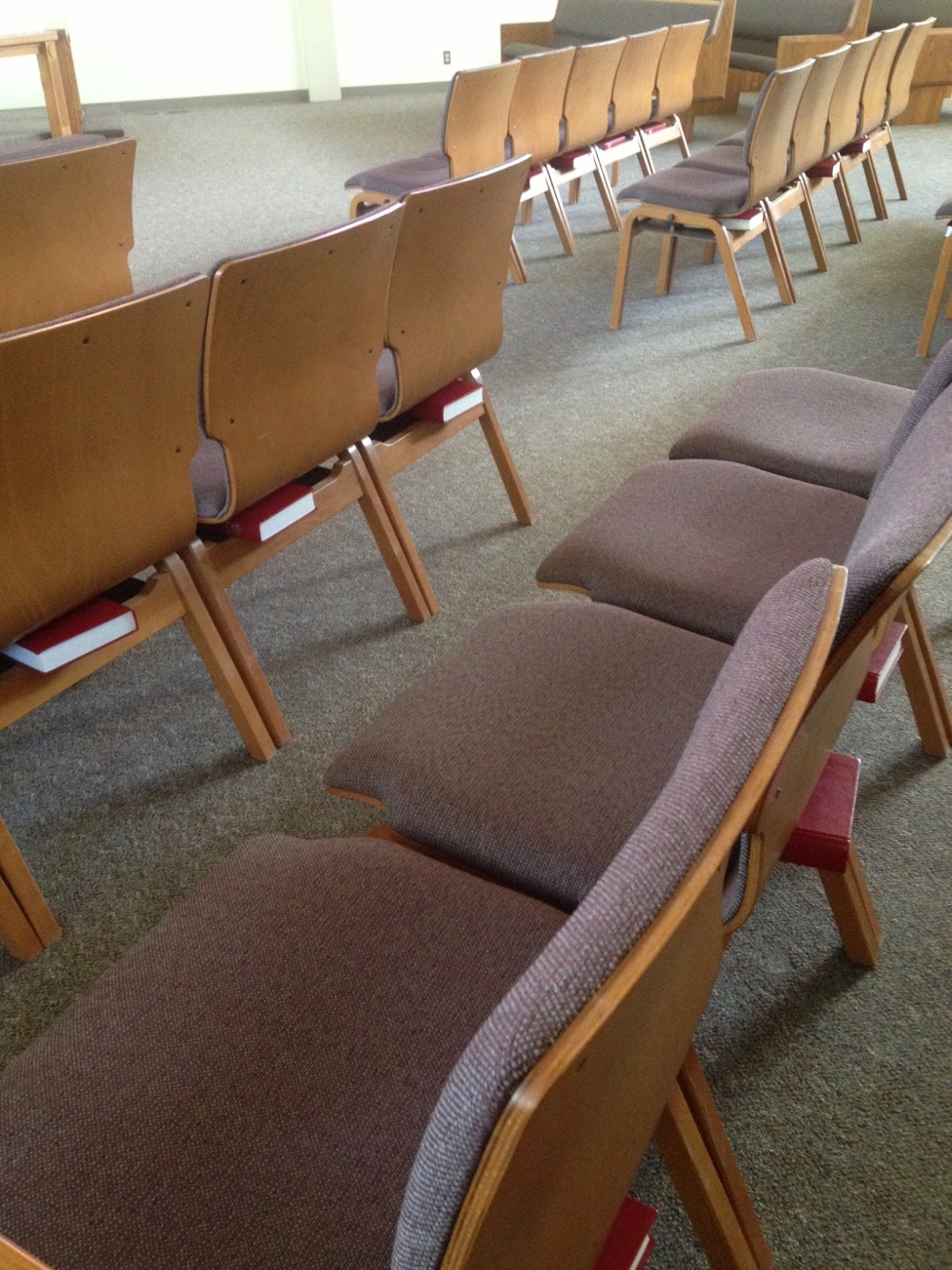
Yesterday, I rearranged the chairs in the church sanctuary. Since the second Sunday in the Easter season (the 1st Sunday after Easter), we’d been sitting in a circle with the altar inside the circle. Many people loved this arrangement. An smaller number of people hated it and there were a minority with no [expressed] opinion.
In an effort to be more visitor-oriented for the summer (our biggest visitor season), we moved the chairs back into their neat little rows. I did not put out as many rows as we had previously because we just don’t need that many chairs. We have moveable chairs and fixed pews. I arranged five rows of six chairs each on two sides (60 chairs). We also have four pews on each side, which could easily accommodate 5-6 people each. Let’s say 5. Thus, we easily have seating for 40 people in the pews.
Sixty plus forty is one hundred (100). We have available seating this Sunday for 100 people.
Last Sunday, at our regular service, we had 37 people.

 
37.
I thought about each of those 37 people as I arranged the chairs yesterday. The circle put us all closer together and made the space seem full and warm. This Sunday, forty people will be spread across seating for 100. The empty seats will be obvious.
And I arranged the chairs.
So frequently I am drawn into conversations about the shrinking church, about lowered attendance, about why people no longer make church a priority.
These are serious questions.
The answers are not really about the style of music or the kind of preaching or the kind of coffee or whether there is childcare.
All of those things are just a different arrangement of the chairs.
The truth is that the people who do regularly attend church (of whatever kind) have to be convinced that what is offered to them, what matters to them, could and would matter to other people. And then they have to act on that thought.
Our desire to see other people experience what we experience in church (if we experience something worth sharing) must be greater than our fear of rejection and failure.
We have to reject, forcefully- with the help of the Spirit, the forces that seditiously whisper the words “inevitable decline”, “too small to matter”, or “too old-fashioned” to oppose God and God’s work. 
We can arrange the chairs in all kinds of ways.
But if we believe that the message of Christ ever mattered, then we must move out in faith BECAUSE THE MESSAGE IS AS IMPORTANT NOW AS IT HAS EVER BEEN.
The message is as important now as it has ever been.
If we do not think it is worth sharing… worth conquering our fear… worth sinning boldly for… then it doesn’t matter. 

And it never did.
In that case, I have some chairs for sale. 

That’s Not An Answer

Luke 13:1-9, 31-35
             Why do bad things happen to good people? Conversely, why do good things happen to people who seem evil? Why should a murderer have joy? Why should a gracious person experience deep grief? This is the question Jesus is confronted with in today’s reading. People want to know why God allowed the faithful Galileans to be killed.
            Jesus responds by asking if the people who were killed in the accidental falling of a tower were worse sinners and deserved to die. The questions that are being raised go all the way back to Job and beyond. We want to know why there is suffering in the world. We want to know why it comes to us and to those we love and to those we deem innocent.
            So, Jesus, ever helpful, answers these deep, heartfelt questions with a parable (everyone’s favorite). He speaks of a fig tree that is not producing fruit and the desire of the owner of the garden to cut it down, presumably to make space for a tree that will produce. The gardener gets the life of the tree extended by promising to rededicate effort to its growth for one more year.
            It is tempting to make a metaphor or an allegory out of this parable. To say that we are the tree(s), God is the owner, and Jesus is the gardener- bargaining for more time for us to produce fruit. However, that scenario pits the Father and the Son against each other, instead of seeing them work together out of love for all creation.
            Jesus does not say why bad things happen; he skips right over that question. We want the world to make sense- for bad things to happen to “bad” people or for bad things to happen as a direct correlation to bad actions. It is not so. God is in the center of all events, but not the immediate cause of all that happens. God is present in all pain and suffering, but not at the root of these things. Human freedom and freedom in the created order can, unfortunately, lead to pain and sadness. (What is freedom in the created order? It means that some things happen like the growth of cancer cells or natural disasters or freak accidents.)

            Knowing that God is present in all things, but not the cause of all situations, Jesus does not answer the questions that we ask, but instead gives us the direction and information that we need to know and to remember. Through the parable of the fig tree, Jesus reminds us that pain will happen to everyone. Everyone will experience loss. Everyone will make a bad decision and experience consequences, sometimes negative and sometimes not. Everyone will (most likely) die. And everyone will experience God’s judgment.
            Jesus is reminding his hearers- then and now- that there are things we do something about and things we cannot. For the fig tree, and for us, fruitlessness is not inevitable. Through the Holy Spirit, God is constantly shaping us… using the events that happen to us and around us to bring forth good things for our neighbors, our communities, our families, and… even for ourselves.
            God is with us as we weather life’s experiences, but then helps us to grow into the producers that we have the potential to be. When we reflect on God’s grace, then, we have to ask ourselves if and how we are producing love, joy, peace, patience, kindness, goodness, faithfulness, gentleness, and self-control. These things grow in us, by God’s help, and we are called to use them to mend the wounds in the world that are caused by bad choices, by poor use of freedom, by accidents, by the forces that oppose God and God’s good work.
            Instead of clearing up the mysteries of the ages, Jesus tells us that we are the answer to someone’s question. We are the answer to someone’s pain, to someone else’s inability to make ends meet, someone’s call for help, to the needs for justice, peace, and healing. Jesus reminds his disciples, his hearers, and those who would deride him that we can still produce this fruit without having all our questions answered.
            This is what it means to live in faith and to live together faithfully. Our life of faith is living together and living in the world until the time when we have all the answers, but the questions no longer matter. We are not brought together, we are not given faith, we are not believing for the answers. We are together, granted faith, and believing with the questions.
            Which does mean that we may become exasperated, on occasion with Jesus, with God, with the Spirit. We may yell. We may rend our clothing. But the difference between living in faith with doubt and not believing is revealed at the end of today’s reading. We can be with Herod, with the religious officials, with the people who demand answers or refuse reason, with those who reject Jesus. Or we can stand with Jesus, with the One who Saves, and say that we do not know all that we will know, but we know enough now, we trust enough now… to continue forward. We can say that we have received enough grace to sustain us into the next step. We can share with one another enough confidence that God is continuing to shape us, feed us, and nurture us into the producers of the fruits of the Spirit that the world so desperately needs.
            Jesus reminds us that, on this side of heaven, pain and death are going to happen. Judgment, God’s decisions toward us, is also inevitable. However, these things- separation, loss, and death- do not mean division from God. And they most assuredly do not mean inevitable unfruitfulness. The good news of God in Jesus the Christ is that God continues to use us for good, whether we know it or not. The world is changed through each of us, for Christ’s own sake. And we are gifted with the opportunities to be participants in God’s grace and creativity. We become co-workers and co-creators through the power of the Spirit.
            The Lenten season reminds us that the time to join with Jesus is now. We do so, invited by the grace we have already known. The promise of God in Christ to continue working in us so that we might bear fruit is the deepest measure of God’s grace. And while that grace does not answer all our questions, it helps us to live with our questions. The consolation of today’s reading is that we can live with questions and still live in faith.  

Gotta Serve Somebody

This week’s reading from Joshua includes the famous verse:

 “Now if you are unwilling to serve the Lord, choose this day whom you will serve, whether the gods your ancestors served in the region beyond the River or the gods of the Amories in whose land you are living; but as for me and my household, well will serve the Lord.” (Joshua 24:15) 

When I think of this verse, I consider the truth that we’re never really choosing if we are going to have a god, we’re constantly choosing what we will worship as god. Will we choose the God of creation, who has chosen us, or we will choose any number of lesser gods- whose glittering promises of health, wealth, and power are played like siren calls from all corners of the world? 
Whom will we serve? 
I keep hearing the words of the prophet, Bob Dylan, singing, “You gotta serve somebody…” It’s not that we’ve gotta, it’s that we’re gonna… so whom will you choose? 

“Gotta Serve Somebody”
You may be an ambassador to England or France
You may like to gamble, you might like to dance
You may be the heavyweight champion of the world
You may be a socialite with a long string of pearls.

But you’re gonna have to serve somebody, yes indeed

You’re gonna have to serve somebody,

It may be the devil or it may be the Lord

But you’re gonna have to serve somebody.

Might be a rock’n’ roll adict prancing on the stage

Might have money and drugs at your commands, women in a cage

You may be a business man or some high degree thief

They may call you Doctor or they may call you Chief.

But you’re gonna have to serve somebody, yes indeed

You’re gonna have to serve somebody,

Well, it may be the devil or it may be the Lord

But you’re gonna have to serve somebody.

You may be a state trooper, you might be an young turk

You may be the head of some big TV network

You may be rich or poor, you may be blind or lame

You may be living in another country under another name.

But you’re gonna have to serve somebody, yes 

You’re gonna have to serve somebody,

Well, it may be the devil or it may be the Lord

But you’re gonna have to serve somebody.

You may be a construction worker working on a home

You may be living in a mansion or you might live in a dome

You might own guns and you might even own tanks

You might be somebody’s landlord you might even own banks.

But you’re gonna have to serve somebody, yes 

You’re gonna have to serve somebody,

Well, it may be the devil or it may be the Lord

But you’re gonna have to serve somebody.

You may be a preacher with your spiritual pride

You may be a city councilman taking bribes on the side

You may be working in a barbershop, you may know how to cut hair

You may be somebody’s mistress, may be somebody’s heir.

But you’re gonna have to serve somebody, yes 

You’re gonna have to serve somebody,

Well, it may be the devil or it may be the Lord

But you’re gonna have to serve somebody.

Might like to wear cotton, might like to wear silk

Might like to drink whiskey, might like to drink milk

You might like to eat caviar, you might like to eat bread

You may be sleeping on the floor, sleeping in a king-sized bed.

But you’re gonna have to serve somebody, yes indeed

You’re gonna have to serve somebody,

It may be the devil or it may be the Lord

But you’re gonna have to serve somebody.

You may call me Terry, you may call me Jimmy

You may call me Bobby, you may call me Zimmy

You may call me R.J., you may call me Ray

You may call me anything but no matter what you say.

You’re gonna have to serve somebody, yes indeed

You’re gonna have to serve somebody,

Well, it may be the devil or it may be the Lord

But you’re gonna have to serve somebody.

My Hour with Thomas

On the second Sunday in Easter, our church observed Bright Sunday (or Holy Humor Sunday)- extending our resurrection celebration. In addition to kazoos, jokes, and laughter, we had an interview with the apostle, Thomas.

Good morning, everyone, and thank you for joining me today on Theology in the Morning with…Pastor Julia! We’ll have a special food giveaway later this hour, but right now let’s meet our special guest. You may know him as the Eeyore of the disciples or the famous doubter, but let’s welcome… Thomas the Apostle!
Thank you so much for coming today. How do I address you? None of you apostles seemed to come with a last name.
Thomas is fine.
Thank you for that. Well, let’s get to it. I think the first question we’d all like an answer to is: Where were you when Jesus showed up that first time?
You know, Pastor Julia. If I’m willing to do the time and space travel it takes to come here and answer questions for you and these other fine folks today, I’d think you’d come up with a better first question. Everyone wants to know and what are you going to say if I tell you that it was my turn to empty the dirt pot (if I may be subtle)… or that I had gone out to get more bread or wine… or that it was just pretty rank in that room with 10 other scared men. Whatever I tell you is going to disappoint you, so all you need to know is that I wasn’t there. Can you live with that?
Wow! I must say, Thomas, I did not expect you to be so frank. I suppose…
It’s like this. I loved Jesus, still do. I mean, I see Him every day now, so can’t really complain. But three years of parables… that can make a man crazy. I wanted some plain talk and I don’t mind telling you that when he did get around to telling it like it was, it was hard to swallow. Since the resurrection, my goal is to tell the truth- straight up. No parables, no metaphors. Also, I don’t spend time on what doesn’t matter. Where I was doesn’t matter in this interview.
Well, thank you for your frankness. Moving on then, what did you think when the others told you that Jesus had been in the room with them?
Honestly, I thought they had all gone crazy together. We were so keyed up, scared, and jittery. It seemed possible that they had a group vision or something. What happened with Judas hit us all pretty hard. Not just because he had traveled with us and been a friend, we thought, but also because most of us understood that anyone of us could have easily done what he did. Maybe not in the same way or for the same reasons, but still… Anyway, when I came back and everyone was tripping over themselves to tell me about Jesus’ return. It was just too much. I’m sure you’ll want to list out the history of Thomas the doubter, but can anyone here tell me that you wouldn’t have said the same thing in the same circumstances?
I’m pretty sure I can’t say that I would have been different. So, what was it like when you did see Jesus?
What do you think it was like? I wanted to throw up and throw myself at his feet, all at the same time. Even after the crucifixion, even when we weren’t entirely sure what to believe about where his body was, we still knew the truth of what we had witnessed when we traveled with him. I still can hear Lazarus’ voice lifting out of that tomb. I can still see the stunned expression of blind men seeing for the first time, of people who walked, of people who heard and received a word of forgiveness. So, even when we as disciples didn’t know what to think… we had these powerful experiences to chew over with one another. Those experiences formed our understanding of Jesus and, in that upper room, none of us were willing to admit to thinking we might have been wrong, even though we all had that thought. And then he was there!
If I may interrupt, how did he come through that wall?
You may not interrupt. That’s not important to the story. However he did it, it was done! And there he was and I was terrified and thrilled and ashamed and gratified and… Even now, it’s too overwhelming to think. Suddenly, when he appeared, everything I knew came into place. The last rock in a wall. The opening move of a game. It was like the most powerful end and at the same time the most astounding beginning of any story, song, or even battle that you might see. Suddenly, I knew that this was my Rabbi, my teacher, and my God, THE God… right there. When he offered for me to touch him, I couldn’t dare. Moses only saw God’s backside and lived to tell about it. What would happen to lowly Thomas who asked for proof, got it, and then pressed his luck?
That’s such an amazing story, Thomas. We’re all curious about what you did next, but this is supposed to be a light-hearted Sunday. We’ve all been enjoying laughing and your story seems so heavy.
It’s not that heavy when you actually think about it. You don’t think there’s humor in it? Believe me, I laugh every time I consider that Jesus didn’t punish me for asking a question. He could have said, “Impudent wretch! Did you ever listen when I was talking?” But he was as kind and generous in resurrection as he ever been.
And, you, you dare to think that this is not a story of joy? What kind of interpreter of scripture are you? There are three gifts in that story and youget two of them. Jesus gives peace to all disciples, he gives proof to me, and he blesses those who won’t quite have the same experience I did. You get peace! AND a blessing! What more do you want?
Well, proof might be nice.
Proof! Ha! Proof is like the buzz of those kazoos that you were playing earlier. It’s great while it lasts, but then it grates on you. It takes your breath away and then leaves you empty of mystery. Proof gives you a tangible experience for a while, but it doesn’t allow for height and depth and breadth and range.
If you have proof, will you have peace? Will your questions end or will they increase? If you received proof, would you relinquish your blessing? The comfort of the Spirit? The experiences you have resurrection in communion and in community and in creation?
I don’t know, but doubting seems so…
What is doubt? It’s like proof, it comes and it goes. If you banish one question, another will arise. Your faith, God’s gift of faith to you, is not the absence of doubt. It’s action in spite of doubt. It’s moving forward, even while questioning. It’s closing a door, but knowing that Jesus just might come through the wall.  You’re learning as you go, just like I was. Just like Peter. Just like Andrew, James, John, and all the women who helped us along the way. But you have written accounts to help your faith. You have the promise and the presence of the Spirit. The resurrection has always been your reality.
And you have my story, my little story that you try to make big in all the wrong ways. What was I doing? How did he come through the wall? How about this?!? Jesus knew my questions, brought me the answer of his own body, did not strike me dead on the spot, and offered a blessing to everyone who doesn’t get what I got. How about that to make your Sunday bright? And your tomorrow? And the day after that?
Wow, Thomas, I don’t know how to thank you for coming in today. You’ve been an amazing guest. I’d like to talk to you more after the break about your life after the upper room, but first we have some messages from our sponsors. Folks, I just want to repeat something Thomas said: Your faith, God’s gift of faith to you, is not the absence of doubt. It’s action in spite of doubt. It’s moving forward, even while questioning. It’s closing a door, but knowing that Jesus just might come through the wall.

Amen