Category Archives: Now it’s personal

Between Jesus and Me

In this week’s coverage of the scandalous words of Representative Todd Akin of Missouri (see: Akin, “legitimate rape”, “shut that down”), his frantic retraction, and the push from other Republicans for him to step down from his race (not because he was wrong, but because he was public)… I have run through a gamut of emotions.

I have revisited how I felt when assaulted by men who did not heed my words to stop and how I felt for friends who experienced far worse assaults than I did.

I have pondered what I will say to the child I currently carry in my womb regarding rights, women, and America.

I have been angry at the attempts to discuss abortion instead of the very real rights and bodies of women- women who are currently alive, women who (theoretically) have constitutional rights, women who are not magical vessels for pedestals or damnation.

All of these emotions swirled in my mind until I had this exchange with myself, in my head, while driving:

I’m so angry about this. I want to write about it, but I don’t know how. 
What specifically are you angry about? 
Being made to feel helpless. 
How will you expand upon that? 
I would discuss previous times this has happened. 
Boring. 
Well, I could… talk about it makes me feel depressed and vengeful when men tell me what I can and can’t do with my body.
To whom does your body belong? 
To me… 
What about R (your husband)? 
No, except through my consent and our mutuality. My body belongs to me. 
What about your children? 
See above re: husband. 
What about to Christ- think of your baptism? 
Ugh. Now Jesus is just another man, laying a claim on my body. 

WAIT A MINUTE.

This is where I nearly wrecked my car. I could not believe the sentence about Jesus ran through my head- exactly like that. “Now Jesus is just another man, laying a claim on my body.” I pulled into the parking lot at work and sat, attempting not to hyperventilate, and thought about that sentence- several times.

The thing is… I do believe that my baptism into Christ’s death and resurrection does have a claim on my body.

AND NOW I AM RESENTFUL OF ANYONE WHO WOULD DIMINISH THAT RELATIONSHIP BY ATTEMPTING TO PLAY GOD WITH MY PERSON.

That’s right, Akin and other supporters of fetal personhood over maternal/female personhood, by attempting to abort my status as a person via amendments and rhetoric, you nearly came between Jesus and me.

It seems that you’d like to think you’re God- knowing the ins and outs of human bodies and minds, but it ain’t necessarily so. In fact, it necessarily ain’t so.

You are not God.

You are not God. I am not God. You are not me. You are not a mediator in the relationship between God and me. You do not get to claim that your work creates me, saves me, sanctifies me, redeems me, or frees me.

You don’t own me. Or any part of me.

What you have not made, what you have not saved, what you are not making whole… you may not claim. You cannot claim. You will not claim.

Jesus appreciates that women can think. I refer you to his conversations with the Canaanite/Syro-Phoenician woman (Matthew 15, Mark 7), in which Jesus yields to the reasoned argumentation of a woman who pleads for the healing of her child.

Jesus believes that women have strength and that women who do not have or may not have children are worthy participants in community life. I refer you to Mark 5, in which a girl who is not yet bearing children and a woman who may be past child-bearing are both healed and restored to their families/communities.

Jesus understands that social situations may lead a woman to make poor choices or to feel trapped by circumstance. Thus, Jesus tells the woman caught in the act of adultery (brought forth without her male partner in John 8) to go and sin no more- granting her the personhood to be bigger and resistant to the male forces that would shape her world. Jesus gives hope to the Samaritan woman at the well, in talking with her as a person of intellectual being, capable of seeing her way to new life, new choices, and renewed hope.

Jesus affirms that women can handle and do handle many types of jobs and tasks. Sometimes they sit and listen, like Mary in Luke 10, to learn and to be part of discussion. Sometimes, like Martha in the same story, women play the role of host- making guests comfortable and providing a gracious space.

Jesus inspires the gospel writers to understand that women are an integral part of the salvific act of resurrection and sharing the good news. All four gospels have women playing significant roles in the spread of the resurrection story. Not as gossipers, but as evangelists- sharing truth with all whom they encounter.

As I consider this Jesus, this Jesus whom I claim to follow, this Jesus in whom I am said to be clothed, this Jesus whose story still brings hope to me and many… this Jesus is a man whom I am willing to allow to lay claim to my body.

Because He sees it.

He knows it.

He saves and renews it.

Furthermore, if and when there is a time when I feel separated from God, because of what has happened to me, because of what I have done, because of choices or actions… I can trust that Jesus will be with me. He will not abandon me. I am and remain a person to (and through) Christ.

But you, Akin and others, … you do not see me. You do not know me. You have no claim on me. And you have dared to attempt to come between me and God, by way of my uterus, my vagina, and my identity as a woman.

Do not offer your words regarding my potential child or other fetal life. Do not offer hasty retractions- apologies for having been caught, not for your actions. Do not wring your hands about loss of life, when you are so clearly willing to dismiss my life as being less than.

There is one man who can make claims upon my body. That man also happens to be God.

And you, your ilk, your fellow travelers, your co-conspirators…
You. Are. Not. That. Man.

Good reading from this week for includes:

Martha Spong on Old Husbands’ Tales
Julie Craig on To Be a Girl, In this World

Jesus Will Not Be Pimped

In March 2012, I attended a conference at which Congressman Emmanuel Cleaver II was the keynote speaker. For the record, Congressman Cleaver can P.R.E.A.C.H. He spoke about the current budget crisis in our government, the changes in how congressional leaders relate to and communicate with one another, and the responsibility of all citizens to care about how our money is used. At one point in the sermon keynote address, Cleaver spoke vociferously against people who loosely talk about “God on their side” or who choose to ignore the plight of struggling people, but speak of Jesus’ approval and how Jesus has brought them success. While ignoring Jesus’ teaching, they give him credit for their success and expect him to continue to deliver. However, said Cleaver, “Jesus will not be pimped.”

Jesus will not be pimped.

Can I hear an amen?

Preach it, Brother Cleaver. We cannot ignore Jesus’ plain teaching about loving our neighbor, about dropping our throwin’ stones, about drawing all people to God, about lifting women and children and outcasts of all types, about understanding that kingdom of God is at hand. We cannot ignore those things, but expect the name of Jesus to bring us political victory, economic victory, religious victory.

Jesus will not be pimped.

In Anchorage this week, there was an election fiasco of historical proportions. Many precincts ran out of ballots, which meant that some people did not get to vote or voted on questioned/questionable ballots. Was there an unexpected number of voters? Maybe. This was an election for mayor and there were several ballot propositions up for consideration. Proposition Five proposed to add “same-sex orientation” and “transgendered identity” to the city’s non-discrimination clause. Proposition Five did not pass, by a large margin. My heart aches.

I was part of campaigning for Proposition Five. Yes on Five. I did public work and I did some private negotiating and conversations with people I know and love, but would not normally be inclined to vote yes on this kind of thing. Some people changed their votes. One person was willing to leave the prop blank, unable to vote yes, but willing to not vote no.

Some of the rhetoric from both sides was harsh. However, from my perspective, the No on Five crowd was particularly vitriolic with pastors using the pulpit to spread false information about homosexuals (uncited and incorrect statistics regarding suicide, child abuse, and crime), conflating transgendered identity with transvestitism (not the same at all), spreading incorrect and damaging information about how Prop 5 would affect churches, and using nebulous phrases like “protect your rights” without clarifying the rights that were “threatened”.*

The use of church time, pulpit authority, and church dollars to spread discrimination in the public sector is abhorrent to me. Using the name of Jesus to keep people in the dark of discrimination with regard to jobs, housing, and services is shameful. People are hurting and churches have kicked them when they’re down, in the name of Jesus. And these same churches will be touting how Jesus brought them victory.

Jesus will not be pimped.

Why am I writing this on Good Friday? Because it’s on this day of all days that we tend to hear about the idea that humanity was (and is) so terrible that God had to send his Son to die for all, but the death (and resurrection) only brings redemption to those who believe. God was/is so angry, so hates the people of the world, that the only satisfaction that would work to satisfy God’s angry need for an appropriate sacrifice that is for the Son to come, live as a human,  and then die in a horrible way for all the sins that have been and will ever be committed.

I don’t think so.

Jesus will not be pimped. Not even by the Father.

The attempt to snuff the Second Person of the Trinity, the Death of Jesus, the Murder of the Messiah comes at the hands of people. People who thought they could force God into acting (I’m looking at you, Jewish Zealots of the Roman occupation). People who thought that the Messiah would look a certain way and Jesus was a blasphemer (if not a threat to their power). (I’m looking at you, chief priests and scribes). People who were scared and uncertain and who had little power, even to try to prevent what was happening (I’m looking at you, disciples who steal away in the dark of the garden).

People killed Jesus for a variety of reasons, but

Jesus will not be pimped.

God acted (and acts) in spite of human actions, with their myriad causes, to bring resurrection- life, hope, and the reality of forgiveness. Forgiveness doesn’t require substitution. Forgiveness is about a clean slate, fresh linen, an empty tomb.

Jesus will not be pimped.

If our work in Jesus’ name is not the work of caring, loving, healing, restoration, clarity, forgiveness… if it’s not work Jesus would recognize as his own… we better be careful to whom we attribute the victory.

It’s a bleak day, but resurrection is coming and it looks exactly how God wants it to look…  and not how any of us define.

Jesus will not be pimped.

*I carefully wrote this sentence because of how No on Five people took sentences and thoughts of Yes on Five people out of context.

Remember Trayvon

Several months ago, I was reading a book to children at church. I pointed out the different skin tones of the kids in the book and asked why the children in the picture looked different. One of the children sitting across from me looked at me like I had crawled out from under a log, “Because they’re people,” he said.

Being “people” means having different skin tones, abilities, hair colors, tendencies, heritage.

It’s great that these 3, 4, and 5-year-olds knew that. May they never forget it.

Apparently, some adults have. Or never knew it.

The stories about Trayvon Martin are breaking my heart. A teenage boy, on his way home from a store, shot to death for being people. For being black people.

There may be enough evidence within a few days or weeks to arrest the shooter, based on witness accounts. (Though, if a black man were suspected of shooting a white teenage, someone would already be under arrest.)

Or Florida’s “Stand Your Ground” laws may protect the shooter, who claims he was defending himself.

I want to see outrage. I want to hear anger. I want to witness righteous foaming at the mouth on the behalf of Trayvon.

I am called to preach forgiveness, but right now not only would I not give the shooter “air in a jug”, I would be likely to beat him with said jug. Remember the presumption of innocence does not mean that someone is actually innocent, just that the court treats them as such.

Then I see a racial slur directed at the president with regard to his re-election: “Don’t Re-Nig in 2012”. Horrible examples here.

I can’t believe I just typed that, but this needs to be called out. I don’t care what you like or don’t like, you don’t say that, print that, wear it, or stick it. Not about the president. Not about anybody.

It’s bad in America for black Americans. Bad. Bad. Bad.

If your response to the sentence above is anything less than, “She’s right”, you’re not paying attention.

The first boy I ever kissed was black. M.W. and I were practicing our multiplication tables when we were 8. We dared each other to kiss. It was chaste, dry, and quick. We went on to memorizing the sixes and no further. This is not my credential, it comes to mind when I think of Trayvon.

Trayvon was someone’s first kiss. Someone’s son. Someone’s friend. Someone’s confidante. Someone’s grandchild. Someone’s customer. Someone’s future employee. Someone’s future employer.

And all that he could have been is no more because of a trigger happy bigot who couldn’t see past the color of Trayvon’s skin. Which was black.

In the Civil Rights era, one could encourage by offering, “Remember the Little Rock 9”, “Think of Rosa Parks”, “Don’t forget the Birmingham 4”, or “Selma”.

If we cannot rise to this occasion by an appeal for justice and neighbor love in Sanford, Florida and across the nation, let us cry out for equality in the name of Trayvon. Remember Trayvon.

Put it in your window. Say it in the prayers at your church. Put it in your Facebook status. Email one Florida politician a day until you’ve gotten to the whole delegation, state and federal. Pray for justice. Pray with your hands, your feet, your dollars, your vote, and, lastly, with your words to God.

If you are not angry enough to speak out for Trayvon, no matter where you live, you cannot delude yourself into thinking that you have been any different than the crowd that will sing “Hosanna” and “Crucify Him” with the same breath.

Yes, I just said that.

If not you, who?

Remember Trayvon. Who died for being black. Who died for being people.

I’m a Religious Voter, Too!

Lately, as the primary season ramps up, I’ve heard the phrase “religious voters” more and more often. Usually this is shorthand for a certain type of conservative voter. Among other feelings, the phrase “religious voter” used in this way makes me angry because…

I’m a religious voter, too!


The American College of Catholic Bishops does not speak for me. Dr. James Dobson doesn’t speak for me. Neither Rick Warren nor Rob Bell nor Barbara Brown Taylor speak for me. The current presiding bishop of the ELCA, Mark Hanson, (a man I respect and admire), speaks for my denomination, but does not speak for me. As a clergywoman, I would not presume to assert that I speak for those who worship within the congregation I lead with regard to most political issues. (This congregation is also full of religious voters.)

As a religious voter, I care about:

  • The health of all Americans – This means, among other things, that I have concerns about the affordability and accessibility of good healthcare for men and women. This means I believe that an ounce of preventative care is worth a million dollars worth of cure. I believe that education and information about communicable diseases, including honest information about contraction and prevention of sexually transmitted diseases (STDs), is helpful and life-giving. I believe that good healthcare for women, including (but not limited to) contraceptives, pre-and-post-natal care, information about heart disease and breast health, is key to the success of all communities. This is not an inclusive list of all my healthcare concerns, but the tip of the iceberg. 
  • Food and farms– I care about the continued success of family farms, real food, and balanced eating. I have serious concerns about the continued government subsidies of the meat and dairy industries, as well as the support genetic engineering of corn and its use in non-whole foods and non-human foods. I have serious concerns about the lobbies of Con-Agra, Monsanto, and others who are cornering conversations not only about food production, but land use and seed sales to other countries. I am concerned that the gap between people who eat “whole foods” and “processed foods” grows wider every day and concerned that there are costs associated with that gap that we will pay for years to come. This is not an inclusive list of all my food and farm concerns, but the tip of the iceberg. 
  • The poor and the very poor– The gap between the haves and the have-nots is not simply about some people sharing what they have. It’s about acknowledging how our communities work. How we still use phrases like “across the tracks”, “in the ghettos”, and “impoverished communities” as codes for racial profiling and deliberate deprivation of community resources. I’m concerned that we have decided the children of certain groups “will never be able to” ____________ and we allow those children to believe that myth. I’m concerned that we hold up certain success stories as individual commendations without pointing to the communities, teachers, pastors, counselors, social workers, family members, and others who made that individuals success possible. No one is an island. This is not an inclusive list of all my concerns about the poor and very poor, but the tip of the iceberg. 
  • Standing– I’m concerned that the government gets a say in who can be married and who cannot. I don’t think the government should have a say in this. In fact, I believe the government should treat everyone who pays taxes as an individual, with no commentary or reward for other relationships. I do not think corporations are individuals, despite their tax level. I do think all tax-paying entities, individuals and corporations, would be able to give more to charities if their tax burden was decreased. Charitable organizations of all kinds do much of the work that either the government cannot (or SHOULD NOT) do efficiently or that is not done by government organizations. This is not an inclusive list of all my concerns with regard to standing and taxation, but the tip of the iceberg. 
  • Members of the military, military action, and foreign relationships– I resent the use of members of the military as pawns in campaigning. No one wants to see people who volunteered (or were volun-told) their lives for this country lack for safety in combat, struggle with mental or physical issues, or be used as guinea pigs. All of these things happen. In addition to failing to protect our current members of the military and our veterans, I would like for someone to be honest about the commitments that have been made around the world with use of our armed forces. Someone, ANYONE, go ahead and take a deep breath and start naming names of where we have people and why. Be honest and say we won’t leave Korea, Japan, Eastern Europe, or close Guantanamo and say why. The secrecy and the distortion of information has to stop. Yes, I believe there are things that are important for national security, but I also believe that national security has become a code word for dishonesty and misuse of resources, fiscal, physical, and human. This is not an inclusive list of all my military and peace concerns, but the tip of the iceberg. 
I’m a religious voter, too. These are but a few of the things I think about. Is anyone interested in my vote? In my concerns? In the future of America… or do you just want to win this election? 
I want a representative (presidential, senatorial, congressional, gubernatorial, mayoral, etc.) who is actually concerned about doing the right thing. Not getting votes, being re-elected, or having a pristine legacy, but about doing the right thing for the right reasons. 
You can tell me that’s what all politicians think they’re doing… the right thing, but I don’t believe it. I’m not saying that what I want is the right thing, but if people who were interested in serving the public, instead of revenge through policy and rhetoric, I believe our campaign cycles would look and sound very different. 
Where’s my candidate?!? 

I’m a religious voter, too. 

Friday Five: LOVE

Over on RevGalBlogPals, revkjarla writes:

Hey RevGals….
It’s Valentine’s Day on Tuesday….
So,
Share 5 Valentines you would like to give this year, and why–
but here is the hitch, 
Can’t give them G-d, Jesus, Holy Spirit…
or your mom, your beloved, your sweet child(ren)…tell us about the other amazing  beings in your life. 
Valentine the First: This one goes out to women whose labor did not goes as planned. I spent a lot of time with C-section regret, even though it was an emergency. Even at the time I knew it had to be done so that we both could (and did) live. Still, it can be hard not to feel like I failed. I didn’t. Other women have this same experience or other birth scenarios that don’t goes as hoped. Some women go home empty-handed for a variety of reasons. Mother’s Day can be hard for all kinds of reasons, so one this day I give a free hug to all moms of all sorts, however you became a mom, whatever happened when you gave birth, however things are working out with your kid(s). 


Valentine the Second: This one goes out to people who are happy being single. This doesn’t mean that they don’t want to meet someone, but that they feel complete in themselves and enjoy their lives as they are already! There’s something to be said for knowing who you are, where you are, and being at peace and at home in that. These people only need Singles Awareness Day inasmuch as they would like you to be aware that they are just fine. 


Valentine the Third: This one goes out to people who are into the sixth week of the diet/exercise regimen  they promised to start on New Year’s! Keep it up! You’re doing a great job. (Would this be you if you hadn’t slipped up a little… it’s okay… just keep going… you can do it… and this Valentine can be a little bit for you too.) 


Valentine the Fourth: This one is for C.C. who watches my son, along with two other children, when I’m at work four days a week. She provides entertainment, instruction, structure, and love. Her work, which she enjoys and at which she excels, makes it possible for me to do the work to which I feel called and at which I strive to excel. There are many children in the neighborhood who have been raised by her capable hands and I’m very grateful that my son gets to be one of the privileged few. 


Valentine the Fifth: This one goes out to the families of people who are in prison or other institutions. I know you think of your son/daughter/father/mother/brother/sister each day. Even if you know he or she is where he or she needs to be or has to be or rightfully should be, the separation is still difficult. You’re doing the best you can.  And you are not alone. 


For all these and more, on St. Valentine’s Day, this bud’s for you: 


The Gospel I Need to Hear (Sermon for 1/8/12)

Sermon for Epiphany 1, Text: Mark 2:1-22

          Sometimes I need a sermon myself. I don’t mean that I need one written for me because I’m tired or uninspired. I mean that I need to hear one.  Usually, I have four or five of you in mind and I hope that the Spirit speaks to all of you through the written and spoken words on Sunday. Yet, sometimes I ended up preaching the Word that I needed to hear and I hope something came to you as well.
            Today, as we look at the stories of people who meet Jesus, I felt like I should be honest about what I want to hear. Perhaps you have the same plea as you listen to these stories. We have a story of friends interceding, a paralyzed man walking, doubtful scribes, uncertain disciples, and adoring crowds. These are the people Jesus meets and it’s hard to decide which thread to follow. Healing, forgiveness, welcome, celebration, correction, renewal, restoration, resurrection- any and all of these are messages I want to receive. How about you?
            Pastor, speak to me of healing. I need to hear that miracles can still happen, that they do still happen, that they will still happen. I want to hear, again, that God heals through medicine  and through miracles and, sometimes through death, through death. Assure me, with sincerity, of the double significance of this gospel story. First, Jesus releases the man from the sins that plague and disturb him- a powerful symbol of the power and grace of God. 

          In order to prove that his power was of God, Jesus then healed his physical ailment, cured whatever bound him to his pallet. In the face of cancer and all manner of other illnesses, Preacher, tell me with confidence that the healing power of God in Jesus is not limited to a house in Capernaum, but that it transcends space and time and the bounds of our understanding. This is the gospel I need today.


            Pastor, speak to me of Epiphany- of a dawning light and a great understanding. In my daily life, I hear a lot of people talking and it all begins to sound the same. I remain hopeful, but cynicism and frustration curls the edges of my hope. I feel kind of like a Pharisee, because I just want something to make sense and to fulfill my expectations. Structure, continuity and tradition provide reliability and stability in chaotic times. A season of new understanding, of A-ha! moments, of bright inspirations is exactly what I need, but not necessarily what I want. 

          Preach to me about the meaning of Emmanuel- God with us. Remind me that there is nowhere I can go that God has not preceded me, nowhere that Jesus does not accompany me, nowhere that the Spirit does not receive me. This is the gospel I need today.
            Pastor, speak to me of sin and of release. Speak the hard truth about sin- about its power to separate us from our neighbors and to make us feel separated from God. Look me in the eye and tell me that sin is action and intention, both concrete and nebulous. Use words that are familiar, but help me understand in a new way that sin is the things I have done and left undone, said and remained quiet about, things I have given too freely and things I have withheld. 

            Now preach to me about release. I don’t want to hear about forgiveness only, about a formula or words that make things right. I want a powerful, truthful, toe-curling honesty about release- release from the fear of death, release from the captivity of sin, release from the mistakes of the past, release into the freedom of a new future in God. Speak to me of the release that is offered through Jesus, every day, every minute. Pastor, speak to me of amazing grace and do not stop. This is the gospel I need today.


            Pastor, speak to me of resurrection. I know that is the wrong season, that we have not yet trudged through Lent to the gleaming white of Easter morning. Nevertheless, I look at today’s gospel and its words of feasting and celebration. I read of new wineskins to receive new wine. This kind of new life makes me think of renewal. Remind me again that God has promised not to make all new things, but to make all things new. Could it be, Pastor, that resurrection happens within us before it happens to us? 

             Is it possible that God-with-us in the person of Jesus was bringing new life to Levi, to John’s disciples, to the outcasts, and even to the Pharisees before the tomb was thrown open? Help me to chew over the idea that spiritual resurrection comes before the resurrection of the body, but is just as important. Tell me in no uncertain terms that God was resurrecting through Jesus Christ long before Easter Sunday. Resurrecting faith, resurrecting community, resurrecting hope, resurrecting relationship. Tell me this is not a metaphor. This is the gospel I need today.
            Pastor, I like it when Jesus says, “I have come not to call the righteous, but the sinners.” I like that a lot, except that I would like to be a little bit righteous. Isn’t Lutheran theology that we are all righteous and sinners at the same time? So aren’t I a little bit righteous? Break it to me gently, one more time, that all have sinned and fallen short of the glory of God. Ugh. Again. All have sinned and fallen short of the glory of God. 

            Okay, I’m ready to hear that my perceptions of myself (and of others) fill up my wineskin and get in the way of the fresh wine that Jesus would put in there. Bring it on home, Pastor, and tie together the truths that I have to release what I think of myself and others, so that I can be open to the healing, the epiphanies, and the resurrection that God has in front of me. Not only that God has in front of me, Preacher, but that God is doing in me and around me. Not only in me and around me, but perhaps, Pastor, with God’s grace and gifts, through me and with me. Today, I am one of the people whom Jesus meets. This is the gospel I need today.
Amen. 

Advent Crossroad: Fourth Sunday in Advent

Fourth Sunday in Advent: Malachi 3-4 (Narrative Lectionary)
            
           This time of year I think a lot about the fact that I had two Jewish grandparents whom I knew and loved. I had four Jewish great-grandparents who died before I was born, whose parents came from Eastern Europe to escape the horrific persecution of Jews. From my Jewish grandparents came my mother who came to know and believe in Christ in her mid-twenties, but still shared with her children some of the celebrations of her youth- Chanukah, Passover, Sabbath.
            This time of year, when we all reflect on families, I think of the Chanukahs of my youth and I think about the people who came before my great-grandparents. My family tree with many branches cut short on one side because of the violence against Jews in Russia and Eastern Europe in the 19th and 20thcenturies. When I read stories of pogroms in ghettos and shtetls, I wonder if those were my distant cousins whose descendants the world will not meet, whom I will not meet.
            When I think of these people, my ancestors, who died because of their religious and cultural identity, I have wondered if I am betraying them. If I am not practicing Judaism (I am technicallya religious Jew, just not of the Jewish faith.), am I undermining their sacrifice?
            It’s not just this time of year that has me asking these questions, but our reading from Malachi. Malachi isn’t really a name, but a title meaning “Messenger of YHWH”. This emissary is bringing another message from God: “See, I am sending my messenger to prepare the way before me, and the Lord whom you seek will suddenly come to his temple. The messenger of the covenant in whom you delight — indeed, he is coming, says the Lord of hosts. But who can endure the day of his coming, and who can stand when he appears?”
            As I read Malachi, I think of all the stories we’ve heard from the Hebrew Scriptures. The story of Abraham and Sarah, of Joseph and his brothers, enslavement in Egypt and freedom with Moses, the giving of the law, the leadership of David and Solomon, the struggle to keep the faith in the midst of tribal warfare, and when kidnapped and taken to a strange land. Through these stories, the Bible points to God’s ultimate faithfulness despite human unfaithfulness.
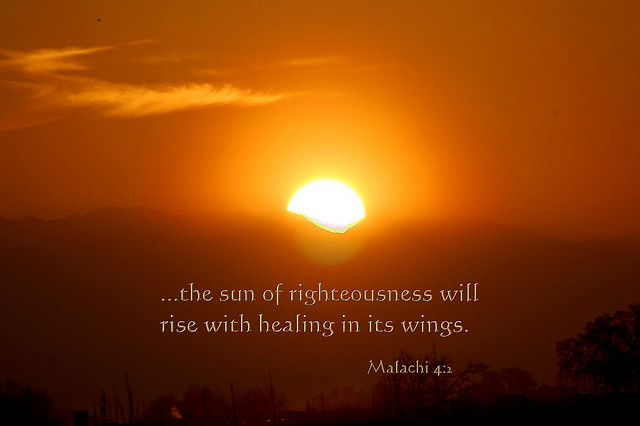
            And now we come to the end of the Hebrew Scriptures. There are other stories that didn’t make it into the regular canon, the agreed upon list of Bible books. There are events that happen after Malachi’s prophecies- the Chanukah story with the lamp oil that lasts for eight days is one such story. But here is a place of turning, a fork in the road, a split in the tree. At this place, we either continue to remain in Advent or we move on to Christmas. Malachi says, “But for you who revere my name the sun of righteousness shall rise, with healing in its wings. You shall go out leaping like calves from the stall. Lo, I will send you the prophet Elijah before the great and terrible day of the Lord comes.”
            For me, as much as I might wrestle with what it means to be Jewish in ancestry, I cannot remain in Advent. This is not the end of the written word of God for me. Somehow, through the Spirit, I have been brought to believe that the sun of righteousness has risen and that Son’s name is Jesus. I may have moments of doubt and of darkness, but I cannot dis-believe the experiences I have had in Christ. The encounters that I have had with Jesus in other people.  My understanding of the powerful reality that God was born onto the earth and knows fully what it means to human.
            Here at the end of Malachi, the branch of Christianity grows out the roots of the tree of Jesse, the Jewish roots of our faith. From this tree we receive our Savior. From this tree we receive the roots of baptism and of blessing bread and wine. From this tree, we receive the understanding of the cloud of witnesses of faithful people who encourage us onward on our journey. Until we are gathered around that manger in Bethlehem and share in Mary’s pondering and the shepherds’ rejoicing, we who believe in God are all Jews.
            But here we are as Christians, believers in Christ, standing at the Advent crossroad and there are two questions for us. The first is will Christ return today? There is still time. And if not, there is still tomorrow.
            The second question that we must ask at this intersection is, “What about God’s promises to Jews?” If we have been brought into faith through Jesus, but there remain some who received God’s promises- what happens to them? What happens to them?
            God happens to them. The oracle of Malachi begins, “’I have loved you’, says the Lord.” The book speaks of God’s election and how God will prepare God’s people to endure judgment and being made holy. Again and again, throughout Hebrew Scriptures, God goes the distance to uphold the promises that have been made between God and God’s people. God does not fail.
“I have loved you” is the banner of a God-created and God-given relationship.  God re-creates and sustains that relationship in the face of human struggle and failure. If no one can endure or stand in the day of the Lord’s appearance, then God will have to create and sustain that which can endure and stand. God will not fail.
            We are poised in a thin space between Advent and Christmas, a place where God meets creation, a place where God became creation. In this space we see backwards and forwards- history and future. It is only in this space that, just between waiting and birthing, we sit with the possibility and the mystery of what has been and what will be.
            There is a possibility that my ancestors might not have been killed and that I might still have become Christian. Who can say? But they were killed. Killed because of who they were and it is a great loss, but one that I cannot change. I do not forget them. I honor them by being honest in who I am and by holding fast to what I believe.
           
            And I believe in God’s work for the world in Jesus. I believe with Mary and Joseph, Abraham and Sarah, Joseph, Moses, David, Jeremiah, Josiah, Isaiah, Hosea, and Daniel in God’s promises from the beginning of creation. In God’s plans for hope and a future. In how God loves God’s people like a parent who lifts an infant to the cheek.
            God has not forgotten the promises made to my ancestors and yours. “I have loved you,” says the Lord. That love burns through all distinctions, all sins and all lies and leaves only what endures. God’s promises are all that can endure and, because of that covenant, God upholds those to whom life has been promised. Then. Now. Forever. God does not fail. 
Amen. 

My Alternative Trinity

I’m a big fan of the Trinity: One God, Three Expressions- Father, Son and Holy SpiritCreator, Redeemer and SanctifierOur Source, Our Brother, Our Sustenance. (The links go to previous Trinitarian love blog posts.)

I believe the Trinity is how God has chosen to make Godself and power know in the world. However, there are other things I believe to be true and worthwhile. In particular, I believe in the holiness of bodies, in backing up your computer and in counseling (talking to someone). This has the potential to be a series, but I’m going to try to be brief this time.

1. The Holiness of Bodies I believe that our bodies are a gift from God and that we are unable to accomplish the work God intends us to do without them. This is why taking care of our physical being is spiritually important. If God’s work within us for Christ’s sake could be accomplished through the power of thinking alone, then we wouldn’t need a physical presence. However, God created a physical world, creatures with bodies and even came among us IN A BODY so that we might understand our call as participants in creation, shapers of this kingdom and our role as “bestowers” of God’s blessings.  You may not have a full complement of limbs or working limbs. You might not run quickly or speak well or be ruddy and handsome, but God is still able to use you. To deny that or to degrade (through action or word) the gift of the body is to doubt God’s own abilities in through the Spirit.

2. Backing up your computer: I’ve nearly lost my hard drive twice. Once in an unexpected computer expiration and once in a hard drive failure. The first time, magic computer elves rescued my files. The second time, I took my little hard drive, plugged it in to my external hard drive and the only things lost were 4 days of email (which were saved to the cloud!). I back my computer up to an external hard drive twice a week and I’m alway surprised when I hear people say that they’ve never backed up their files. It’s one of those “I know I should, but…” (If you don’t know how, go buy and external hard drive and I’ll come to your house and show you. I promise. Or I’ll show you via Skype if you don’t live in the Anchorage area.)

There are many things in that “I know I should, but…” category: exercise (see above), making a will (or dealing with other legal matters), creating a budget, talking about issues that are going unspoken… They’re all hard to do, but going ahead and doing them gives a freedom from fear that is only rivaled by the freedom we have in Christ. It does take time to review your insurance paperwork, have the conversation, plug in the external hard drive, but none of these things take as long as we think they will. Furthermore, none of them take as long as replacing files, lamenting lost items, fixing something without insurance or waiting out the probate court. Back it on up, baby!

3. Counseling. The following is a quote from the book, Rage Against the Meshugenah, by Danny Evans.

Depression= crazy. Crazy= people who mutter angrily to themselves, people who see things that aren’t really there, people who try to kill themselves. Crazy doesn’t = me. I’m married + I have a son + I have a college degree, for Pete’s sake! These things > crazy. Crazy most certainly does not = me.

When I recommend seeing a counselor more qualified than myself to someone I’ve talked to about the same issue more than 3 times, this is the response I usually get. They can’t see themselves lying on a couch talking about their mother. (You don’t do that on your first visit!) Talking to a professional is a great way to make links to situations in your life, to figure out some of your behavior patterns, to discuss thoughts or feelings or reactions around major life changes. Not every down feeling is depression. Not everyone benefits from talking things out, but many, many, many people (including me) do. Additionally, you may have to re-visit counseling more than once in your life. You don’t expect what worked for you physically or emotionally at 20 to keep working when you’re 35 or 40 or 65. You change and grow and how you think does as well. And, yes, you may have to revisit the same thing more than once. I’ve had short-term counseling (6 months to 1 year) 3 times in my life and it’s been transformative for me each time. Though some of the same issues were covered, I had changed and needed to think things through again. Each time was with a different counselor because I lived in a different location. 
I usually give myself the talk above when I start thinking I should see someone. Then I berate myself for not being able to solve my depression/ anxiety/ sadness/ frustrations on my own. And then, finally, I make some calls, go on the first visit and wonder why the heck I didn’t do this sooner. 
The Holy Trinity gets us into life, carries us through it and receives us into the next. However, there are additional blessings from God that make our present life more real, more enjoyable and more connected. Without a body, back ups, and counseling, I wouldn’t be where I am today, enjoying the life that God, +lifeboat, wind and waves+, has gifted me.  

Embarrassing Freedom

It’s the least wonderful time of the year. I’ve already been hit with one memo from the American Family Association, urging me to boycott Dick’s Sporting Good’s stores for promoting a “holiday shop” instead of a Christmas shop. Within days, Dick’s caved to the pressure and changed their website to read “Christmas Shop”. And so AFA has another “victory” in the “War on Christmas”.


Well, I call, “Baloney”.


While the AFA was fighting the good fight against pluralistic advertising, the US State Department issued its Annual Report on Religious Freedom. (Executive summary linked here.) This lengthy document covers the oppression, repression and struggle of believers of all faiths around the world. The report details how governments, juntas, militaries, private groups and others restrict religious freedoms, withdraw permission to practice from certain groups, kill, injure or imprison missionaries and charitable workers and otherwise prevent the free expression of faith. 


Here are just a few excerpts: 

Afghanistan:  Residual effects of years of jihad against the former USSR, civil strife, Taliban rule, popular suspicion regarding outside influence and the motivations of foreigners, and weak democratic institutions remained serious obstacles. Intolerance in the form of harassment, occasional violence, discrimination, and inflammatory public statements by members of parliament and television programming targeted members of non-Muslim minority groups, particularly Christians, Hindus, and Sikhs, as well as Muslims perceived by government and societal forces as not respecting Islamic strictures.Non-Muslim minority groups, particularly Christian, Hindu, and Sikh groups, were targets of intolerant attitudes. Conversion from Islam was understood by Shi’a and Sunni Islamic clergy, as well as many citizens, to contravene the tenets of Islam. Relations among different Muslim sects continued to be difficult, and members of the minority Shi’a community continued to face societal discrimination from the majority Sunni population.


China: The constitution protects “normal religious activities,” but officials have wide latitude to interpret the meaning of “normal.” The government restricts legal religious practice to five (Buddhist, Taoist, Muslim, Catholic, and Protestant) state-sanctioned “patriotic religious associations.” The government bans some religious groups. Treatment of unregistered religious groups varied significantly across the country. In some areas unregistered religious groups met without interference; in other areas officials disrupted their meetings, and even imprisoned worshipers on charges of “illegal religious activities.” Lawyers and other activists who tried to defend the religious freedom of unregistered or banned religious groups faced disbarment, harassment, and imprisonment.


Malaysia: Officials at the federal and state levels oversee Islamic activity and sometimes influenced the content of sermons, used mosques to convey political messages, and prevented certain imams from speaking. Religious minorities remained generally free to practice their beliefs, although approval processes for building permits for places of worship were reportedly at times extremely slow. The High Court overturned the government-issued ban on use of the word “Allah” by non-Muslims after an appeal by the Catholic Church, although the ban remains in place pending further appeal. Numerous attacks on religious venues, most of them minor incidents, followed the court ruling, and in response the government quickly condemned all violence and dispatched police to guard religious sites. The Hindu community continued to express concern about the demolition of Hindu temples.


North Korea: Although the constitution provides for “freedom of religious belief,” genuine religious freedom does not exist, and there was no change in the extremely poor level of respect for religious freedom during the reporting period. The government severely restricted religious freedom, including organized religious activity, except that which officially recognized groups linked to the government supervised tightly. Some foreign visitors to the country stated that services at state-authorized churches appeared staged and contained political content supportive of the regime. The 2009 Korean Institute for National Unification White Paper indicated the regime used authorized religious entities for external propaganda and political purposes, and strictly barred citizens from entering places of worship. Defectors reported the regime increased its investigation, repression, and persecution of members of unauthorized religious groups in recent years. 


These few examples hardly begin to detail the struggle of people around the world to practice what they believe to be true and holy. And, yes, it might not be what you believe to be true and holy. The embracing of pluralism pushes forth the idea of “one God” in a way that can’t be true, if all religions were honest about their tenets. The struggles for religious freedom in the United States are not detailed, presumably because we are optimistic about the level of religious freedom we have here. In my lifetime, I have been targeted for attack, personally, because of my Jewish heritage. Not being a practicing Jew or a person of color, I don’t think I can even estimate the way religious freedom is viewed here. 


Still, each year we are bombarded with messages about the “War on Christmas” and the removal of Christ from the public square. Until you have to buy religious Christmas cards on the black market and exchange them, furtively, in dark alleys- there is no war on Christmas. Until the name of the holiday is changed to Mid-Winter Festival or Saturnalia or Day of Giving, there is no War on Christmas. Until your creche is confiscated, your neighbors calling the police because you displayed a manger in a window- there is no War on Christmas. Until each church is locked and Christians gather in little rooms, daring to defiantly light a candle to celebrate- there is no War on Christmas. 


I heard Christmas carols in a store today. I heard people talking about Christmas shopping. I saw decorations for “Christmas trees”. I saw Christ’s name EVERYWHERE, even if people weren’t using it specifically to refer to Him. 


You may not like it when people say “Happy Holidays”. You can smile and say, “My family celebrates Christmas. I hope you enjoy your celebration.” You could smile and say, “Thank you and you too.” You could just smile. 


Despite the loud protestations of the AFA, in the United States, we have amazing, embarrassingly abundant religious freedom- especially those of us who are Christian and vaguely mainstream, even with some level of standard deviation to the right or left. 


How about we thank God for that freedom and we pray for our brothers and sisters around the world, loved by God, struggling in darkness? How about we pray for an end to oppressive regimes? For the courage to fight for freedom? For wisdom to know how to support educational, medical, and spiritual missions around the world? 


Why should you do that?


It’s what Christ would do. 


You remember Christ. 


The reason for the season? 


I just wonder if the AFA remembers Him.