
Category Archives: no whining

Deck Chairs

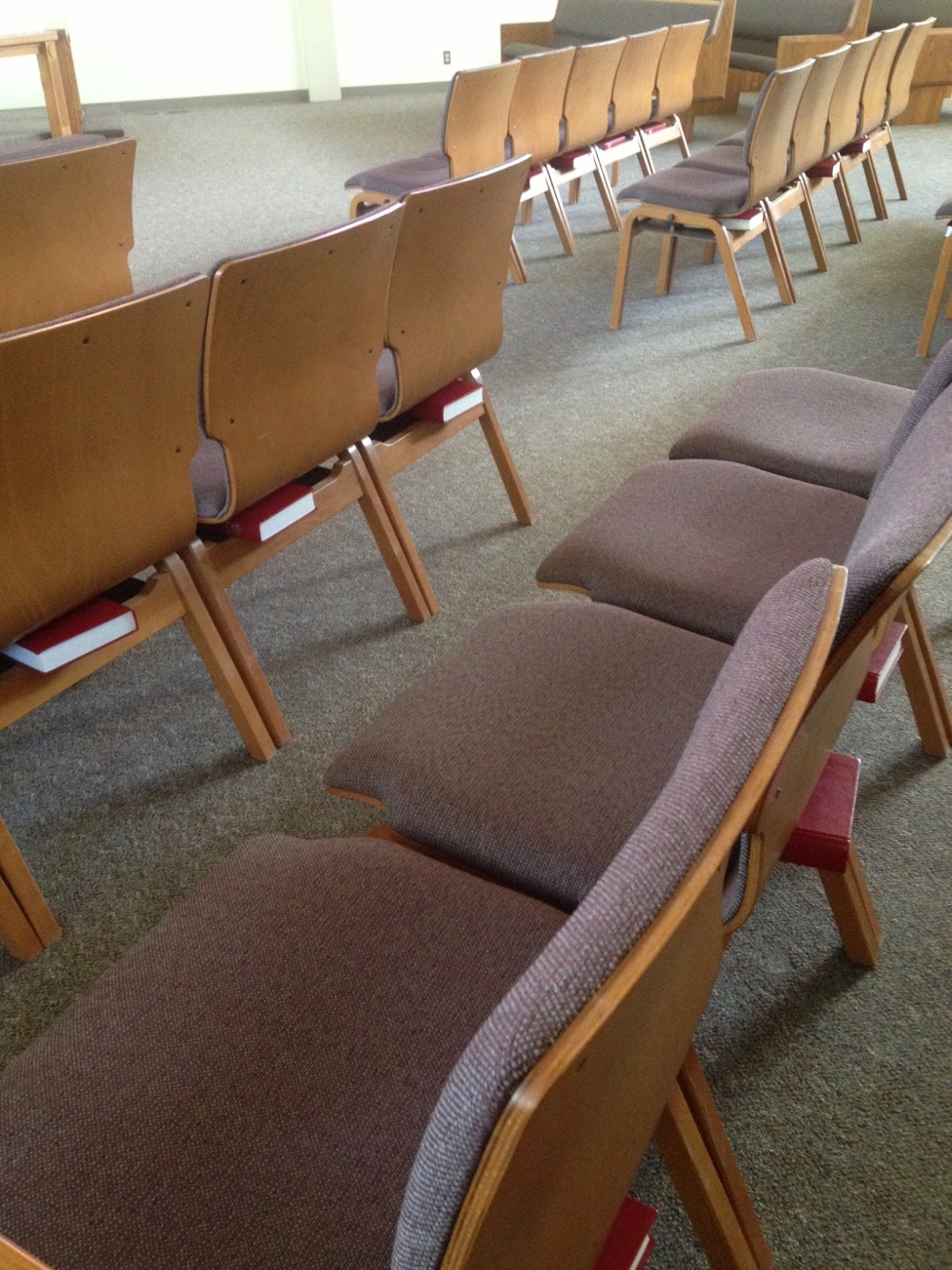
Yesterday, I rearranged the chairs in the church sanctuary. Since the second Sunday in the Easter season (the 1st Sunday after Easter), we’d been sitting in a circle with the altar inside the circle. Many people loved this arrangement. An smaller number of people hated it and there were a minority with no [expressed] opinion.
In an effort to be more visitor-oriented for the summer (our biggest visitor season), we moved the chairs back into their neat little rows. I did not put out as many rows as we had previously because we just don’t need that many chairs. We have moveable chairs and fixed pews. I arranged five rows of six chairs each on two sides (60 chairs). We also have four pews on each side, which could easily accommodate 5-6 people each. Let’s say 5. Thus, we easily have seating for 40 people in the pews.
Sixty plus forty is one hundred (100). We have available seating this Sunday for 100 people.
Last Sunday, at our regular service, we had 37 people.
 
37.
I thought about each of those 37 people as I arranged the chairs yesterday. The circle put us all closer together and made the space seem full and warm. This Sunday, forty people will be spread across seating for 100. The empty seats will be obvious.
And I arranged the chairs.
So frequently I am drawn into conversations about the shrinking church, about lowered attendance, about why people no longer make church a priority.
These are serious questions.
The answers are not really about the style of music or the kind of preaching or the kind of coffee or whether there is childcare.
All of those things are just a different arrangement of the chairs.
The truth is that the people who do regularly attend church (of whatever kind) have to be convinced that what is offered to them, what matters to them, could and would matter to other people. And then they have to act on that thought.
Our desire to see other people experience what we experience in church (if we experience something worth sharing) must be greater than our fear of rejection and failure.
We have to reject, forcefully- with the help of the Spirit, the forces that seditiously whisper the words “inevitable decline”, “too small to matter”, or “too old-fashioned” to oppose God and God’s work. 
We can arrange the chairs in all kinds of ways.
But if we believe that the message of Christ ever mattered, then we must move out in faith BECAUSE THE MESSAGE IS AS IMPORTANT NOW AS IT HAS EVER BEEN.
The message is as important now as it has ever been.
If we do not think it is worth sharing… worth conquering our fear… worth sinning boldly for… then it doesn’t matter. 

And it never did.
In that case, I have some chairs for sale. 

The Bondage of Memory (Sermon 8/5)

Exodus 16:2-4, 9-15; John 6:24-35
            Every four years, I have a little jealous streak that rears its head. It’s not because I wish I had put more effort into being an Olympic athlete, though I am admittedly envious of their skills. The little green monster that peeks out dates way back to my childhood when, looking at a poster in the hallway of my house, I realized there were no women presidents. Immediately, I wanted to be one. The presidency became my goal. In high school, I pursued a lot of avenues that were open for politically inclined students. I was voted most likely to succeed and most likely to become President. So every four years, I feel a little nostalgia that it is not going to happen.
            At some point, I realized this was not the path for me. I do not mean a path that was not open to me- I mean not the best one for me. In order to move on to places and things that were better suited for my skills, I had to let the dream of being president die. Yet, the ghost of that dream occasionally haunts me.
            In today’s readings, people are having a hard time letting their dreams die. The Israelites likely dreamt of freedom each night they were in Egypt and, to be sure, it did not look like this wandering in the desert, uncertain, hot, and wistful, even, for the food of Egypt (tinged with the poison of slavery, though it was). They are in bondage to their memory, unable to be thankful to the God who has brought them thus far.
            Their memories will neither allow them to let go of what they thought freedom would be like nor will their memories recall the truth of what life in Egypt truly was. Their memories are holding them back from seeing God’s actions right in front of them- the actions that are bringing them life.
            The people gathered around Jesus in today’s gospel, both Jews and Gentiles, are not able to see who he really is. Their memories are fixated in two directions as well. On the one hand, they are clearly remembering the many baskets of leftover food after an entire crowd ate their fill. On the other hand, they are remembering what has always been promised about the Messiah of God and what his advent will bring. Obsessed with the signs they’ve witnessed, they crowd Jesus- unable or unwilling to hear what he is saying about belief in God and what truly sustains life.
            Their memories will not allow them to see past the obviousness of the miracles nor will it allow them to let go of the messiah of their minds. Their memories are holding them back from seeing God’s actions right in front of them- the actions that are offering them life.
            We too can be in bondage to our memories. Not just to what we once thought we might have been personally, but in many directions. We can hold ourselves captive by society’s standards or the expectations of those we hold dear. We may be enslaved by the memories of our own beliefs about ourselves, our work, our families- what they were going to be, what they could be if we just made a few changes.
            As a church family, we can be in bondage to our memories of what we think we our best times. We can long for the leeks and cucumbers of days gone by, forgetting the work that went with those meals. As part of the church universal, we can hold so tightly to our memories of what we believed would happen when we nailed the theses to the door, ordained women, become more welcoming… that we are devastated by events that do not live up to the expectation of our memories.
            I’m not talking about our memories of people we have loved or times that we appreciated- those are gifts from God that we’re able to recognize. But the memories of what we thought would be… Our communities, our homes, ourselves… can be held back by what we once believed would be our future. When this happens, and it does, we often grieve for what might have been- without taking stock in what is. Our memorial grief can hold us back from seeing God’s actions right in front of us- the actions that are offering us life.
            When Jesus says, “I am the bread of life”- it’s not about food for the stomach. When God provides manna in the wilderness, it’s not about keeping the Israelites alive for another day. It’s about the present… and the presence. About the relating… and the relationship. The reality of the spiritual strength that is offered to us through Jesus, by the work of the Spirit… that reality is so that we can live, right now. So that we can believe that God is with us, right now. So that we can grow into our potential as God’s beloved, right now. 
            Part of the work to which we are called letting go of the idols of our memories, breaking the bonds of what we thought would be, and helping our neighbors to do the same. We have a very real present in which to live, a very Real Presence that feeds and sustains us. In order to appreciate these gifts and their accompaniments, forgiveness, reconciliation, hope, we have to be willing to be open to the immediate work of the Spirit. We have to accept that God is still speaking. We have to expect that Christ will feed us. We must believe that what God is doing, right now, in our lives and in the world, is greater than what we could have expected or dreamed.
            And then we find ourselves released from the bondage of our memories, false as they were. And we find ourselves in a gracious present, lacking nothing, equipped and energized to carry the bread of life into the world. Whether we are Olympian, pastor, lawyer, teacher, accountant, retiree, homebody, or president.