Category Archives: Jews

What God has Cleansed (Earth Day Sermon)

Acts 11: 1-18
            Care of creation as a part of our Christian life seems a little obvious. Does it feel that way to you? We believe that God’s hand was active in establishing the universe. We understand that there are natural processes that are mysterious to us. We grasp the fact that we are not alone on the earth and that many millions of plants, non-human animals, fish, and lots of other people can be affected by our choices and our actions.
            So we understand, basically, why it’s important. We get it. But do we change what we’re doing based on what we know to be true? I had a lot of heartburn about having a service on Earth Day, oriented toward creation, with a 12-page bulletin. That’s a lot of paper. But we have people who can’t hear and need to be able to follow the service. We have a worship book that turns out not to be very visitor-friendly in its orientation (lots of flipping back and forth). So we sacrificed trees for the sake of hospitality. Does it mean anything to regret this decision? Could we figure out how to go bulletin free one Sunday a month?
            When I ask that kind of question, I immediately see that I have a problem, a flaw in my thinking. I’m skipping right to the specific before I comprehend the reason for the general. I can read Job and understand, again, that God knows and loves all creation on both the micro and macro- scale. Yet, how am we brought into that love? I do not mean how are we brought into loving creation. I mean, how are we brought into God’s love, into God’s knowledge?
            Imagine, if you will, that you are Peter. The Apostle. You fished for years, your life was pretty much set, and then came Jesus. Like a bat out of Nazareth (or something like that). You follow him. You see amazing things. You have powerful revelations. You deny, confess, distort, and accept. You see the risen Christ. You witness the flames of Pentecost. And through all of this, you’re a Jew. Jesus was a Jew. John was a Jew. Thomas, Andrew, Philip- Jewish, Jewish, Jewish. All the people at the Pentecost event- Jewish.
            And now there are people who believe in Jesus as the Messiah. They trust that he is the Son of God. They experience truth in the story of the resurrection. And they. Are. Not. Jewish. What do you do? Send them away? Slap the pork chop out of their hands and circumcise them on the spot? Tell them it is too bad they weren’t chosen?
            When Peter is in Joppa, God sends a vision to a man named Cornelius. Cornelius is an Italian soldier who believes in God and, in his time of prayer, God tells him to go and see Peter. In the meantime, God sends Peter the dream of the “unclean animals” and repeats the scene until Peter gets the point God is trying to make, “Who are you to say that what I have made is profane? Unclean? Unworthy?” When Cornelius appears before Peter and introduces himself and tells Peter of his vision, Peter probably has a little hallucination of a pig, induced by lifelong hatred of Romans and conflation of Roman soldiers with pigs. Then he realizes this is the point of the dream! Truly God shows no partiality because God has even spoken truth to this Italian swine soldier.
            Of course, Peter later gets a lot of flack for sharing the gospel with Gentiles. His reasoning is actually rock solid, “God did it first.” Peter cannot keep the Holy Spirit from blowing where it will, descending as it desires, inspiring the understanding of truth in whom it shall. One of the interesting ironies of the Bible is how long it takes people who have been called by God to realize that God is also working in other people and in other circumstances.
You might think that people whose understanding of God’s work in history included Ruth, Cyrus (the Great), Melchizedek (blessed Abraham), and Pharaoh’s daughter (raised Moses), among others, might not be so shocked that God would conspire to bring inspiration and salvation to non-Jews. And the thing is, we cannot speak against Peter and the other Jews for being slow to come to this understanding. Christians do it all the time. We forget how we have been grafted onto the tree of life. We assume that we are the very roots, trunk, branches, and leaves. (And we know what ass-u-me does.)
            This brings me back around to care of creation. We did not invent this. A green revolution did not begin with us. It began with God, whose farm is all creation. The stories of God at the beginning of the world mention that there was not yet land because there was not yet people (man) to tend the soil, to care for the land, to be co-creators.
            People have slowly come around to understanding God’s call to all people, God’s welcome and openness to every person. How long can the rest of the world wait for us to understand the extension of renewal and redemption? How long can we pretend that we do not understand Peter’s dream that nothing God has made is profane? How long will we profane what God has made by being careless with what we eat, what we do, what we buy, how we live?
            I’m saying this to you, but the voice in my head is saying, “Sit down and be quiet, you hypocrite. Remove the plank from your own eye.” We’re in this together… on Earth Day… on the third Sunday in Easter…
            Where do we start? Let’s begin by making the revelation of Peter’s dream our prayer: “What God has cleansed you must not call common.” When you eat, let your prayer be of gratitude for the ways the food got to your table. “What God has cleansed you must not call common.” When you look at the grit of spring or cut your eyes from a man holding a sign on the corner, “What God has cleansed you must not call common.” When you take out the trash or sort things for the garage sale, “What God has cleansed you must not call common.” When you look in the mirror, when you wash your face, “What God has cleansed you must not call common.”
            The first step toward the acceptance of Gentiles was the realization that God had loved them already. God was there first. So the first step in our own journey toward care of creation, realizing that God loves it already. God loved it first. And God has loved us to share entrust the responsibility of caring. But we have to begin with understanding that what God has made clean, what God has welcomed, what God loves, cannot be called or treated as common.
Amen.  

God’s Punctuation (Sermon 2/12/12)

Epiphany 6 (NL, Year B)
12 February 2012
Mark 7:1-23
            Some of you may remember George Burns and Gracie Allen. Some of you may have heard of them. Some of you may have no idea what I’m talking about. Burns and Allen were a comedy duo couple in the first half of the last (20th) century. He was the straight man to her comedy lines and they were very successful on the radio, on stage, and on television. Their television show was on from 1950- 1958. After having some heart trouble, Gracie decided to retire. George attempted the show without her for one year, but it didn’t work without Gracie. She died of a heart attack in 1964. When George went through her papers, he found a note she wrote to him, which included the line, “Never place a period where God has placed a comma.”
            Never place a period where God has placed a comma. George Burns took this reminder from his beloved that his life on earth wasn’t over yet. He went on to continue acting, directing, and writing until he died at the age of 100 in 1996, always missing Gracie, but continuing to truly live his own life. Never place a period where God has placed a comma.
            I was thinking about this phrase with regard to our text today because it is hard to know if the Pharisees thought there was a period at the end of the law or a comma. It is too easy for us to immediately make the Pharisees the villains of any gospel story in which they appear. The organ music ratchets up, “Dum dum dum”, and we practically see them holding their capes up and cackling.
           
            That’s not exactly the most accurate picture. What is that the Pharisees are upset about in this chapter? They are not thrilled that the disciples are not washing their hands before they eat. It’s not just that the disciples aren’t hygienic, but that they are not performing the rituals of cleanliness before eating and not just for their hands, but also their dishes, cookware, and so forth.
The Pharisees are a reform movement. (What, reformers already?!?) They are trying to help people understand and live out the written and oral laws. Why do those laws matter? As the saying goes, “cleanliness is next to godliness”. Both the written law (Exodus, Leviticus, Numbers, and Deuteronomy) and the oral tradition are aimed at keeping the community of the Israelites pure. When the Israelites are wandering in the desert, they have with them the Tabernacle of the Lord. This is where presence of the Lord dwelled, God’s RV if you will. The Lord is holy. The presence of the Lord is holy. Where that presence lives needs to be holy. The people who enter that presence better be holy. And it helps if the people around them are… holy. Laws about cleanliness, sacrifice, and punishment are also about keeping the community holy so that the presence of the Lord can and will remain there.
Cut to the Pharisees at the time of Jesus. Part of their mission is to help people understand and follow the myriad rules for cleanliness so that they will continue to be a holy people and, thus, so the presence (and, possibly, the favor) of the Lord will be with the Hebrew people. This does not seem quite so evil, when you consider the oppression of Rome and the long history of struggle to survive.
Then Jesus enters the picture and he touches dead people, women who are bleeding, and a leper. He eats with Gentiles and sinners of all stripes. His disciples were not chosen because of their success in Hebrew school (shul), but on their willingness to follow. Furthermore, he is teaching these disciples (and everyone else) to disregard the laws that regulate cleanliness and, thereby, holiness. This Jesus is not just a threat to the power of the Pharisees. That’s not their problem. The way they see it, he has the ability to destroy the holiness of the community by making it impossible for God to dwell with God’s people.
Where they see a period, Jesus is a comma- a place where God has broken into the story and is altering the narrative. The story is still the same, but now God is telling it through Jesus in the world.  Jesus tells the Pharisees that it is not that the laws or the traditions are wrong, but that theyare going in the wrong direction. By continuing to focus on minutiae as holiness, the Pharisees are missing the forest for the trees. Is it right to allow your elderly parents to have a leaky roof because you financed a new wing to the church (synagogue)? Is it right to proudly carry your beautiful offering of birds past many hungry beggars? Is it right to have prayed a formula perfectly and then to be so proud of how much better you can do it than others? This is the point that Jesus makes to the Pharisees and that he makes to us as well.
These are some of the questions for us as individuals, as a congregation, as part of the Church catholic. Are we worried about the mechanics of our spiritual life or are we actually concerned with our own actions? Let’s say no one here has any sexual sins, thefts, murders, or unrestrained immorality on their record. That leaves greed, deceit, arrogance, envy, insults, and foolishness. If anyone here is totally free of those, I invite you come forward and take over because I may well have done two or three already this morning.
            Does how you live from day to day reflect the idea that God is still acting? In Mark, the purpose of Emmanuel… God-with-us… Jesus is to give us a deeper understanding into God’s desires and actions. But it’s not just touchy-feely, it’s a deep, gritty, too bright revelation that God is present at all times and God cares about us doing the right thing for the right reason.
            The very traditions and habits we think are helping us to live faithful lives may very well be getting in the way of living in the way God is calling us. That includes our attachment to this space, our feelings about the order of worship, formulas we’ve developed for spiritual practices, the excuses we give for not having spiritual practices… all these things can become the minutiae of holiness that prevents us, like the Pharisees, from seeing Jesus right in front of us.
            Never place a period where God has placed a comma. By embracing the idea 1) God continues to act and 2) God continues to bring us to a deeper understanding of God’s written word, we are living into the truth that we are known and loved by a living God. Through the Holy Spirit, we are called out of the distraction of details. We are called away from the habits of religiosity that can themselves become idols, gods of false hope and comfort. We are not defiled by what comes into us, but by what we do and we must be honest with ourselves about the wrongs we do. God already knows them. We are called into wholeness, into holiness with the God who made the whole world a tabernacle. We reflect the holiness of that relationship by how we treat the world around us. We are participants in this relationship, not performers hoping to get the motions right to appeal to a God who appears and disappears on a whim. We are participants in the relationship, which means our input matters. We are living with and in a living God.
            George Burns’s life wasn’t over when Gracie Allen died. There was a comma. God continued speaking through his life for over 30 more years.
            God’s presence is not limited to the tabernacle of the ancient Israelites or to physical body of Jesus. God’s presence is in the world, in every place, through the power of the Spirit. That same Spirit that continues to refresh us with deeper understanding of God’s revelation… That same Spirit continues to shape us… cleanses us… makes us holy places where God can and does dwell…
            The God of creation has not stopped creating… The God of our salvation has not stopped saving…. The God of renewal has not stopped reforming… A light still shines in the darkness and the darkness has not overcome it.
Never place a period where God has placed a comma.
God is still speaking.
Amen.


** “God is still speaking” is one of the mottos of the United Church of Christ (UCC). They also quote Gracie Allen. Having recently spent sometime with UCC clergy, I’ve been turning over the idea in my head ever since. 

Advent Crossroad: Fourth Sunday in Advent

Fourth Sunday in Advent: Malachi 3-4 (Narrative Lectionary)
            
           This time of year I think a lot about the fact that I had two Jewish grandparents whom I knew and loved. I had four Jewish great-grandparents who died before I was born, whose parents came from Eastern Europe to escape the horrific persecution of Jews. From my Jewish grandparents came my mother who came to know and believe in Christ in her mid-twenties, but still shared with her children some of the celebrations of her youth- Chanukah, Passover, Sabbath.
            This time of year, when we all reflect on families, I think of the Chanukahs of my youth and I think about the people who came before my great-grandparents. My family tree with many branches cut short on one side because of the violence against Jews in Russia and Eastern Europe in the 19th and 20thcenturies. When I read stories of pogroms in ghettos and shtetls, I wonder if those were my distant cousins whose descendants the world will not meet, whom I will not meet.
            When I think of these people, my ancestors, who died because of their religious and cultural identity, I have wondered if I am betraying them. If I am not practicing Judaism (I am technicallya religious Jew, just not of the Jewish faith.), am I undermining their sacrifice?
            It’s not just this time of year that has me asking these questions, but our reading from Malachi. Malachi isn’t really a name, but a title meaning “Messenger of YHWH”. This emissary is bringing another message from God: “See, I am sending my messenger to prepare the way before me, and the Lord whom you seek will suddenly come to his temple. The messenger of the covenant in whom you delight — indeed, he is coming, says the Lord of hosts. But who can endure the day of his coming, and who can stand when he appears?”
            As I read Malachi, I think of all the stories we’ve heard from the Hebrew Scriptures. The story of Abraham and Sarah, of Joseph and his brothers, enslavement in Egypt and freedom with Moses, the giving of the law, the leadership of David and Solomon, the struggle to keep the faith in the midst of tribal warfare, and when kidnapped and taken to a strange land. Through these stories, the Bible points to God’s ultimate faithfulness despite human unfaithfulness.
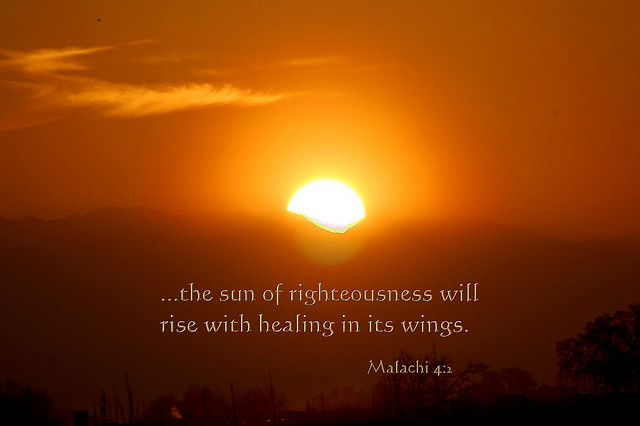
            And now we come to the end of the Hebrew Scriptures. There are other stories that didn’t make it into the regular canon, the agreed upon list of Bible books. There are events that happen after Malachi’s prophecies- the Chanukah story with the lamp oil that lasts for eight days is one such story. But here is a place of turning, a fork in the road, a split in the tree. At this place, we either continue to remain in Advent or we move on to Christmas. Malachi says, “But for you who revere my name the sun of righteousness shall rise, with healing in its wings. You shall go out leaping like calves from the stall. Lo, I will send you the prophet Elijah before the great and terrible day of the Lord comes.”
            For me, as much as I might wrestle with what it means to be Jewish in ancestry, I cannot remain in Advent. This is not the end of the written word of God for me. Somehow, through the Spirit, I have been brought to believe that the sun of righteousness has risen and that Son’s name is Jesus. I may have moments of doubt and of darkness, but I cannot dis-believe the experiences I have had in Christ. The encounters that I have had with Jesus in other people.  My understanding of the powerful reality that God was born onto the earth and knows fully what it means to human.
            Here at the end of Malachi, the branch of Christianity grows out the roots of the tree of Jesse, the Jewish roots of our faith. From this tree we receive our Savior. From this tree we receive the roots of baptism and of blessing bread and wine. From this tree, we receive the understanding of the cloud of witnesses of faithful people who encourage us onward on our journey. Until we are gathered around that manger in Bethlehem and share in Mary’s pondering and the shepherds’ rejoicing, we who believe in God are all Jews.
            But here we are as Christians, believers in Christ, standing at the Advent crossroad and there are two questions for us. The first is will Christ return today? There is still time. And if not, there is still tomorrow.
            The second question that we must ask at this intersection is, “What about God’s promises to Jews?” If we have been brought into faith through Jesus, but there remain some who received God’s promises- what happens to them? What happens to them?
            God happens to them. The oracle of Malachi begins, “’I have loved you’, says the Lord.” The book speaks of God’s election and how God will prepare God’s people to endure judgment and being made holy. Again and again, throughout Hebrew Scriptures, God goes the distance to uphold the promises that have been made between God and God’s people. God does not fail.
“I have loved you” is the banner of a God-created and God-given relationship.  God re-creates and sustains that relationship in the face of human struggle and failure. If no one can endure or stand in the day of the Lord’s appearance, then God will have to create and sustain that which can endure and stand. God will not fail.
            We are poised in a thin space between Advent and Christmas, a place where God meets creation, a place where God became creation. In this space we see backwards and forwards- history and future. It is only in this space that, just between waiting and birthing, we sit with the possibility and the mystery of what has been and what will be.
            There is a possibility that my ancestors might not have been killed and that I might still have become Christian. Who can say? But they were killed. Killed because of who they were and it is a great loss, but one that I cannot change. I do not forget them. I honor them by being honest in who I am and by holding fast to what I believe.
           
            And I believe in God’s work for the world in Jesus. I believe with Mary and Joseph, Abraham and Sarah, Joseph, Moses, David, Jeremiah, Josiah, Isaiah, Hosea, and Daniel in God’s promises from the beginning of creation. In God’s plans for hope and a future. In how God loves God’s people like a parent who lifts an infant to the cheek.
            God has not forgotten the promises made to my ancestors and yours. “I have loved you,” says the Lord. That love burns through all distinctions, all sins and all lies and leaves only what endures. God’s promises are all that can endure and, because of that covenant, God upholds those to whom life has been promised. Then. Now. Forever. God does not fail. 
Amen.