Category Archives: Jesus

Understanding Martha: We’re Doing it Wrong

Pentecost 9 (Year C)
21 July 2013
Genesis 18:1-10a; Luke 10:38-42

            With this cartoon in mind, I think that the common interpretation of this story might have been wrong for several hundred years. Each story in Scripture has three contexts, all of which we are relying on the Holy Spirit and God’s gift of reason to help us interpret. With today’s gospel reading, we have to determine what was happening when the actual event occurred, why the writer thought it was important to include over nearly fifty years later, and what God is saying to us today with regard to the story.
         When Jesus first came to Bethany and stayed with Martha and Mary, he already knows them. They are friends of his. Martha is apparently the older sister, since the house is listed as hers. Maybe there is some sibling rivalry between Mary and Martha (younger and older) or maybe Martha has always done most of the work. Regardless, Martha has begun the culturally appropriate tasks of preparing her home to host a guest (or several) and Mary is not helping. When Martha complains about her burden, Jesus tells her Mary has made a different choice.
         The implication of Jesus’ words is that what Mary has chosen is more important that what Martha has chosen. It doesn’t mean that Jesus doesn’t understand that dinner has to get made, but that Martha shouldn’t be consumed with what has to be done, but should instead focus on who she’s hosting. Having Jesus present means that the focus isn’t on what you can do for him, but what he does for you. Mary is learning from him, hearing his radical teaching,… she is actually paying attention to who their guest is, as opposed to what has to be done for a guest. Even when we hear this story this way, most of us still have a lot of sympathy for Martha and what it takes to get things done. We are able to understand, however briefly, what Jesus is saying about Mary.
         When Luke is writing sometime in the 70s A.D./C.E., the early church is struggling with what to say about the role of women. Are they able to sit and learn with men? Do they have the capacity? Is it appropriate? When Luke includes this story in that context, it is a rebuke to those who believe women are better suited to the tasks of hospitality at the edges of the early church, rather than the work of discipleship through learning (and maybe teaching!). Luke’s story makes the space for people to hear Jesus say that a woman learning is right and proper and even part of their duties as his followers. Luke understands the importance of hospitality and the work of the community, but it is not to be done solely by women to the exclusion of their ability to participate otherwise in the life of the community.
         When we hear that interpretation, we are a little more able to understand the meaning and the layers of the story. Furthermore, in that context, we are able to see how wrong later church interpretation has been around this story. How many years have Marthas- people who are on the go or active or who get things done- been denigrated instead of Marys- people who want to sit, perhaps let someone else do things, and who learn well in traditional classroom settings? How many women have felt frustrated and hurt by this story? How many women have been told that they can learn, but then they can’t teach? How many men feel frustrated by this as well, but left out because the parable mostly seems to be about women?
         And, in all this, what if we’ve been very, very, very wrong about what the parable means for us in our time? The following saints have their feast days in the coming week (among others): Macrina (early church monastic and teacher), Margaret of Antioch (martyr), Mary Magdalene, Bridget of Sweden (mystic), James the apostle, Elizabeth Cady Stanton, Amelia Bloomer, Sojourner Truth, and Harriet Tubman, Bach, Handel, and Henry Purcell. None of these were content with sitting, but all worked… all were active in their faith- even in doubt- to the glory of God.
         Every single one of those people probably related more to Martha of Bethany than to her sister, Mary. By venerating Mary over Martha all these years, the church has mistakenly promoted the idea that orthodoxy (right thinking/teaching) will always trump orthopraxy (right practice). Jesus never expected anyone to sit at his feet forever, but to learn and to go out into the world- knowing he’s with them!
         The gift of the Holy Spirit is not so we can continue to brood over Scripture, waiting and hoping for complete clarity. If we understand anything at all, it is that the love of Christ compels us to go out into the world and live- asking God to help and guide us. We are called to the hospitality of Martha, without her worry, knowing that we will be hosting Jesus everywhere we go. We will be encountered by Christ in the store and the school, in music and in art, in knitting and in running, in cooking and in shopping, in study and in action.
         The lives of the saints teach us that the church has been carried forward not merely by Marys, but primarily by Marthas. Marthas who have learned that Jesus is for them as well. Marthas who cannot be still, but learn on the go and on the move. Marthas who appreciate the call of hospitality, but also know whom they are hosting and Who is hosting them. Marthas who compose, teach, learn, make, and wait on the Lord.
         Mary and Martha of Bethany… we’ve been thinking about them all wrong. The grace of God is for both doers and thinkers, for teachers and students, for active learners and introspective ponderers. The grace of God is for all of them. For all of us. And so is the work of the kingdom. Amen. 

Lord’s Prayer: Fifth Petition

Forgive us our debts, as we forgive our debtors.
            The most frequent conversation I have around this petition is which word people prefer: some like trespasses, some like sins, and some like debts. Let’s think about them for a minute.
            Trespass… a trespass is occupying a space that one does not have the right to be. A person who abuses another person physically or emotionally is clearly trespassing… using and misusing space that is not theirs.
            Sin… a sin is an attempt at power, an effort to control a situation or another person. Sinning might happen through trying to manipulate with words or power or it might be a sneaky way of cutting corners or even gossiping. A shared conversation about a person who is not in the room, which is not positive or uplifting, is about feeling more powerful than them in the moment. That’s an example of sin.
            The language of debts and debtors is clearly about a gap in a relationship. One person owes the other person something or a group owes another group. It might be reparations for past actions, it might be financial, or it might be an effort to make up for a failure to act. A community’s efforts to exclude a certain group of people or a city’s neglect of certain areas or locations might be considered establishing a debt.
            So those are examples of how sins, trespasses, and debts works between people. How do those things work between people and God? What are examples of how we trespass, sin, or are indebted to God?
            Trespass: How do we occupy a space that only God has a right to be? Where to we trample in a space that should belong to God?
            Sin: What are our attempts at power that should belong to God? How do we attempt to usurp authority that should only belong to God?
            Debts: What do we owe God? What debt is there between God and us that we cannot cover?
            When we talk about forgiveness, we tend to either discuss how grateful we are for God’s forgiveness or we talk about how other people need to forgive or what we might not be able to forgive. We rarely talk about how hard it is to actually forgive someone. We rarely talk about the effects of not forgiving. We hardly mention the mental and emotional and physical toll of holding onto how we have been trespassed, sinned against, and the debts that others have incurred.
           
            What can sin do? Sin can affect our self-perception. It can make us feel ashamed and insecure. We feel uncertain. We are assured of God’s love, but our ability to experience it seems dampened and frustrated.
            Sin builds barriers. Even if we are in a safe place, holding on to the sins that have been committed to us keeps us from being able to fully engage with and experience relationships with other people around us. We cannot trust them- because if we do… they might hurt us in the same way.
            Sin makes us feel weak. When we are angry, it’s not actually a powerful feeling. We feel frustrated and powerless. We feel ineffective and hurt. We might like a good rant or vent, but ultimately, as long as we focus on what’s been done to us, we have no power. In fact, we are giving the power to the person or group that has hurt us.
            Forgiveness, on the other hand, centers us in who God is, breaks down barriers, and empowers. When God forgives, it is the essence of who God is. God’s self is revealed to be merciful and loving. When God forgives, barrier- real and perceived, come down. We are reminded that nothing can come between God and God’s love for all creation through Jesus Christ. That love is made real through grace and through the Spirit- gifts and manifestations of forgiveness.
            God is in control and forgiveness is the revelation of that control. God is not momentarily distracted by anger or revenge. God laments, but brings things around to growth and renewal through forgiving sins, trespasses, and debts. Our attempts at control, our efforts to play God, the obligations we cannot cover… God’s forgiveness heals these things.
            When we forgive, healing occurs as well. We can be centered in who God has made us to be. We are able to be in relationship with others. You feel empowered. If I don’t forgive the person who hurts me… they can continue to hurt me. They have the power, even if they are miles away… by not forgiving them… the trespass or sin or debt… I am controlled by an event and a person who is not myself and is not my God. I have no freedom. I am managed by something outside myself… and that spirals out quickly, as most of us know.
            Forgiveness is hard, but if we don’t do it… if we don’t actually do the work of letting go, of mending where possible, of distancing if necessary, of regaining our center in Christ, of being led by the Holy Spirit instead of a spirit of anger or revenge or victimization… if we don’t do the work of forgiveness, how can we truly begin to trust and rejoice in God’s forgiveness of our sins? If we are holding onto to slights and blows, historical sins and anticipated future trespasses… how can we faithfully live in the hope that God can bring good out of all things. If we do not do the work of forgiveness, what is the framework we have for doing anything else that God has called us to do?
            Frederick Buechner, a Presbyterian pastor and theologian, said:

Of the Seven Deadly Sins, anger is possibly the most fun. To lick your wounds, to smack your lips over grievances long past, to roll over your tongue the prospect of bitter confrontations still to come, to savor to the last toothsome morsel both the pain you are given and the pain you are giving back–in many ways it is a feast fit for a king.The chief drawback is that what you are wolfing down is yourself.The skeleton at the feast is you.[1]

            There is a feast to which we are called… not just invited, but called… a feast that is the food of forgiveness of ourselves and others. To taste of that feast is to taste of God… not a foretaste of the feast to come… but of meal that already is… juicy, abundant, sweet, filling, comforting, and nourishing… forgiveness.
Amen.


[1] Frederick Buechner, Wishful Thinking: A Theological ABC (New York: Harper & Row, 1973), 2.

Washed and Fed for the World

Easter 4 (Narrative Lectionary, Year C)
21 April 2013
Acts 8:26-39
The Holy Spirit does not hold to geographic boundaries. The Spirit does not hold to racial lines or ethnic markers. The Spirit does not detour to avoid the people we’d prefer not to see, not to hear, not to sit beside, or have included in our gathering. In the passage from Acts 8, that person is the Ethiopian eunuch. A eunuch is a man who does not have functioning testicles- either because they did not develop or because he has been maimed. A eunuch’s ability to reproduce has either withered on the vine or been pruned.
A eunuch is still a Jew, but may have been excluded from the assembly. Thus, for the purposes of temple life and worship, a eunuch is a man who is essentially a woman. And women don’t get to offer sacrifices. They don’t have standing. One’s blessings come through one’s husband and one’s ability to be receptive to his offerings, so to speak. (This is just awkward for everyone, but this eunuch is important. So stay with me.) A eunuch cannot fulfill the “actions of a man”(so to speak), so he does not get the privileges of being a man… including gathering in the assembly of the faithful. (Deut. 23:1)
Now, in your reading of Isaiah, you may recall a little song about eunuchs with a different tune. The prophet writes: Let no foreigner who is bound to the LORD say, “The LORD will surely exclude me from his people.” And let no eunuch complain,“ I am only a dry tree.” The prophet goes on to say that God will give a memorial better than children to faithful eunuchs, to faithful people. It might have served for God to mention that in one or two other places, since repetition is one of the main ways we learn, but sometimes I think God says to us, “How many times do I have to tell you this stuff?” (Isaiah 56:3)
            The Ethiopian eunuch is a servant in the queen’s court, chosen for that valued position because of his sexual safety. He will not overthrow the government because he cannot have children to continue his line, so (presumably) it would not be worth it. He obviously understands himself to be Jewish because he has traveled to Jerusalem for worship, for worship in the community that may not receive him. He goes to be present with people who are, mostly, of much lower social status than he is as a royal servant. The man has his own chariot and copies of Scripture. Even Peter doesn’t have that!
            Now consider this: how badly would you have to want to worship to travel hundreds of miles to go to a place that wouldn’t receive you to worship a God whose people have conspired to exclude you from the fullness of community? How much would you have to crave sacramental life to be enriched by just being close to it, much less participating? How much would you have to desire to know more about God’s salvation, which might not include you, to be reading a scroll of Isaiah on a bumpy chariot ride back to your home country? Does anyone here have that much desire? Is anyone here willing to allow the Spirit to be that powerful in his or her lives?
            And Philip appears- running alongside the chariot. Philip, who has been assigned to be a part of the food distribution in the Jerusalem meeting houses, is now speaking to someone who might as well be from the ends of the earth. Philip says, “Do you know what you’re reading?” and then goes on Isaiah’s servant song in the light of Jesus Christ. When Isaiah wrote it, it was understood in to apply to God’s servant Israel and Israel’s people. The Spirit’s interpretive expansion helped the early followers of Jesus to understand him (and their own call) as the servant who suffers for the sake of God’s work in the world.
            Moved by this interpretation, moved by this Bible study, the Ethiopian eunuch stops the chariot and says, “Here is water. What is to prevent me from being baptized?” He is so transformed by hearing Philip’s discourse on Jesus that he cannot wait to be included in the community through God’s promise in water and word. Baptism will change his allegiance, and his alliances, but it will be worth it because he will be drawn, clearly, into the story of God that the Spirit has been whispering in his ear.
            Does anyone here desire baptism that much? Does anyone long to revisit their baptism? Have you held yourself back from just splashing your face in the font- to remember, to clear your vision, to wake you up to your life reorientation in Christ? We trust that God loves and uses people who are not baptized, but in the Christian community it is the marker of beginning and belonging. It is a moment we can revisit again and again- a moment when the salvation we work out with fear and trembling became tangible. We are supposed to crave this moment- remembering it and desiring it for all around us.
Along with holy communion, the baptismal font give us a different lens for seeing ourselves, the people around us, and the people who we encounter outside of these doors- the same expanding circles of Spirit-inclusion that are in the Acts reading (the people in Jerusalem, the people in Judea, the people in Samaria, the people in Ethiopia and beyond). These sacraments, two places where we are assured of Christ’s presence, make us citizens in the kingdom of God with work to do right now. Part of that work is sharing the message that is implicit in these acts of communal washing and eating together- the message that all people are children of God.
When the world says, “racial minority”, we say “child of God.”
When the world says, “sexually suspect”, we say “child of God.”
When the world says, “illegal immigrant”, we say “child of God.”
When the world says, “homeless by choice”, we say “child of God.”
When the world says, “Palestinian or Israeli”, we say “child of God.”
When the world says, “mentally ill”, we say “child of God.”
When the world says, “terrorist”, we say “child of God.”
            The naming of our people, our friends and our enemies, as children of God puts us in the position to do the work of Christ. Work of feeding. Work of peace-making. Work of creating equality. Work of ensuring justice. The work of making God’s presence real by revealing that presence through the actions of God’s people. I am not saying we make God real through our right actions. I am saying that who God is becomes understandable through the clear actions of the people who call themselves people of God.
            In a world full of terror, natural disasters, and preventable human tragedies, there are people who crave good news. There are people who need advocates, though they may be in the wrong. There are people who are certain that they will never belong to the community of God- but they read the story anyway. In a world with this kind of longing, how do you account for the hope that is within you? Do we dare to cheapen God’s grace by assuming that the font and the table exist merely to assure us of God’s affection for us?
            These are dangerous places. They change the way we see the world and the way we see all children of God. We should approach these places with trembling- longing for the truth of their promises and afraid of what faithful participation will lead us into doing?
            The Holy Spirit does not hold to geographic boundaries. The Spirit does not hold to racial lines or ethnic markers. The Spirit does not detour to avoid the people we’d prefer not to see, not to hear, not to sit beside, or have included in our gathering.  And the Spirit does not, cannot, will not, pass by you
Amen.

That’s Not An Answer

Luke 13:1-9, 31-35
             Why do bad things happen to good people? Conversely, why do good things happen to people who seem evil? Why should a murderer have joy? Why should a gracious person experience deep grief? This is the question Jesus is confronted with in today’s reading. People want to know why God allowed the faithful Galileans to be killed.
            Jesus responds by asking if the people who were killed in the accidental falling of a tower were worse sinners and deserved to die. The questions that are being raised go all the way back to Job and beyond. We want to know why there is suffering in the world. We want to know why it comes to us and to those we love and to those we deem innocent.
            So, Jesus, ever helpful, answers these deep, heartfelt questions with a parable (everyone’s favorite). He speaks of a fig tree that is not producing fruit and the desire of the owner of the garden to cut it down, presumably to make space for a tree that will produce. The gardener gets the life of the tree extended by promising to rededicate effort to its growth for one more year.
            It is tempting to make a metaphor or an allegory out of this parable. To say that we are the tree(s), God is the owner, and Jesus is the gardener- bargaining for more time for us to produce fruit. However, that scenario pits the Father and the Son against each other, instead of seeing them work together out of love for all creation.
            Jesus does not say why bad things happen; he skips right over that question. We want the world to make sense- for bad things to happen to “bad” people or for bad things to happen as a direct correlation to bad actions. It is not so. God is in the center of all events, but not the immediate cause of all that happens. God is present in all pain and suffering, but not at the root of these things. Human freedom and freedom in the created order can, unfortunately, lead to pain and sadness. (What is freedom in the created order? It means that some things happen like the growth of cancer cells or natural disasters or freak accidents.)

            Knowing that God is present in all things, but not the cause of all situations, Jesus does not answer the questions that we ask, but instead gives us the direction and information that we need to know and to remember. Through the parable of the fig tree, Jesus reminds us that pain will happen to everyone. Everyone will experience loss. Everyone will make a bad decision and experience consequences, sometimes negative and sometimes not. Everyone will (most likely) die. And everyone will experience God’s judgment.
            Jesus is reminding his hearers- then and now- that there are things we do something about and things we cannot. For the fig tree, and for us, fruitlessness is not inevitable. Through the Holy Spirit, God is constantly shaping us… using the events that happen to us and around us to bring forth good things for our neighbors, our communities, our families, and… even for ourselves.
            God is with us as we weather life’s experiences, but then helps us to grow into the producers that we have the potential to be. When we reflect on God’s grace, then, we have to ask ourselves if and how we are producing love, joy, peace, patience, kindness, goodness, faithfulness, gentleness, and self-control. These things grow in us, by God’s help, and we are called to use them to mend the wounds in the world that are caused by bad choices, by poor use of freedom, by accidents, by the forces that oppose God and God’s good work.
            Instead of clearing up the mysteries of the ages, Jesus tells us that we are the answer to someone’s question. We are the answer to someone’s pain, to someone else’s inability to make ends meet, someone’s call for help, to the needs for justice, peace, and healing. Jesus reminds his disciples, his hearers, and those who would deride him that we can still produce this fruit without having all our questions answered.
            This is what it means to live in faith and to live together faithfully. Our life of faith is living together and living in the world until the time when we have all the answers, but the questions no longer matter. We are not brought together, we are not given faith, we are not believing for the answers. We are together, granted faith, and believing with the questions.
            Which does mean that we may become exasperated, on occasion with Jesus, with God, with the Spirit. We may yell. We may rend our clothing. But the difference between living in faith with doubt and not believing is revealed at the end of today’s reading. We can be with Herod, with the religious officials, with the people who demand answers or refuse reason, with those who reject Jesus. Or we can stand with Jesus, with the One who Saves, and say that we do not know all that we will know, but we know enough now, we trust enough now… to continue forward. We can say that we have received enough grace to sustain us into the next step. We can share with one another enough confidence that God is continuing to shape us, feed us, and nurture us into the producers of the fruits of the Spirit that the world so desperately needs.
            Jesus reminds us that, on this side of heaven, pain and death are going to happen. Judgment, God’s decisions toward us, is also inevitable. However, these things- separation, loss, and death- do not mean division from God. And they most assuredly do not mean inevitable unfruitfulness. The good news of God in Jesus the Christ is that God continues to use us for good, whether we know it or not. The world is changed through each of us, for Christ’s own sake. And we are gifted with the opportunities to be participants in God’s grace and creativity. We become co-workers and co-creators through the power of the Spirit.
            The Lenten season reminds us that the time to join with Jesus is now. We do so, invited by the grace we have already known. The promise of God in Christ to continue working in us so that we might bear fruit is the deepest measure of God’s grace. And while that grace does not answer all our questions, it helps us to live with our questions. The consolation of today’s reading is that we can live with questions and still live in faith.  

Born that We No More May Die

I’m having trouble sleeping these days. Part of it is the late stage of being pregnant, but the other part is the pictures that keep running through my mind.
Not a picture of my friend
The first is picture of a friend of mine, her significant other and their baby, a baby who was stillborn last week, just before full-term. In the picture, she is clutching the baby, wrapped up, close to her chest and her SO is leaned over them both, his head touching hers and his eyes on the baby. It is a nativity to behold. 
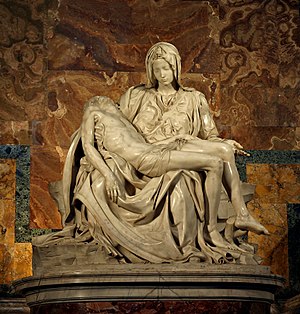
The second image is the Pietà, Michaelangelo’s to be specific. I keep thinking of this image in connection with the violent deaths of the children of Sandy Hook, Connecticut. It is likely that most of those parents were not able to cradle the bodies of their babies- stopped from doing so because of the cause of death and the condition of the bodies. Thus, I think of that image of Mary cradling the grown Jesus and remembering in her mind how she held him so many times before. I know those parents are remembering every moment they held their children. The other thoughts that are probably running through their minds are too hard for me to imagine. Not impossible to imagine, but too hard for me to consider and still let go of my own toddler and refuse to live in fear.
These images are not only interfering with my sleep, but they are marching into the forefront of my mind as I try to prepare for Christmas. One of the things that I wrestle with all the time, theologically and personally, is the connection between Christmas and Easter. More specifically, the connection between Christmas and Good Friday. I do not accept that Jesus was born, destined for the cross. I am not resigned to the idea that betrayal and crucifixion were inevitable. My faith is anchored, beyond the veil, in the trust that God is bigger than all things, was revealing that power before Jesus, and that the Messiah came into the world to be the clear sign of that power and a clear revelation of God’s expectations of creation.
Death, violent or otherwise, was never a part of God’s intentions for creation. With our scientific minds (and I love science), we understand a cycle of birth, decay, and death. Yet, our faith teaches that this is not preordained. We are not born to die. We are born for life. We are gifted with faith for abundant life. Somehow, in some way, the Christmas story is the heart of this truth- that God came into the world in an expected way, so that we might believe and live. When death tries to trump that truth, life wins. Love wins. Joseph does not stone Mary. The childhood illnesses that could have claimed Jesus’ life do not succeed. The devil’s temptations do not stand. The threats of detractors do not hold water. The cross and tomb are not the final word. Incarnation leads to not to crucifixion, but to resurrection. Life wins.
In this season of grieving, personal and public, for my friends, for people I do not know, for our world, I do believe that life wins. The story of God’s entrance into the world as one of us is not the beginning of that theme, but the powerful plot twist that no one expected and that surprises us still.
Every death, every stillbirth, every child, every 110-year-old, is a death that is too soon when it precedes God’s final renewal of heaven and earth. Yet these deaths are not the final word. That Word is God’s. The Word that has always been with God, indeed the Word that is God, is life. Life.
There comes a point where I don’t have anything else to say and so I have to stop talking. The grief is too real. The pain is too sharp. The explanations are weak or non-existent.
And still hope flickers.
And still we say, “Come, Lord Jesus.”
And still Life shines through the darkness. And the darkness cannot overcome it.

A Prayer for Suicide Prevention

On World Suicide Prevention Day: 

God of all space and time,
There is darkness that exists which feels impenetrable.
Darkness that seems to overcome all light.
Darkness which swallows the will to live,
The desire to go on,
The possibility of grace,
The existence of hope.
There is darkness in this world, in some hearts, in some minds…
Darkness which makes a person feel separated from You and from Love.
You have created a light which no darkness can overcome,
But sometimes the darkness seems too great.
On this day, be with those who feel surrounded by darkness…
Who are afraid to speak of their plans,
Who are pondering in their hearts what seems the only end to their pain.
Be with those who have reached out, but not been believed.
Be with people who are left behind, who have questions, who blame themselves.
Send your Spirit of consolation and hope into the world on this day,
Turn up the Light of Love- burnish and banish the darkness,
Strengthen all to speak, to listen, to hold, and to share.
Holy God, we ask for the kind of peace- in hearts, minds, and all creation- that can only come from you.
Gracious God, hear our prayer.
And in your mercy, answer us.

Cross-posted at RevGalPrayerPals

Between Jesus and Me

In this week’s coverage of the scandalous words of Representative Todd Akin of Missouri (see: Akin, “legitimate rape”, “shut that down”), his frantic retraction, and the push from other Republicans for him to step down from his race (not because he was wrong, but because he was public)… I have run through a gamut of emotions.

I have revisited how I felt when assaulted by men who did not heed my words to stop and how I felt for friends who experienced far worse assaults than I did.

I have pondered what I will say to the child I currently carry in my womb regarding rights, women, and America.

I have been angry at the attempts to discuss abortion instead of the very real rights and bodies of women- women who are currently alive, women who (theoretically) have constitutional rights, women who are not magical vessels for pedestals or damnation.

All of these emotions swirled in my mind until I had this exchange with myself, in my head, while driving:

I’m so angry about this. I want to write about it, but I don’t know how. 
What specifically are you angry about? 
Being made to feel helpless. 
How will you expand upon that? 
I would discuss previous times this has happened. 
Boring. 
Well, I could… talk about it makes me feel depressed and vengeful when men tell me what I can and can’t do with my body.
To whom does your body belong? 
To me… 
What about R (your husband)? 
No, except through my consent and our mutuality. My body belongs to me. 
What about your children? 
See above re: husband. 
What about to Christ- think of your baptism? 
Ugh. Now Jesus is just another man, laying a claim on my body. 

WAIT A MINUTE.

This is where I nearly wrecked my car. I could not believe the sentence about Jesus ran through my head- exactly like that. “Now Jesus is just another man, laying a claim on my body.” I pulled into the parking lot at work and sat, attempting not to hyperventilate, and thought about that sentence- several times.

The thing is… I do believe that my baptism into Christ’s death and resurrection does have a claim on my body.

AND NOW I AM RESENTFUL OF ANYONE WHO WOULD DIMINISH THAT RELATIONSHIP BY ATTEMPTING TO PLAY GOD WITH MY PERSON.

That’s right, Akin and other supporters of fetal personhood over maternal/female personhood, by attempting to abort my status as a person via amendments and rhetoric, you nearly came between Jesus and me.

It seems that you’d like to think you’re God- knowing the ins and outs of human bodies and minds, but it ain’t necessarily so. In fact, it necessarily ain’t so.

You are not God.

You are not God. I am not God. You are not me. You are not a mediator in the relationship between God and me. You do not get to claim that your work creates me, saves me, sanctifies me, redeems me, or frees me.

You don’t own me. Or any part of me.

What you have not made, what you have not saved, what you are not making whole… you may not claim. You cannot claim. You will not claim.

Jesus appreciates that women can think. I refer you to his conversations with the Canaanite/Syro-Phoenician woman (Matthew 15, Mark 7), in which Jesus yields to the reasoned argumentation of a woman who pleads for the healing of her child.

Jesus believes that women have strength and that women who do not have or may not have children are worthy participants in community life. I refer you to Mark 5, in which a girl who is not yet bearing children and a woman who may be past child-bearing are both healed and restored to their families/communities.

Jesus understands that social situations may lead a woman to make poor choices or to feel trapped by circumstance. Thus, Jesus tells the woman caught in the act of adultery (brought forth without her male partner in John 8) to go and sin no more- granting her the personhood to be bigger and resistant to the male forces that would shape her world. Jesus gives hope to the Samaritan woman at the well, in talking with her as a person of intellectual being, capable of seeing her way to new life, new choices, and renewed hope.

Jesus affirms that women can handle and do handle many types of jobs and tasks. Sometimes they sit and listen, like Mary in Luke 10, to learn and to be part of discussion. Sometimes, like Martha in the same story, women play the role of host- making guests comfortable and providing a gracious space.

Jesus inspires the gospel writers to understand that women are an integral part of the salvific act of resurrection and sharing the good news. All four gospels have women playing significant roles in the spread of the resurrection story. Not as gossipers, but as evangelists- sharing truth with all whom they encounter.

As I consider this Jesus, this Jesus whom I claim to follow, this Jesus in whom I am said to be clothed, this Jesus whose story still brings hope to me and many… this Jesus is a man whom I am willing to allow to lay claim to my body.

Because He sees it.

He knows it.

He saves and renews it.

Furthermore, if and when there is a time when I feel separated from God, because of what has happened to me, because of what I have done, because of choices or actions… I can trust that Jesus will be with me. He will not abandon me. I am and remain a person to (and through) Christ.

But you, Akin and others, … you do not see me. You do not know me. You have no claim on me. And you have dared to attempt to come between me and God, by way of my uterus, my vagina, and my identity as a woman.

Do not offer your words regarding my potential child or other fetal life. Do not offer hasty retractions- apologies for having been caught, not for your actions. Do not wring your hands about loss of life, when you are so clearly willing to dismiss my life as being less than.

There is one man who can make claims upon my body. That man also happens to be God.

And you, your ilk, your fellow travelers, your co-conspirators…
You. Are. Not. That. Man.

Good reading from this week for includes:

Martha Spong on Old Husbands’ Tales
Julie Craig on To Be a Girl, In this World

Why are you Eating? (Sermon 8/12)

1 Kings 19:4-8; Ephesians 4:25-5:2; John 6:35, 41-51
            My best friend and I are what you might call “eating friends”. She lives in Pennsylvania, but when we know we are going to get together- we immediately start making a list of restaurants in the area in which we will be. We make choices about which days to eat the big breakfast, lunch, OR dinner. We also have foods we both buy or bring, only on trips, because they are our vacation foods and because we enjoy eating them together. For us, the experience of eating together is a fun part of our relationship and our memories of things we have done together. (For the record, we do things other than eat. I think.)
            What are some of the reasons we eat? We eat for pleasure. We eat because it’s time. We eat because we’re hungry. Anyone who has worked at losing weight knows that it’s easy to fall into the trap of eating because you’re lonely, bored, or sad. We eat when we’re celebrating and when we’re grieving. But when it comes down to it, we eat to stay alive. We eat because without eating, we cannot function.
            So, we understand that while we often have many, sometimes overlapping reasons for eating, there is one basic reason why we eat- to stay alive. So here’s my follow-up question to that: why do we trust in Jesus? What are some of the reasons why we put our faith in Jesus, a Jewish man of two centuries ago, who some say was the Messiah of God?
            We may have faith in Jesus the Christ because of some experience- internal or external. We may trust in our tradition and the tradition of our families, a part of which is belief in Jesus. We may still be questioning in our hearts, but feel that Jesus is the best bet for an anchor in a rocky sea. We may be seeking our best life now and a great return for bread cast out upon the waters. Of all these reasons, when it comes down to it, why do we believe in Jesus?
            We want eternal life.
We want eternal life. We want to stay alive. We want heaven. We want the reunion with those who have gone before us. In a way that is beyond our imagination, we want the banquet and the rejoicing and the tree of life and city beyond imagination and the parade of nations and the drying of all tears and abounding joy. We eat to stay alive and, often, (more often than not) we look to Jesus as our ticket to doing the exact same thing. We treat the bread of life like a ticket to heaven. We look at the table as a foretaste of the feast to come and, when it doesn’t turn to ashes in our mouths, we see it as insurance and assurance that we will be at that feast.
            But the life of faith is so much more than that. More importantly, Jesus is so much more than a ticket to ride or insurance toward immortality. In today’s readings, God’s story unfolds to help us understand that bread of heaven (and bread from heaven) is for the life of the world, eternally. Which is wholly different than being for eternal life.
            When Elijah is fleeing from Jezebel (the actions preceding today’s excerpt), he travels to the end of the known world and then goes one more day- just to be on the safe side. He’s ready to die. He wants to die. God sends a messenger to Elijah, bringing him food and telling him to eat. Why does Elijah  need to eat? Because his work is not done. He has to eat for life- his own life and for the life of God’s word in the world. As a prophet, his work of speaking truth, of revealing God’s power, of bringing hope to God’s people is not yet over. Thus he receives bread for the journey because it is not time for him to die. Elijah receives bread from heaven, the bread of life, for his life here on earth (and for the other lives whom he encounters as well).
            When the crowds gather around Jesus, they grumble about what he has to say- even though he’s fed them, healed them, and generally amazed them. Still, they know his people, they’ve seen his followers, they know he sleeps and has physical needs. What’s this about heaven? Yet, he tells them the One who has come from God is the bread of life. The bread of life comes for the life of the world. Jesus explains that the bread of life feeds us for eternal life and for life right now.
            Like the crowds, we do not always like that “life right now” part. What does that look like? The writer of Ephesians says it is a life of uplifting speech (no slander, no backbiting), a life of kindness and gentleness, a life of forgiveness and imitation of Christ. Would this be the same Christ who gave up his life for the sake of the world? Are we supposed to imitate that Christ?
            That’s where our experience of Jesus gets tough- where we’d rather think about eternal life, than what’s happening right here and now. When the imitation of Christ means loving our enemies, not the ones far way, but the ones next to us, the ones who we see in the grocery store, at the family reunion, at the communion rail… When the imitation of Christ means trying something new and uncertain… When the imitation of Christ means admitting that you’re not, that we’re not in control… When the imitation of Christ means living by faith, and faith alone… all of that makes the bread of life seem a little dry and to catch in our throats.
            Eternal life, whatever it is like, will be fantastic. But we are here now. The bread of life… the life, death, and resurrection of Jesus Christ that we experience in communion, in Word, and in community… this bread of life is food for this journey, nourishment so that we can live, sustenance so that we can live right now, provisions so that we can live right now for the sake of the world. Fuel for the imitation of Christ.
            Our faith is not a retirement plan. It is not a moral system that we use for guidance on occasion. We have been given the gift of faith, so that the world might know the joy of salvation, the salvation that has come through Jesus the Christ. We have been baptized into God’s history for the life of the world, the life of the world right now. We are fed- as a community and as individuals- in communion and in prayer- through the power of the Holy Spirit. We are fed so that we can stay alive. Alive in faith. Alive in Christ. Alive to do the work to which we have been called and to which we are being led.
            We are eating friends, food friends, bread sharers. Being fed from heaven right now- for Christ’s sake and for the sake of the world.
Amen. 

My Hour with Thomas

On the second Sunday in Easter, our church observed Bright Sunday (or Holy Humor Sunday)- extending our resurrection celebration. In addition to kazoos, jokes, and laughter, we had an interview with the apostle, Thomas.

Good morning, everyone, and thank you for joining me today on Theology in the Morning with…Pastor Julia! We’ll have a special food giveaway later this hour, but right now let’s meet our special guest. You may know him as the Eeyore of the disciples or the famous doubter, but let’s welcome… Thomas the Apostle!
Thank you so much for coming today. How do I address you? None of you apostles seemed to come with a last name.
Thomas is fine.
Thank you for that. Well, let’s get to it. I think the first question we’d all like an answer to is: Where were you when Jesus showed up that first time?
You know, Pastor Julia. If I’m willing to do the time and space travel it takes to come here and answer questions for you and these other fine folks today, I’d think you’d come up with a better first question. Everyone wants to know and what are you going to say if I tell you that it was my turn to empty the dirt pot (if I may be subtle)… or that I had gone out to get more bread or wine… or that it was just pretty rank in that room with 10 other scared men. Whatever I tell you is going to disappoint you, so all you need to know is that I wasn’t there. Can you live with that?
Wow! I must say, Thomas, I did not expect you to be so frank. I suppose…
It’s like this. I loved Jesus, still do. I mean, I see Him every day now, so can’t really complain. But three years of parables… that can make a man crazy. I wanted some plain talk and I don’t mind telling you that when he did get around to telling it like it was, it was hard to swallow. Since the resurrection, my goal is to tell the truth- straight up. No parables, no metaphors. Also, I don’t spend time on what doesn’t matter. Where I was doesn’t matter in this interview.
Well, thank you for your frankness. Moving on then, what did you think when the others told you that Jesus had been in the room with them?
Honestly, I thought they had all gone crazy together. We were so keyed up, scared, and jittery. It seemed possible that they had a group vision or something. What happened with Judas hit us all pretty hard. Not just because he had traveled with us and been a friend, we thought, but also because most of us understood that anyone of us could have easily done what he did. Maybe not in the same way or for the same reasons, but still… Anyway, when I came back and everyone was tripping over themselves to tell me about Jesus’ return. It was just too much. I’m sure you’ll want to list out the history of Thomas the doubter, but can anyone here tell me that you wouldn’t have said the same thing in the same circumstances?
I’m pretty sure I can’t say that I would have been different. So, what was it like when you did see Jesus?
What do you think it was like? I wanted to throw up and throw myself at his feet, all at the same time. Even after the crucifixion, even when we weren’t entirely sure what to believe about where his body was, we still knew the truth of what we had witnessed when we traveled with him. I still can hear Lazarus’ voice lifting out of that tomb. I can still see the stunned expression of blind men seeing for the first time, of people who walked, of people who heard and received a word of forgiveness. So, even when we as disciples didn’t know what to think… we had these powerful experiences to chew over with one another. Those experiences formed our understanding of Jesus and, in that upper room, none of us were willing to admit to thinking we might have been wrong, even though we all had that thought. And then he was there!
If I may interrupt, how did he come through that wall?
You may not interrupt. That’s not important to the story. However he did it, it was done! And there he was and I was terrified and thrilled and ashamed and gratified and… Even now, it’s too overwhelming to think. Suddenly, when he appeared, everything I knew came into place. The last rock in a wall. The opening move of a game. It was like the most powerful end and at the same time the most astounding beginning of any story, song, or even battle that you might see. Suddenly, I knew that this was my Rabbi, my teacher, and my God, THE God… right there. When he offered for me to touch him, I couldn’t dare. Moses only saw God’s backside and lived to tell about it. What would happen to lowly Thomas who asked for proof, got it, and then pressed his luck?
That’s such an amazing story, Thomas. We’re all curious about what you did next, but this is supposed to be a light-hearted Sunday. We’ve all been enjoying laughing and your story seems so heavy.
It’s not that heavy when you actually think about it. You don’t think there’s humor in it? Believe me, I laugh every time I consider that Jesus didn’t punish me for asking a question. He could have said, “Impudent wretch! Did you ever listen when I was talking?” But he was as kind and generous in resurrection as he ever been.
And, you, you dare to think that this is not a story of joy? What kind of interpreter of scripture are you? There are three gifts in that story and youget two of them. Jesus gives peace to all disciples, he gives proof to me, and he blesses those who won’t quite have the same experience I did. You get peace! AND a blessing! What more do you want?
Well, proof might be nice.
Proof! Ha! Proof is like the buzz of those kazoos that you were playing earlier. It’s great while it lasts, but then it grates on you. It takes your breath away and then leaves you empty of mystery. Proof gives you a tangible experience for a while, but it doesn’t allow for height and depth and breadth and range.
If you have proof, will you have peace? Will your questions end or will they increase? If you received proof, would you relinquish your blessing? The comfort of the Spirit? The experiences you have resurrection in communion and in community and in creation?
I don’t know, but doubting seems so…
What is doubt? It’s like proof, it comes and it goes. If you banish one question, another will arise. Your faith, God’s gift of faith to you, is not the absence of doubt. It’s action in spite of doubt. It’s moving forward, even while questioning. It’s closing a door, but knowing that Jesus just might come through the wall.  You’re learning as you go, just like I was. Just like Peter. Just like Andrew, James, John, and all the women who helped us along the way. But you have written accounts to help your faith. You have the promise and the presence of the Spirit. The resurrection has always been your reality.
And you have my story, my little story that you try to make big in all the wrong ways. What was I doing? How did he come through the wall? How about this?!? Jesus knew my questions, brought me the answer of his own body, did not strike me dead on the spot, and offered a blessing to everyone who doesn’t get what I got. How about that to make your Sunday bright? And your tomorrow? And the day after that?
Wow, Thomas, I don’t know how to thank you for coming in today. You’ve been an amazing guest. I’d like to talk to you more after the break about your life after the upper room, but first we have some messages from our sponsors. Folks, I just want to repeat something Thomas said: Your faith, God’s gift of faith to you, is not the absence of doubt. It’s action in spite of doubt. It’s moving forward, even while questioning. It’s closing a door, but knowing that Jesus just might come through the wall.

Amen