A Sermon on Hosea 6:1-6, 11:1-9
Who knows anything about Hosea (the book or the prophet)?
Hosea is a prophet in the Northern Kingdom, probably just a little more than seven hundred years before Jesus is born. The Northern Kingdom of Israel, remember, has more money, more tribes and more power, but it doesn’t have the Davidic line (the line of kings descending from David). During the time of Hosea’s prophecies, the Assyrians will come and conquer the Northern Kingdom and carry them off into exile.
One of the reasons we don’t get a whole lot of Hosea is because the book can cause a lot of indigestion. There are two main metaphors in the book: a husband/wife metaphor and a parent/child metaphor.
In that first one, the husband/wife metaphor, God is the faithful husband and Israel is the unfaithful wife, deserving of punishment- possibly death. While we can understand a metaphor of idolatry as adultery, we don’t always think about the fact that in ancient Israel, there wasn’t really any such thing as an unfaithful husband. Men controlled money, land, power and women’s lives. When we try to bring the metaphor forward into modern times, the language of faithfulness and unfaithfulness stands, but not the husband and wife language, which can get in the way of what prophet is using the metaphor to express.
How were the Israelites unfaithful? They didn’t honor their covenant with God, the God who had brought them out of Egypt and sustained them. By the time of Hosea, Israel had little religious cults that worshipped the Caananite ba’als. A significant portion of this worship involved fertility ceremonies- sacrifices, worship and sexual activity to ensure the fertility of the land, especially rain, safe planting and plentiful harvest.
We know that the Israelites should have trusted God to provide these things, but in an arid, desert climate- we can have a little sympathy for people who tried to hedge their bets so that they could have enough food.
After all, how many of us have ever said, “Knock on wood” or thrown some salt over our shoulder? Did we really think that would do anything? Then why do we do it? It’s something we’ve heard about and we think it can’t hurt to do it. Technically, if we trust God for and in all things, we don’t need little rituals like that. Furthermore, we shouldn’tperform little rituals like that. Same for the Israelites, but on a bigger scale.
Before I talk about the parent/child metaphor, I’d like to ask how many of you are afraid of God? I know we talk a strong and long line about God’s grace and mercy, but in the end how many of us still worry about God’s anger?
Here’s the thing, though. If we were going to be afraid of God, we shouldn’t be afraid of God because of who God is. We should be afraid because of who we are. We are to fear, love and trust God, but all of those emotions stem from knowledge that goes two ways… knowledge of God and knowledge of ourselves.
Lots of times, children get grouchy about the punishment their parents dole out, but there is a way to avoid punishment. What would that be? (Don’t do it in the first place.) This is the heart of the parent/child metaphor of Hosea. Israel deserves punishment for violating, for forgetting, for abandoning the rules of the covenant between them and God. God is tempted to wipe them off the map.
What stops God from doing this? Not a sense that the punishment would be too harsh, but the love that God has for them. Listen to those verses again:
1 “When Israel was a child, I loved him,
and out of Egypt I called my son.
2 But the more they were called,
the more they went away from me.
They sacrificed to the Baals
and they burned incense to images.
3 It was I who taught Ephraim to walk,
taking them by the arms;
but they did not realize
it was I who healed them.
4 I led them with cords of human kindness,
with ties of love.
To them I was like one who lifts
a little child to the cheek,
and I bent down to feed them.
5 “Will they not return to Egypt and will not Assyria rule over them because they refuse to repent?
6 A sword will flash in their cities; it will devour their false prophets
and put an end to their plans.
7 My people are determined to turn from me. Even though they call me God Most High, I will by no means exalt them.
8 “How can I give you up, Ephraim? How can I hand you over, Israel?
How can I treat you like Admah? How can I make you like Zeboyim?
My heart is changed within me;
all my compassion is aroused.
9 I will not carry out my fierce anger, nor will I devastate Ephraim again.
For I am God, and not a man—
the Holy One among you.
I will not come against their cities.
I was to them like those who lift infants to their cheeks. I bent down to them and fed them.
What did I say before? If we were going to be afraid of God, we shouldn’t be afraid of God because of who God is. We should be afraid because of who we are. We are to fear, love and trust God, but all of those emotions stem from knowledge that goes two ways… knowledge of God and knowledge of ourselves.
Even though we don’t like to admit it, we know ourselves. We, like sheep, have gone astray and we will again. We could knock wood after each confession and assurance of forgiveness, to hope that we won’t need it again, but we know we will.
So we need the knowledge of God to bring us comfort. We are afraid because we know the judgment we deserve, but we trust in God’s goodness and mercy because of who God is and because of God’s compassion toward all creation. In the Hebrew Bible, knowledge isn’t only intellectual- head stuff. It’s in your gut, in your heart, in your body. Knowledge is knowing AND doing. Acting on knowledge brings relationship. God acts on God’s knowledge of creation and keeps God in relationship with all creation, because God will not break his end of the covenant.
We have to act on our knowledge of God. And this is what Hosea tries to impart to the Israelites (and to us) through his metaphors. God is the Holy Parent, bringing people into the world to share in creative love. As a parent teaches, so God gives us the Spirit to instruct us, shape us and help us become the people God means for us to be. God is a patient parent, who will allow mistakes, forgives them and knows there will be more. God’s love is unconditional, more so than even the best parents among us. God’s love heals us, bringing wholeness and peace.
I led them with cords of human kindness,
with ties of love.
To them I was like one who lifts
a little child to the cheek,
and I bent down to feed them.
God’s parental love always leaves the light of faith shining for us, drawing us back home. Amen.

 This time of year, when we all reflect on families, I think of the Chanukahs of my youth and I think about the people who came before my great-grandparents. My family tree with many branches cut short on one side because of the violence against Jews in Russia and Eastern Europe in the 19th and 20thcenturies. When I read stories of pogroms in ghettos and shtetls, I wonder if those were my distant cousins whose descendants the world will not meet, whom I will not meet.
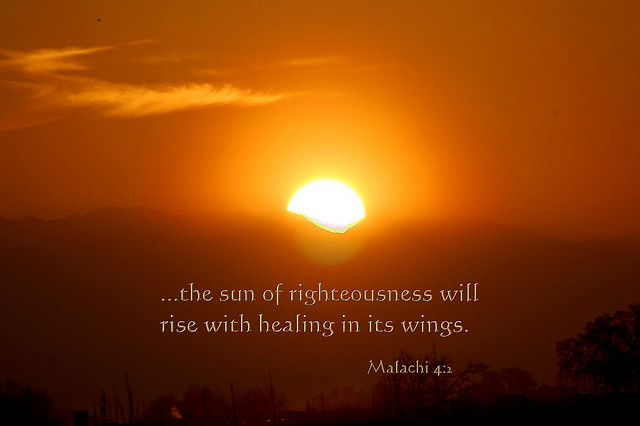
  For me, as much as I might wrestle with what it means to be Jewish in ancestry, I cannot remain in Advent. This is not the end of the written word of God for me. Somehow, through the Spirit, I have been brought to believe that the sun of righteousness has risen and that Son’s name is Jesus. I may have moments of doubt and of darkness, but I cannot dis-believe the experiences I have had in Christ. The encounters that I have had with Jesus in other people. My understanding of the powerful reality that God was born onto the earth and knows fully what it means to human.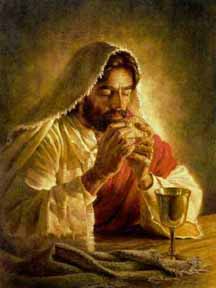
 Faith, Grace, and Hope