
Category Archives: God’s story

Mind the Gap

This post originally appeared here as “Second-Class Baptism” on 22 November 2012. 

         In the fall of 2005, I was an exchange student from Yale Divinity School to Westcott House, a member of the Cambridge Theological Federation in Cambridge, England. It was quite an awakening for this Lutheran. Despite knowledge of some of the rifts in the Episcopal Church (USA), I had very little awareness or comprehension of the major theological divides in the Church of England. In the wake of the recent decision (11/20/12) by the General Synod of the Church of England not to ordain women as bishops, I have recalled learning about those divides, specifically through a speech I heard that semester. 

            During my time in Cambridge, I went to an event sponsored by Women and the Church (WATCH) to hear speakers arguing for the ordination of women as bishops. One speaker, whose name is lost to my memory, gave a carefully constructed and passionate speech about baptism and vocation within the church. She noted that if we do not believe women are qualified and gifted by God for leadership at any and all levels, why do we bother to baptize them? I have never forgotten that sentence, which was so stunning that the room was silent for several seconds afterwards.

            Even with disparate understandings and beliefs about baptism, most Christians agree that the washing rite reveals God’s claim on an individual and, simultaneously, a welcome of that individual into the corporate work of the church on earth. What happens to that second part when we baptize someone, but tell her that because of her sex organs- the Church will interpret how God is using her? What does it mean to pour the water, make the sign of the cross, and say, “But because of your sex, you’re only fit to carry the cross of Christ this far, in this way, and with these provisions?”

            Furthermore, when the Church places provisos for leadership based on sex, gender identity, sexual orientation, race, or other biological circumstance, we presume a kind of certainty and zeal in speaking for God that should make us pause. Throughout history, people have been quick to use the name of God as the seal of approval on whatever preferred course of action was believed to need pursuing. This often occurred through the same kind of biblical gymnastics that still occur today- a little limbo under the inconvenient verses, a vault over the stories that are contradictory, a lovely ribbon-dancing floorshow with the few verses that, out of context, support exactly the argument one is trying to make.

            If the Church of England was honest about its history, its theology, and its current struggle to remain relevant in today’s society, perhaps the voting would have gone differently. Perhaps if the space were made for lament over the rifts in the modern church and, in the next breath, prayers for the future were offered, maybe the voting would have gone differently. Maybe if we could point out that shortly after Peter and Andrew left their nets, they were joined by Mary of Magdala, Joanna, and Susanna in following Jesus- we might be able to have the conversation that nothing about the image of ministry or mission in the Bible at all resembles the way most churches and denominations are structured today. Maybe then things would go differently. 

            The main conversation that must happen, though, is the one around God’s ability to equip, regardless of biology. Either we believe that the Holy Spirit blows where She wills or we don’t. Either we believe that God is more powerful that human weakness (present in all) or we don’t. Either we believe that Jesus broke down social and gender barriers in community and communion or we don’t. Either we wrestle with our human limitations in comprehending the expansive nature of God’s mercy, call, and creative purposes or we get used to our efforts failing as God says, “Oh, no, you don’t.”

          The failure of the General Synod to pass, by just six votes, a measure allowing for the ordination of women as bishops is not a sign of failure on the part of either side. It is a sign that there is a gap between the understanding of the gift of baptism and the Church’s willingness to allow all people to live into that gift. That space creates an unholy chasm into which many gifts will fall and go unused because of the pain in this construction: “You are a child of God, but here’s exactly what that looks like.” When a significant church body, like the Church of England, says to women, “Your skills are useful this far and no further,”- what most women and girls hear is this: “God loves you as you are, but would love you more if you were a man.” If that is the case, why, and into what, are we baptizing women? As they say on the London tube (subway), “Mind the gap, please.” 
Grace: Motivator or Excuse? (Sermon 11/11)

Jonah 1, 3-4
            I do not love the last line of the hymn “O Zion, Haste”: “Let known whom he has ransomed fail to greet him/ through your neglect, unfit to see his face.” That makes me itchy all over, in part because I think salvation is not my job. I don’t save people. Jesus has saved people. Isn’t that the point of grace? That it’s available to all people and we don’t work for it.
            Yet what is grace, saving grace, costly grace, grace that comes from death and resurrection, if I don’t know about it? What does it mean to me? Furthermore, what does it mean to the person who knows, but doesn’t think it is worth talking about every day? What does it mean to the person who knows about grace, who believes grace is amazing and true, but not quite amazing and true enough to risk anything for it? What does grace mean to the person who loves benefitting from it, but not enough to take a message of grace to people who ache for grace, people in a place like Ninevah?
            The story of Jonah has a very specific function in the Hebrew Scriptures. We tend to narrow it down to the part about the big fish, sometimes forgetting how Jonah ended up in that place anyway. A few people say the conversion of a whole city is a bigger miracle, especially with such a lousy sermon, “Forty days more and Ninevah shall be overthrown.” We could talk about resisting God’s call in our lives, but that’s not why the story of Jonah is important or why it lasted for years and years, even to us today.
            Jonah is written down in this very critical time period in the Hebrew scripture history, when things are going okay for the Israelites. With a righteous leader and the exile far off enough into the future as to be unpredicted, the Hebrew people can live for a moment into what it feels like to be “chosen people”.
Basking in God’s favor, as they see it, however, they are doing nothing to communicate the message of one God- creator and redeemer of all- to the people around them. They have forgotten that this is for what they have been chosen: to carry the message of Adonai to the world. They love the idea of a gracious and merciful God, as long as the grace and mercy are for them. Not the others nearby and certainly not the others far away.
Jonah has no interest in taking a message of grace to Ninevah, a city full of non-Hebrews, a city of infamous iniquity. Why should they get the grace he knows God will provide? So he goes in the opposite direction to Tarshish and, when that plan seems foiled, he’d rather die by drowning than go to Ninevah.
Why should Jonah go? If God will be gracious in the end anyway, why does it matter if Jonah goes or not? Why are you here this morning? At some point, we all have to decide if grace is an excuse or an motivator? Are we using the grace of God, the grace we believe that applies to all, to relieve us of responsibility? Are we skipping the third verse because we know that people will still get to see Jesus- no matter what we do?
Or is grace our motivator? Are we motivated by joy in our salvation? Are we stirred up in knowing that God intends something better for the world now, as well as the world to come? Not only that, but God chooses to use us in the bringing about of those improvements? Are we moved enough by the idea of grace to embrace a call to good works?
By hearing the story of Jonah, the Hebrew people of the time were reminded that God’s gift of grace to them was not to set them above others, but to bring them into the midst of a world that truly needed to hear about the one God- maker and redeemer of all.
The last couple sentences of Jonah are my favorite in the whole of the Bible. Then the Lord said, “You are concerned about the bush, for which you did not labor and which you did not grow; it came into being in a night and perished in a night. And should I not be concerned about Nineveh, that great city, in which there are more than a hundred and twenty thousand people who do not know their right hand from their left, and also many animals?”
They reveal God’s sense of humor and God’s boundless love for all. Furthermore, Jonah’s whole story reveals God’s intention to use each of us to share that love and the message of repentance and grace. For me, I have to consider these lines with the last line of that hymn. Even if I believe that people receive grace through the faithfulness of Christ, there is still work for me to do… for you to do… so that people may see a face of Christ in this life.
Are you moved enough by the gift of grace to go to Ninevah? To do the very last thing that you want to do? Grace is not simply for heaven later, it is to prevent feeling like hell is on earth now. Each of us has a call and gifts to help people experience the presence of Christ with them today.  That’s why we’re here, not to simply see friends, have communion, and check off church for a week. We gather to be recharged so that we can go out and publish glad tidings… tidings of peace… tidings of Jesus… redemption and release. 

Around the Edges (All Saints Sermon)

1 Kings 17:1-16
            A famous theologian once said, “You should preach with the Bible in one hand and the newspaper in the other.” That can be tough, because then in one hand I have stories of droughts and floods, wars and struggles between ruling parties, unexpected deaths, people struggling to make ends meet, and people longing for justice… and is that the hand that holds the newspaper or the Bible? Sometimes, it can be hard to tell one from the other without looking carefully and remembering what each one is supposed to do. The newspaper shows us a world that longs for God’s kingdom to come or has forgotten its promise. The Bible reminds us of the promise and shows us God’s actions through history, so that we have a foundation on which to base our hope in and expectation of God’s future actions.
            If the Bible were like other history books, today’s reading would be about Ahab’s reaction to the prophet Elijah. We would have a detailed account of the king’s comings and goings and how other, sycophantic “prophets” would have advised him, and (almost certainly) what Jezebel had to say about the matter. Yet, Israel’s history does not chronicle the kings as much as the people affected by the king and the king’s decisions. Remember that when Israel called for a king, the people were reminded that the Lord was to be their one leader and a king would come with some serious consequences for their national wellbeing.
            Thus, instead of learning more about Ahab, we get a story of Elijah fleeing for his life and a widow with a child, someone who is directly affected by the policies of the king. The first situation that is facing the widow is that she is a widow. Her source of income is gone. Her husband’s family, if still living, hasn’t taken her in to be with them. Her own family, if still living, would not be expected to do so. So she depends on the generosity of others, toward her and toward her son, so that they may live. She may be able to do little tasks in exchange for food or coin to make ends meet, but she certainly lives with very little extra and, consequently, very little participation in societal life.
            The second situation facing the widow (and her neighbors) is the drought. The writer of 1 Kings is careful to point out that the Lord says through Elijah that it will not rain for several years. The significance of this is not that the Lord wants people to suffer in a drought, but that the Lord wants them to remember who makes the rain. The Canaanite god, Baal, was thought to be the giver of rain. If it was dry, Baal was dead. If it rained, he was alive. But Elijah’s prophesy points out that it is the Lord God who is the giver of life. So now we have a situation where people are going to be tightening their belts and have less to give to the widow, whom God has commanded them to remember. We have a prophet who has angered a king who is clearly refusing to acknowledge the Lord as God (and the only God).
            Finally, the widow has a plan for how she and her son will die and here comes a prophet of the Lord, distinguished in some way that lets her know that he’s a holy man, who wants some of her last bits of food. Now, the widow is from the same region (Sidon) as Jezebel, so she is likely to be a worshiper of Baal. Yet she speaks to Elijah with the words he spoke to Ahab, “As the Lord your God lives…” Her circumstances are overwhelming and horrifying. If we were reading to this point in a newspaper article, woman struggling to make ends meet in bad times is confronted by a man who claims to speak for God who tells her to feed him… Who would root for her? Who would blame her if she closed the door on him? Who would say she should absolutely make him some food? Who would say, “The Lord never gives us more than we can handle” and expect her to bake that bread?
            Elijah promises her that she and her son will have enough food, throughout the drought, if she helps him. And so she did. Hooray! Faithful action pays off! It’s a heart-warming page 2 story!
            But not so fast, remember earlier in the story when the ravens feed Elijah? We’re all familiar with ravens- eating out of dumpsters and what’s been hit in the street. Who here would eat meat and bread brought to them by a raven? Even more so, in ancient Israel, ravens are nasty, unclean birds. You don’t eat scavengers, yet they are what God sends to keep Elijah alive. The unexpected birds are how God provides for the prophet.
Similarly, the widow, with all of the circumstances piled against her, should not be expected to provide for a prophet. There are better-favored people to do that, yet God’s provision for her allows her to have an expected role as a sustainer, as a provider, as a person whom God has not forgotten. The God she does not worship has not failed to provide for her and, furthermore, has not forgotten use her to the hope of others and for the hope of creation.
This is what it means to be a saint. It’s not about having great stories written about you or having powerful visions or heroic actions. It’s about faithful action, in spite of what else is happening, and it is about being the hope in God of the people around us. The people whose lives we remember today and the lives that the Spirit is shaping today are exactly this… lives that remember the people around them, lives that are structured by small, unseen remembrances, gifts, and help.
Sometimes we do have more than we can handle on our own. Sometimes life does pile up. It is not merely by our own determination that we survive, but by the help and support of others- who bring us bread, words of hope, silent companionship, refills of oil for our jars. This is what sainthood looks like… un-haloed, but still hallowed, unsung, but still a song, unremarked, but still remarkable.
It is work that happens through family and friends AND through outsiders and rejects (in this story, widows and ravens). This is how the Spirit moves-from all directions, expected and unexpected. This is how God reminds us who is in charge. This is how saints are made, how creation is renewed, and how Christ continues to make resurrection happen out of death in this life.
A famous theologian once said, “You should preach with the Bible in one hand and the newspaper in the other.” In one hand, I have stories of droughts and floods, wars and struggles between ruling parties, unexpected deaths, people struggling to make ends meet, and people longing for justice… and is that the newspaper or the Bible?
In the end, it doesn’t matter. Either way, the Holy Spirit is in these stories, breathing from the edges and from the middle, encouraging people (and sometimes animals) to actions that save and preserve life. It’s not the headline news, but it must be remembered. God is in charge, no matter what else happens, and, with that eternal truth, comes this corollary: the Spirit is still making saints. 

You Know Why They Built That Calf (Sermon 10/7)

Exodus 32:1-14
            It is said that when Augustine preached, in his role as the Bishop of Hippo, that he preached for two hours or so at the time. Within the length of his sermon, he would have smaller sermons that were directed at different people who might be gathered in the congregation. He would preach to people who were just hearing of the faith. He would preach to the catecumenate, the people preparing for baptism. He would preach to those feeling lost and to those who were a long time in the faith. Everyone sat through all of the sermons, absorbing the lesson aimed at them and the lessons that swirled over them.
I have been thinking about Augustine this week as this text of the Golden Calf turned over in my mind. There are at least six sermons here. All of them do not apply to all of you. I think I can cover three of them and keep my time under two hours.
            The first group to whom I will speak today are those who would consider themselves young in faith, those who still feel raw and uncertain. If you feel a little shaky about your Bible knowledge or confused as to why we do what and when, this is for you. You know why the idols were built.
            The story of the Golden Calf takes place after the Israelites have been freed from Egyptian slavery, after they have seen the violent death of Pharaoh’s army in the Sea of Reeds, after God has led them with a pillar of clouds by day and a pillar of fire by night, after they’ve received food from the heavens, and after the Israelites have been gifted with the Ten Commandments, which begin with “You shall have no other gods before me.”
            The Israelites did not make it to this place on their own, but each step has been an overwhelming confirmation of God’s presence with them and God’s guidance through their leader, Moses. Even though the Israelites know their history, each day is a new experiment in trust. They are totally dependent on God and God’s providence. While the goal of living by faith is their ideal, sometimes it requires too much.
            You may find yourself relating well to the Israelites in this situation, oh people of new faith. It turns out to be harder than expected. The glories of those first days of freedom and revelation are strengthening, but the need for new confirmation each day is tough. It is hard to say that to those around you, those who share your tent, those who sit around the table with you. But you must. The Israelites missed the chance to hold one another up when they grumbled to themselves and then despaired. Sometimes the constant re-telling of the stories of freedom and hope are what keep the flame burning until new wood, experience, confirmation, depth of wisdom in Christ, is added. For you receiving this first sermon, I encourage you to tell your story- share the breath of God that is in you. Let the Spirit be the wind that parts the waters of doubt for you and those around you and lets you pass through on dry land.
            The second sermon is for those of you who have been faithful for years. If you have heard this story as a child and as an adult, if you feel like the facts are familiar, if you are listening and making a to-do list in your head at the same time- this is the sermon portion for you.
            It is you, beloved second group who do much of the work of the church and, yet, are at the greatest risk of imitating the Hebrew people of this story. It is you who know the story so well who may overlook the two reasons the Golden Calf gets built. When the people lament that Moses has been gone too long, they gather around his brother, Aaron, and beg him to help them make an idol.
            If you remember, Aaron was Moses’s spokesman in front of Pharaoh. Aaron knows EXACTLY what has happened between God and the people. And yet, he collects up the jewelry, melts it down, and makes a golden calf- a common shape for worship in the Mesopotamian region. Representing food, milk, clothing, and potential livelihood, as idols go, the calf is not unreasonable. And yet, it is not appropriate for people who have been saved by the God of their ancestors and who are yet covered by the same promises made to those ancestors.
            The people may have made the idol because they needed a concrete image to worship. Perhaps the God of freedom who acted unseen was too much of a strain. Perhaps they were trying to make an image of this God and this is what they came up with. Regardless, Moses is up on the mountain receiving instructions for how to build the tabernacle, a place for God’s Spirit to dwell in the encampment, and down below the people are trying to make a concrete image to worship, from which to seek guidance, to praise for all that has happened to them.
            People of faithful years, this is too easy to do. We live in a world that craves newness and, in newness, concreteness. Our sports teams, our gadgets, our cars, our clothing, our patriotic idealism, our financial worries, our hobbies, our families, our work, our health, our church programs, our history, our future… these all can and do become our idols. They become the images that absorb our concentration, our energy, and our focus. The place where we push the most focus becomes our god. It may not be sparkly and shiny, but we can have it built and receiving the offerings of our time and our talents faster than we expect.
            What is the first thing you think of when you wake up? Is it your baptism in Christ? Is it the taste of communion? Is it the powerful conversation with your neighbor about God’s providence? As you go to sleep, were you praying? Was your prayer, “Lord, how will I get everything done tomorrow?” or “Lord, thank you for today”?
            We look down on the builders of the Golden Calf, but we often forget the idols that crop up around us- idols that demand our attention, our money, and our devotion. Oh, people of years of faith, beware the siren call of new things, of crammed schedules, of political promises and hope anchored in quicksand. Think on what is truth- the gifts of God in Christ, communion, community, and consolation. Dwell on these things and other idols will tarnish and crumble, because they cannot stand.
            Lastly, I will speak to you who have lived faithful lives of many decades. You know why the idols were built. The Israelites, in waiting for Moses’s return, believed that God had grown silent. Despite their earlier experiences, they found themselves without a prophet. They prayed and felt no answer. They wept and felt no consolation. They ate and they drank food from heaven and, yet, they felt empty.
            You, elders in faith, know this feeling. None of us wish to speak of this dark night of the soul, but you know of the words poured forth in grief, in anger, and in frustration that seemed to go unheard, because you have waited for a response that has not yet seemed to come. You feel a kinship with the Israelites, who lift their eyes to the mountain and say, “It is well and good for Moses to talk to the Lord, but what about me? What about what I have to say? What about what I need to hear?” You understand that sometimes idols are made, not because of disobedient nature or confusion, but out of the sheer need to hold onto something- grief, relief, memory, control.
            You, people in this third group, know too well what it is like to proceed through the valley of the shadow and to feel like the sun doesn’t always make down to where you are. And, yet, you have walked. You have walked through the silence, you have waded through the depths, you have remembered Egypt and you have said, “That was nothing.”
            And, in your walking, you have also become prophetic. You read this story and you know God didn’t change the plan. You know that God had no intentions of destroying the people of the promise again. Instead, you look at this Scripture through eyes of wisdom and you see God coaching Moses into his role as prophet. You see God stirring up fear and frustration in Moses until Moses is finally responding with the strength and the nerve that God knows is in him, “These are your people, Lord! The people you led out of slavery! Would you have others say that it was they would die in the wilderness? Would you have their children say that you are God who does not keep promises?”
            With decades of experience, you all see the God pulling Moses along because you’ve been there. You’ve been in the spot of negotiating with God on one side, only to realize you were handed a new and different task. And you’ve done this trick yourself. With your years of experience, you know that other idols crumble, but they remain tempting when it seems God is silent or, conversely, when it seems that all you can hear is God calling you into a new and scary place of relationship and prophetic living.
            People of Hope, whichever group you are in, you know why those idols were built. You have done it yourself and we will do it again. And yet, we know that we have a God who forgives, who relents, who comes among us in Jesus to show us, ultimately, that there is nothing this world can offer that cannot be trumped by what God gives- hope in the face of doubt, strength in the place of insecurity, freedom in the place of enslavement, life where death would have the last word.
            We all long for the concreteness of idols, but our hearts are made by God and long for God. Whichever you find yourself in today, here are words from St. Augustine to God, which could be from any of us: “Thou madest me for thyself and my heart is restless until it finds repose in thee.”
Thou madest me for thyself, and my heart is restless until it finds repose in thee.
No idol offers that kind of repose.
Amen.

God’s Plan, Our Choices (Sermon 9/23)


Genesis 15:1-6
            What is God’s plan? Many times, in some of the darkest moments of our lives, people (well-meaning people) tell us that God has a plan for our pain, that what has happened to us makes sense in a grand scheme, that we are not hurting in vain. Yet think about what that says about God: that God uses pain as a means to an end, to bring us where God wants us to be? That there is a long-range plan, full of illnesses and pains, which is how God is bringing the kin-dom into fruition? That the forces that oppose God, including cancer, chaos, and criminal actions, do not really have any power- though we go through the motions of renouncing them at baptism.
            If God’s plan for the world is down to the tiny details, what’s our part in it? Do we play a role? Are the encouragements in the creation story, the relationship that we see there between God, humans, and the rest of creation, is that a real relationship or just a backdrop while God moves us around according to a plan?
            If we take a look at Abraham’s story, we can see two things: one is God has a plan and two, people are participants in that plan. God’s plan for Abraham is no less than God’s plan for anyone of us- a future, hopes fulfilled, abundant life. God draws Abram out into the dark of the night and promises that, though currently childless, he will be a father to many generations. God has a plan for Abram’s future… including a name change, but God’s plan requires trust and faithful action on Abram’s part.
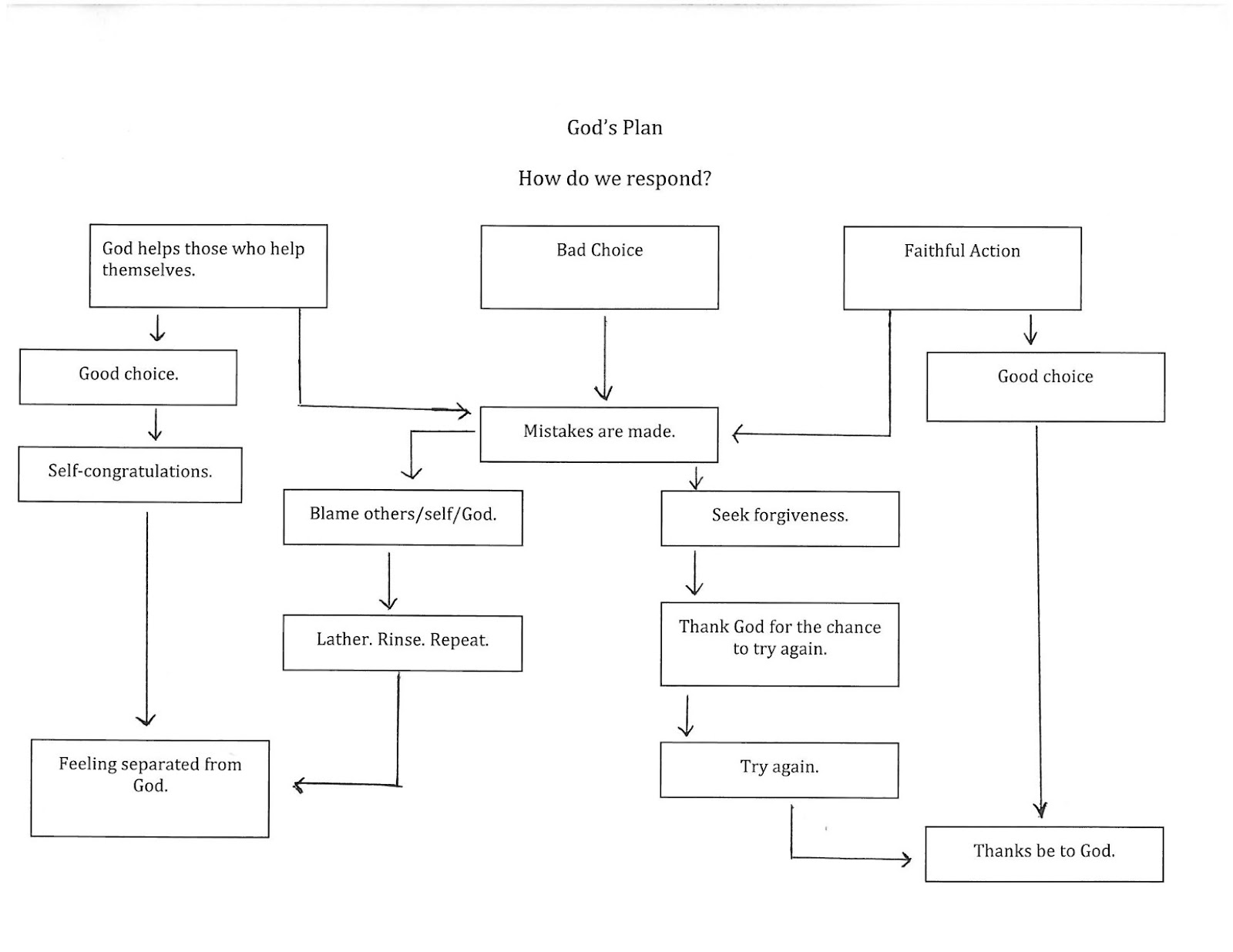
See chart above:
The chart moves from the idea that God has an over-arching plan, but we are called to respond, through the gifts of faith and free will. Consider the choices Abram/Abraham made. 
God helps those who help themselves: Hagar and Ishmael
Expedient Choice (ending up badly): Passing Sarah off as his sister
Faithful action: leaving homeland, creating Isaac, arguing on behalf of Sodom and Gomorrah, near-sacrifice
            Each of this situations arise from choices that Abraham makes, just like each of us find ourselves in situations because of our own choices. Occasionally, we find ourselves in situations, good or bad, because of someone else’s choices. As participants in God’s work in the world, as co-creators and communicators of God’s blessings (just like Abraham), we are continually called to think through who we are as people, as families, as a faith community, as a city/state/nation.
            The idea that God is micro-managing us and everything else leads to a kind of carelessness- a disregard for ourselves, for others, and for creation. The idea that God helps those who help themselves inevitably leaves someone out in the cold and, eventually, leaves many people feeling separated from God.
            Faithful living, on the other hand, is hard work. It comes from trust. Trust can only be based on a foundation of fulfilled promises, consistent action, and a reasonable expectation of future care. The Abraham story lets us see that we can only expect those things from God and not because of God’s reign in minutiae, but because God is the details of care, of peace, of justice, of community relationships.
            Because we see through scripture and through experience that we can trust God and that trust makes the foundation of our faith, which God graciously counts to us as righteousness. We get credit for the right response because of God’s history of faithful action to God’s people and through Jesus.
            God’s plan is always for creation in the way he explained it to Abraham- a plan for generations, a plan for descendants, a plan for a future hope and a fulfilled promise. God also graciously invites us into that plan, gives us the solid foundation of faith, and allows us the freedom of choice in how to respond. Do we deserve this? No. Did Abram deserve a special promise? Did Mary deserve to be chosen by God? It’s not about what we do, any of us, it is always about what God does. God’s plan always included the curious, the stubborn, the little, the lost, the least, you, and me. And that plan, into which you and I are invited, is always for hope, for justice, for blessing, for creation, for relationship, and for peace.
            Amen. 

Not Safe for Children (Sermon, 9/16)

Text: Genesis 6-9            

          In all the things I do for our children’s service, Heavenly Sunshine, one thing I never do is read the flood story. I do a lot of wild and crazy things, but I never read that story. I do not like presenting it as a story for children. It’s not a story about cute animals- it’s a story of the idea that the world went so wrong that God decided to undo creation. That’s not Vacation Bible School-friendly, that’s apocalypse. No number of cute songs or rainbows can make me okay with this story.
            This is an interesting perspective because most of us never hear about the flood again after our VBS or day camp days are finished. A few of us may have discussed Genesis as adults or once or twice heard a sermon on the flood, but so rarely. Who wants to talk about it? Who wants to consider that God, who was merciful to Adam and Eve and to Cain (after he killed his brother), decided a few generations later that things were so bad, they had to end.
            Things were so bad (how bad were they?) that Genesis 6:5-7 says: The Lord saw that the wickedness of humankind was great in the earth, and that every inclination of the thoughts of their hearts was only evil continually. And the Lord was sorry that he had made humankind on the earth, and it grieved him to his heart. So the Lord said, “I will blot out from the earth the human beings I have created—people together with animals and creeping things and birds of the air, for I am sorry that I have made them.”
            What was the great sin of the time? As I thought about this story this week and wished I had anything else on which to preach, I read an interesting thought in a Torah commentary. A Torah commentary is a Jewish commentary on the first five books of the Hebrew Scriptures. This modern commentary sifts through thousands of years of Jewish scholarly thought and offers small nuggets to chew on regarding different texts.
            The commentary suggested that the early people- the pre-flood people- stopped valuing children. I am not saying this is what’s in the Bible, but when commentators through the centuries have read this story and the rest of Hebrew Scripture, one of the conclusions they have reached is that the destruction of the flood is attributed to a societal neglect of children.[1]
            Since Noah lived to be quite old, the Scriptural tradition understands that he did not have children until he was five hundred years old. (Remember one of the punishments that comes with the flood is that people will no longer live past 120.) Noah waited a long time to have children, possibly, because he did not think the world was a good place in which to bring children.
            A lack of spiritual and social role models, a failure to plan carefully for the future, a disregard for community support of parents, a breakdown of the societal institutions that offer support and structure for future generations… all of these might have been characteristics of that pre-flood culture (or a contemporary culture, come to think of it). Everyone did what they wanted, focused on themselves and their needs first, and failed to consider God’s preference, God’s desires, God’s commands toward relationship and fruitfulness- which means bearing children, supporting children, and being a part of a society that values children.
            To value children does not mean that everything becomes child-centric. Not everyone can or should have children, but we all live in a world in which children are affected by all kinds of decisions. Economic, political, spiritual, educational, environmental… if our thoughts are not on the impact of what we choose and how we choose it, then we have stopped considering the future generations, we have stopped valuing children.
            And so we have the story of the flood. A story told and re-told to make sense of a devastating event. A story that is filled with grief and anguish. Noah and his family surely had friends and neighbors who died, who were killed. A story in which God has regrets. A story that may have been repeated because in later generations, when the world seemed very upside down, people wondered how bad could it really have been before the flood?
            It is a story that is not for children because it can be understood to be about children. The later events of the Hebrew scripture are completely focused on children- on having them, on their struggles, on God’s promises of children. Even when we read about the time of slavery in Egypt, the Hebrew people were more focused on continuing to have and preserve the lives of children than they were on obeying the Pharaoh.
            At the end of the Noah story, God promises not to destroy the known world by flood again. Very shortly thereafter, Noah gets drunk and his sons get in trouble over their reaction. Despite the warnings of the flood, people didn’t change. Mistakes are made.
            Yet the story reveals God as resolute, as having made up God’s mind. The price of destruction is too great for a creator to pay. The pain of the loss is not worth the break in relationship. So God makes plans, plans for the generations, plans for hope and a future. There will still be judgments, but there will also be mercy. And there will not be massive destruction that comes from the hand of God as a judgment. God takes the long view and the long view includes many, many, many children.
            The question for us is do we have that same view? In a week with the death of a U.S. ambassador and many others, where are our values? Have we thought about children- about our children, about the children of our neighbors, about the children of the world? Do we trust enough in God’s promises of life and hope for all, in Jesus, that we make decisions based on the continuity and value of the people who are to come after us? Decisions about relationships, leadership, natural resources, or economics?
            The story wraps up neatly when we tell it to children, but for we who are older… it’s tough stuff. Maybe we avoid the flood story, not because of the deaths and the destruction and even what it makes us question about God, but because we can see that the same behaviors are rising, like dark water, all around us. 

           God will not forget God’s promises. Do we remember them? Do we care enough about those promises to be guided by the Spirit in all things, for the sake of children? Do we trust enough in God’s memory to believe that destruction has not been forgotten and that, if we are willing to see them, all around us are signs of renewal and creation? If not, maybe we should just leave this story to the kids.
Amen.


[1] Artson, Rabbi Bradley Shavit. The Everyday Torah. McGraw-Hill, 2008. p. 10 f. 

Life Force and Momentum (Sermon 8/19)

John 6:51-58
           
            How many of you know someone who says they don’t believe in God? Most of us do. Many of us have had conversations with friends or family members or even strangers who tell us that they don’t believe. Sometimes their reasoning has to do with church history or personal experiences and sometimes they just feel like what we trust is true just cannot be. So in your conversations with these people, how many of you have ever offered today’s gospel passage as an argument support?
            How many of you have just casually offered, “You know, Jesus said: Very truly, I tell you, unless you eat the flesh of the Son of Man and drink his blood, you have no life in you. Those who eat my flesh and drink my blood have eternal life, and I will raise them up on the last day; for my flesh is true food and my blood is true drink. Those who eat my flesh and drink my blood abide in me, and I in them. Just as the living Father sent me, and I live because of the Father, so whoever eats me will live because of me. This is the bread that came down from heaven, not like that which your ancestors ate, and they died. But the one who eats this bread will live forever.” (John 6:53-58)
         What? No one has used this passage as an argument or comfort in a discussion with someone who has difficulty experiencing God in the world? Why not? Why wouldn’t you use this passage? Because it sounds crazy. You might try to tone it down by saying, “Well, I know it sounds crazy, but we don’t really eat Jesus. I mean, we eat this bread and drink this wine and we believe he’s present in those things. We don’t really know how he’s present, we just sort of trust and eat and look at each other and go home and it’s very meaningful. But we’re not crazy. I swear.”
            Well, that falls a little flat, doesn’t it? This passage sounds strange even to us. Even if we’ve come to accept that we’re a little crazy, we like for things to make sense, to seem logical, to be rational… and this passage brings us right up to the edge of what we believe and says, “Here it is, all laid out for you. And it’s a little bit more than you can swallow.”
            What is Jesus saying here- to the people around him at the time and to us today? Part of this goes all the way back to the beginning of this whole section of John- with the feeding of the 5,000 and having leftovers, with the walking across the water and stilling the storm, with the phrase “I am the bread of life”. Part of what Jesus is telling his audience is that it’s not enough to participate in what is easy or obvious- the miracles, the healings, the supernatural events. It’s not enough to live based on the history of what God has done. In the case of the Jews in Scripture, it’s the memory of the freedom from slavery and manna in the wilderness. In our case, it’s not enough to believe in Christmas and Easter- the birth and resurrection. When we reduce God’s actions to what was and a vague expectation of what may come, we are missing the present, the current action, the contemporary revelations.
            The bread of life is not fast food. We do not grab it and go. It’s not something we consume just to have eaten, to have enough to get us to the next meal. What Jesus is telling those who would hear him is that the body and blood is something to chew on, to sit with, to return to. It’s something to gnaw on- with your mind and with your body. We chew on the bones of our salvation- making the taste last, always finding one more morsel, one more piece that gives us the flavor of heaven.
            And what is this eating for? Why do we chew over Jesus? What’s to be gained from eating the flesh and drinking the blood? True enough, eternal life. True enough, a better understanding of God. True enough, a very strange image to have in your mind. But what about the word Jesus uses, “abide”? What about abide? Eating the body and blood brings us to abide in Christ and Christ, in us. What does that mean?
            This week, I’ve been reading a book called “God’s Hotel” about one of the last almshouses in the country. An almshouse is where people used to go if they weren’t really able to pay for a hospital stay, but still needed care and had nowhere else to go. In one section, the author, Dr. Victoria Sweet, talks about the difference between seeing a person alive and seeing the body of the same person after they’ve died.

            “Much later I learned that medicine had once had a name for this, this something present in the living body but missing from the corpse. Two names, actually. There was spiritus, from which we get the English spirit, although the Latin spiritus was not as insubstantial as “spirit”. Spiritus was the breath, the regular, rhythmic breathing of the living body that is so shockingly absent from the dead. Spiritus is what is exhaled in the last breath.
            And there was anima. Usually translated as soul, the Latin is better for conveying the second striking distinction between [the body of the person] and [the person themselves]- its lack of movement. Because anima is not really the abstraction, “soul”. Anima is the invisible force that animates the body. That moves it, not only willfully buy also unconsciously- all those little movements that the living body makes all the time. The slight tremor of the fingers, the pounding of the heart that shakes the living frame once a second, the rise and fall of the chest. Those movements by which we perceive that someone is alive. Anima, ancient medicine had observed, is just as absent from the dead body as spiritus.” (p. 2-3)[1] 

            I read this passage this week and I thought, “That’s what we get through eating the body and blood of Jesus. This is what happens with Christ abides in us! We have spiritus! We have anima!” When Jesus abides, resides, dwells, within us- we have something that we otherwise lack. We cannot always put our fingers on it specifically, which is what makes it hard to explain to doubtful listeners, but it is something that both comforts and motivates us, something that feeds and exhausts us, something that grounds us and gives us forward momentum. That’s what it means to have Jesus abide in us- as a result of our feeding on him.
            And what does it mean for us to abide in him? It means our spiritus and our animahave an anchor, a solid base. It means that when we look around, we see Christ in all things. And it means that all things see Christ in us. It means when we are wondering how to respond to all that God has done in Christ, when we are asking the question, “What should I do?” The answer is “Abide.” When we rest in presence of Christ, we are even more able to be present to the people and circumstances of our lives. Having fed on the body and blood, the Spirit uses that fuel to help us brighten the corner where we are, to shine the Christ light right onto our every day tasks, to love our neighbors and to be about the work of justice and peace.
            Yes, it all sounds a little crazy, but in the end… what we do here is not about bread and wine. What God does here is not about bread and wine. It’s about bodies. It’s about flesh and blood. It’s about life force and movement. It’s about Jesus, abiding in us and we, in him.


[1] Sweet, Victoria. God’s Hotel: A Doctor, A Hospital, and a Pilgrimage to the Heart of Medicine. Riverhead Books, New York. 2012. p. 2f 

Theology of the Cross (Sermon 3/18)

Lent 4 (Narrative Lectionary, Year B)
Mark 12:38-44
            I like to start sermons with a story. I feel like a story helps us to get into the groove of listening and pondering what’s happening in the Scripture reading. The story is like a little bridge that we cross over into history and that history crosses over to meet us.
            However, in order to be true to the gospel of Christ according to Mark, today’s passage does not lend itself to a good story, to a catchy story, to a story that I want to remember and to tell. In Luke, the widow with her two coins is the hero of the story. In Luke’s account of this story, Jesus praises the woman for giving her last two coins. For generations, she has been upheld as the model of sacrificial giving for the cause of the church.
            For Mark, the woman is symbolic, too. But she doesn’t represent sacrificial giving. Instead, in Mark’s gospel, the woman is a sacrificial lamb, preyed upon by greedy church leaders who posture at showy displays of piety, but in truth consume the goods of the poor, down to their last coins and then their houses.  Mark’s version of this story puts me in mind of all of church history, the bad parts, not a story I want to open with today.
            In 70 A.D., the temple in Jerusalem is destroyed. This is the second temple. The first temple is built under Solomon’s direction, with the conscripted labor of the Israelites. (Conscripted labor is a fancy phrase for slavery.) When it is destroyed and the people of Israel are held captive in Babylon, there is a deep longing for a place to connect with God. After the time of captivity, the second temple is built with money from Cyrus the Great. No matter how great he was, no matter how respectful of Hebrew history, Cyrus is Persian. This is not a king of Israel.
            The building project that is begun by Cyrus continues until it is finished under Herod the Great. By now, the structure of worship life in the temple is strictly monitored. Animals must be bought from the temple. Money has to be changed to temple coinage. The scribes and temple leaders demand, in the name of God, offerings for all kinds of sins. The cost of living righteously keeps many people in a cycle of poverty.
            Many people, regular people, probably have a deep sense of ambivalence about the temple because of this history. The building itself, the worship inside, the people who run the show. Yet it is also the place where people have felt close to God, where they have had deeply moving moments in their hearts or with members of their family, it is a place that is connected with hope, a future, and promises. This is what the woman believes she is giving her last two coins, too. So that someone else may have what she has experienced.
            Mark is trying to convey all of this in his story, in this fleeting description of Jesus and the disciples witnessing temple life. If Mark is writing before the temple falls, he is trying to remind people of what the story of the building is and of what Jesus said it would be, should be. If Mark is writing after the temple has fallen, he is trying to remind people of the corruption that was and the wholeness that can be.
            What Mark is conveying, what Jesus is showing, what the widow remembers is the best of what a community of faith can be. The truth that is revealed to and through a community of faith comes via the story that it tells. Is it a story of obvious glory, of fancy structures, of powerful leaders, of devouring the houses of widows for the sake of show? Or is the story of glory in the cross, of welcome and consolation, of quiet conversations, food and fellowship, support, and making ends meet?
            It’s amazing to me, though it shouldn’t be, that church history is filled with this story repeating over and over again. The story of people whose power or position went to their head and they began to build towers, cathedrals, and cities. They expected their influence to last forever. It didn’t and it can’t.
            We can’t hold the earthly idea of power, the idea that the scribes and so many since them have had… we can’t hold that idea and, at the same time, say that we trust God-in-Jesus who noticed the widow, who called unschooled fishermen, who spoke with isolated women, who healed lepers, who blessed children. The theology of glory, honor, and triumph can’t hold a candle to the theology of the cross. One is empty because it is hollow. The other is empty because of the power of God. One is pyrite, sparkly and worth nothing. The other is the light that shines in the darkness and the darkness cannot overcome it.
            The deep, dark valleys of church history, the good, the bad, and the very, very ugly, can’t overcome the hope and comfort that is the story of God. This is the call to us, to each of us and to our congregation. We are called to remember that the life of faith isn’t about the story of this church, but about the story of God. The story of God-in-us and with us. The story of the family into which we have been adopted through baptism, the family table at which we eat together, the family circle that we see here and is completed in heaven.
            The story of the temple, of the building, of the scribes… the stories of seeking earthly power never end well. These things do pass.
            The story to which the widow belonged, the story into which we are called, the story of abundant life, the story of grace… it’s a story for the ages. For all ages. It’s the story that will carry us into the life that is to come.
Amen.