Category Archives: God’s story

God’s Best to Our Worst

1 Samuel 16:1-13, Psalm 51:10-14
            Two years ago, a man called the church and asked to come speak with me. When we met, he told me that his son had died from suicide over twenty years before. At his son’s funeral, the pastor lamented that it was too bad that the man’s son was in hell, using the opportunity (a funeral!) to warn others against suicide. This warning, of course, ignores the fact that most people who are considering suicide feel as though they are in hell already.
            So, two years, this man, this grieving father, came to talk to me about heaven. In particular, he had a little booklet about heaven that he had carried around for about ten years. He’d read the slick pages over and over until they were soft and floppy. He wanted to question me about the specifics of heaven. In particular, he was very concerned about the idea that we will be able to recognize other people in heaven.
            He felt that if he was able to see who WAS there; he would also know who WASN’T there. His little booklet told him to anticipate a great reunion with many loved ones. This man believed it would never be heaven for him if he had to spend eternity knowing that his son wasn’t there. He asked me how heaven could be a perfect place if, while he was there, he would know that his son was suffering elsewhere.
            This man, like many others, grew up and had been told again and again about suicide as an unforgiveable sin. Some people have been taught that it’s unforgiveable because you can’t repent. Some people have been told that taking one’s own life is usurping God’s power and privilege. We even, still, talk about suicide like it’s a crime: we say “commit” suicide. I try to use the phrase “die from suicide”.
            What does this have to do with David, who died of old age- probably in his seventies? As we’ve been studying David on Sunday mornings and talking about the cross on Wednesday nights, one of the issues arises repeatedly is the idea of God’s justice. We want to think of God being “fair”- even though fairness is not a Biblical principle in any stretch of the imagination.
            We like the story of God calling the little brother, the youngest, the sheep-keeper . We like knowing that he was musical and had a heart for God. We like the idea of David killing Goliath and speaking forcefully for the living God of Israel. We are drawn to the deep relationship and promises between David and Jonathon.
            But then we think of David using his kingly advantage to seduce Bathsheba and to have her husband, Uriah, killed. We think of him over-indulging his sons and placing them among his advisors when they were likely too young. He neglected to lead his military generals. He was a mercenary for a while with the Philistines. He conducted an illegal census of the people of Israel. He killed the remainder of Saul’s family, except Mephibosheth- Jonathon’s son who was crippled in some capacity.
            We wrestle with the idea that David did these terrible things and yet remained God’s beloved. There are events in David’s life that were perceived to be God’s punishment for his actions, yet God did not withdraw God’s love from David. God did not turn his back on David. God did not undo God’s promise of bringing redemption to Israel and to the world through David’s descendants.
            When I met with that man two years ago, we talked about the nature of God. I asked the man if he had ever thought that his son might be with God now, might be at peace. He looked at me like I was crazy. In twenty-plus years, no one had ever asked him this outright. I asked him if he thought soldiers went to heaven. He said yes- because they kill in the line of duty and they can repent. I asked about executioners and people who kill someone else in an accidental death. Yes, because they can repent- he replied- they can go to heaven.
            We talked about his son, about his struggles and pain, about why he might have come to the decision he did. I asked the man if he thought God was with his son in those struggles. Yes, he thought God was there, but then his son did what he did. In the long conversation we had, we went around and around. This man had spent these many years believing his son was in hell. He just wanted to understand how he, the father, could expect to find heaven a perfect place, when he would obviously know that his son was not there.
            We do not live in a world of fairness. Even with laws and governments, there is very little justice because of our entwined and enmeshed systems that contribute to and perpetuate the struggles of many people. Given what we see and experience all the time, it is very important to remember that God does not function in the same way that we do.
            In a fair system, Jesus would not be from David’s line. He’d be from a lineage of fine, upstanding citizens. All the women would be pure and perfect. All the men would be robust and faithful. Jesus would be from Lake Woebegon- where are the women are strong, the men are good-looking, and the children are above average. And what consolation would that be to us? God comes and lives among us, but lives as the crème de la crème? Instead, Jesus spends his toddler years as a refugee, his youth in a backwater as the son of a carpenter, his early adulthood working with his dad and friends in community life, his ministry years with fishermen, tax collectors, and women, his moments of death as a criminal and one wronged by both religious and civil leaders. This is God’s experience as one of us.
            And we shouldn’t be surprised by it, since we’ve known from the moment that God didn’t kill Adam and Eve, gave Cain a second chance, preserved Noah, called Moses (the murderer), and used David to bring Israel into a place where they could truly be a light to the world, if they so chose. God doesn’t do fair. God does grace. God does power. God does God’s justice.
            Our justice would result in Mary Magdalene showing up on Easter morning and weeping over Jesus’ lifeless body. God’s justice, God’s ways, have her met in the garden by her rabbouni, her teacher and Lord- Jesus the Christ. Our ways would have us muddle along, hoping to get things right. Instead, God’s ways have Jesus meet us too… in all kinds of times, places, and people.
            Our ways would have squashed David like a bug after the Uriah and Bathsheba incident. Our ways would declare that some sins are unforgiveable- even those committed in the depths of despair. Instead, God’s ways continued to use David, defining him not by the worst thing David ever did, but by the best thing God ever did. If God does that for David, isn’t that surely what God does for each of us? Not seeing us by the worst thing we ever do or that ever happens to us, but by the best thing that God ever did.
            That’s what I told that man two years ago and what I’ve prayed every day since for him to receive and understand. It’s what I want you to hear on this Sunday as well. The God of resurrection, the Christ of baptism and holy community, the Holy Spirit of constant renewal does not see or define us by our worst, but through God’s best.
Amen. 

God’s Servants Are Never Retired

1 Samuel 3:1-21
            Since Samuel is a child when God calls him and his work as a prophet begins immediately, this story usually focuses on that fact alone. We use that information to underline the fact that God calls and works through all kinds of people- regardless of age, experience, or even knowledge of the Lord (see: “Samuel did not yet know the Lord”). Many of us have heard this part of the story lifted up so many times; we begin to miss the other details in the story.
            Pretend you never heard this story before. This is entirely fresh to you- as an adult. You have not been hearing about Samuel for 20, 30, 40, 70 years. Instead, you’re hearing this for the first time.
What might stand out to you?
       Eli knows who is talking to Samuel.
       Eli is punished for his sons’ misdeeds (or for ignoring them).
       Eli’s call is undone so that Samuel can be called.
       Samuel’s first experience as a prophet is to retire his predecessor.
How is God’s character portrayed in this story? Is this a God you want to serve? A God who calls and speaks through children, that sounds hopeful and promising. A God who withdraws favor without warning… less hopeful. If this were the first Bible story you ever heard as an adult, what would you think about God?
            It’s important to remember that 1 and 2 Samuel and 1 and 2 Kings are written down for the preservation of the life and lineage of David. Everyone else is a footnote in that story. The recorders are not interested in what happened to Samuel, Saul, Eli, or anyone else beyond their role in the story of David.            
Eli is a temple priest in the time of the Judges. The book of Judges closes with the acknowledgment that there was no king in Israel, so everyone did what was right in their own eyes. Part of this statement is technically untrue. There was always a king in Israel. Who was the king? God. With God as a king, the leaders of the people were ones who pointed to God and to God’s expectations. This would have been Eli’s call and work. At some point, he wasn’t able to do that work. He apparently fell short in training his sons correctly or in sufficiently correcting them when they “did what was right in their own eyes”.  
            This passage opens with the note that the “word of the Lord was rare in those days”. Does that mean that the Lord wasn’t speaking or that people weren’t listening? I know for a fact that I can tell my son to four or five times to put on his shoes before it finally happens. Is the word of his mother rare, unheard, or unheeded (or some combination thereof)? So Eli has given his life to the service of God. Maybe that service interfered with his ability to be a good parent. Nevertheless, Eli is released from service, which has the distinct look of falling out of favor with God.
            We’ve already discussed how God comes across in this story (uncaring, cold, capricious). Is that your experience of God? Is that the scope of God’s character as revealed elsewhere in Scripture? If you think about the Bible as a whole, how does God come across?
            Part of reading this story is pulling away from its narrow understanding of vocation. When we do that in the story, we also have to do it in our daily lives. We have a tendency to judge our own worth and the value of those around us based on the work they do for pay or on the “success” of their relationships. Paid work has more value than unpaid work. Parenthood has more value than being an uncle or an aunt. Being a widow or widower has a higher perceived rating than being divorced. The CEO has more value than the kindergarten teacher who has more value than the garbage collector.
            Our culture has a ranking system based on perceived contributions to society and status therein. We study people for how they fit into the categories we’ve been taught. Occasionally, we’re able to move things around, when a child receives a clear call from God- for example, but otherwise, we keep things the same. Furthermore, as society works to uphold that framework, God’s favor is subtly (or not) attached to the status of higher value. Surely a better position, family success, material wealth… etc. are all signs of God’s favor. And which comes first- God’s favor, then success? Or success, and then God’s favor?
            When the writers of 1 Samuel begin to write for the main purpose of recording the life of David, it seemed obvious to them that Eli had lost God’s favor. How could God call Samuel, if God doesn’t first “uncall” Eli? And once Eli is no longer the chief priest, who cares what happens to him?
            Except that his priesthood is not the only way God could use him. It may well not be the only way God did use him. Eli is still a father, perhaps still a husband, a father-in-law, maybe a grandfather, a neighbor, a Jew, a child of God. While he might no longer have paid work, he is not outside of God’s plans or God’s ability to use him.
            So we too have multiple vocations… paid worker, volunteer, spouse or partner, sibling, child, parent, friend, neighbor, citizen, library card holder, sandwich maker,… etc. The end of any one of these roles does not indicate a withdrawal of God’s favor. It does not signify the end of that relationship. It does not put you or me or Eli or anyone else beyond the ability of God to use or to bring about God’s kingdom through us.
            When Peter and Andrew stopped fishing, they started following Jesus. They became disciples. However, they were still husbands, children, friends, and Jews. They still had other defining characteristics. Each of those vocations was now shaped by following Jesus. Their other relationships changed, didn’t end, but were changed by their new understanding of what it meant to be a child of God.
            That same meaning is part of our lives. All that we do is shaped by what it means to be a child of God- as we have seen God revealed in Jesus. When we hear the Scriptures, we are called to always listen with new ears. Each of us is also a Bible interpreter- not for ourselves or to make things easier, but for the sake of the people around us and for God’s sake.
            Despite how the story is recorded, God wasn’t done with Eli. Neither is God done with any of us when one chapter ends and another begins. God’s favor is not revealed through success or failure, but through grace and the ever-present promise of renewal and abundant life. That’s good news that we are to take to heart. And, more specifically, that’s the good news we are to take into the world.
Amen. 
Audio here: 
morning-8

I AM is Enough (Sermon 9/29)

Exodus 2:23-25; 3:10-15; 4:10-17
            When I was graduating from college, I accepted a position to be the deputy news director of KNOM radio in Nome, Alaska- (KNOM, Yours for Western Alaska). I took this position over offers in for positions in England and in Boston. At the time, it seemed like God had given me many choices and I got to choose from several great options.
            Moving to Nome led to loving Alaska. Loving Alaska led to meeting and dating Rob. Marrying Rob led to staying in Alaska. Staying in Alaska led to restricting where I was available for call. Restricting meant that I was available to come here. Coming here meant that we learned to live with and love each other. Living with one another means that I was here to do the premarital counseling for Joyce and Bryan, preach at their wedding, pray during their medical emergencies, frustrate Bryan by my softball ineptitude, have the privilege of baptizing their children.
            All of those things, ostensibly, became possible when I said yes to KNOM. Some doors opened and others closed (some temporarily and some permanently). I was thinking about that this week as I looked at the verses we have from Exodus. The Israelites- the descendants of Abraham and Sarah- are in Egypt. When God made promises to Abraham and then, later, to Jacob, the covenant included the flourishing of generations, the strength to be a blessing to others, and the gift of land. God promised people, presence, and place.
            When Exodus begins, the Israelites are not where they are supposed to be. After Joseph’s brothers (Jacob’s sons) sold him into slavery, he eventually became a very successful assistant to the Pharaoh. In a time of famine, Joseph had overseen the storage of enough food to sustain Egypt and their neighbors. Thus, the Israelites were among those who arrived to eat and multiply through Joseph’s resourcefulness (inspired by God).
            Thus, generations after generations were born in Egypt until there arose a Pharaoh who knew not Joseph. This Pharaoh looked at the numerous people who were NOT “his” people and, thus, enslaved them. While I am in no way trying to blame the victims of slavery here, part of the problem is that the Israelites never returned to the place in which God had covenanted to bless them. They grew comfortable in Egypt and didn’t go back to Israel- the land that was their inheritance and insurance.
            So when Moses is in Midian (having fled a murder charge in Egypt), God speaks to him from a flaming bush. Consider the character of God in this story. God doesn’t surround Moses with flames. God doesn’t pin Moses down so he has to listen. The bush burns, but is not consumed. Moses can’t help but get closer to investigate and then God speaks to him. This reveals God’s compelling, but not coercive nature. When considering what God can do and does, it is hard to look away.
            Moses tries to resist. Five times he has a great excuse for why he can’t do what God asks- Moses is a nobody, he’s not eloquent, he doesn’t want to go, he’s afraid, he doesn’t know God’s name. Moses wants a sign, a signal, he can use when he goes to people so they know that he’s really from God. He wants a badge or a number- Moses, God’s Moses, Agent 001.
            Instead, God says, “I am who I am. Tell the people ‘I am has sent me.’” What kind of name is “I am”? God goes on to tell Moses, “You can remind them that I am the God of their ancestor- Abraham, Isaac, Jacob, Sarah, Rebekah, Rachel.” Presumably, the Israelites will recognize God’s call through Moses’ words and respond. They need to get back to where they’re supposed to be- to the place of covenant and blessing. It’s not that God is not with them in Egypt or even that God is not blessing them in Egypt, but the specific promises of God to them involve being back in the land of their ancestors.
            This is the good news for Dottie, and for all of us who are children of God. The font is the place of promise- God’s covenant of welcoming, of redeeming, of presence, people, and promise. The font isn’t the source of these promises- it is the reminder and the refresher.
            When we are baptized, we come into a new life- a life that is united with Jesus’s own death and resurrection. It is in Jesus that God clarified the “I am”. Jesus says, “I am the way, the truth, and the life.” “I am the light of the world.” “I am the bread of life and the living water.” “I am the Good Shepherd.” Jesus is God enfleshed. Jesus as the Christ reveals to us the nature of God.
            The God who is revealed in Jesus is love. God is not sometimes loving or usually loving. God is love. This is the love that is. Love that says “I am”. Love, that through baptism, says, “Dottie, I am with you. I am in you. I am wherever you go. I am not letting you go. I am always with you. I am never leaving you alone. I am guiding you.”
            The God who attracts, the God who knows what Moses is capable of, the God who is made known to us in Jesus… this God says, “I am.” And, though we long to have that be a longer sentence… it is still complete in those two words. And “I am” is enough. It is enough to know that God is. It would be enough to know that God had blessed our ancestors. It would be enough to know how God had spoken through prophets. It would be enough to know that God had come among as Jesus. It would be enough to know that God had resurrected once.
            But we do not live in a God who says, “I am done.” God says to Moses, to Dottie, to all the baptized, and to all creation, “I am.” That’s an identity we can’t escape. That’s a bush that burns, but is not consumed. It is a reality that weaves in and out of what we perceive to be our choices (KNOM, Rob, LCOH), but in truth is the guiding hand of the Spirit and the power of God at work in the world, moving us to where we need to be.
            “I am” is enough. It is enough of a name to know, to call upon, and to be claimed by… For because of “I am”, we are.
Amen. 

Sacrifice (Sermon 9/15/13)

Genesis 21:1-3; 22:1-14
            Sacrifice.
            The life of faith is one of sacrifice. That’s the truth of it. Sacrifice on the part of God and sacrifice on the part of those who trust God, who want to trust God, who work to trust God.
            Sacrifice.
            Frankly, in a religious system that requires those who believe to tell others- sacrifice is among the LEAST appealing words. No one sings, “I love to tell the story. It is fierce and gory/ To tell the old, old story/ of Abr’m and his son.” We are squeamish at the songs that are about blood, about sacrifice, about giving up all our things, about the less- than- stellar human rights record of the church and its equally dull historical response to evil.
            Sacrifice.
            It is also difficult to realize that even reading Scripture requires sacrifice. There are things that cannot all be true when we read Scripture as a whole. We all generally have a habit of considering certain stories more relevant than others. In so doing, we sacrifice what we don’t want to think about or what seems unimportant to what we prefer or seems more significant to us.
            Which brings us to the story of the testing of Abraham and the binding of Isaac. This is a terrible story, a horrific story, and, in general, the number one story cited by atheists as a proof for the rejection of God. What kind of God would do this?
            And I’m confronted with a dilemma- do I defend God (is God’s reputation mine to defend)? Do I laud Abraham? Do I give Isaac or Sarah a voice that’s otherwise not recorded in the scripture? And I have a very small amount of time, so I will be sacrificing many things I’d like to say.
            This story requires sacrifice from us. We can choose to sacrifice from among many things, but there are three main choices that we will lay upon the altar and prepare to offer up and away from us. We must either sacrifice the idea that this story is a historical fact or we must sacrifice the idea of a God who does not test through trauma or we sacrifice the idea of God’s perfect foreknowledge, that God knows what we will do before we do it.            
            The first sacrifice that we may make is the idea that all Scripture is a historical fact. The stories of Genesis and early Exodus, in particular, were first written down when the people of Israel were in exile. Some had been told for generations and generations, but others were organized during exile to give strength to the people. A particular story may not have actually occurred, but still contained an important truth that supported the life of the people who are doing the telling.
            Israel was likely alone among its neighboring nations in not practicing child sacrifice. Other groups of people may also specifically have had a practice of sacrificing the first fruits of all things- plants, animals, and children. Israel needed story, an explanation, for the way they did things- sparing the firstborn children, refusing to kill their infants. The story of the binding of Isaac reveals a way that could have happened- God set up a situation to make it clear to Abraham that child sacrifice was NOT the things were to be done.
            Maybe.
If this story is told during the exile- in Babylon or elsewhere- the people of Israel need to make sense of what’s happening to them and where God is in it. They perceive themselves to be the beloved of God, the firstborn of God’s plan, the vessels of God’s promises. They may be on the sacrificial altar of exile, but God will not let them be destroyed. Provisions will be made. Israel will not perish and the consolation story, the reminder tale, the encouraging word is a story going as far back as Abraham. God tested, but did not allow the beloved and longed- for son of Father-of-Many (which is what Abraham means) to die in the test.
If either of these constructions makes more sense to us than the idea that God would test Abraham in this way. Or that the man who argued on behalf of Sodom and Gomorrah wouldn’t speak up for his son. If either of these reasons for the story is more acceptable, we have sacrificed the idea of historical fact (for this specific scripture reading) for a transmission of cultural truth.
Several years ago, I was meeting with some of the parents of children who attend our preschool (the kids do, not the parents). We met because a preschool family- two parents and two little girls- had died in a small plane crash. I met with people to talk about their own grief and to help them know how to discuss this with their children. We had a long talk about where God might be in such a tragedy and what we could know and what we didn’t know. At the end of a good conversation, just before we prayed, one woman said, “I don’t know. I believe God does these things sometimes to test our faith.”
I just looked at her, thinking, “If God feels the need to kill a whole family just to test our faith, then I’m out. I’m done. No more.” What I said was, “Hmm… well, let’s pray.” Maybe we look at this story and we think, “This is not the word of the Lord for me. I can’t believe in a God who tests through trauma. I have come to trust that God may stretch me and push me and even hit me upside the head sometimes. However, a God that kills children, a God that would even suggest it, a God that creates and uses horrible and traumatic situations to bolster faith, which is supposed to be a gift- I can’t believe in that God. I won’t.”
Perhaps we read this story and we have to either sacrifice the idea of a God who wouldn’t test through trauma (meaning God did and God does). Or we trust that God tempers our faith, but the wretched things that happen in life are not a result of God’s desire to see us be more faithful. They are the result of our choice (sometimes), the choices of others (sometimes), and the forces that oppose God. If God tests through trauma, then God wants Syrian civilians to die. God expects great faith to come from 8 and 9 year-old girls who are given in marriage to 40-year-old men in Yemen. God is building enormous trust through the inequality and inhumanity that is our criminal justice system.
If we want to accept that this story is factual and significant to Scripture as a real event, we must accept that God made Abraham righteous, but also tested the limits of that righteousness. That if God will test through trauma one time, God would, could, and does do it again. Is that a sacrifice you’re willing to make, a belief you’re willing to accept? Because holding that to be true will prove to sacrifice a certain peace of mind about God’s will in which we’ve usually found peace.
The last, and hardest, sacrifice we might make with this story is the notion that divine foreknowledge is perfect. Maybe God knows the arc of how things will work out, but does not always know how we will respond. God made a series of very serious covenants with Abraham- promises that involved generations, land, and blessings. God didn’t make these promises to just anyone and maybe it was time be sure the choice was a good one. Before Isaac gets to the age of reproducing, before the generations really get rolling, before Abraham tries to pass Sarah off as his sister again (as he did twice before), God needs to be sure that Abraham is truly faithful, is trusting, and is worthy of the work God intends to do through him. And God tests because God does not know for sure.
How does that sit with you- the idea that God does not know what we will do before we do it? This is the ultimate definition of free will- that we are faced with a myriad of choices and responses to God’s actions (God always moves first). When human actions occur, God responds- using the Spirit to bring about good. If God already knows what we will do, then why would God be involved in the world at all now? God can retreat, sit on God’s lounge chair, and relax until whatever time it is that Jesus will return. If we sacrifice the idea that God has perfect foreknowledge, we are received, instead, into a relationship with an active and responsive God.
I haven’t explained the story of the binding of Isaac. I haven’t said a firm statement about why it’s there or what it means. I can’t. We come to this story and it does require sacrifice of us. We must either embrace it as a story with truth, but not facts. Or we must believe in a God who tests through trauma, among other things. Or we have to let go of the idea that God has predestined and knows every action. 
This story requires a sacrifice, but so does all faithful living. We must sacrifice the idea that we can save ourselves, that we are in control, that our goodness brings redemption, that sanctification (becoming more holy) happens through our willpower. We must sacrifice the idea that we can fully know and, in the ashes of that surrender, the peace that passes our understand can and does bloom.
We have welcomed Jax into a life that is mysterious, frustrating, and powerfully hopeful. And it’s full of sacrifices, starting with God’s own willingness to create, to be involved, to walk among us, and to pour out the Spirit in blessing and guidance.
Sacrifice.
            The life of faithfulness is one of sacrifice. That’s the truth of it. Sacrifice on the part of God and sacrifice on the part of those who trust God, who want to trust God, who work to trust God.
            Amen. 

Renunciation

Galatians 5:1,13-25; Luke 9:51-62
There is a moment in each baptism service when the voices become a little weaker and uncertain. Is it when the parents of the person to be baptized (or the person themselves) are asked the long list of promises? Is it when the congregation promises to offer support and guidance and is expected to follow through on that promise? Is it when we have to affirm our trust and hope in the truth of the words of the Apostles’ Creed? Is it when I pray for an infant to have a spirit of knowledge and fear of the Lord? 
It is not. 
It is when we come to the space where I say: I ask you to profess your faith in Christ Jesus, reject sin, and confess the faith of the church. 
And then we proceed: 
Do you renounce the devil and all the forces that defy God? 
Response: I renounce them. 

Do you renounce the powers of this world that rebel against God? 
Response: I renounce them. 

Do you renounce the ways of sin that draw you from God? 
Response: I renounce them. 
When we come to that part of the service, our responses are hesitant. It’s not that we are secretly in favor of forces that defy God or rebel against God or that we’re pro-sin. It’s more that we’re not sure what renouncing it looks like. What does it mean for a five-month old baby? What does it mean for a 65-year-old man? What are we really saying? 
If I said to you: I ask you to in the goodness of Jesus Christ, to resist wrongdoing, and to believe that the church exists to bear God’s light and truth into the world with the help of the Spirit… would anyone have trouble with that? It seems clear and it has a little more wiggle room. Resisting wrong-doing sounds easier than “rejecting sin”- though we want to do the latter. Trusting in the goodness of Jesus Christ feels more expansive than “professing faith in Jesus Christ”. And do I need to unpack the difference between hearing “confess the faith of the Church” and “believe that the church exists to bear God’s light and truth into the world with the help of the Spirit”. 
I think we falter in this part of the baptism service because we are unclear on what we are promising. We are not certain what we are renouncing. Some of that hesitation is because of the language we are using and some of it is because we are still worried about what baptism really means. 
In today’s reading, James and John are incensed at how Jesus is rebuffed in a Samaritan village. The behavior of the villagers is not a surprise, since Jews and Samaritans had tense relations going back to when Israelites were conquered by the Babylonians in 587 B.C.E. and Assyrians in 722 B.C.E.  So it had been a while since everyone was one big happy family under their ancestor Jacob. 
However, the Samaritans’ rejection of Jesus made the “Sons of Thunder”- John and James- vengeful. What is it they ask Jesus? “Lord, do you want us to command fire to come down from heaven and consume them?” Lord, can we kill them? Please, Jesus, please? While we may resonate with the thought, I hope we’re all relieved that Jesus didn’t say, “Right here. Right now. Let’s go!” Or even “You may and I ask God to help and guide you.” 
He rebuked them. He rejected not only their words, but the spirit behind them. He didn’t say, “Now, boys, ya’ll know they’ll get what’s coming to them.” He didn’t say, “We don’t talk that way.” He didn’t even say, “Strike one.” In my mind, he says, “Have you learned nothing? Nothing? Do you think that sermon on the plain was because I like the sound of my own voice? Did I heal all those Gentiles just because I can’t resist a sad story? Do I feed anyone who comes because I want to fatten them up before the Father smites them? Do I rejoice in peace and in the breaking down of boundaries because I’m too simple-minded to see that people will never get along?” 
James and John missed the essential meaning of what it meant to walk with Jesus. Being pulled, by the Spirit, into the work God was doing in the world did not mean knowing everything. It did not mean being mistake-free. It did not mean special privileges over other people. This is a reminder for us with regard to baptism. We are not suddenly endowed with special knowledge. We will not be without faults. We do not get to hold our baptisms over other people’s heads.  
What we are renouncing in the service of baptism are all the things that try to distract us from what baptism really means and who is really doing the work and the promising. When I say “distract”, we think of a minor distraction, “Oooh, shiny.” What I mean is serious spiritual, physical, emotional, and political powers that do try to stop the on-going work of God’s creative and healing Spirit in the world. 
The devil and all the forces that defy God? Spiritual forces- things beyond our understanding
The powers of this world that rebel against God? Political and governmental groups and individuals that reject the good of others and creation.
The ways of sin that draw you from God? Physical, mental, and emotional powers within ourselves that tell us that we know the mind of God… to lean on our own understanding… that exacerbate our doubts and undermine our trust. 
When we renounce (reject) these things in a baptismal service, we are reminding ourselves and assuring the baptized that these things are real, but they are trumped by God’s power. These things will try to tempt us, but they will never be better than the consolation of grace or more peaceful than the hope of rest in Christ. When we renounce these forces and powers, it is not just saying that we are blowing off some minor distractions. With the promise that is our inheritance as children of God, we are dismissing precisely the things that would cause us to look back as our hand is put to the plow. 
Understanding what we are saying matters because of what it says about God and what it reveals about what God says about us. At Heavenly Sunshine (our service for children), we say: 
Do you say no to things that do not like God?
Response: I say no to them. 

Do you say no to lies that may be told about God?
Response: I say no to them.

Do you say no to sin, that is, actions that make you feel far away from God and God’s love?
Response: I say no to them.
Baptism is not magic. It’s work. It’s God work of washing us clean, of giving us a fresh start, of re-framing our self-understanding so that it is not oriented in what we can do, but is instead rooted in… anchored in… growing out of what the One who made us knows and says about us. We are refocused, not on original sin, but on original blessing. Baptism reveals God’s own truth is an everlasting welcome- a open washing and an equally open table. Accepting this about ourselves and about others is what it means to follow Jesus. With the acceptance also comes a rejection of what is not true of God… the lesson of saying no to those distractions that derailed James and John and so easily do the same to us. 
What we have all agreed to this morning is to teach these things to Alice: 
Alice, you are a beloved child of God. 
Alice, the church exists- across time and space- to help you understand that truth.
Alice, there are forces that want to distract you from that truth. We firmly renounce them. 
Alice, we will always walk with in discovering and living into God’s grace for all people. 
Alice, you are a beloved child of God. Welcome to the family. 
What is true for Alice is true for all of us. 
Amen.

Whose Blueprint

I strongly recommend the sound file of this sermon (at the bottom) to you , as it has the transitions missing in the text. 

Easter 7 (Narrative Lectionary, Year C)
12 May 2013
Galatians 3:1-9, 23-29
What bewitches us?
            We are (all) easily distracted (or seduced) by things that are not important. How many times have you lost an hour or three to television or to the Internet and ended up feeling guilty about that time? Very few of us have had that same experience in prayer or devotional time. Yet, false piety can be equally bewitching. We are not called to live lives of sequestered prayer and study, but prayer and devotion in word and deed. Our prayers are in how we live, how we use our time and talents, how we reveal our trust in God’s grace.
            The Galatians were “bewitched” by false teachers who continued to emphasize the necessity of fulfilling all of the laws of Judaism in order to be assured of God’s blessing through Christ. Paul rejects this notion. The law was and is important for those who were born into it, he says. However, God is bringing others into the good news of freedom in Jesus Christ. Their right-ness with God comes through Jesus’ faithfulness alone- not through anything that they are able to do to merit that grace or favor.
What do commercials/ads tell us is important?
            We are all subjected to advertizing- both subtle and overt- that says we are not yet what we could be. We can be stronger, faster, more beautiful, smarter, more useful, more clever, a better parent/neighbor/child/spouse… with just one more product, one more item, one more thing. That final thing will give us what we’ve been missing to have a perfect life. Until we get it and we find that we are still lacking. In addition to exacerbating and exploiting our fears, commercials reveal a poor system of creation- where the only way a person can succeed is if someone else fails. In the commercialized and commodified system, people become the means to our achievements- not through support and mutual aid, but because we can climb over them in our race to the top. 
How can we live into God’s grace in our lives?
            Faithful living seems daunting when we understand it to be a system of perfect and perfected belief. The Spirit tries to draw us away from that idea- into an understanding that the life of faith is one of trust in God’s promises and actions. Neither our belief system nor our actions save us or even get God “right”, but we trust in God’s work of justifying us through Christ. Furthermore, our trust is not in the on-going act of justification (being made right), but in the completed action of justification. It’s not something God is doing that God could decide to stop. Bringing the world into right relationship through Jesus Christ is something that God has already done. It is finished. (Heard that phrase before?)
            Thus, we are being helped by the Spirit to understand that justification, to accept that right-ness, to live into the trust that God’s on-going work of creation and healing serves to help understand what God has already done. Not to earn it. Not to complete it. But to come to see ourselves and everyone around us through the light of Jesus.
Blueprint
            This is a blueprint of a proposed remodel/addition to this church dated May 1969. There is a note on it from 1977 saying that this proposal was never used. Yet we’ve saved it. We have saved proposed changes to a building that no long exists as it did forty-four (44) years ago.
            Why do we still have it? Some of you would say it is because we never throw anything away. I suspect that for years, people said, “We might use it. It might be useful. Don’t throw it away just yet.”
            Even as the building changed and changed again, we still held on to an old idea, an old picture, a possibility- even though it wouldn’t work.
            This is what so many of us do when it comes to grace. We keep our old blueprint. We say: Yes, we are clothed in Christ. Yes, we are new creations. Yes, we have been made right with God through God’s own actions. But we want to keep this blueprint… We want to hold on to our notions of how the world works… We are afraid… and we might need a fallback plan- in case God doesn’t come through.
            Don’t raise your hand. Has anyone thought that before? It sounds so terrible when I say it out loud, but it is what so many of us do. We trust that grace is true, but we want to hold on to our blueprint- our way of seeing the world, just in case.
Bewitched by our illusion of control
            We are bewitched by our illusions of control. When my grandmother died, the rabbi for the funeral home (who didn’t really know her), spoke very briefly at her funeral service. I am sure he meant to be comforting and inclusive when he talked about remembering her and her legacy and then said, “Whatever God there is or isn’t…” I thought, “What?!? Whatever God there is or isn’t…” It is one thing to be cautious about the actions one attributes to God, but it’s another thing entirely to straddle the fence at a time of proclamation.
            I called another pastor after the service and complained, “Who says that? I could do better than that.” The pastor laughed and said, “Sure you could, but more importantly, God does better than that.”
            We have been called, through the Spirit, into lives of proclamation- lives that say “God is”, lives that are lived without fear, lives that are carried forward because of what God has already done.
            When we hold onto our blueprints- our maps and attempts to say that we might need our own power later- we are living lives that say, “Whatever God there is or isn’t…” When we refuse to listen to the siren song of the commercial world or the whisper of the forces that oppose God, when we swallow our fears and live by trusting in God’s grace… we are living like Abraham and Sarah.
            When we trust that we are not defined by our work, our race, our abilities, our body types, our mental state, our family’s achievements, our church’s size, our ability to pray… when we trust that we are defined by Christ and Christ alone… then we have the courage to welcome all people, to care for our neighbors, to work for change in our community, to appreciate creation.
Trust is not about fully comprehending and explaining a formula or creed. It is about prayerful and devotional living- without fear- through confidence in what God has finished in Jesus Christ.
            The promise we have inherited is not that there may or may not be a God who may or may not be working on something for the future. The promise we have inherited is that God who knows all things, who made all things, who has saved all things has included us in that salvation through Jesus the Christ. It is on the authority of this promise that we throw out our plans and live into God’s blueprint- an outline that has remodeled us all into the image of Christ. 


Dying For and Dying To (Sermon, Easter 3)

Acts 6:1-14, 7:44-60
            Once there was a church full of people who loved Jesus and who tried to love one another. They had the best of intentions in all they did, in worship and in serving others. They even hosted a food pantry of sorts with fresh food that was passed out so that all could eat and be satisfied.
            Of course, behind the scenes, things were less rosy. There were some who wished that church could be the way it always was. Too many changes made them upset. They felt that the congregation needed to slow down, heed what had always worked, and focus on their community.
            There were others who felt that innovation was needed, that the church needed to be more open and outward-focused. These people were interested in different styles of worship and new areas of service. They struggled with how slowly things seemed to change and were frustrated by their inability to change everything all at once.
            Then the leaders wanted to help, but were stretched in too many directions. Not all the homebound were being visited, not everyone who needed help was being seen, and when the leaders focused more on administrative tasks- the worship suffered. The community struggled to get things done, to get things right, and to get along with one another.
            This description, of course, is of the church in early Acts. The Christians who were from Jewish backgrounds had memories of the temple worship and a sense of tradition. They were the ones who had always “belonged” and they felt that honoring those traditions was critical to the future of the community that followed Jesus. The Hellenists, Gentile Christian who spoke Greek, were newer to the community, but were equal contributors. They showed up and volunteered and were truly dedicated. They felt that in return for their dedication- their families and relatives should receive the same considerations (like being a part of the distribution of goods).
            The apostles and leaders in the community wanted to be dedicated to teaching and preaching about Jesus, but when they get caught up in the other workings of the community- they aren’t able to study and pray in a way that leads to effective leadership. In order to remedy that situation, they divide up some of the tasks. In particular, seven men are appointed to head up the food distribution- the passing out of goods that everyone has brought together for the good of the order.
            Stephen is one of those seven. He is assigned to distribute food, but he cannot refrain from preaching as he does it. Instead of just handing out the bread and the fruit, he talks about why they are doing this and the motivation behind their community living. He makes some people very angry by pointing out how they are still ignoring the work of God in the world, just as people have done since the world’s beginning. He offends the wrong people and they kill him. He dies for and in the Lord. (And he does so with Saul looking on and approving.)
            Despite the struggles and divisions in the early church over all kinds of things, the Holy Spirit continued to work through them so that people continued to be brought to the faith. Yes, more of them died. Many more were killed for their faithful actions. It had little to with what they believed and lots to do with what they were willing to do to be a part of God’s work of justice and peace in their towns and cities. In order to live out the way of discipleship, some died for the faith and some died to their ideas of the faith.
            Everyone who decided to follow the way of Jesus had to let go of certain ideas, certain convictions, certain assumptions about the world, about other people, about life in community. They had to die- to perish the thoughts- so that the new life of Christ could grow in them. That new life comes with a lot of extra growth that needs much room.
           The community of Christ today is called to the same new life. What are we willing to die to so that the community of Christ will grow? Do we have the conviction of Stephen to continue to talk of Christ, even when it’s not officially our job and when it makes others angry? Are we willing to let go of the way things have always been so that things may become the way God is shaping them to be?
            What would you give up to see new people learning about the love and life in God? What about our life in Christ would you die for and what should you die to?
            We cannot expect that the God of renewal and reformation intends for the church to remain the same. We cannot hope that the Spirit of fire and water will leave things unaltered and unaffected by time and circumstance. We dare not rest on the idea that the Christ of healing and justice will allow us to sit back and organize our creeds while the world struggles in darkness.
            The life of faith is a life of action. A life of action has seasons of growth and seasons of dying. What in this community, in the larger church, in each of our lives is dying so that God’s new growth can spring forth?
            Despite the divisions, the arguments, and the deep grief over change, the early church worked forward in the Spirit to keep the way of life in Jesus the Christ alive and changing their world. We are called to no less of a life of action in discipleship. In fact, we are called to the very same life of healing, sharing, and working for justice. And the very same Spirit is at work in us… carrying us through deaths (of people, of ideas, of traditions) and bringing forth new and abundant life.
Amen.  

This sermon was inspired by this blog post by Jan Edmiston: http://www.ecclesio.com/2013/03/a-risky-invitation-jan-edmiston/. I’ve been thinking about this since I first read it- weeks ago. 

Born that We No More May Die

I’m having trouble sleeping these days. Part of it is the late stage of being pregnant, but the other part is the pictures that keep running through my mind.
Not a picture of my friend
The first is picture of a friend of mine, her significant other and their baby, a baby who was stillborn last week, just before full-term. In the picture, she is clutching the baby, wrapped up, close to her chest and her SO is leaned over them both, his head touching hers and his eyes on the baby. It is a nativity to behold. 
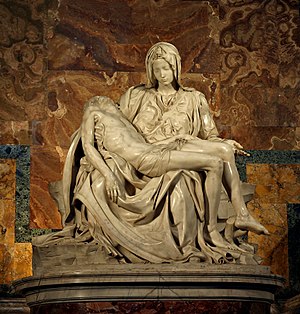
The second image is the Pietà, Michaelangelo’s to be specific. I keep thinking of this image in connection with the violent deaths of the children of Sandy Hook, Connecticut. It is likely that most of those parents were not able to cradle the bodies of their babies- stopped from doing so because of the cause of death and the condition of the bodies. Thus, I think of that image of Mary cradling the grown Jesus and remembering in her mind how she held him so many times before. I know those parents are remembering every moment they held their children. The other thoughts that are probably running through their minds are too hard for me to imagine. Not impossible to imagine, but too hard for me to consider and still let go of my own toddler and refuse to live in fear.
These images are not only interfering with my sleep, but they are marching into the forefront of my mind as I try to prepare for Christmas. One of the things that I wrestle with all the time, theologically and personally, is the connection between Christmas and Easter. More specifically, the connection between Christmas and Good Friday. I do not accept that Jesus was born, destined for the cross. I am not resigned to the idea that betrayal and crucifixion were inevitable. My faith is anchored, beyond the veil, in the trust that God is bigger than all things, was revealing that power before Jesus, and that the Messiah came into the world to be the clear sign of that power and a clear revelation of God’s expectations of creation.
Death, violent or otherwise, was never a part of God’s intentions for creation. With our scientific minds (and I love science), we understand a cycle of birth, decay, and death. Yet, our faith teaches that this is not preordained. We are not born to die. We are born for life. We are gifted with faith for abundant life. Somehow, in some way, the Christmas story is the heart of this truth- that God came into the world in an expected way, so that we might believe and live. When death tries to trump that truth, life wins. Love wins. Joseph does not stone Mary. The childhood illnesses that could have claimed Jesus’ life do not succeed. The devil’s temptations do not stand. The threats of detractors do not hold water. The cross and tomb are not the final word. Incarnation leads to not to crucifixion, but to resurrection. Life wins.
In this season of grieving, personal and public, for my friends, for people I do not know, for our world, I do believe that life wins. The story of God’s entrance into the world as one of us is not the beginning of that theme, but the powerful plot twist that no one expected and that surprises us still.
Every death, every stillbirth, every child, every 110-year-old, is a death that is too soon when it precedes God’s final renewal of heaven and earth. Yet these deaths are not the final word. That Word is God’s. The Word that has always been with God, indeed the Word that is God, is life. Life.
There comes a point where I don’t have anything else to say and so I have to stop talking. The grief is too real. The pain is too sharp. The explanations are weak or non-existent.
And still hope flickers.
And still we say, “Come, Lord Jesus.”
And still Life shines through the darkness. And the darkness cannot overcome it.

Advent Lions (Sermon 12/2)

Daniel 6:6-27
            Talk to me about the war on Christmas. How many of you are having a hard time finding Christmas decorations? How many of your family members have met you in back alleys to exchange cards, hoping to be undetected? Other than the icy roads, who was worried about coming here today? Has anyone been so deluged by Happy Holidays, Happy Hanukkah, or Kwanzaa commercialism that they just felt unable to get a word in edgewise for the Christmas holiday? Anyone?
            It is hard for me to listen to rhetoric about the “war on Christmas” and think about religious persecution around the world that happens today, both to Christians and non-Christians. It’s hard for me to listen to rants about the “war on Christmas” and to read about Daniel at the same time. Here is a story about real persecution and real faith. A story about a young Jewish exile, likely born in Babylon, never having seen Jerusalem… he serves under four kings, the first two of which change his name- not calling him by his Hebrew name Daniel, but by the Greek name- Belteshazzar. Daniel serves at the pleasure of the king and does not hold back from the obviousness of his true devotion to the one God.
            Daniel maintains a strict diet (see Daniel 1), interprets dreams (Daniel 3-5), and finally refuses to cave to pressure from jealous rivals and does not stop worshipping God (Daniel 6). This story is almost intimidating in Daniel’s faithfulness. He has no guarantee that God will prevent the lions from destroying him. God didn’t prevent the exile into Babylon. Daniel’s only comfort is in trusting in God’s faithfulness above all else- above the desertion of exile, above the power of King Darius, above the ferocious nature of the lions.
            When I think of what it means to live faithfully, under those kind of conditions, the much-discussed “war on Christmas” becomes unimpressive indeed. As we enter the season of Advent today, we are called to ponder what are the lions that face us? What is the exile we experience?
            We know that Christmas, the holy day (as opposed to the holiday), is not for another 22 days, beginning the evening of 24 December. Believing that God-with-us, Emmanuel, has already been born into world once, is present with us still, and yet will come again, what are we waiting for? The exile we experience is the space between what we believe is true and what we observe around us.
            We believe in the Prince of Peace and yet we do not see peace. We believe in the Spirit of Consolation and still we see many who are not consoled, grieving, anguished. We believe in the Creator of all that is seen and unseen and yet we see many who struggle- some because of their own decisions, some because of the actions of others. We believe a light shines in the darkness and the darkness has not overcome it, yet the darkness still seems very, very deep (and not just because it’s winter in Alaska).
            The lions that slink around us in Advent are both obvious and subtle. There are showy lions of commercialism, decadence, and acquisition. Their roars tempt us to place our hope in things that are shiny and promising now. Then there are the subtle, hungry lions of hopelessness, frustration, depression, and isolation. Their sneak attacks undercut our ability to stand false brightness of the holiday and leave us unprepared for the holy day. The war on Christmas isn’t some outside entity, but a struggle that happens within us and around us to undercut our waiting hope- emphasized this time of year, but lived out every day of the year.
            Our Advent exile- our time apart, waiting in hope- gives us the opportunity to fight off these lions, to dare to be a Daniel and to pray beyond the falseness of their promises. In this season of waiting, we are presented with the chance to exercise our faithfulness, our hope in God, our expectation of holiness, our trust in the promise of Emmanuel, God-with-us. And, like Daniel, our faithfulness only stands in the light- the undimmed light- of the One God who is the gifter, sustainer, and perfecter, who is Faithfulness itself.