
Category Archives: Christmas

Born that We No More May Die

I’m having trouble sleeping these days. Part of it is the late stage of being pregnant, but the other part is the pictures that keep running through my mind.
Not a picture of my friend
The first is picture of a friend of mine, her significant other and their baby, a baby who was stillborn last week, just before full-term. In the picture, she is clutching the baby, wrapped up, close to her chest and her SO is leaned over them both, his head touching hers and his eyes on the baby. It is a nativity to behold. 
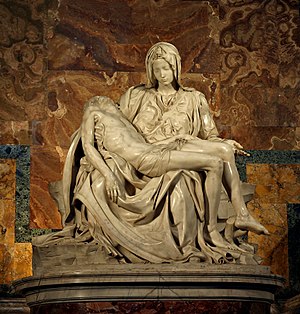
The second image is the Pietà, Michaelangelo’s to be specific. I keep thinking of this image in connection with the violent deaths of the children of Sandy Hook, Connecticut. It is likely that most of those parents were not able to cradle the bodies of their babies- stopped from doing so because of the cause of death and the condition of the bodies. Thus, I think of that image of Mary cradling the grown Jesus and remembering in her mind how she held him so many times before. I know those parents are remembering every moment they held their children. The other thoughts that are probably running through their minds are too hard for me to imagine. Not impossible to imagine, but too hard for me to consider and still let go of my own toddler and refuse to live in fear.
These images are not only interfering with my sleep, but they are marching into the forefront of my mind as I try to prepare for Christmas. One of the things that I wrestle with all the time, theologically and personally, is the connection between Christmas and Easter. More specifically, the connection between Christmas and Good Friday. I do not accept that Jesus was born, destined for the cross. I am not resigned to the idea that betrayal and crucifixion were inevitable. My faith is anchored, beyond the veil, in the trust that God is bigger than all things, was revealing that power before Jesus, and that the Messiah came into the world to be the clear sign of that power and a clear revelation of God’s expectations of creation.
Death, violent or otherwise, was never a part of God’s intentions for creation. With our scientific minds (and I love science), we understand a cycle of birth, decay, and death. Yet, our faith teaches that this is not preordained. We are not born to die. We are born for life. We are gifted with faith for abundant life. Somehow, in some way, the Christmas story is the heart of this truth- that God came into the world in an expected way, so that we might believe and live. When death tries to trump that truth, life wins. Love wins. Joseph does not stone Mary. The childhood illnesses that could have claimed Jesus’ life do not succeed. The devil’s temptations do not stand. The threats of detractors do not hold water. The cross and tomb are not the final word. Incarnation leads to not to crucifixion, but to resurrection. Life wins.
In this season of grieving, personal and public, for my friends, for people I do not know, for our world, I do believe that life wins. The story of God’s entrance into the world as one of us is not the beginning of that theme, but the powerful plot twist that no one expected and that surprises us still.
Every death, every stillbirth, every child, every 110-year-old, is a death that is too soon when it precedes God’s final renewal of heaven and earth. Yet these deaths are not the final word. That Word is God’s. The Word that has always been with God, indeed the Word that is God, is life. Life.
There comes a point where I don’t have anything else to say and so I have to stop talking. The grief is too real. The pain is too sharp. The explanations are weak or non-existent.
And still hope flickers.
And still we say, “Come, Lord Jesus.”
And still Life shines through the darkness. And the darkness cannot overcome it.

Advent Ache (Sermon 12/9)

Joel 2:12-13, 28-29

            Here’s the funny thing about Christmas- the holy days, not the holiday- it’s the shortest church season we have. Even if Lent starts early, Epiphany is still longer than 12 days. Lent is forty days. The Easter season is fifty days. The season of Pentecost or Ordinary Time goes on past twenty weeks. Advent is four weeks. Christmas, as church season, is short.
            Many of us get tired of seeing the Christmas things all around us long before we show up to mark the birth of the Savior and our true expectation of God’s completion of that good work in Christ’s return. Christmas can get old before it gets here and yet we’re uncertain what to do with Advent. (How many have Advent wreaths in their homes?)
            Frankly, I’m feeling very Advent. I go into Safeway and I hear, “It’s the most wonderful time of the year…” Yet all I can think about is the number of suicides that have been in the news this week.
I enter Fred Meyer and hear: “I really can’t stay (Baby, it’s cold outside). I gotta go ‘way (But, baby, it’s cold outside).” Yet, I think about the people who call the church office every week asking for food assistance, for gifts for children, for rental help.
           
            I wait to get my oil changed and I hear, “Santa Baby, slip a sable under the tree… for me… been awful good girl.” I think about the people who use the Listening Post downtown and the volunteers there who hear powerful and overwhelming stories, every day of the year- not just in this season.
            I turn on the car radio and I hear, “’Come,’ they told me, Pa-rum-pa-pum-pum.” I think of the drums of war, the drums of greed, the drums of fiscal concern that are beating all around.
            I have an Advent ache and the Christmas music can’t drown it out. The short Christmas season is never long enough to overcome all of these less cheery realities that are currently part of this life.
So then I sit in my office and I turn to the reading for this week- four short verses from the prophet Joel. Thinking about Joel’s time frame, one might expect that the book would be full of rejoicing, but it’s not. Joel is writing to the Judeans who have returned to Jerusalem after the exile. There may be a few people who can still dimly remember earlier days, but most of the exiles are younger and have never seen the city. The temple ruins, the place the market once stood, the homes haunted by memories of what was before Babylon swept in and carried it all away… the most intense longing for Jerusalem did not prepare them for the return.
            And in those first days and first weeks of trying to reclaim, resettle, restore, no one wants to say how disappointing it all is. How it is not what they expected. How the triumphant return has not only fallen flat, but flat out sucks. They are expecting Christmas- actually, they are longing for the Messiah- but they are in a very Advent time.
            And, honestly, it is an Advent time for God. The people did not return thanking God. They didn’t speed over the hills and valleys, with their hearts in their throats in anticipation of worshiping in what was left of the temple. Some of them chose to stay in Babylon, to adapt to life there-including the religious practices of the new location. God’s waiting, too- waiting for people to heed the call of the prophets, to sing the songs of praise, to stop taking favor for granted, but to put it to use for making the world a better place.
            It’s the Advent ache. Things are not what we would hope for. We are not always what God would hope for. The longing of this season allows us to sit in silence with that and to express our longing for God’s answer to the problem, to the gap, to the divide. The longing of the season allows us to sit with God’s own longing hope for creation. The response to that hope came at the first Christmas…and comes again in all kinds of ways.            
            Our Advents hymns express this longing, especially some of the ones that are worked into our liturgy.
Consider: Come, thou long expected Jesus– “born to set thy people free- from our fears and sins release us- set our hearts at liberty…” (Charles Wesley) The verses of this song express our hope in all that Christ’s advent will bring- freedom, peace, rest.
Consider: O come, O come, Emmanuel– written as early as the 8th century (or maybe a little earlier). Based on the old “O antiphons” or verses that reflection Advent anticipation. The verses in Latin form an acrostic, a word out of the first letter of each verse, the word Erocras meaning, “I will be tomorrow”. The longing for Christ in the song is answered, mysteriously, by a response that Christ is coming.
Consider: Ososo,  or “Come now, O Prince of Peace”. This is a Korean hymn, written in 1988 for a world conference focused on attaining peace and reunification for the Korean peninsula. “Come now, Lord Jesus, reconcile all nations” has a very different feel when you are considering people who are separated from family members, from resources, from peace.
            These are songs of Advent, songs of longing, songs that say, “Things are not what we hoped for.” The answer we get, to our singing and our sighing, is “Return to the Lord, your God, for he is gracious and merciful, slow to anger, and abounding in steadfast love, and relents from punishing.” Return to the Lord… gracious and merciful… steadfast love… slow to anger…
            Christmas is a short season, in part because we live in an Advent world. A world that has received God’s body in its midst and still remains broken. A world that has seen (and still sees) miracles like no other. A world that has been gifted the outpouring of the Holy Spirit… and still cries for reconciliation, for peace, for grace. It’s not a sin to not be ready for Christmas. It’s a reality. It’s a real expression of where we are, who we are, and what we are asking God to do in the world. It is honest to look at the paper, the city, the news, the world, and say, “This is not what we hoped for.” It echoes what God also is saying to us.
            Advent means God has not let our hope die. Advent is a season for waiting in the Lord, for returning to the Lord, for hoping in the Lord. It is not yet time for “Good Christian friends, rejoice, with heart and soul and voice…” It is the season of “Come, now, O God of love, make us one body. Come, O Lord Jesus, reconcile your people.”
Amen.