Category Archives: Choose this day

Nuclear Family Affair

I recently read this book: Full Body Burden: Growing Up in the Nuclear Shadow of Rocky Flats

I couldn’t stop reading, even when I was horrified and frustrated by the government coverups, the nuclear disasters, and the persistent denial that plutonium dust in the wind around the general Denver area was a problem.

Still processing, I wrote this long haiku:

Fukushima still

Leaks. Nearly three years later,

Oceans and air fill


With poisons. Unknown:

their full power, permanence,

possibility.


West Coast counters ping.

Measuring high, off the charts.

Radiation moves.


Do we still recall

Chernobyl and Rocky Flats?

Who will be a voice


For Three-Mile Island

Or Hanford? Did we forget

Not so long ago


Destruction promised?

Mutually assured, we

Worked fevered, counting


Our efforts as so

Much patriotism. Safety

Was secondary.


Radiation lives

Up to its name, spreading out

In water and air.


In animals and

Dusting our salad leaves, we

Take every meal with


Delectable sides

Of plutonium, along

With other spices.


Mutual, assured

Destruction has become real.

Nuclear waste kills


Us before we can

Eliminate each other.

Still we don’t, won’t quit.


Don’t act. Stay silent,

Confused. Would our government

Lie? Cover up? Say


Something is quite safe

When it is killing us, our

Children, theirs, and theirs?


What cost: energy?

Bomb stockpile must equal X.

When is it enough


Proliferation?

For any country? Person?

When does will it end?


This is my Father’s

World. And my children’s. Neighbors’

And my enemies’.


Will I pray with my

Feet, hands, voice, dollars, Spirit.

Even if it feels


Futile? Otherwise

Poison hisses over both

Apples and tuna.


Cleaning and clearing

Deserve our every effort

Since mutually


Assured blessings are

Certainly preferable

For all creation.


Fukushima still

Leaks. Nearly three years later,

Oceans and air fill


With poisons. Unknown:

their full power, permanence,

possibility.


Cross-posted at RevGalBlogPals for The Pastoral is Political. 

Deck Chairs

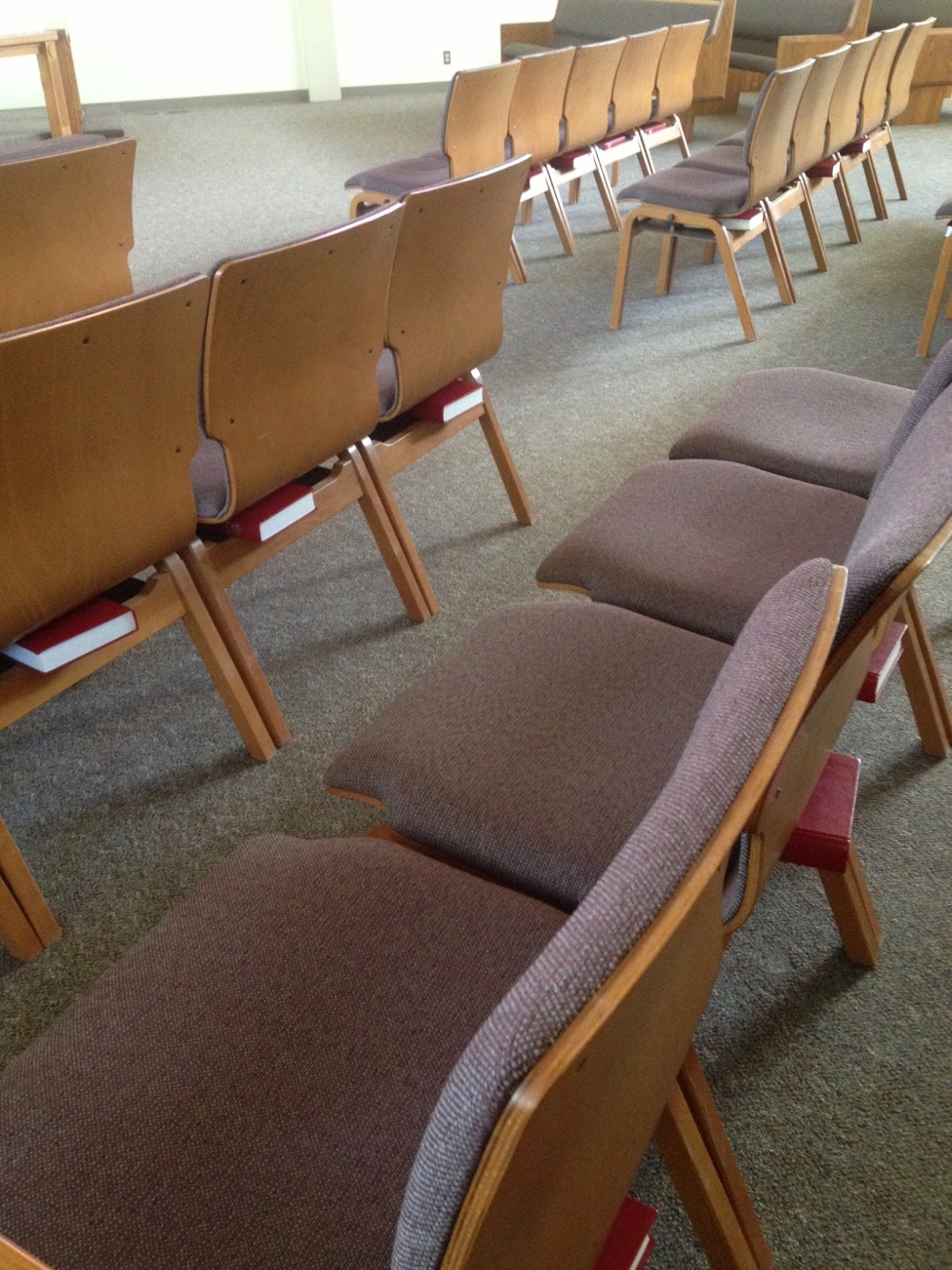
Yesterday, I rearranged the chairs in the church sanctuary. Since the second Sunday in the Easter season (the 1st Sunday after Easter), we’d been sitting in a circle with the altar inside the circle. Many people loved this arrangement. An smaller number of people hated it and there were a minority with no [expressed] opinion.
In an effort to be more visitor-oriented for the summer (our biggest visitor season), we moved the chairs back into their neat little rows. I did not put out as many rows as we had previously because we just don’t need that many chairs. We have moveable chairs and fixed pews. I arranged five rows of six chairs each on two sides (60 chairs). We also have four pews on each side, which could easily accommodate 5-6 people each. Let’s say 5. Thus, we easily have seating for 40 people in the pews.
Sixty plus forty is one hundred (100). We have available seating this Sunday for 100 people.
Last Sunday, at our regular service, we had 37 people.

 
37.
I thought about each of those 37 people as I arranged the chairs yesterday. The circle put us all closer together and made the space seem full and warm. This Sunday, forty people will be spread across seating for 100. The empty seats will be obvious.
And I arranged the chairs.
So frequently I am drawn into conversations about the shrinking church, about lowered attendance, about why people no longer make church a priority.
These are serious questions.
The answers are not really about the style of music or the kind of preaching or the kind of coffee or whether there is childcare.
All of those things are just a different arrangement of the chairs.
The truth is that the people who do regularly attend church (of whatever kind) have to be convinced that what is offered to them, what matters to them, could and would matter to other people. And then they have to act on that thought.
Our desire to see other people experience what we experience in church (if we experience something worth sharing) must be greater than our fear of rejection and failure.
We have to reject, forcefully- with the help of the Spirit, the forces that seditiously whisper the words “inevitable decline”, “too small to matter”, or “too old-fashioned” to oppose God and God’s work. 
We can arrange the chairs in all kinds of ways.
But if we believe that the message of Christ ever mattered, then we must move out in faith BECAUSE THE MESSAGE IS AS IMPORTANT NOW AS IT HAS EVER BEEN.
The message is as important now as it has ever been.
If we do not think it is worth sharing… worth conquering our fear… worth sinning boldly for… then it doesn’t matter. 

And it never did.
In that case, I have some chairs for sale. 

A Statement of Faith for All Saints Day

We believe in God, who brings creation out of chaos, healing out of brokenness, light out of darkness, and life out of death.
We believe in Jesus Christ, God’s Son and our Lord.
Jesus came into the world for teaching, for healing, for reconciliation, and to announce the reign of God’s kingdom.
Though his work was opposed, even unto death, the Word of Life could not be silenced.
He was resurrected for the sake of all, including we who are gathered here.
We await his return in glory and we continually look for his presence in this life.
We trust this expectation is not in vain. 
We believe in the Holy Spirit, giver of the gifts of community, communion, and consolation.
The Spirit preserves our hearts in the midst of things we cannot understand and connects us to the cloud of faithful witnesses, who are our encouragement.
The Spirit shapes us as God’s people and gives us faith and courage to respond to the gifts of mercy, grace, and healing until we reach the place our faith moves from hope to revelation.
Amen. 

God’s Plan, Our Choices (Sermon 9/23)


Genesis 15:1-6
            What is God’s plan? Many times, in some of the darkest moments of our lives, people (well-meaning people) tell us that God has a plan for our pain, that what has happened to us makes sense in a grand scheme, that we are not hurting in vain. Yet think about what that says about God: that God uses pain as a means to an end, to bring us where God wants us to be? That there is a long-range plan, full of illnesses and pains, which is how God is bringing the kin-dom into fruition? That the forces that oppose God, including cancer, chaos, and criminal actions, do not really have any power- though we go through the motions of renouncing them at baptism.
            If God’s plan for the world is down to the tiny details, what’s our part in it? Do we play a role? Are the encouragements in the creation story, the relationship that we see there between God, humans, and the rest of creation, is that a real relationship or just a backdrop while God moves us around according to a plan?
            If we take a look at Abraham’s story, we can see two things: one is God has a plan and two, people are participants in that plan. God’s plan for Abraham is no less than God’s plan for anyone of us- a future, hopes fulfilled, abundant life. God draws Abram out into the dark of the night and promises that, though currently childless, he will be a father to many generations. God has a plan for Abram’s future… including a name change, but God’s plan requires trust and faithful action on Abram’s part.
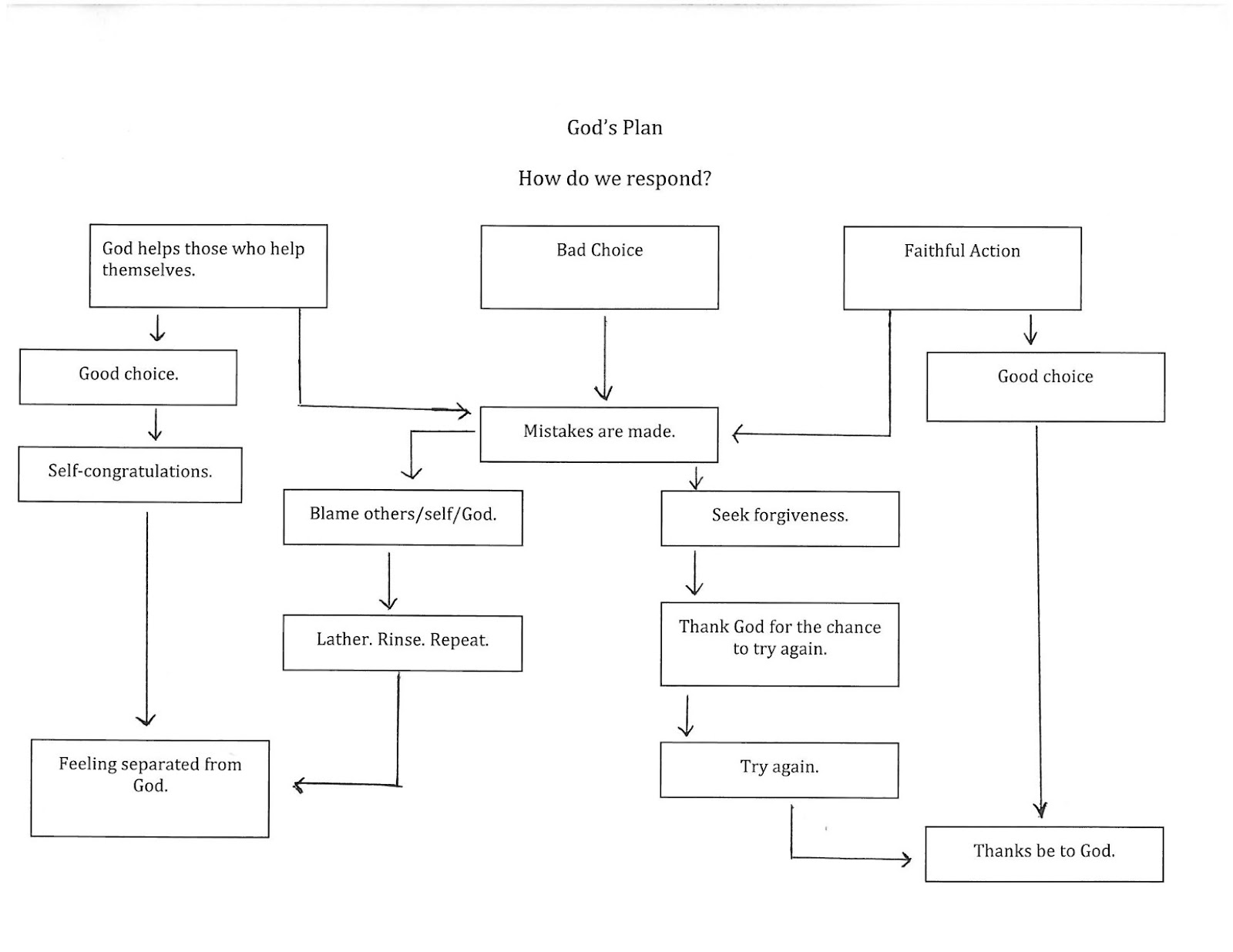
See chart above:
The chart moves from the idea that God has an over-arching plan, but we are called to respond, through the gifts of faith and free will. Consider the choices Abram/Abraham made. 
God helps those who help themselves: Hagar and Ishmael
Expedient Choice (ending up badly): Passing Sarah off as his sister
Faithful action: leaving homeland, creating Isaac, arguing on behalf of Sodom and Gomorrah, near-sacrifice
            Each of this situations arise from choices that Abraham makes, just like each of us find ourselves in situations because of our own choices. Occasionally, we find ourselves in situations, good or bad, because of someone else’s choices. As participants in God’s work in the world, as co-creators and communicators of God’s blessings (just like Abraham), we are continually called to think through who we are as people, as families, as a faith community, as a city/state/nation.
            The idea that God is micro-managing us and everything else leads to a kind of carelessness- a disregard for ourselves, for others, and for creation. The idea that God helps those who help themselves inevitably leaves someone out in the cold and, eventually, leaves many people feeling separated from God.
            Faithful living, on the other hand, is hard work. It comes from trust. Trust can only be based on a foundation of fulfilled promises, consistent action, and a reasonable expectation of future care. The Abraham story lets us see that we can only expect those things from God and not because of God’s reign in minutiae, but because God is the details of care, of peace, of justice, of community relationships.
            Because we see through scripture and through experience that we can trust God and that trust makes the foundation of our faith, which God graciously counts to us as righteousness. We get credit for the right response because of God’s history of faithful action to God’s people and through Jesus.
            God’s plan is always for creation in the way he explained it to Abraham- a plan for generations, a plan for descendants, a plan for a future hope and a fulfilled promise. God also graciously invites us into that plan, gives us the solid foundation of faith, and allows us the freedom of choice in how to respond. Do we deserve this? No. Did Abram deserve a special promise? Did Mary deserve to be chosen by God? It’s not about what we do, any of us, it is always about what God does. God’s plan always included the curious, the stubborn, the little, the lost, the least, you, and me. And that plan, into which you and I are invited, is always for hope, for justice, for blessing, for creation, for relationship, and for peace.
            Amen. 

Choose This Day (Sermon 8/26)

Joshua 24:1–2a, 14–18; John 6:56-69
If, on a morning, I open my eyes,
My first decision thereupon lies.
Will I continue to lie in the bed,
Allowing my thoughts to run through my head?
Will I get up and go to the shower,
Regardless of both weather and hour?
What of my child, who may want me to stay?
What of the tasks that call me this day?
From the minute of waking, there are choices to make,
What will I give today? What will I take?
I want to be saintly and say my first thoughts are of God,
But sometimes they’re not and, in that, I’m not odd.
We may rise with the sun or maybe at noon,
And we make hasty promises to get with God soon.
Yet, that instant, a choice has been made-
The balance of time against God has been weighed.
We can’t do it all. Surely God understands.
Consider this: did not God make this world, its demands?
But in each thing we choose, and it is choosewe must
We have decided in which god we shall trust.
When we make decisions for work or for pleasure,
With money or time, talents or leisure,
With each small decision we leave or we make,
We are choosing a god for each task’s sake.

When Joshua says, “Choose this day whom you’ll serve.
My household and I, from God we’ll not swerve.”
He means the God of justice and freedom,
The God who through the desert did lead them.
This is a God of providence, of mercy and manna
Compared to others, God proved top banana.
For the Israelites, Joshua clearly lays out a decision,
Because they had, in history, treated God with derision.
Sometimes God seemed so far and so distant,
They struggled to find God’s mercy consistent.
Yet, who gave the manna? Who gave the quail?
Who brought forth the water when the people did wail? 
“People of Israel,” Joshua said,
“Turn all that you’ve known ‘round in your head.
Think of the guidance through both day and night,
Think of God’s grace. Think of God’s might.”
The people responded, “Our choice has been made.
We’ve looked around. Only Yahweh makes grade.
Only one God can say, ‘I am who I am’
Only one God would work for our father, Abraham.”
So Israelites promised to serve God whatever may come,
For richer, for poorer, when happy, when glum.
The years passed, however, and memories faded.
People thought of this choice and became jaded.
The desert, the manna- they all became history.
What God’s doing now… that became mystery.
It became easier to feel freed by law and instruction,
Only society’s rules prevented destruction.
But that structure left some people wanting,
The gift of the law could seem rather daunting.
When onto the scene, this man Jesus appeared.
Some people rejoiced. Some people jeered.
Then, and again, he talked about bread
About life here right now and life after we’re dead.
He healed sick people, he fed many others,
But his teaching confused both sisters and brothers.
What was this about flesh to eat, blood to drink?
A hard teaching to swallow, most people did think.
Said his disciples, “Jesus, this is enough.
What you’re teaching- it’s too much. It’s too tough.
We don’t like it. We don’t understand.
We’d like to quit you, but it doesn’t seem that we can.
We’ve looked around as to where we might go.
The problem is, there’s some truth we doknow.
Within a world of struggle and strife,
You have the words of eternal life.
Only you have offered hope in the future,
Between God and us, you are the suture.
Even though it is hard to stay,
We cannot leave you or your way.”
The disciples decided (or most of them did)
It was with Jesus that they placed their bid.
They decided, as their ancestors had,
To be on God’s side couldn’t be bad.
And so I say to you this day…
“Wait, Pastor Julia, I’ve something to say…”
“What is it, my child, what bothers you so?”
“Well, you’ve confused me. And so I must know
I thought God chose us. I thought it was done.
I thought the war’s over. The fight had been won.
Didn’t Luther write we’d never say yes…
Without God’s Spirit, we can’t acquiesce!
If you tell us, ‘Today you must choose’
Are you not setting us up… to lose?”
You are right, my child, in every way.
And yet you made a choice today.
You came to be here, to be in communion
To pray, to eat, to embody reunion.
Each day, we see gods far and near.
We can worship success. We can give over to fear.
We can spend our resources or over-honor our kin,
We can reverence our bodies from our toe to our chin.
We can make work our idol, honored, adored.
We can seek that which gives immediate reward.
But in the end, it all fails. It all becomes dust.
These idols- they fade, they die, they rust.
In the end, what we want is something that lasts,
Something that goes beyond all other forecasts.
What can bring order to confusion and strife?
Only the hope of eternal life.
Eternal life, both for there and for here.
A growing, a knowing, a ridding of fear.
This is what Jesus offers- in body and blood.
Without that promise, bread and wine are just mud.
Like us, they’re from dust and to dust shall return,
But through eating and drinking, still we can learn
That God has chosen in creation’s favor,
The presence of Christ is what we savor
When we gather at table, both willing and able
To experience Jesus as truth and not fable.
To trust, to be open, is the choice we must make,
Each day, in the moment right when we wake.
In every moment, we choose a god to serve
With all that we have, each sinew and nerve.
We have a God on the side of all of creation,
Who knows and who loves without cessation.
Who gives us each talents and gives us each gifts,
Who forgives our sins, who mends our rifts.
Who with body and blood has chosen to feed us.
Who through valleys and o’er mountains, has chosen to lead us.
Lord, where could we go? You made us, you know us.
Now, through the Spirit, continue to grow us.
God has called you by name, so as your fear eases,
Choose your god. Every day. I recommend… Jesus. 
Amen.

Gotta Serve Somebody

This week’s reading from Joshua includes the famous verse:

 “Now if you are unwilling to serve the Lord, choose this day whom you will serve, whether the gods your ancestors served in the region beyond the River or the gods of the Amories in whose land you are living; but as for me and my household, well will serve the Lord.” (Joshua 24:15) 

When I think of this verse, I consider the truth that we’re never really choosing if we are going to have a god, we’re constantly choosing what we will worship as god. Will we choose the God of creation, who has chosen us, or we will choose any number of lesser gods- whose glittering promises of health, wealth, and power are played like siren calls from all corners of the world? 
Whom will we serve? 
I keep hearing the words of the prophet, Bob Dylan, singing, “You gotta serve somebody…” It’s not that we’ve gotta, it’s that we’re gonna… so whom will you choose? 

“Gotta Serve Somebody”
You may be an ambassador to England or France
You may like to gamble, you might like to dance
You may be the heavyweight champion of the world
You may be a socialite with a long string of pearls.

But you’re gonna have to serve somebody, yes indeed

You’re gonna have to serve somebody,

It may be the devil or it may be the Lord

But you’re gonna have to serve somebody.

Might be a rock’n’ roll adict prancing on the stage

Might have money and drugs at your commands, women in a cage

You may be a business man or some high degree thief

They may call you Doctor or they may call you Chief.

But you’re gonna have to serve somebody, yes indeed

You’re gonna have to serve somebody,

Well, it may be the devil or it may be the Lord

But you’re gonna have to serve somebody.

You may be a state trooper, you might be an young turk

You may be the head of some big TV network

You may be rich or poor, you may be blind or lame

You may be living in another country under another name.

But you’re gonna have to serve somebody, yes 

You’re gonna have to serve somebody,

Well, it may be the devil or it may be the Lord

But you’re gonna have to serve somebody.

You may be a construction worker working on a home

You may be living in a mansion or you might live in a dome

You might own guns and you might even own tanks

You might be somebody’s landlord you might even own banks.

But you’re gonna have to serve somebody, yes 

You’re gonna have to serve somebody,

Well, it may be the devil or it may be the Lord

But you’re gonna have to serve somebody.

You may be a preacher with your spiritual pride

You may be a city councilman taking bribes on the side

You may be working in a barbershop, you may know how to cut hair

You may be somebody’s mistress, may be somebody’s heir.

But you’re gonna have to serve somebody, yes 

You’re gonna have to serve somebody,

Well, it may be the devil or it may be the Lord

But you’re gonna have to serve somebody.

Might like to wear cotton, might like to wear silk

Might like to drink whiskey, might like to drink milk

You might like to eat caviar, you might like to eat bread

You may be sleeping on the floor, sleeping in a king-sized bed.

But you’re gonna have to serve somebody, yes indeed

You’re gonna have to serve somebody,

It may be the devil or it may be the Lord

But you’re gonna have to serve somebody.

You may call me Terry, you may call me Jimmy

You may call me Bobby, you may call me Zimmy

You may call me R.J., you may call me Ray

You may call me anything but no matter what you say.

You’re gonna have to serve somebody, yes indeed

You’re gonna have to serve somebody,

Well, it may be the devil or it may be the Lord

But you’re gonna have to serve somebody.