Category Archives: Children of God

Nuclear Family Affair

I recently read this book: Full Body Burden: Growing Up in the Nuclear Shadow of Rocky Flats

I couldn’t stop reading, even when I was horrified and frustrated by the government coverups, the nuclear disasters, and the persistent denial that plutonium dust in the wind around the general Denver area was a problem.

Still processing, I wrote this long haiku:

Fukushima still

Leaks. Nearly three years later,

Oceans and air fill


With poisons. Unknown:

their full power, permanence,

possibility.


West Coast counters ping.

Measuring high, off the charts.

Radiation moves.


Do we still recall

Chernobyl and Rocky Flats?

Who will be a voice


For Three-Mile Island

Or Hanford? Did we forget

Not so long ago


Destruction promised?

Mutually assured, we

Worked fevered, counting


Our efforts as so

Much patriotism. Safety

Was secondary.


Radiation lives

Up to its name, spreading out

In water and air.


In animals and

Dusting our salad leaves, we

Take every meal with


Delectable sides

Of plutonium, along

With other spices.


Mutual, assured

Destruction has become real.

Nuclear waste kills


Us before we can

Eliminate each other.

Still we don’t, won’t quit.


Don’t act. Stay silent,

Confused. Would our government

Lie? Cover up? Say


Something is quite safe

When it is killing us, our

Children, theirs, and theirs?


What cost: energy?

Bomb stockpile must equal X.

When is it enough


Proliferation?

For any country? Person?

When does will it end?


This is my Father’s

World. And my children’s. Neighbors’

And my enemies’.


Will I pray with my

Feet, hands, voice, dollars, Spirit.

Even if it feels


Futile? Otherwise

Poison hisses over both

Apples and tuna.


Cleaning and clearing

Deserve our every effort

Since mutually


Assured blessings are

Certainly preferable

For all creation.


Fukushima still

Leaks. Nearly three years later,

Oceans and air fill


With poisons. Unknown:

their full power, permanence,

possibility.


Cross-posted at RevGalBlogPals for The Pastoral is Political. 

My Brother’s Not Heavy. Jesus Said So.

I’ve been thinking about the cuts to SNAP (Supplemental Nutrition Assistance Program) last week. Remember the House voted 217 to 210 to separate SNAP from the farm bill. The legislation that passed will significantly reduce SNAP funding in the next four years.
Good! Too many people abuse that program. Too many people sit around- expecting handouts.
Do you really think that? Do you truly believe the majority of food stamp (SNAP) recipients are just sitting around, doing nothing, and waiting for the mail?
Yes, I do. I’ve been to the grocery store on the day the benefits come out. It’s crazy.
Did you think it might be because people didn’t have the funds to go shopping prior to that day? Maybe their spare cash went to rent or a car payment.
Or to cable or to pay for an iPhone.
What would satisfy you in this scenario? There are genuinely people who cannot make ends meet. Do you care at all about that?
Let them get a second job.
Who will watch their kids during that time?
Maybe they should have thought about that before they had kids.
*Sigh*.
You know, the gospel reading for this Sunday is the parable of the rich man and Lazarus. You know the one where the rich man feasts every day in expensive clothes and there’s a starving, sick man outside his doorstep whom the rich man ignores. Maybe he doesn’t even ignore Lazarus. Maybe he truly doesn’t see him.
Anyway, Lazarus dies and the angels carry him to be with Abraham. The rich man dies and goes to a place of torment. When he asks Abraham to send Lazarus with water, Abraham informs the rich man that the chasm between them could not be breeched.
Furthermore, Lazarus can’t go to warn the man’s brothers what happens if they are not good stewards of the gifts with which they have been endowed. They already have Moses and the prophets to do that.
What does this have to with SNAP? Or are you trying to change the subject because you were losing?
No, we always think about how Lazarus would have loved the crumbs from the rich man’s table. We make a big deal about how little the rich man could have done and how much it would have helped them both. But, in truth, SNAP is just table scraps, it’s nothing but crumbs. Congress could have passed that legislation and it would have been the merest noblesse oblige, but they couldn’t be bothered to do even that.
You always want to give other people’s money away.
No. I want to distribute God’s gifts. We can’t just throw out scraps or cast-off clothing or donate an old car and consider our duty done. There’s no justice in that.
Where’s the justice in feeding someone who doesn’t work?
Fine. There are people who cheat. There are all cheaters at all levels of society, but our almost single-minded focus on those in the lower economic bracket is gross and misguided. If you want people to NOT use SNAP and other assistance programs, we have to start sooner. We have to work on schools and neighborhoods and our justice system. We have to actually care enough about our neighbors to want to see them flourish and to help them do it.
Why?
Would you show up at a barn raising and throw a sack of nails across the floor and call it good?
No. I wouldn’t go to a barn raising at all. I don’t care about someone else’s barn.
And why would you? Their barn is their problem. They need to get it up by themselves. Fill it by themselves. And then feed themselves from it. Just like you do.
Yes.
Where do you get your seeds?
From the farm supply.
That’s cheating. Make them yourself.
But-
NO! You can’t have help. You have to make the seeds yourself. And it’s going to be a bitch building your own tractor. Let me know how you’re going to figure out smelting your own iron and making the rubber for the engine gaskets.
It’s not a subtle point you’re making.
It must be. Otherwise, we wouldn’t have the same fight all the time. No one is self-made. There is a fundamental human community that must be recognized so that life for EVERYONE can improve. Lazarus and the rich man must learn to see one another, accept help from one another, and truly desire the wellbeing of one another.
But doesn’t Jesus say, “There will always be poor among you.” If I help the poor, aren’t I proving Jesus wrong? You wouldn’t want that.
Jesus isn’t proscribing a permanent situation. He’s speaking about a specific instance wherein his body could be honored- when people could actually honor the body of God. (Mark 14:7) He goes on to mention you can help the poor ANYTIME, but you shouldn’t fail to do so- under the guise of “giving to God”.
You just have all the answers, don’t you.
No, I don’t. But I do believe God expects us to help our neighbors. And I believe that God grieves when we miss clear opportunities to lift other people up into freedom and hope. Cutting SNAP is exactly the kind of thing that causes pain and is the evidence of a society with misplaced priorities.
Do you want people to be on assistance forever?
No. I dare to dream of something bigger- where people have enough to eat and aren’t afraid of getting sick and are able to save and have dreams for themselves. I dream of the possibility of joy. Not happiness, but joy. True gospel joy that flourishes in security and trust. Not flat happiness that is fleeting and based on momentary stability that can be snatched away. We must all want that enough for our neighbors and want it more than we want money or goods or services.
What if I don’t?
Then maybe you need to revisit Luke 16. 

Notes on Jacob

(These notes were my “back-up” reflection for Sunday 9/22/13. God delivered a much more intense word in reality. The audio is in this post.)

Genesis 27:1-4, 15-23; 28:10-17
            For me, the stories of Genesis begin to feel “real” when Jacob appears on the scene. I understand Abraham as the “Father-of-many” and father of our faith. I sympathize with Isaac- in the binding, in the grief of the death of his parents, etc. However, Jacob- wrestling within the womb, grasping all he can, wanting more than he can define clearly, and prepared to do anything to get it- Jacob is a truly fleshed-out character, a human being, a person who makes the Scriptures pop and sing. After all, why would this ancestor be included, with his cheating and tricky ways, except that through him, we understand (like many generations before us) that God is no respecter of persons.
            Jacob comes out of the womb clinging to Esau’s heel and spends the rest of his childhood trying to overtake him. An oracle is revealed to his mother, Rebekah, there were two nations in her womb and the younger would overtake the older. Whether this provokes her later actions or gives her an excuse for what she does, Rebekah doesn’t hold back from helping Jacob grab onto what’s not his.
            Of course, Esau doesn’t help. He is very willing to give into his human desires, too. A birthright, his right to inherit all his father’s material property, for a lentil stew- is this the decision of a model older sibling? Of course, we grieve for Esau when he loses out on Isaac’s blessing. This is not a mere “bless you, my child”- but a powerful blessing that conveys with it the covenantal relationship between God and Abraham that will now be passed to Jacob. God’s words brought this into being and Isaac’s words pass it to Jacob. He cannot withdraw these words once spoken.
            Jacob has to flee so that Esau will not kill him. He has both the birthright (his father’s property) and the blessing of an elder son, but he is afraid and alone. He sleeps on a rock- probably terrified for his life for the first time ever. In his exhaustion, he has a vision of heaven and God speaks to him.
            Jacob is granted the one thing he cannot grab for himself- God’s blessing. God shows him a glimpse of heaven and speaks to Jacob of what is to come. Jacob will own the land on which he currently sleeps. He will have many children. God’s own legacy will spread out through Jacob.
            And it does. It is neither Abraham nor Isaac who receive the name “Israel”. It is not Sarah or Rebekah who give birth to the man who will save the Hebrew people from starvation- it is one of the wives of Jacob. The people of Israel are named through Jacob. The 12 tribes of the nation come through Jacob. Much of the identity of what it meant to be an Israelite comes through Jacob- a man who wrestled that blessing from God.
            The story of Jacob tells us that God is in places we do not expect, as Jacob found out when he slept in the desert. More importantly, God is present in people we do not expect and God is using them in ways we do not expect. Additionally, God’s blessing is not something we can grasp for ourselves. No one is keeping it from us and we are not earning it through good behavior. It is God’s to give freely and God does so, through the power of the Living Word.
Amen. 

Deck Chairs

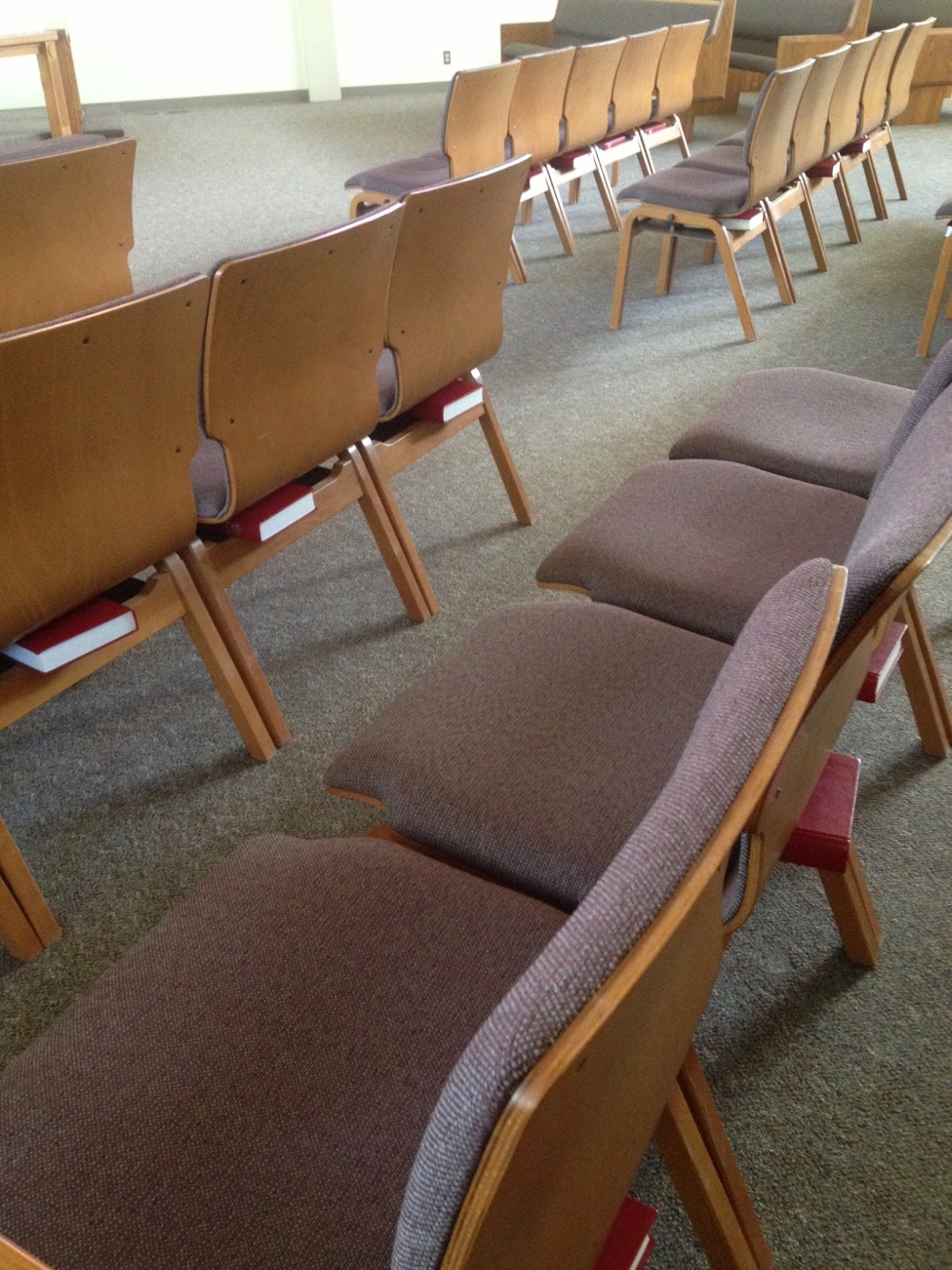
Yesterday, I rearranged the chairs in the church sanctuary. Since the second Sunday in the Easter season (the 1st Sunday after Easter), we’d been sitting in a circle with the altar inside the circle. Many people loved this arrangement. An smaller number of people hated it and there were a minority with no [expressed] opinion.
In an effort to be more visitor-oriented for the summer (our biggest visitor season), we moved the chairs back into their neat little rows. I did not put out as many rows as we had previously because we just don’t need that many chairs. We have moveable chairs and fixed pews. I arranged five rows of six chairs each on two sides (60 chairs). We also have four pews on each side, which could easily accommodate 5-6 people each. Let’s say 5. Thus, we easily have seating for 40 people in the pews.
Sixty plus forty is one hundred (100). We have available seating this Sunday for 100 people.
Last Sunday, at our regular service, we had 37 people.

 
37.
I thought about each of those 37 people as I arranged the chairs yesterday. The circle put us all closer together and made the space seem full and warm. This Sunday, forty people will be spread across seating for 100. The empty seats will be obvious.
And I arranged the chairs.
So frequently I am drawn into conversations about the shrinking church, about lowered attendance, about why people no longer make church a priority.
These are serious questions.
The answers are not really about the style of music or the kind of preaching or the kind of coffee or whether there is childcare.
All of those things are just a different arrangement of the chairs.
The truth is that the people who do regularly attend church (of whatever kind) have to be convinced that what is offered to them, what matters to them, could and would matter to other people. And then they have to act on that thought.
Our desire to see other people experience what we experience in church (if we experience something worth sharing) must be greater than our fear of rejection and failure.
We have to reject, forcefully- with the help of the Spirit, the forces that seditiously whisper the words “inevitable decline”, “too small to matter”, or “too old-fashioned” to oppose God and God’s work. 
We can arrange the chairs in all kinds of ways.
But if we believe that the message of Christ ever mattered, then we must move out in faith BECAUSE THE MESSAGE IS AS IMPORTANT NOW AS IT HAS EVER BEEN.
The message is as important now as it has ever been.
If we do not think it is worth sharing… worth conquering our fear… worth sinning boldly for… then it doesn’t matter. 

And it never did.
In that case, I have some chairs for sale. 

Hope Looks like My Pruned Lilac Tree


Job 14:7-9 (out of context) NRSV
For there is hope for a tree, 
Though its root grows old in the earth, 
If it is cut down- that it will sprout again, 
and that its shoots will not cease. 
and its stump dies in the ground, yet at the scent of water it will bud
and put forth branches like a young plant. 
……………………………………


Interpretation:


The scent of hope is 
Water, wafts on the fragrant
Breath of the Spirit.


Washed and Fed for the World

Easter 4 (Narrative Lectionary, Year C)
21 April 2013
Acts 8:26-39
The Holy Spirit does not hold to geographic boundaries. The Spirit does not hold to racial lines or ethnic markers. The Spirit does not detour to avoid the people we’d prefer not to see, not to hear, not to sit beside, or have included in our gathering. In the passage from Acts 8, that person is the Ethiopian eunuch. A eunuch is a man who does not have functioning testicles- either because they did not develop or because he has been maimed. A eunuch’s ability to reproduce has either withered on the vine or been pruned.
A eunuch is still a Jew, but may have been excluded from the assembly. Thus, for the purposes of temple life and worship, a eunuch is a man who is essentially a woman. And women don’t get to offer sacrifices. They don’t have standing. One’s blessings come through one’s husband and one’s ability to be receptive to his offerings, so to speak. (This is just awkward for everyone, but this eunuch is important. So stay with me.) A eunuch cannot fulfill the “actions of a man”(so to speak), so he does not get the privileges of being a man… including gathering in the assembly of the faithful. (Deut. 23:1)
Now, in your reading of Isaiah, you may recall a little song about eunuchs with a different tune. The prophet writes: Let no foreigner who is bound to the LORD say, “The LORD will surely exclude me from his people.” And let no eunuch complain,“ I am only a dry tree.” The prophet goes on to say that God will give a memorial better than children to faithful eunuchs, to faithful people. It might have served for God to mention that in one or two other places, since repetition is one of the main ways we learn, but sometimes I think God says to us, “How many times do I have to tell you this stuff?” (Isaiah 56:3)
            The Ethiopian eunuch is a servant in the queen’s court, chosen for that valued position because of his sexual safety. He will not overthrow the government because he cannot have children to continue his line, so (presumably) it would not be worth it. He obviously understands himself to be Jewish because he has traveled to Jerusalem for worship, for worship in the community that may not receive him. He goes to be present with people who are, mostly, of much lower social status than he is as a royal servant. The man has his own chariot and copies of Scripture. Even Peter doesn’t have that!
            Now consider this: how badly would you have to want to worship to travel hundreds of miles to go to a place that wouldn’t receive you to worship a God whose people have conspired to exclude you from the fullness of community? How much would you have to crave sacramental life to be enriched by just being close to it, much less participating? How much would you have to desire to know more about God’s salvation, which might not include you, to be reading a scroll of Isaiah on a bumpy chariot ride back to your home country? Does anyone here have that much desire? Is anyone here willing to allow the Spirit to be that powerful in his or her lives?
            And Philip appears- running alongside the chariot. Philip, who has been assigned to be a part of the food distribution in the Jerusalem meeting houses, is now speaking to someone who might as well be from the ends of the earth. Philip says, “Do you know what you’re reading?” and then goes on Isaiah’s servant song in the light of Jesus Christ. When Isaiah wrote it, it was understood in to apply to God’s servant Israel and Israel’s people. The Spirit’s interpretive expansion helped the early followers of Jesus to understand him (and their own call) as the servant who suffers for the sake of God’s work in the world.
            Moved by this interpretation, moved by this Bible study, the Ethiopian eunuch stops the chariot and says, “Here is water. What is to prevent me from being baptized?” He is so transformed by hearing Philip’s discourse on Jesus that he cannot wait to be included in the community through God’s promise in water and word. Baptism will change his allegiance, and his alliances, but it will be worth it because he will be drawn, clearly, into the story of God that the Spirit has been whispering in his ear.
            Does anyone here desire baptism that much? Does anyone long to revisit their baptism? Have you held yourself back from just splashing your face in the font- to remember, to clear your vision, to wake you up to your life reorientation in Christ? We trust that God loves and uses people who are not baptized, but in the Christian community it is the marker of beginning and belonging. It is a moment we can revisit again and again- a moment when the salvation we work out with fear and trembling became tangible. We are supposed to crave this moment- remembering it and desiring it for all around us.
Along with holy communion, the baptismal font give us a different lens for seeing ourselves, the people around us, and the people who we encounter outside of these doors- the same expanding circles of Spirit-inclusion that are in the Acts reading (the people in Jerusalem, the people in Judea, the people in Samaria, the people in Ethiopia and beyond). These sacraments, two places where we are assured of Christ’s presence, make us citizens in the kingdom of God with work to do right now. Part of that work is sharing the message that is implicit in these acts of communal washing and eating together- the message that all people are children of God.
When the world says, “racial minority”, we say “child of God.”
When the world says, “sexually suspect”, we say “child of God.”
When the world says, “illegal immigrant”, we say “child of God.”
When the world says, “homeless by choice”, we say “child of God.”
When the world says, “Palestinian or Israeli”, we say “child of God.”
When the world says, “mentally ill”, we say “child of God.”
When the world says, “terrorist”, we say “child of God.”
            The naming of our people, our friends and our enemies, as children of God puts us in the position to do the work of Christ. Work of feeding. Work of peace-making. Work of creating equality. Work of ensuring justice. The work of making God’s presence real by revealing that presence through the actions of God’s people. I am not saying we make God real through our right actions. I am saying that who God is becomes understandable through the clear actions of the people who call themselves people of God.
            In a world full of terror, natural disasters, and preventable human tragedies, there are people who crave good news. There are people who need advocates, though they may be in the wrong. There are people who are certain that they will never belong to the community of God- but they read the story anyway. In a world with this kind of longing, how do you account for the hope that is within you? Do we dare to cheapen God’s grace by assuming that the font and the table exist merely to assure us of God’s affection for us?
            These are dangerous places. They change the way we see the world and the way we see all children of God. We should approach these places with trembling- longing for the truth of their promises and afraid of what faithful participation will lead us into doing?
            The Holy Spirit does not hold to geographic boundaries. The Spirit does not hold to racial lines or ethnic markers. The Spirit does not detour to avoid the people we’d prefer not to see, not to hear, not to sit beside, or have included in our gathering.  And the Spirit does not, cannot, will not, pass by you
Amen.