Category Archives: Advent

Wild and Holy is Our God (Sermon)

Advent 2
Ezekiel 37:1-14
            God is wild and holy, untamed by our efforts to tame, contain, or fully understand. The book of Ezekiel reveals some of the nature of a wild and holy God. The prophet Ezekiel speaks to the people of Israel as they are in exile in Babylon. He is among the first deportation from Israel and is still there as two generations of children have been born on Babylonian soil.
            Ezekiel rails against Israel’s idolatry (worshipping of other gods) and failure to trust in the covenant God has made with them. He receives and presents visions of God’s holiness that pursues Israel in a chariot, seeking to overtake them, even as God’s people flee to other paths.
            Ezekiel notes the unfaithfulness of the people again and again. In almost the same breath, he pours forth promises from the Lord that the covenant will still be upheld from the Lord’s end. That God will not fail to keep God’s word is the refrain of the fiercesome song that is the book of this prophet.
            In chapter 33, Ezekiel gets word from a refugee from Jerusalem. The temple has fallen. The place where God was believed to reside was now a pile of rubble. What does that mean for where God is now? How can God act without a base of operations? What will become of those who called themselves people of God?
            Now you will see, Ezekiel says. Now you will understand God’s faithfulness, God’s holiness, God’s way of being in the world and beyond. And so we come to the vision described in chapter 37. Up to this point, Ezekiel has been describing the destruction and pain of the Israelites in Babylon and scattered throughout Egypt and along the trade routes of Northern Africa and toward India.
            The scene we see at the beginning of 37 is a battlefield. In ancient (and not so ancient) tradition, the victors did not bury the bodies of the defeated. Those who lost in battle and who lost their lives were left where they fell. Presumably the victors carried any living off into slavery or also slew them on the spot. The dead lay out, under the hot sun, as carrion for all predators, including the birds of prey. The bones would have been picked clean and then sun-bleached. The battlefield, with its dry, gruesome memorial, would have been a testament to the strength of the victors.
            So we are talking about a scene of death. Nothing living. Nothing even rotting. Just death. Yet nothing is too dead for God. Nothing is beyond God’s ability to restore life and bring wholeness. Nothing is past where God can heal and bring peace.
            This is the vision and message that God brings to Ezekiel to tell the people who are prepared to abandon all hope. God doesn’t need a base camp. God is wild and free and able to bring life out of death.
            For we who are Easter people, that God brings life out of death is a refrain we are almost too used to hearing. Yet, that was not the case in this time period. The people of Israel, at this time, did not have a fully developed embrace of resurrection. It was not part of their religious faith or understanding. Thus, this vision was ASTOUNDING. God would bring dead things back to life… God would restore life to Israel… a life of promise and possibility… enfleshed, muscled, and filled with breath, with the Spirit.
            Why does God do this? We would be quick to say because of grace. Others would say it is for the sake of God’s reputation. I don’t think it is grace or because God is worried about what people think.  Instead, this vision is a revelation, like so many from Scripture, about the fundamental nature of God. God is a God of revelation, resurrection, and reformation. Not just in Babylon, not just in 15thcentury Germany, not just in the person of Jesus (though especially in the person of Jesus), but in all times and all places.
            God brings life out of death… creation out of a void… light out of darkness in all times and all places. This is who and what God is about. That is the essence of the wild and holy nature of God. What we might declare dry, life pours out of – by the hand of God. What we would declare dead lives- by the hand of God. What we would declare unchangeable is recreated- by the hand of God.
            There is nothing that is too dead for the God who has called us, named us, and claimed us. Not society, not creation, not the church, not anything in our lives. Thus, we are called to look- look for real signs of life, look for the shoots of promise growing, look for springs of hope pouring forth. We too, like the Israelites, must avoid the idolatry of resignation, of impatience, of lack of eager anticipation. What in your life, in your neighborhood, in the world needs resurrection? What is the vision God is giving you of flesh on that skeleton, of breath in that body, of movement in what was previously still?
            Many centuries ago, Advent lasted until Epiphany. It was much more clearly a season marked by prayer and anticipation of God’s promises in Christ. Slowly, as Christmas became a bigger celebration, Advent became smaller. It was still a marker to think about Christ coming again, but as that became intertwined with anticipating the celebration of Jesus’ birth… Advent became somewhat secondary.
            However, Advent is the season to speak to dry bones. Advent is the season that speaks to God’s wild holiness. Advent is the season that says we are engaged in a mystery- a mystery which we cannot fully understand or resolve, but in which we are called to full participation.
            If you are here, if you can hear my voice, if you are reading this… you, like Ezekiel, are called to speak to dry bones- whatever they might be in your life. Declare that the very nature of God is to restore life to what seems dead. Speak firmly that nothing, nothing is too dead for God. The very hope we have in the Christ we await is the clearest revelation of that truth: nothing is too dead for resurrection. God is wild and holy, untamed by our efforts to tame, contain, or fully understand.
Thanks be to God.
Amen. 

Ubi Caritas

Originally posted at RevGalBlogPals.

            This past Sunday, I read The Sparkle Boxto a group of children. The premise behind this book is that a family notes the things they do to help other people during the Christmas season. They write down their efforts- donating to blankets, funding a well, giving mittens- and put the slips of paper in a sparkly box under the tree. Their deeds are their gift to Jesus on his birthday.
            As I read the story to the kids, who were very engaged, I also explained how we could do this kind of thing, not just at Christmas, but also during any time of the year. Even as I spoke, I watched the reactions of parents. I could see some who were nodded and interested. I could also see those who were skeptical and some who frowned.
            I knew some of the frowners wanted to point out that the man who was sleeping in the park could have made better choices, that food distribution goes to support “welfare queens”, that building wells doesn’t help people change their system or their behavior. We have moved from understanding “charity” not to be associated with caritas (Latin: costliness, esteem, affection), but to be something that is anathema to many, including those who might give and those who might receive.
            We argue about enabling, about worthiness, about “feel-good” measures. We lament and, often, we become resigned to systems and ways of thinking that seem unchangeable. Injustice and a culture of death seem insurmountable. Thus, charity becomes something we all wrestle with, that causes mixed feelings, that is never elevated to the caritas and mutual benefit that is the desire of God- when we are commanded and commended to the care of the poor.
            This week was filled with gushing commentary on Evangelii Gaudium, the urgent letter from Pope Francis to clergy, religious, and all people of faith in the world. Some people could not say enough about the letter, which lifted up the plight of the poor, urged joy in evangelism, and encouraged a posture of reason and rationality among the Church’s faithful. Others howled that the letter encouraged “Marxism” and denounced capitalism.
            Pope Francis never mentions capitalism at all, but instead speaks firmly and forcefully against the way that money has come to possess our minds and habits, rather than being a tool of or for them. The pursuit of money causes people, churches, governments, and nations to trample over what is perceived as weak or weakness. The greater gain triumphs over the greater good.
            In abandoning caritas, we reject the truth of Mary’s Magnificat– that God can, has, and will bring down those who are in high places and lift up the lowly. God’s desire and plan is for those who are hungry to feast and for those who are wealthy to learn what it means to do without. We grow used to hearing arguments about people who “don’t try” or who “game the system”. We feel frustrated by the assumptions we make about the people around us, without knowing their whole story. Exhausted by what seems to be a never-ending need, we start to dial back our efforts- certain that the problem can never be fixed.
            Pope Francis writes:

Realities are more important than ideas[1]

 231. There also exists a constant tension between ideas and realities. Realities simply are, whereas ideas are worked out. There has to be continuous dialogue between the two, lest ideas become detached from realities. It is dangerous to dwell in the realm of words alone, of images and rhetoric. So a third principle comes into play: realities are greater than ideas. This calls for rejecting the various means of masking reality: angelic forms of purity, dictatorships of relativism, empty rhetoric, objectives more ideal than real, brands of ahistorical fundamentalism, ethical systems bereft of kindness, intellectual discourse bereft of wisdom. 

232. Ideas – conceptual elaborations – are at the service of communication, understanding, and praxis. Ideas disconnected from realities give rise to ineffectual forms of idealism and nominalism, capable at most of classifying and defining, but certainly not calling to action. What calls us to action are realities illuminated by reason. Formal nominalism has to give way to harmonious objectivity. Otherwise, the truth is manipulated, cosmetics take the place of real care for our bodies… We have politicians – and even religious leaders – who wonder why people do not understand and follow them, since their proposals are so clear and logical. Perhaps it is because they are stuck in the realm of pure ideas and end up reducing politics or faith to rhetoric. Others have left simplicity behind and have imported a rationality foreign to most people. 

233. Realities are greater than ideas. This principle has to do with incarnation of the word and its being put into practice: “By this you know the Spirit of God: every spirit that confesses that Jesus Christ is come in the flesh is from God” (1 Jn 4:2). The principle of reality, of a word already made flesh and constantly striving to take flesh anew, is essential to evangelization. It helps us to see that the Church’s history is a history of salvation, to be mindful of those saints who inculturated the Gospel in the life of our peoples and to reap the fruits of the Church’s rich bimillennial tradition, without pretending to come up with a system of thought detached from this treasury, as if we wanted to reinvent the Gospel. At the same time, this principle impels us to put the word into practice, to perform works of justice and charity which make that word fruitful. Not to put the word into practice, not to make it reality, is to build on sand, to remain in the realm of pure ideas and to end up in a lifeless and unfruitful self-centredness and gnosticism.

            Dealing with reality is more important that holding onto ideals that never come to fruition. Where have we seen this in practice? Certainly this principle was visible in the work and life of Nelson Mandela. Had he simply held that apartheid was evil and should be ended, without acknowledging the serious work that would be part of tearing down that practice, it might well continue today.
            If Mandela had said, “We need to come together,” but never donned the soccer jersey and strode onto the field during the World Cup in 1995, his ideals would have been nothing more than symbolic. His willingness to put into practice, to live out what he hoped would become true exactly undergirds what Pope Francis is explaining now: a failure to heed realities makes a mockery of truth.
            Certainly Advent is a season of acknowledging reality. We wonder if Jesus is really returning. We are no longer certain that peace can happen in our lifetimes. We despair that anything will be better for our children. We are resigned that our efforts to improve the plight of the poor actually makes any difference.
            The difference between charity and caritasis the difference between the idea and the reality. The idea behind charity, as we have come to say the word today, is improving the situation of our neighbors. The reality of charity is that the improvement is usually short-term and rarely (but sometimes!) systemic.
            The idea behind caritas is a lifting of all boats, a growth in understanding of our neighbors, a genuine sharing of what is deep, essential, and costly. The reality of caritas is that, when lived out, everyone can participate. Every person can give of what is costly to him or herself for the sake of neighbors, for the sake of the world, for the sake of Christ. Caritas is what brings ideas into being new realities. Caritas is what works to end oppression, division, and strife. Caritas is how God brings the kingdom through our hands. Caritasgoes beyond the sparkle box to the manger to where God’s ideals of mercy and grace became the reality of Emmanuel. To again quote Pope Francis, and to channel Nelson Mandela: Caritas… “Not to put the word into practice, not to make it reality, is to build on sand, to remain in the realm of pure ideas and to end up in a lifeless and unfruitful self-centredness and [ignorance of material truths]”.

Dressed for Joy (Sermon 12/16)

Isaiah 61:1-11
How many of you know the adage, “Wear clean underwear, because you never know when you’ll be in an accident”? While I do not want to know how many of you follow that rule, I suspect many of you think about what you wear each day. Am I dressed or ready for the car to break down? Am I dressed or ready if I had to sit for a while and wait? Am I dressed and ready for walking around the store, getting gas, watching a toddler, changing a tire, having lunch with a friend?
This is a question I ask myself all the time. Especially as the number of clothes I have that fit begins to dwindle, I ask myself, “Is this what I want to be wearing for a hospital visit? For an emergency call? For pastoral authority in the office?” Sometimes I’m not dressed, or I don’t feel like I am, for what I need to do.
On Friday, after the initial shock of the news out of Connecticut, I was thinking about opening the church into the evening for prayers. When I decided to do that, I was wearing jeans and a sweater. A fine outfit for sitting in the office and writing a sermon, not what I wanted to be wearing when we were opening the church and I was talking with the people who came in and out all day. “I’m not dressed for this”- I kept thinking. What I really meant was- I’m not ready. I’m not prepared for this.
This is not the first time this has happened. Someone here once told me- it doesn’t matter what you’re wearing, just show up. Good advice, but I know I’m not the only one to whom this happens. How many of you felt overwhelmed this week- either by the season, by events, or by memories? How many of you have had a call during the day or in the night- for which you weren’t dressed, for which you weren’t ready?
Thus, in considering that the third Sunday in Advent is Joy Sunday, I don’t feel dressed for it. If we had colored candles, this would be the pink one (the others being blue or purple). Joy Sunday! And that’s what the task that the prophet Isaiah delivers to Israel and that is also communicated to us, as our task, through Jesus. It is our task to seek joy, to be found by joy, to communicate joy.
Isaiah says the role of the prophet, which is now the mantle that goes over all of Israel and extends to all who live by faith is this: The spirit of the Lord God is upon me, because the Lord has anointed me; he has sent me to bring good news to the oppressed, to bind up the brokenhearted, to proclaim liberty to the captives, and release to the prisoners; to proclaim the year of the Lord’s favor, and the day of vengeance of our God; to comfort all who mourn; to provide for those who mourn in Zion — to give them a garland instead of ashes, the oil of gladness instead of mourning, the mantle of praise instead of a faint spirit.  (61:1-3)
Do you feel dressed to do that? To declare the year of the Lord’s favor? To bring good news to the oppressed and to comfort all who mourn? Do you feel ready to proclaim joy?
Joy is not happiness. It is one of the fruits of the Spirit (love, joy, peace, patience, kindness, goodness, faithfulness)- not something we can produce ourselves, but something that God brings forth in us. Joy has the twinge of the fight, of how far it took to get there, it is hard earned and treasured. Joy is the light that shines in the darkness and shines that focused beam, making us aware of how dark things can be. How can we be ready for joy? How can we be ready to proclaim it? How do we dress for this?
The only way to be dressed for joy is to be clothed in Christ.  To be clothed in the experience of weeping at the death of a friend, to know betrayal, to have eaten good-bye meals, to have people turn away from grace, to feel forsaken… and to still taste resurrection, to still hope in return and restoration, to trust in the possibility of peace, to rest in the light of Love. 
The only way to be dressed for joy is to be clothed in Christ, clothing which comes with all of these experiences, the accessories of faith, if you will- the very real experiences of this very real life.  Joy is not the absence of suffering, but the presence of God.
            I cannot tell you why bad things happen. I cannot tell you that we will live to see the good that God will bring from some of the tragedies of our lifetimes. I cannot undo the exile of the Israelites and I cannot redo Friday with a different outcome.
            God is not the “why” of tragedy and devastation. God is the how- the how we get through it. God is the where- consoling to the grieving, receiving the dying, walking with the confused and afraid. God is the who- the One who made all things and loves all creation. God is the when- a mystery to us, but a promise of renewal and bringer of unexpected joy. God is the what- the what we shall wear, the what we shall say, the what we shall turn to.
            When there is no “why”, there is a Holy Who/Where/How/When/What that clothes us in grace, that dresses us in mercy, that accessorizes us with joy. We come as we are to God’s dressing room- the baptismal font, Holy Communion, a conversation with a friend, a time of prayer- and we are draped in Christ.
            What do you wear to do that proclaiming, to be a priest of the Lord, a minister proclaiming God’s favor (as Isaiah says you are)?
            (Make the sign of the cross). You wear the sign of the cross and…
There! You’re dressed for proclamation. You are wearing the promise of the Holy Spirit, the mark of Christ crucified and risen, the symbol of hope for the whole world. You will never be more ready to bear joy. You will not find anything that fits you better. There’s never been a more graceful fit, a closer fit, a more beautiful shape. The cross is the clothing we’ve got… its emptiness, its inability to be the final word, its attempt to stop the Word of Life… it is how God dresses us to go out into the world. The sign of the cross is our clothing for grieving and for rejoicing, for sorrow and for joy. The sign of the cross is our Christmas sweater, our Easter suit, our Epiphany workout clothes, our Pentecost learning outfit, our clothing for waiting, for hoping, for proclaiming.
            It is Advent and we wait. We wait for a great deal, including joy. But we’re dressed for it, when it comes. Saved and clothed in righteousness by Christ’s own faithfulness, we are dressed to heal, to share hope, to be a part of the work of the kingdom. In the midst of tragedy and hope, we are dressed, in the cross, to seek and to be found by joy. Amen.

Advent Ache (Sermon 12/9)

Joel 2:12-13, 28-29

            Here’s the funny thing about Christmas- the holy days, not the holiday- it’s the shortest church season we have. Even if Lent starts early, Epiphany is still longer than 12 days. Lent is forty days. The Easter season is fifty days. The season of Pentecost or Ordinary Time goes on past twenty weeks. Advent is four weeks. Christmas, as church season, is short.
            Many of us get tired of seeing the Christmas things all around us long before we show up to mark the birth of the Savior and our true expectation of God’s completion of that good work in Christ’s return. Christmas can get old before it gets here and yet we’re uncertain what to do with Advent. (How many have Advent wreaths in their homes?)
            Frankly, I’m feeling very Advent. I go into Safeway and I hear, “It’s the most wonderful time of the year…” Yet all I can think about is the number of suicides that have been in the news this week.
I enter Fred Meyer and hear: “I really can’t stay (Baby, it’s cold outside). I gotta go ‘way (But, baby, it’s cold outside).” Yet, I think about the people who call the church office every week asking for food assistance, for gifts for children, for rental help.
           
            I wait to get my oil changed and I hear, “Santa Baby, slip a sable under the tree… for me… been awful good girl.” I think about the people who use the Listening Post downtown and the volunteers there who hear powerful and overwhelming stories, every day of the year- not just in this season.
            I turn on the car radio and I hear, “’Come,’ they told me, Pa-rum-pa-pum-pum.” I think of the drums of war, the drums of greed, the drums of fiscal concern that are beating all around.
            I have an Advent ache and the Christmas music can’t drown it out. The short Christmas season is never long enough to overcome all of these less cheery realities that are currently part of this life.
So then I sit in my office and I turn to the reading for this week- four short verses from the prophet Joel. Thinking about Joel’s time frame, one might expect that the book would be full of rejoicing, but it’s not. Joel is writing to the Judeans who have returned to Jerusalem after the exile. There may be a few people who can still dimly remember earlier days, but most of the exiles are younger and have never seen the city. The temple ruins, the place the market once stood, the homes haunted by memories of what was before Babylon swept in and carried it all away… the most intense longing for Jerusalem did not prepare them for the return.
            And in those first days and first weeks of trying to reclaim, resettle, restore, no one wants to say how disappointing it all is. How it is not what they expected. How the triumphant return has not only fallen flat, but flat out sucks. They are expecting Christmas- actually, they are longing for the Messiah- but they are in a very Advent time.
            And, honestly, it is an Advent time for God. The people did not return thanking God. They didn’t speed over the hills and valleys, with their hearts in their throats in anticipation of worshiping in what was left of the temple. Some of them chose to stay in Babylon, to adapt to life there-including the religious practices of the new location. God’s waiting, too- waiting for people to heed the call of the prophets, to sing the songs of praise, to stop taking favor for granted, but to put it to use for making the world a better place.
            It’s the Advent ache. Things are not what we would hope for. We are not always what God would hope for. The longing of this season allows us to sit in silence with that and to express our longing for God’s answer to the problem, to the gap, to the divide. The longing of the season allows us to sit with God’s own longing hope for creation. The response to that hope came at the first Christmas…and comes again in all kinds of ways.            
            Our Advents hymns express this longing, especially some of the ones that are worked into our liturgy.
Consider: Come, thou long expected Jesus– “born to set thy people free- from our fears and sins release us- set our hearts at liberty…” (Charles Wesley) The verses of this song express our hope in all that Christ’s advent will bring- freedom, peace, rest.
Consider: O come, O come, Emmanuel– written as early as the 8th century (or maybe a little earlier). Based on the old “O antiphons” or verses that reflection Advent anticipation. The verses in Latin form an acrostic, a word out of the first letter of each verse, the word Erocras meaning, “I will be tomorrow”. The longing for Christ in the song is answered, mysteriously, by a response that Christ is coming.
Consider: Ososo,  or “Come now, O Prince of Peace”. This is a Korean hymn, written in 1988 for a world conference focused on attaining peace and reunification for the Korean peninsula. “Come now, Lord Jesus, reconcile all nations” has a very different feel when you are considering people who are separated from family members, from resources, from peace.
            These are songs of Advent, songs of longing, songs that say, “Things are not what we hoped for.” The answer we get, to our singing and our sighing, is “Return to the Lord, your God, for he is gracious and merciful, slow to anger, and abounding in steadfast love, and relents from punishing.” Return to the Lord… gracious and merciful… steadfast love… slow to anger…
            Christmas is a short season, in part because we live in an Advent world. A world that has received God’s body in its midst and still remains broken. A world that has seen (and still sees) miracles like no other. A world that has been gifted the outpouring of the Holy Spirit… and still cries for reconciliation, for peace, for grace. It’s not a sin to not be ready for Christmas. It’s a reality. It’s a real expression of where we are, who we are, and what we are asking God to do in the world. It is honest to look at the paper, the city, the news, the world, and say, “This is not what we hoped for.” It echoes what God also is saying to us.
            Advent means God has not let our hope die. Advent is a season for waiting in the Lord, for returning to the Lord, for hoping in the Lord. It is not yet time for “Good Christian friends, rejoice, with heart and soul and voice…” It is the season of “Come, now, O God of love, make us one body. Come, O Lord Jesus, reconcile your people.”
Amen. 

Advent Lions (Sermon 12/2)

Daniel 6:6-27
            Talk to me about the war on Christmas. How many of you are having a hard time finding Christmas decorations? How many of your family members have met you in back alleys to exchange cards, hoping to be undetected? Other than the icy roads, who was worried about coming here today? Has anyone been so deluged by Happy Holidays, Happy Hanukkah, or Kwanzaa commercialism that they just felt unable to get a word in edgewise for the Christmas holiday? Anyone?
            It is hard for me to listen to rhetoric about the “war on Christmas” and think about religious persecution around the world that happens today, both to Christians and non-Christians. It’s hard for me to listen to rants about the “war on Christmas” and to read about Daniel at the same time. Here is a story about real persecution and real faith. A story about a young Jewish exile, likely born in Babylon, never having seen Jerusalem… he serves under four kings, the first two of which change his name- not calling him by his Hebrew name Daniel, but by the Greek name- Belteshazzar. Daniel serves at the pleasure of the king and does not hold back from the obviousness of his true devotion to the one God.
            Daniel maintains a strict diet (see Daniel 1), interprets dreams (Daniel 3-5), and finally refuses to cave to pressure from jealous rivals and does not stop worshipping God (Daniel 6). This story is almost intimidating in Daniel’s faithfulness. He has no guarantee that God will prevent the lions from destroying him. God didn’t prevent the exile into Babylon. Daniel’s only comfort is in trusting in God’s faithfulness above all else- above the desertion of exile, above the power of King Darius, above the ferocious nature of the lions.
            When I think of what it means to live faithfully, under those kind of conditions, the much-discussed “war on Christmas” becomes unimpressive indeed. As we enter the season of Advent today, we are called to ponder what are the lions that face us? What is the exile we experience?
            We know that Christmas, the holy day (as opposed to the holiday), is not for another 22 days, beginning the evening of 24 December. Believing that God-with-us, Emmanuel, has already been born into world once, is present with us still, and yet will come again, what are we waiting for? The exile we experience is the space between what we believe is true and what we observe around us.
            We believe in the Prince of Peace and yet we do not see peace. We believe in the Spirit of Consolation and still we see many who are not consoled, grieving, anguished. We believe in the Creator of all that is seen and unseen and yet we see many who struggle- some because of their own decisions, some because of the actions of others. We believe a light shines in the darkness and the darkness has not overcome it, yet the darkness still seems very, very deep (and not just because it’s winter in Alaska).
            The lions that slink around us in Advent are both obvious and subtle. There are showy lions of commercialism, decadence, and acquisition. Their roars tempt us to place our hope in things that are shiny and promising now. Then there are the subtle, hungry lions of hopelessness, frustration, depression, and isolation. Their sneak attacks undercut our ability to stand false brightness of the holiday and leave us unprepared for the holy day. The war on Christmas isn’t some outside entity, but a struggle that happens within us and around us to undercut our waiting hope- emphasized this time of year, but lived out every day of the year.
            Our Advent exile- our time apart, waiting in hope- gives us the opportunity to fight off these lions, to dare to be a Daniel and to pray beyond the falseness of their promises. In this season of waiting, we are presented with the chance to exercise our faithfulness, our hope in God, our expectation of holiness, our trust in the promise of Emmanuel, God-with-us. And, like Daniel, our faithfulness only stands in the light- the undimmed light- of the One God who is the gifter, sustainer, and perfecter, who is Faithfulness itself. 

Advent Crossroad: Fourth Sunday in Advent

Fourth Sunday in Advent: Malachi 3-4 (Narrative Lectionary)
            
           This time of year I think a lot about the fact that I had two Jewish grandparents whom I knew and loved. I had four Jewish great-grandparents who died before I was born, whose parents came from Eastern Europe to escape the horrific persecution of Jews. From my Jewish grandparents came my mother who came to know and believe in Christ in her mid-twenties, but still shared with her children some of the celebrations of her youth- Chanukah, Passover, Sabbath.
            This time of year, when we all reflect on families, I think of the Chanukahs of my youth and I think about the people who came before my great-grandparents. My family tree with many branches cut short on one side because of the violence against Jews in Russia and Eastern Europe in the 19th and 20thcenturies. When I read stories of pogroms in ghettos and shtetls, I wonder if those were my distant cousins whose descendants the world will not meet, whom I will not meet.
            When I think of these people, my ancestors, who died because of their religious and cultural identity, I have wondered if I am betraying them. If I am not practicing Judaism (I am technicallya religious Jew, just not of the Jewish faith.), am I undermining their sacrifice?
            It’s not just this time of year that has me asking these questions, but our reading from Malachi. Malachi isn’t really a name, but a title meaning “Messenger of YHWH”. This emissary is bringing another message from God: “See, I am sending my messenger to prepare the way before me, and the Lord whom you seek will suddenly come to his temple. The messenger of the covenant in whom you delight — indeed, he is coming, says the Lord of hosts. But who can endure the day of his coming, and who can stand when he appears?”
            As I read Malachi, I think of all the stories we’ve heard from the Hebrew Scriptures. The story of Abraham and Sarah, of Joseph and his brothers, enslavement in Egypt and freedom with Moses, the giving of the law, the leadership of David and Solomon, the struggle to keep the faith in the midst of tribal warfare, and when kidnapped and taken to a strange land. Through these stories, the Bible points to God’s ultimate faithfulness despite human unfaithfulness.
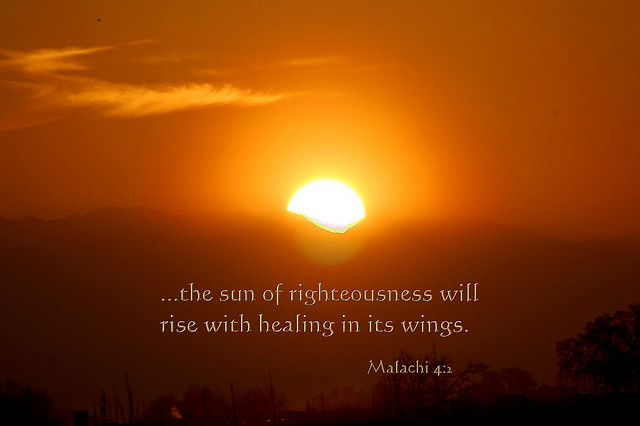
            And now we come to the end of the Hebrew Scriptures. There are other stories that didn’t make it into the regular canon, the agreed upon list of Bible books. There are events that happen after Malachi’s prophecies- the Chanukah story with the lamp oil that lasts for eight days is one such story. But here is a place of turning, a fork in the road, a split in the tree. At this place, we either continue to remain in Advent or we move on to Christmas. Malachi says, “But for you who revere my name the sun of righteousness shall rise, with healing in its wings. You shall go out leaping like calves from the stall. Lo, I will send you the prophet Elijah before the great and terrible day of the Lord comes.”
            For me, as much as I might wrestle with what it means to be Jewish in ancestry, I cannot remain in Advent. This is not the end of the written word of God for me. Somehow, through the Spirit, I have been brought to believe that the sun of righteousness has risen and that Son’s name is Jesus. I may have moments of doubt and of darkness, but I cannot dis-believe the experiences I have had in Christ. The encounters that I have had with Jesus in other people.  My understanding of the powerful reality that God was born onto the earth and knows fully what it means to human.
            Here at the end of Malachi, the branch of Christianity grows out the roots of the tree of Jesse, the Jewish roots of our faith. From this tree we receive our Savior. From this tree we receive the roots of baptism and of blessing bread and wine. From this tree, we receive the understanding of the cloud of witnesses of faithful people who encourage us onward on our journey. Until we are gathered around that manger in Bethlehem and share in Mary’s pondering and the shepherds’ rejoicing, we who believe in God are all Jews.
            But here we are as Christians, believers in Christ, standing at the Advent crossroad and there are two questions for us. The first is will Christ return today? There is still time. And if not, there is still tomorrow.
            The second question that we must ask at this intersection is, “What about God’s promises to Jews?” If we have been brought into faith through Jesus, but there remain some who received God’s promises- what happens to them? What happens to them?
            God happens to them. The oracle of Malachi begins, “’I have loved you’, says the Lord.” The book speaks of God’s election and how God will prepare God’s people to endure judgment and being made holy. Again and again, throughout Hebrew Scriptures, God goes the distance to uphold the promises that have been made between God and God’s people. God does not fail.
“I have loved you” is the banner of a God-created and God-given relationship.  God re-creates and sustains that relationship in the face of human struggle and failure. If no one can endure or stand in the day of the Lord’s appearance, then God will have to create and sustain that which can endure and stand. God will not fail.
            We are poised in a thin space between Advent and Christmas, a place where God meets creation, a place where God became creation. In this space we see backwards and forwards- history and future. It is only in this space that, just between waiting and birthing, we sit with the possibility and the mystery of what has been and what will be.
            There is a possibility that my ancestors might not have been killed and that I might still have become Christian. Who can say? But they were killed. Killed because of who they were and it is a great loss, but one that I cannot change. I do not forget them. I honor them by being honest in who I am and by holding fast to what I believe.
           
            And I believe in God’s work for the world in Jesus. I believe with Mary and Joseph, Abraham and Sarah, Joseph, Moses, David, Jeremiah, Josiah, Isaiah, Hosea, and Daniel in God’s promises from the beginning of creation. In God’s plans for hope and a future. In how God loves God’s people like a parent who lifts an infant to the cheek.
            God has not forgotten the promises made to my ancestors and yours. “I have loved you,” says the Lord. That love burns through all distinctions, all sins and all lies and leaves only what endures. God’s promises are all that can endure and, because of that covenant, God upholds those to whom life has been promised. Then. Now. Forever. God does not fail. 
Amen. 

Embarrassing Freedom

It’s the least wonderful time of the year. I’ve already been hit with one memo from the American Family Association, urging me to boycott Dick’s Sporting Good’s stores for promoting a “holiday shop” instead of a Christmas shop. Within days, Dick’s caved to the pressure and changed their website to read “Christmas Shop”. And so AFA has another “victory” in the “War on Christmas”.


Well, I call, “Baloney”.


While the AFA was fighting the good fight against pluralistic advertising, the US State Department issued its Annual Report on Religious Freedom. (Executive summary linked here.) This lengthy document covers the oppression, repression and struggle of believers of all faiths around the world. The report details how governments, juntas, militaries, private groups and others restrict religious freedoms, withdraw permission to practice from certain groups, kill, injure or imprison missionaries and charitable workers and otherwise prevent the free expression of faith. 


Here are just a few excerpts: 

Afghanistan:  Residual effects of years of jihad against the former USSR, civil strife, Taliban rule, popular suspicion regarding outside influence and the motivations of foreigners, and weak democratic institutions remained serious obstacles. Intolerance in the form of harassment, occasional violence, discrimination, and inflammatory public statements by members of parliament and television programming targeted members of non-Muslim minority groups, particularly Christians, Hindus, and Sikhs, as well as Muslims perceived by government and societal forces as not respecting Islamic strictures.Non-Muslim minority groups, particularly Christian, Hindu, and Sikh groups, were targets of intolerant attitudes. Conversion from Islam was understood by Shi’a and Sunni Islamic clergy, as well as many citizens, to contravene the tenets of Islam. Relations among different Muslim sects continued to be difficult, and members of the minority Shi’a community continued to face societal discrimination from the majority Sunni population.


China: The constitution protects “normal religious activities,” but officials have wide latitude to interpret the meaning of “normal.” The government restricts legal religious practice to five (Buddhist, Taoist, Muslim, Catholic, and Protestant) state-sanctioned “patriotic religious associations.” The government bans some religious groups. Treatment of unregistered religious groups varied significantly across the country. In some areas unregistered religious groups met without interference; in other areas officials disrupted their meetings, and even imprisoned worshipers on charges of “illegal religious activities.” Lawyers and other activists who tried to defend the religious freedom of unregistered or banned religious groups faced disbarment, harassment, and imprisonment.


Malaysia: Officials at the federal and state levels oversee Islamic activity and sometimes influenced the content of sermons, used mosques to convey political messages, and prevented certain imams from speaking. Religious minorities remained generally free to practice their beliefs, although approval processes for building permits for places of worship were reportedly at times extremely slow. The High Court overturned the government-issued ban on use of the word “Allah” by non-Muslims after an appeal by the Catholic Church, although the ban remains in place pending further appeal. Numerous attacks on religious venues, most of them minor incidents, followed the court ruling, and in response the government quickly condemned all violence and dispatched police to guard religious sites. The Hindu community continued to express concern about the demolition of Hindu temples.


North Korea: Although the constitution provides for “freedom of religious belief,” genuine religious freedom does not exist, and there was no change in the extremely poor level of respect for religious freedom during the reporting period. The government severely restricted religious freedom, including organized religious activity, except that which officially recognized groups linked to the government supervised tightly. Some foreign visitors to the country stated that services at state-authorized churches appeared staged and contained political content supportive of the regime. The 2009 Korean Institute for National Unification White Paper indicated the regime used authorized religious entities for external propaganda and political purposes, and strictly barred citizens from entering places of worship. Defectors reported the regime increased its investigation, repression, and persecution of members of unauthorized religious groups in recent years. 


These few examples hardly begin to detail the struggle of people around the world to practice what they believe to be true and holy. And, yes, it might not be what you believe to be true and holy. The embracing of pluralism pushes forth the idea of “one God” in a way that can’t be true, if all religions were honest about their tenets. The struggles for religious freedom in the United States are not detailed, presumably because we are optimistic about the level of religious freedom we have here. In my lifetime, I have been targeted for attack, personally, because of my Jewish heritage. Not being a practicing Jew or a person of color, I don’t think I can even estimate the way religious freedom is viewed here. 


Still, each year we are bombarded with messages about the “War on Christmas” and the removal of Christ from the public square. Until you have to buy religious Christmas cards on the black market and exchange them, furtively, in dark alleys- there is no war on Christmas. Until the name of the holiday is changed to Mid-Winter Festival or Saturnalia or Day of Giving, there is no War on Christmas. Until your creche is confiscated, your neighbors calling the police because you displayed a manger in a window- there is no War on Christmas. Until each church is locked and Christians gather in little rooms, daring to defiantly light a candle to celebrate- there is no War on Christmas. 


I heard Christmas carols in a store today. I heard people talking about Christmas shopping. I saw decorations for “Christmas trees”. I saw Christ’s name EVERYWHERE, even if people weren’t using it specifically to refer to Him. 


You may not like it when people say “Happy Holidays”. You can smile and say, “My family celebrates Christmas. I hope you enjoy your celebration.” You could smile and say, “Thank you and you too.” You could just smile. 


Despite the loud protestations of the AFA, in the United States, we have amazing, embarrassingly abundant religious freedom- especially those of us who are Christian and vaguely mainstream, even with some level of standard deviation to the right or left. 


How about we thank God for that freedom and we pray for our brothers and sisters around the world, loved by God, struggling in darkness? How about we pray for an end to oppressive regimes? For the courage to fight for freedom? For wisdom to know how to support educational, medical, and spiritual missions around the world? 


Why should you do that?


It’s what Christ would do. 


You remember Christ. 


The reason for the season? 


I just wonder if the AFA remembers Him.