Author Archives: lutheranjulia

Lord’s Prayer: Fourth Petition


Give us this day our daily bread.
Hundreds of millions of people pray the Lord’s Prayer today. Tens of millions will pray it tomorrow. We all say it.
We all say, “Give us this day our daily bread.” Millions of people say this and yet there are still hungry people. There are people who do not have enough. People who are unable to make ends meet. People who will go to bed tonight with growling stomachs. Children who will go without eating because they depend on the school lunch program for a meal each day and now it’s summer.
Most of us have enough. In fact, most of us have more than enough. And most of us are not hungry right now, unless we happened to skip breakfast today.
And yet we pray, Give us this day our daily bread.
We pray it and we pray in concert with all people around the world. It is not Give me or Give my family. It is Give us. We are praying with people who believe like us, who are living faithfully in God’s promises… we are praying with people who believe like us on behalf of everyone.
To pray for daily bread for all people and to expect the fulfillment of that petition is to take seriously three things.
1.    That you were serious about the 2nd and 3rd petitions (Thy kingdom come. Thy will be done on earth as it is in heaven).
2.     That you understand that God has not predestined some people for suffering.
3.    That you believe everything any of us have is a gift from God.
These three things, along with the Holy Spirit, combine to create a different kind of hunger than one for food. In Matthew, Jesus teaches this prayer in the context of the Sermon on the Mount- a long set of lessons about how to live faithfully. Hunger is mentioned more specifically in the Beatitudes- the series of specific instructions for holy living- living into Thy kingdom come…
Here Jesus says, Blessed are those who hunger and thirst after righteousness for they shall be filled.
God does not desire that anyone should be hunger- should have that feeling of hollow emptiness- should want for anything. Therefore, those who have enough, who have more than enough, should be hungering to share, hungering to improve the circumstances of those around them, hungering for justice for all people, hungering that no one should feel separated from God because of essentials they do not have.
Give us this day our daily bread is not an empty prayer. Or it shouldn’t be. With so many people praying it and expecting that Jesus would not have us pray falsely or without hope of answer, we have to seriously ask ourselves what gets in the way of this prayer being answered.
Those of us with enough to eat who will not be hungry for long today, if at all, are called (called!) to specifically hunger and thirst, to crave, something better. And in that craving, we are supposed to be moved to be a part of how God answers that prayer.
Give us this day our daily bread.
Everyone hungers until all are fed.
If we dare to ask for it, we must dare to act on it. Amen.  

Deck Chairs

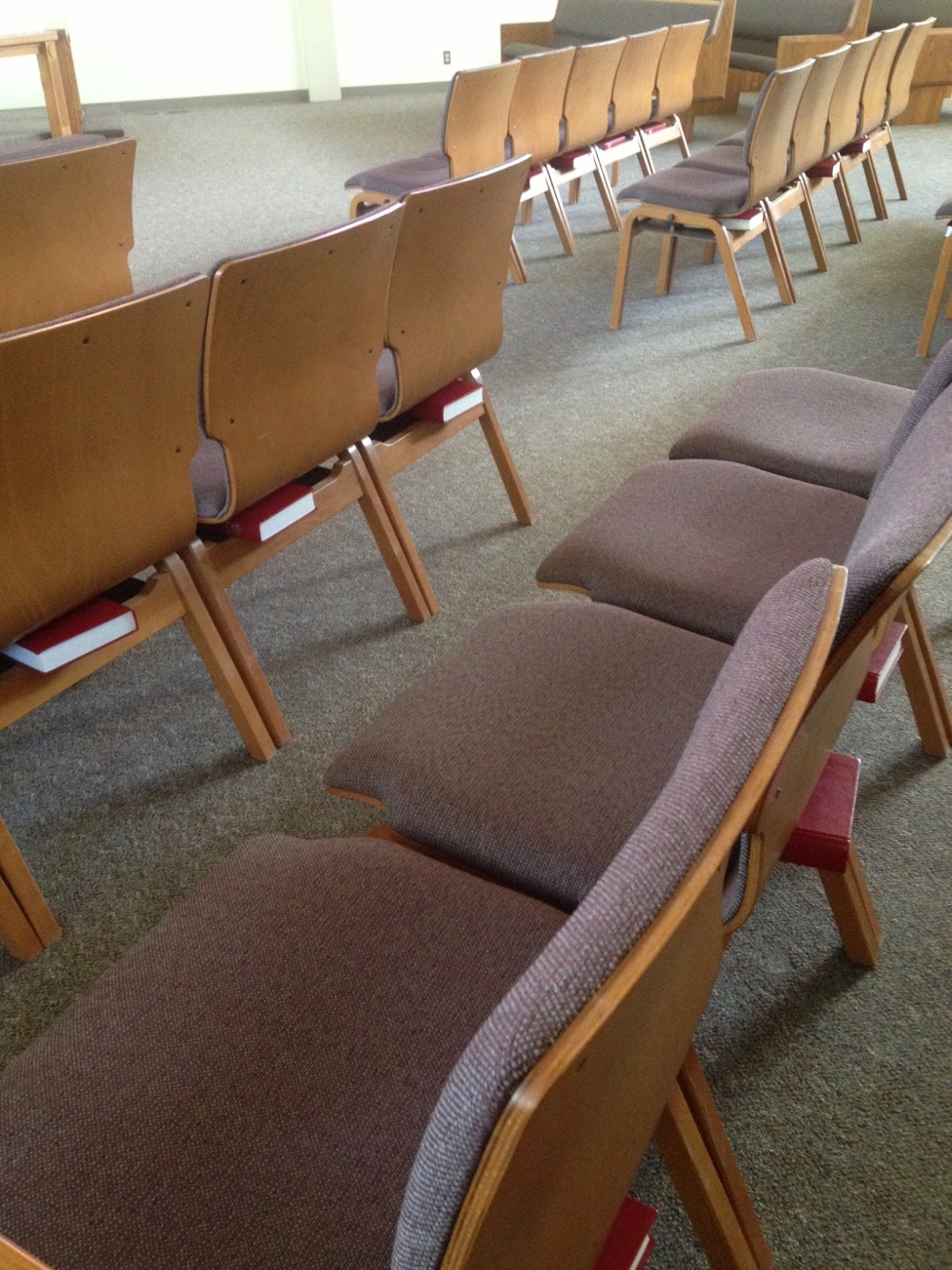
Yesterday, I rearranged the chairs in the church sanctuary. Since the second Sunday in the Easter season (the 1st Sunday after Easter), we’d been sitting in a circle with the altar inside the circle. Many people loved this arrangement. An smaller number of people hated it and there were a minority with no [expressed] opinion.
In an effort to be more visitor-oriented for the summer (our biggest visitor season), we moved the chairs back into their neat little rows. I did not put out as many rows as we had previously because we just don’t need that many chairs. We have moveable chairs and fixed pews. I arranged five rows of six chairs each on two sides (60 chairs). We also have four pews on each side, which could easily accommodate 5-6 people each. Let’s say 5. Thus, we easily have seating for 40 people in the pews.
Sixty plus forty is one hundred (100). We have available seating this Sunday for 100 people.
Last Sunday, at our regular service, we had 37 people.

 
37.
I thought about each of those 37 people as I arranged the chairs yesterday. The circle put us all closer together and made the space seem full and warm. This Sunday, forty people will be spread across seating for 100. The empty seats will be obvious.
And I arranged the chairs.
So frequently I am drawn into conversations about the shrinking church, about lowered attendance, about why people no longer make church a priority.
These are serious questions.
The answers are not really about the style of music or the kind of preaching or the kind of coffee or whether there is childcare.
All of those things are just a different arrangement of the chairs.
The truth is that the people who do regularly attend church (of whatever kind) have to be convinced that what is offered to them, what matters to them, could and would matter to other people. And then they have to act on that thought.
Our desire to see other people experience what we experience in church (if we experience something worth sharing) must be greater than our fear of rejection and failure.
We have to reject, forcefully- with the help of the Spirit, the forces that seditiously whisper the words “inevitable decline”, “too small to matter”, or “too old-fashioned” to oppose God and God’s work. 
We can arrange the chairs in all kinds of ways.
But if we believe that the message of Christ ever mattered, then we must move out in faith BECAUSE THE MESSAGE IS AS IMPORTANT NOW AS IT HAS EVER BEEN.
The message is as important now as it has ever been.
If we do not think it is worth sharing… worth conquering our fear… worth sinning boldly for… then it doesn’t matter. 

And it never did.
In that case, I have some chairs for sale. 

Lord’s Prayer: Second and Third Petitions

Thy Kingdom come. Thy will be done, on earth as it is in heaven.
What is the Kingdom of God?
Jesus gives many descriptions of the kingdom, particularly through his parables. While some of his stories are metaphors beyond our understanding, some are very clear in their explanations. Whether or not we want to accept his message about the expansiveness of the kingdom or its openness is a different story.  In particular, the kingdom is a place of welcome, no tears, no dying, growth in mind and spirit, forgiveness, justice, and inclusion.
What is heaven like? Specifically, how is heaven different from earth?
In the most specific sense, given our knowns, unknowns, and unknown unknowns, heaven is the place [right now] where God’s kingdom, Christ’s reign, the Spirit’s effects, are all fully realized. It is the place of the healing of the nations, the river of life, where death and sin have no power.
However, since we are not yet there… more correctly, since we are here, we have purpose here. Jesus specifically says, according to Matthew, that the kingdom of heaven is at hand. And, according to Luke, the kingdom of heaven is within you. Thus, we are not talking about an abstract place, but a reality that is both here and now. A place apart from sin and death is at hand and within you… at this moment.
If the kingdom of heaven is among us… what would that look like?
I know a couple people who do not like the song we sang earlier and will finish after the homily. They don’t like the line, “I abandon my small boat” because they like their boats. They enjoy the experience of God they feel on their boats- in creation, in harvesting, in solitude, in family time. All of us have things like that… if not specifically a boat. No one wants to sing- I abandon my garden, my hiking boots, my dog’s leash…
The song isn’t about leaving behind pursuits that we love- per se. It’s about discipleship. It is about understanding that when Jesus spoke to the disciples, the fishing disciples, they left what they knew- essentially all that they knew- and followed him. We are called to the same kind of following. To let go of our insistence on perfect knowledge before action, on total agreement before prayer, on hours of study before acceptance… we are called into faithful living as a way of trusting that God’s kingdom is at hand and within us.
When we pray for God’s kingdom to come- what are we asking for? Are we prepared to have it come through us?
In the Large Catechism, Martin Luther writes about the second petition: But just as the name of God is in itself holy, and we pray nevertheless that it be holy among us, so also His kingdom comes of itself, without our prayer, yet we pray nevertheless that it may come to us, that is, prevail among us and with us, so that we may be a part of those among whom His name is hallowed and His kingdom prospers.
God’s kingdom will come, possibly despite our efforts and still- more possibly- through us. By trusting in God and the truth and power of the kingdom, we are more open, more ready for the Spirit to use us in the work of defeating death and sin here and now- being a part of the kingdom of heaven at hand. But there is no limit to whom God may use to bring about the kingdom.
In his 5/22/13 homily, Pope Francis said: “The Lord created us in His image and likeness, and we are the image of the Lord, and He does good and all of us have this commandment at heart: do good and do not do evil. All of us. ‘But, Father, this is not Catholic! He cannot do good.’ Yes, he can… “The Lord has redeemed all of us, all of us, with the Blood of Christ: all of us, not just Catholics. Everyone! ‘Father, the atheists?’ Even the atheists. Everyone!”… We must meet one another doing good. ‘But I don’t believe, Father, I am an atheist!’ But do good: we will meet one another there.”
Through Jesus, we trust that God is committed to creation and re-creation, to redemption and to perfecting, to wooing and to receiving, to welcoming and to reassuring. The Holy Spirit does all of that and more, through all kind of people. We who believe… we who are living through faithful action and trust… we are more ready to see how God is at work in all things (or we are supposed to be).
We are bold to pray…
This is why we say we are “bold to pray the way our Savior taught us”. When we say, “Thy kingdom come. Thy will be done, on earth as in heaven”, we are asking to be part of the work that we trust God is doing in creation, in the world around us right now! It is not a pray that God do what God needs to do and we look forward to the results.
It is a prayer of power. A prayer that God’s will- to see an end to the destruction and separation of death and sin- would take effect in us and all around us and that we would be a part of how that happens. If we are not willing to be active participants in that work, if we do not believe it is possible, if we are not sure that God can do it… then we are not praying boldly. Our prayer is weak tea- at best.
Jesus is the pioneer of our faith (Hebrews). He teaches us to pray in this way because what we are asking for is not only possible, but is a reality within God and God’s work in the world.  The kingdom… a kingdom of life, light, and love… is at hand. It is a kingdom that welcomes all people, including us. And it is a kingdom within us, through Christ, and moving out of us by the Spirit.  Praying to be included in how heaven is experienced on earth is the privilege of our faith. Being included in God’s kingdom work is the freedom we have received through being saved by grace- God’s grace in Jesus the Christ.
Amen.

Lord’s Prayer: First Petition (+ Holy Trinity)

I wrote this to be read by our congregational president when I was out sick on Holy Trinity Sunday, which also marked the start of our Lord’s Prayer sermon series. 
I am not with you because I am at home, sick. The illness is not a mystery. It is just something that I am waiting to finish. Being sick is a little like a puzzle. With enough information, we can solve the puzzle and, usually, things work out.
Of course, we know situations where people were sick and did not get well in the way we had hoped. Nevertheless, we almost always pursue the solution- the full solution, the answers to all our questions. No stones are left unturned. Questions are answered. Puzzles are solved.
We like solutions. There is hardly anything more aggravating than not being able to fix something or know an answer. In this room, right now, with the human knowledge plus the technological benefit of smart phones- there are many questions that could be answered, many problems that could be solved. Facts and figures and history and science- at our fingertips, in our minds, remembered and recorded.
Yet, there are two mysteries that remain here with us- two things we cannot solve, two puzzles that specifically do not have solutions. We cannot adequately explain the Trinity- the idea of one God with three expressions. And we cannot explain prayer.
Even if I were here in front of you, I could not solve these puzzles for you. And, frankly, Megan would probably rather be sick herself than to have to attempt it. The thing is… these are not problems. They do not need to be solved. The work of faith is learning to live both with God’s expansive nature and with the command to pray.
Oh, we do want to solve these mysteries. There are all kinds of object lessons about the Trinity- a three-note chord, an apple (skin, flesh, and seeds), water (ice, liquid, vapor). Ultimately, though, we cannot explain anything adequately. The faithful thing to do, then, is to stop trying. Stop trying to make sense of the Trinity. Stop trying to adhere to a specific kind of orthodoxy that will make it neat and clean.
Rest in the messiness of a God who is both Parent and Child, both enfleshed and ineffable, both eternal and resurrected, who knows all things and also experiences a thousand years like a day. God is bigger than we can imagine and yet we keep thinking we can solve God- like a Rubic’s cube. If we get all the colors lined up, then God- Father, Son, and Holy Spirit- will make sense, will be solved!
We do the same thing with prayer- except that we worry about getting it right. So much depends, we think, on being able to do it correctly, on solving the prayer problem, that we hardly notice when we’re praying all the time. We focus on the “how” and we forget the “who”.
            Jesus teaches disciples to pray, in Matthew’s gospel, by beginning, “Our Father in heaven, holy is your name.” God’s name is holy because it is the name upon which we can call for all things- for healing, in distress, in joy, for hope, for help. We begin by calling on the name of God because we can ask things of this name (and in this name) that cannot come from anyone or anything else.
            Yet, when people tell me they have a hard time praying, often they are concerned about “getting it wrong”. We want to have all our ducks in a row because, surely, if we pray in the right way, we will receive the thing for which we are asking. And that, right there, is the tough mystery of prayer. The part we want to solve. It is hard accept that a God who has made us, who has lived as one of us, and who sighs with us in prayer is present and at work in all things, even when our experience is bleak and dark.
            If things are not improving (in the way we expect), then God must not be listening (so we think) and if God is not listening (according to us), then we must be doing it wrong (it stands to reason). We are able to do so much, so quickly now and to know so many things… waiting with mystery is hard. What is hard is uncomfortable and what is uncomfortable is to be avoided. No one ever says, “Let’s go to the park with the hard benches! I love how uncomfortable we are there.”
            Part of living in faith, in trusting God, is learning to be consoled by the mystery of God’s relationship to God’s ownself (as Father, Son, and Spirit) and the mystery of God’s relationship to us- as we experience it through prayer- our prayers with words and our prayers with actions. God is bigger than our knowledge, than our imaginations, than our dreams. We cannot solve the mystery of God. That actually is good news. A puzzle has a solution. A riddle has an answer. But God, God is forever- and we live and rest, not through our own doing, in that eternity- even when we do not understand it.
Amen. 

Hope Looks like My Pruned Lilac Tree


Job 14:7-9 (out of context) NRSV
For there is hope for a tree, 
Though its root grows old in the earth, 
If it is cut down- that it will sprout again, 
and that its shoots will not cease. 
and its stump dies in the ground, yet at the scent of water it will bud
and put forth branches like a young plant. 
……………………………………


Interpretation:


The scent of hope is 
Water, wafts on the fragrant
Breath of the Spirit.


Friday Five: Be On Your Way

This Friday Five (my first in a LOOOONG time) is from Deb: RevGal Jan is under the weather, so we are swapping weeks for the Friday Five. (Feel better, Jan!) Actually, I want to thank her because she inspired me when she recently shared this poem by Rumi:
It’s your road, and yours alone.
Others may walk it with you,
but no one can walk it for you.
So in thinking about our life’s journey, and the rhythm of our lives, here’s five questions on this theme…
1. What “road” is in your immediate future? 
The road I’m currently traveling is one out of depression. I’m trusting that it’s an out road because the path is unclear, but seems soft and in diffused light. I’m not feeling my way in darkness any more.
So many people think mental illness (depression in particular) can be overcome by an act of willfulness. When people say that or imply it, I think of Jesus casting out a demon in Mark 9. When the disciples ask why they weren’t able to do it, Jesus says, “This kind can only come out by fasting and prayer.”
That kind did, but other kinds of demons may require different approaches toward exorcism. The road I’m traveling now needs prayer and counseling, along with other assistance from friends and family. The road may be long and I have to travel it, but others are walking with me.
2. Where have you been “traveling” a lot lately — and are you going back there? 
No, I will not be revisiting the places that I have traveled lately if I can help. The land of fear and anxiety, the dwelling place of exhaustion and hopelessness, the tar pits of anger and self-doubt. I know those landscapes will probably send their own postcards to me occasionally, but I am endeavoring not to visit again.
As for non-metaphorical traveling, we have not done much with a new baby in tow. We are hoping to have a family camping trip in the next month.
3.  Who are your fellow travelers? 
Family, friends, midwife, counselor, colleagues, Holy Spirit.
4.  Who are the unintentional companions (or hitchhikers) that you find on the road with you? 
Hannah Swensen, the baker/detective of the mystery series by Joanne Fluke, is walking along with me. Her stories are engaging, funny, and light. I went through a month of not reading (a serious sign) and her warm little novels helped me move back into feeling like myself.
I discovered a few months ago that I have Autonomous Sensory Meridian Response (ASMR). I’ve had this my whole life. If I hear someone talk in a certain way or listen to a certain combination of sounds, a relaxing wave sort of sweeps over me starting from the top of my head. It makes me feel warm all over and is VERY soothing. It’s not sexual- kind of the opposite because I feel so liquid and limpid when it occurs. Apparently, I’m not the only one with this and I discovered (WHOO-HOO) the variety of ASMR videos on YouTube around the time that I most needed them. Listening to someone speak in a soft voice about tea or bath soaps or watching someone whisper and draw a fake plan for home improvement is very soothing. Thus, some of the “whisperers” have been companions with me.  WARNING: If you don’t have ASMR, the videos will seem odd (or annoying or humorous) to you.
5.  As a family, we always recite “the traveler’s prayer” — a tongue-in-cheek petition as we pull out of the driveway (“Lord, whatever we have forgotten, may it not be important!”) What have you forgotten lately, and did it matter?
I don’t know if I’ve forgotten anything lately. I’ve been writing many notes to myself to try to avoid that. However, I occasionally forget about my efforts toward positive thinking. I recite this poem by Ron Padgett to myself:
Nothing in that drawer.
Yes, that’s the poem. When I read it or recite it to myself in a moment of panic or high anxiety, I’m able to imagine myself closing a drawer on my dark thoughts. There’s nothing in there for me. Nothing that’s helpful. Nothing that brings life. I imagine the Holy Spirit’s soft voice whispering to me, “There’s nothing in that drawer.”
BONUS: Share a photo of a road you’ve traveled. Or of traveling companions who have made the journey special. Or perhaps there’s a song or another poem that suits your journey. If so, please share!


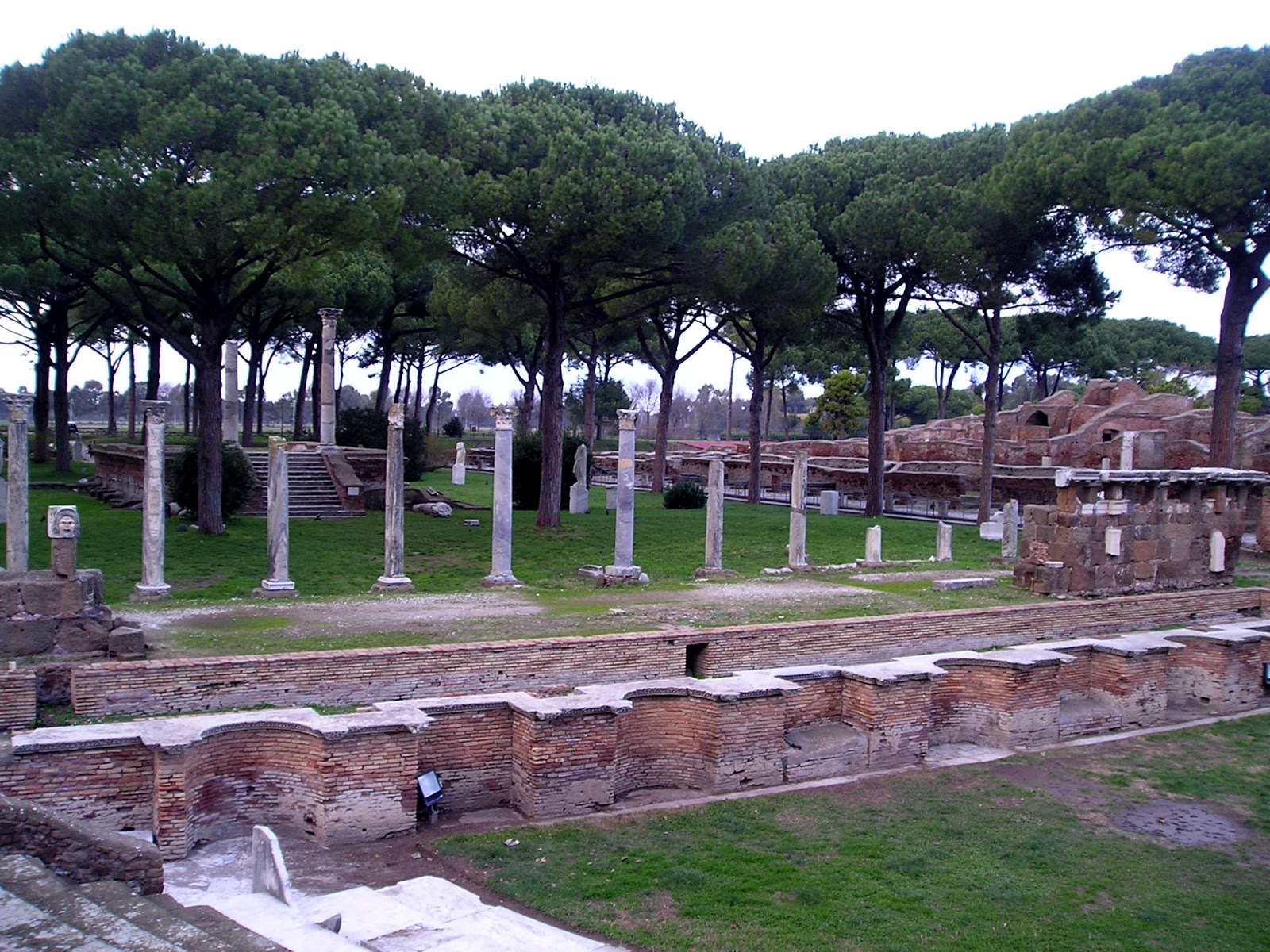
I like looking at this picture of Ostia Antica(from my 2005 visit). The ancient streets and walkways- tiled and smoothed dirt- make me think of people who may walk after me. I’m able to see myself floating in history- part of what was and what will be all while being part of what is. This is very centering and makes me feel closer to the heart of God. 


Whose Blueprint

I strongly recommend the sound file of this sermon (at the bottom) to you , as it has the transitions missing in the text. 

Easter 7 (Narrative Lectionary, Year C)
12 May 2013
Galatians 3:1-9, 23-29
What bewitches us?
            We are (all) easily distracted (or seduced) by things that are not important. How many times have you lost an hour or three to television or to the Internet and ended up feeling guilty about that time? Very few of us have had that same experience in prayer or devotional time. Yet, false piety can be equally bewitching. We are not called to live lives of sequestered prayer and study, but prayer and devotion in word and deed. Our prayers are in how we live, how we use our time and talents, how we reveal our trust in God’s grace.
            The Galatians were “bewitched” by false teachers who continued to emphasize the necessity of fulfilling all of the laws of Judaism in order to be assured of God’s blessing through Christ. Paul rejects this notion. The law was and is important for those who were born into it, he says. However, God is bringing others into the good news of freedom in Jesus Christ. Their right-ness with God comes through Jesus’ faithfulness alone- not through anything that they are able to do to merit that grace or favor.
What do commercials/ads tell us is important?
            We are all subjected to advertizing- both subtle and overt- that says we are not yet what we could be. We can be stronger, faster, more beautiful, smarter, more useful, more clever, a better parent/neighbor/child/spouse… with just one more product, one more item, one more thing. That final thing will give us what we’ve been missing to have a perfect life. Until we get it and we find that we are still lacking. In addition to exacerbating and exploiting our fears, commercials reveal a poor system of creation- where the only way a person can succeed is if someone else fails. In the commercialized and commodified system, people become the means to our achievements- not through support and mutual aid, but because we can climb over them in our race to the top. 
How can we live into God’s grace in our lives?
            Faithful living seems daunting when we understand it to be a system of perfect and perfected belief. The Spirit tries to draw us away from that idea- into an understanding that the life of faith is one of trust in God’s promises and actions. Neither our belief system nor our actions save us or even get God “right”, but we trust in God’s work of justifying us through Christ. Furthermore, our trust is not in the on-going act of justification (being made right), but in the completed action of justification. It’s not something God is doing that God could decide to stop. Bringing the world into right relationship through Jesus Christ is something that God has already done. It is finished. (Heard that phrase before?)
            Thus, we are being helped by the Spirit to understand that justification, to accept that right-ness, to live into the trust that God’s on-going work of creation and healing serves to help understand what God has already done. Not to earn it. Not to complete it. But to come to see ourselves and everyone around us through the light of Jesus.
Blueprint
            This is a blueprint of a proposed remodel/addition to this church dated May 1969. There is a note on it from 1977 saying that this proposal was never used. Yet we’ve saved it. We have saved proposed changes to a building that no long exists as it did forty-four (44) years ago.
            Why do we still have it? Some of you would say it is because we never throw anything away. I suspect that for years, people said, “We might use it. It might be useful. Don’t throw it away just yet.”
            Even as the building changed and changed again, we still held on to an old idea, an old picture, a possibility- even though it wouldn’t work.
            This is what so many of us do when it comes to grace. We keep our old blueprint. We say: Yes, we are clothed in Christ. Yes, we are new creations. Yes, we have been made right with God through God’s own actions. But we want to keep this blueprint… We want to hold on to our notions of how the world works… We are afraid… and we might need a fallback plan- in case God doesn’t come through.
            Don’t raise your hand. Has anyone thought that before? It sounds so terrible when I say it out loud, but it is what so many of us do. We trust that grace is true, but we want to hold on to our blueprint- our way of seeing the world, just in case.
Bewitched by our illusion of control
            We are bewitched by our illusions of control. When my grandmother died, the rabbi for the funeral home (who didn’t really know her), spoke very briefly at her funeral service. I am sure he meant to be comforting and inclusive when he talked about remembering her and her legacy and then said, “Whatever God there is or isn’t…” I thought, “What?!? Whatever God there is or isn’t…” It is one thing to be cautious about the actions one attributes to God, but it’s another thing entirely to straddle the fence at a time of proclamation.
            I called another pastor after the service and complained, “Who says that? I could do better than that.” The pastor laughed and said, “Sure you could, but more importantly, God does better than that.”
            We have been called, through the Spirit, into lives of proclamation- lives that say “God is”, lives that are lived without fear, lives that are carried forward because of what God has already done.
            When we hold onto our blueprints- our maps and attempts to say that we might need our own power later- we are living lives that say, “Whatever God there is or isn’t…” When we refuse to listen to the siren song of the commercial world or the whisper of the forces that oppose God, when we swallow our fears and live by trusting in God’s grace… we are living like Abraham and Sarah.
            When we trust that we are not defined by our work, our race, our abilities, our body types, our mental state, our family’s achievements, our church’s size, our ability to pray… when we trust that we are defined by Christ and Christ alone… then we have the courage to welcome all people, to care for our neighbors, to work for change in our community, to appreciate creation.
Trust is not about fully comprehending and explaining a formula or creed. It is about prayerful and devotional living- without fear- through confidence in what God has finished in Jesus Christ.
            The promise we have inherited is not that there may or may not be a God who may or may not be working on something for the future. The promise we have inherited is that God who knows all things, who made all things, who has saved all things has included us in that salvation through Jesus the Christ. It is on the authority of this promise that we throw out our plans and live into God’s blueprint- an outline that has remodeled us all into the image of Christ. 


The Boundaries of Grace

5 Easter
Narrative Lectionary, Year C

Acts 15:1-17
            The disciples are determining the purpose of their congregation. Is it to make Gentiles (Greek, Roman, any non-Jewish believer) into Jews? Or is it to take people of all stripes who are prepared to act in the name of Jesus and to move forward and out in faith? The purpose might seem clear to us, but it was as fraught a discussion as we occasionally find in congregations and in denominations today. This is the first synod assembly (so to speak) recorded in the early church and they have real issues on their hands.
            They have to determine the boundaries of God’s grace and the marks of the recipients of that grace. They are trying to respect the traditions and history of those gathered, history that is part of how God’s work and presence in the world has been revealed.  The disciples are also trying to understand the exponential pace at which the Spirit is bringing people into faith.            
            In this critical time, they are trying to determine how to tell who is included and what is required of those who say they believe? Should they be brought into the community of faith via circumcision, the sign of one of God’s earlier covenants with Israel? Are there dietary restrictions or certain worship rites? How will the new believers show their dedication to the Way of Jesus?
            How do we know who has received God’s grace? If there are no visible physical markers, perhaps there are markers in one’s life. Surely a person who is especially blessed has received God’s grace. After all, we hear that phrase, “There, but for the grace of God, go I” applied to people for whom we have sympathy, who are struggling in some way. When the nuance of that phrase is unpacked, it reveals that if God’s grace has kept us from a certain circumstance, then any unfortunate suffering soul is clearly without God’s grace. There, but for the grace of God… implies that there are places and people that are without God’s grace. And we can tell because of how they are suffering.
            The family that can’t receive food stamps (SNAP) because they are a few dollars over the income limit… The woman or man who makes the choice to sell sex because it seems easier than other options… The person who gets hurt or killed on a trail you’ve hiked many times… The person who gets caught in a bad spot that you went through only minutes before… The person who took the flight that crashed, but you just missed… The person who dies from suicide, a desperation you’ve felt before… The person who dies from complications of a surgery that you sailed through…
            There, but for the grace of God… except were any of these people without God’s grace? Would we dare, would we presume to say that God did not care about these people? That God’s Spirit was withdrawn from them? That they were forsaken? Either the grace of God is open and expansive and all-encompassing… or God is capricious and malevolent and extends mercy to a select few (who can live into very exacting standards).
            We want to believe the former- in a gracious God. And yet we live in a world that acts on the latter premise- that God’s favor is spotty. If it was expansive, why would there be suffering in the world? And then the worst of both beliefs- that God’s grace is for all, but you have to reach a state by pulling yourself to it.
This is precisely the problem that Peter points out in Acts, “My brothers, you know that in the early days God made a choice among you, that I should be the one through whom the Gentiles would hear the message of the good news and become believers.  And God, who knows the human heart, testified to them by giving them the Holy Spirit, just as he did to us; and in cleansing their hearts by faith he has made no distinction between them and us. Now therefore why are you putting God to the test by placing on the neck of the disciples a yoke that neither our ancestors nor we have been able to bear? On the contrary, we believe that we will be saved through the grace of the Lord Jesus, just as they will.”
            We are specifically warned against testing God’s grace through judging our neighbors circumstances. Specifically warned against believing that a person’s struggling, suffering, pain, or despair is reflective of God’s opinion of them. There is only one way to show that we are not testing the grace of God. We trust in grace and so we act upon it. God’s work in our hands… God’s grace in our actions… God’s mercy in our words and deeds.
            By trusting in God’s faithfulness, as revealed in Jesus, we are brought into the same river of faithful action that swept up the first disciples. The grace of God extends to all, Jew and Greek, slave and free, male and female. In the community of the Way of Jesus, here and elsewhere, we preach the love of God for all and we practice it with one another. Then we carry it out to the world that wants to believe that physical health, financial well-being, and mental stability are the obvious markers of God’s grace, when any of these things may fail. There, but for the grace of God… goes no one. Surely a God who would go to the lengths of coming into the world as person to teach and to heal and then to be resurrected… surely that God desires that all people should experience the light of grace.
            The purpose of this assembly is steep ourselves in the faithfulness of God, to absorb trust and hope and then to stride out- refreshed by Word and water, community and communion. Strengthened, we set to the work of revealing that no one is outside of God’s grace. We feed, we clothe, we advocate, we listen, we invite, we pray.
            If we are not doing these things, then we are testing God. We are testing whether God’s grace is sufficient for all people. We are hoarding the gifts we have received and waiting to see what the Lord will do. God does not fail tests. God will not fail our neighbor, but we can shortchange ourselves in responding to God’s invitation and being frontline witnesses to the way that God’s grace makes all things new.
            The purpose of the church is to bring people together into the Way of Jesus and then to live that Way in the world. The inclusion of Gentiles, as they were, into the community of the faithful was a revolution we cannot comprehend. The Spirit does not stop its work of reformation and renewal, of provocation and invitation. The grace of God is on the move and disciples, then and now, are called to be at the frontlines of the work of boundary expansion.
Amen.

Washed and Fed for the World

Easter 4 (Narrative Lectionary, Year C)
21 April 2013
Acts 8:26-39
The Holy Spirit does not hold to geographic boundaries. The Spirit does not hold to racial lines or ethnic markers. The Spirit does not detour to avoid the people we’d prefer not to see, not to hear, not to sit beside, or have included in our gathering. In the passage from Acts 8, that person is the Ethiopian eunuch. A eunuch is a man who does not have functioning testicles- either because they did not develop or because he has been maimed. A eunuch’s ability to reproduce has either withered on the vine or been pruned.
A eunuch is still a Jew, but may have been excluded from the assembly. Thus, for the purposes of temple life and worship, a eunuch is a man who is essentially a woman. And women don’t get to offer sacrifices. They don’t have standing. One’s blessings come through one’s husband and one’s ability to be receptive to his offerings, so to speak. (This is just awkward for everyone, but this eunuch is important. So stay with me.) A eunuch cannot fulfill the “actions of a man”(so to speak), so he does not get the privileges of being a man… including gathering in the assembly of the faithful. (Deut. 23:1)
Now, in your reading of Isaiah, you may recall a little song about eunuchs with a different tune. The prophet writes: Let no foreigner who is bound to the LORD say, “The LORD will surely exclude me from his people.” And let no eunuch complain,“ I am only a dry tree.” The prophet goes on to say that God will give a memorial better than children to faithful eunuchs, to faithful people. It might have served for God to mention that in one or two other places, since repetition is one of the main ways we learn, but sometimes I think God says to us, “How many times do I have to tell you this stuff?” (Isaiah 56:3)
            The Ethiopian eunuch is a servant in the queen’s court, chosen for that valued position because of his sexual safety. He will not overthrow the government because he cannot have children to continue his line, so (presumably) it would not be worth it. He obviously understands himself to be Jewish because he has traveled to Jerusalem for worship, for worship in the community that may not receive him. He goes to be present with people who are, mostly, of much lower social status than he is as a royal servant. The man has his own chariot and copies of Scripture. Even Peter doesn’t have that!
            Now consider this: how badly would you have to want to worship to travel hundreds of miles to go to a place that wouldn’t receive you to worship a God whose people have conspired to exclude you from the fullness of community? How much would you have to crave sacramental life to be enriched by just being close to it, much less participating? How much would you have to desire to know more about God’s salvation, which might not include you, to be reading a scroll of Isaiah on a bumpy chariot ride back to your home country? Does anyone here have that much desire? Is anyone here willing to allow the Spirit to be that powerful in his or her lives?
            And Philip appears- running alongside the chariot. Philip, who has been assigned to be a part of the food distribution in the Jerusalem meeting houses, is now speaking to someone who might as well be from the ends of the earth. Philip says, “Do you know what you’re reading?” and then goes on Isaiah’s servant song in the light of Jesus Christ. When Isaiah wrote it, it was understood in to apply to God’s servant Israel and Israel’s people. The Spirit’s interpretive expansion helped the early followers of Jesus to understand him (and their own call) as the servant who suffers for the sake of God’s work in the world.
            Moved by this interpretation, moved by this Bible study, the Ethiopian eunuch stops the chariot and says, “Here is water. What is to prevent me from being baptized?” He is so transformed by hearing Philip’s discourse on Jesus that he cannot wait to be included in the community through God’s promise in water and word. Baptism will change his allegiance, and his alliances, but it will be worth it because he will be drawn, clearly, into the story of God that the Spirit has been whispering in his ear.
            Does anyone here desire baptism that much? Does anyone long to revisit their baptism? Have you held yourself back from just splashing your face in the font- to remember, to clear your vision, to wake you up to your life reorientation in Christ? We trust that God loves and uses people who are not baptized, but in the Christian community it is the marker of beginning and belonging. It is a moment we can revisit again and again- a moment when the salvation we work out with fear and trembling became tangible. We are supposed to crave this moment- remembering it and desiring it for all around us.
Along with holy communion, the baptismal font give us a different lens for seeing ourselves, the people around us, and the people who we encounter outside of these doors- the same expanding circles of Spirit-inclusion that are in the Acts reading (the people in Jerusalem, the people in Judea, the people in Samaria, the people in Ethiopia and beyond). These sacraments, two places where we are assured of Christ’s presence, make us citizens in the kingdom of God with work to do right now. Part of that work is sharing the message that is implicit in these acts of communal washing and eating together- the message that all people are children of God.
When the world says, “racial minority”, we say “child of God.”
When the world says, “sexually suspect”, we say “child of God.”
When the world says, “illegal immigrant”, we say “child of God.”
When the world says, “homeless by choice”, we say “child of God.”
When the world says, “Palestinian or Israeli”, we say “child of God.”
When the world says, “mentally ill”, we say “child of God.”
When the world says, “terrorist”, we say “child of God.”
            The naming of our people, our friends and our enemies, as children of God puts us in the position to do the work of Christ. Work of feeding. Work of peace-making. Work of creating equality. Work of ensuring justice. The work of making God’s presence real by revealing that presence through the actions of God’s people. I am not saying we make God real through our right actions. I am saying that who God is becomes understandable through the clear actions of the people who call themselves people of God.
            In a world full of terror, natural disasters, and preventable human tragedies, there are people who crave good news. There are people who need advocates, though they may be in the wrong. There are people who are certain that they will never belong to the community of God- but they read the story anyway. In a world with this kind of longing, how do you account for the hope that is within you? Do we dare to cheapen God’s grace by assuming that the font and the table exist merely to assure us of God’s affection for us?
            These are dangerous places. They change the way we see the world and the way we see all children of God. We should approach these places with trembling- longing for the truth of their promises and afraid of what faithful participation will lead us into doing?
            The Holy Spirit does not hold to geographic boundaries. The Spirit does not hold to racial lines or ethnic markers. The Spirit does not detour to avoid the people we’d prefer not to see, not to hear, not to sit beside, or have included in our gathering.  And the Spirit does not, cannot, will not, pass by you
Amen.