Author Archives: lutheranjulia

Friday Five: Summertime Edition

Dorcas over at RevGalBlogPals encouraged some general sharing today and I’ve been longing for the perfect…something… to get me back to regular writing.

She writes: Share five things that are happening in your life, personally or professionally or some of each, in this season of life.


1. Exercise! In training for a triathlon in June, I managed to push myself from seeing as exercise as something I needed to do to something that I enjoyed. It has become something that I need to do. I bought a bike rack and drive with my bike on the back of my car at all times and I keep gym clothes and a few shower items in a bag in the car. This past Sunday, I managed to grab a 6 mile bike ride in between services (morning and evening) and visitations! I felt great. I’m really trying to get my tolerance and speed up so that when I have to go back to the gym in the winter months, I will be faster and leaner. I do miss my weight-lifting, so that will get back on the agenda when the weather is cooler too. 

2. Toddler love: My son is not-quite 2 years old, but for sure the cutest thing I’ve ever experienced. I love his soft neck, his giggle, his excited discoveries. He yells in the car about what he can see and we’re in a “buck” phase. Buck= truck. There are a lot of bucks around. It’s never been easy to leave him and go to work, but it is so much harder to leave a toddler than an infant. I’m making a kissy-face right now in my office, thinking about how I will just squish him when I pick him up in about 45 minutes. 


3. Bible exploration: I’m big on the book of Judges, which was left out of this year’s narrative lectionary passages. I’m trying to figure out how to slot one of those stories in and which one. The bonus of Deborah’s story is that it includes two powerful women, but it’s early in the book. I once wrote a paper on Jepthah’s daughter’s story as the hinge of the Old Testament, but that’s a different kind of preaching. I’m thinking, maybe, Gideon. Pondering, pondering… 

4. Watermelon: Don’t tell my nutritionist, but I haven’t quit the watermelon. I’m supposed to stick to the higher fiber, less sugary fruits. She wouldn’t actually be surprised, though, because I told her I would still eat watermelon in season and I refused to feel guilty about it. If you are going to take watermelon, garlic or lemons from me… I might as well throw in the towel now. Blech. No watermelon in Alaska tastes like the sun-warmed watermelons of my Southern youth. I can only get decent watermelon in the short season when we get them from California. So I’m eating it while the eating is good. I would say you can have my watermelon when you pry from my hands, but I’d stab you before you got that far. (Not somewhere too essential, but serious enough to be a distraction while I finish the melon!) 


5. Ecumenism: Our congregation is starting to do more and more with the United Methodist Church up the street, which makes sense in many ways- not the least of which is our mutual love of Jesus! (Imagine that!) However, I’m surprised at all kinds of ecumenical gatherings when so much of the time is spent rejoicing in how alike we are and how small are our differences. How true. 

The Chore List

Holy Trinity Sunday, Year A
19 June 2011
Genesis 1:1-2:4a; Psalm 8; 2 Corinthians 13:11-13; Matthew 28:16-20
            For me, this is the “most wonderful time of the year” because it’s my favorite Sunday. As most of you know, I love the concept of the Holy Trinity. The Three-in-One and One-in-Three God. A relational God whose love outpours in a variety of ways- creating, redeeming and sustaining the world. We have the Father who brings us into a holy and eternal family, the Son who is our brother in faith, and the Spirit who is our advocate.
            I spend a lot of time thinking about the Trinity- possibly more than you do. In fact, I worry that when I mention the Holy Trinity, your eyes glaze over and you stop listening because it is a difficult concept. Thinking about God is challenging enough. Thinking about God in Three persons can seem nearly off-putting.
            So, let’s back off from the idea of the Trinity for a minute and just think about God. Or rather, what do you think God thinks about us? It’s often taken for granted that God thinks about us. We think of what we believe about Jesus and the Spirit. Believing that the coming of Christ and the presence of the Spirit are signs of God’s love for us, then surely God does think about us.
            But the question that the psalmist (the writer of the psalm) asks today is why should we expect God to think of us? When we considered the sky and the stars, for us in Alaska the ever-present sunshine this time of year, when we think of the depth of the ocean and the expansion of creation… why should we assume at all that God thinks of us? Who are we, but blips in human history, in creation history?
            But loving fathers, loving parents, remember each of their children. So surely God does remember us and does think on us. How can we know that? Well, one of the pressing memories I have of my dad is the Saturday chore list. We’d get up on a Saturday morning and there would be a list of things to do on the dining room table. Some of them were standard (clean the bathrooms, wash the sheets, vacuum, etc) and some of them were unusual or depended on the season (stack wood, move the chicken coop, turn the compost pile).
            Here’s the thing with a chore list. In order to write it, my dad had to think about my siblings and me- what he knew we could do and we couldn’t. We might not have always wanted to do the list. We might have thought it was unrealistic or unfair and maybe sometimes it was. Nevertheless, the list meant that our dad was thinking of us. He could have done these things himself, but then we wouldn’t have learned how and we wouldn’t have understood what it means to work together as a family.
            Similarly, we know that God is thinking of us because God gives us a chore list. God could do these things without our help, but that’s not how God decided to work with people. The psalmist notes that from the beginning, what we heard in Genesis, God has given us the responsibility of caring for the earth. This is chore list of stewardship, of creation care. We are charged with caring for animals and plants, for helping the earth to produce and for using what is before us to its fullest and healthiest extent.
            From God, we have a chore list that extends into our life in Christ. The risen Jesus tells his disciples to train others in the way of the godly life, in the way of discipleship. They are charged with extending the care of creation into caring for their neighbors. Caring for them means helping them to understand the realities and possibilities of abundant life in Christ, of joyous life in God.
            We know that God thinks about creation and about people because we are charged with carrying out these activities in the world. When I remember back to the chore lists of my youth, I recall that my siblings and I spent a good amount of time yelling at each other to do more work and pointing out who wasn’t doing their fair share. Now where do I see that behavior repeated…?
            Ah, yes. Many times, that’s how God’s faithful people use our time and talents- pointing out who isn’t holding up their end. We know what the chores are. We haven’t been asked to do things that are out of the realm of our possibility. God could do everything without our help, including making disciples, but then we have no role and, furthermore, we won’t understand what it means to work together as a family.  Without our chore list, our relationship to God and to one another is limited. We just exist, our tasks having very little meaning except to move us to the next day.
            Being given responsibility for creation care and for sharing the good news of Jesus means that God knows us and trusts us. It means that God is thinking of us and trying to include us in the building of the kingdom. Having a list of things to do bring us into a working relationship with God and with one another.
            In the story of creation, all things are relational. Nothing exists on its own. The day has the night, the sky has the heavenly bodies, the land gets the water, and the living things work together. Nothing that is made is declared good until it has a relational counterpart. Those counterparts work together for good, for wholeness.
            So it is between the Father, the Son and the Holy Spirit. The Three-in-One God works together for good, for wholeness. There is a relationship there that may well be beyond our understanding, but it exists because of the love that burst forth from the heart of God. There is not, there cannot be, one expression of that love and God has three expressions… a Loving Creator, a Healing Redeemer and an Ever-present Inspiration. The chores of being God are shared between the members of the Trinity and the love in that relationship flows forward into God’s relationship with us.
            It is easy to feel overwhelmed by what it seems like we are called to do, but it’s a short chore list and it’s specialized to what God knows we can do. God has even given us the gifts to do these things- to care for creation and to share Christ with all whom we encounter. We are able to do these things because of the grace we have received through Christ. We are invited to do these things through the urging of this Spirit. We must do these things for the sake of God’s name in the world.
            What did Jesus tell his disciples when he gave them their chore list, that Great Commission? “I’ll be with you as you do this, day after day after day, right up until the end of the age.” (Message) You aren’t doing this alone. You’re not even doing it just with other people. The amazing grace of Jesus Christ, the extravagant love of God and the intimate friendship of the Holy Spirit is with all of you!
Amen. 

Born of the Spirit

Day of Pentecost, Year A
12 June 2011
Numbers 11:24-30; 1 Corinthians 12:3b-12; John 7:37-39a
            How many of you expected to hear a different reading today? What did you think you would hear? (The story of tongues of fire on the disciples and the different languages) Can it still be Pentecost without that reading from Acts 2?
            Certainly it can. Pentecost means 50 days. It was already a Jewish festival, the Festival of Weeks (Shavuot), where people celebrated fifty days from the original Passover event in Egypt and the gift of the Torah- bringing the Hebrew people together as a nation to serve God. For us, it is still 50 days since Easter, since Jesus passed over from death into life and brought the reality of new life with him. We celebrate those fifty Easter days and come together for this festival and celebrate a new understanding of the Holy Spirit, drawing people together and inspiring them in God’s service.  
            I have some problems with that reading from Acts. The first is we sometimes forget that the Spirit existed before that day in Jerusalem. The shy member of the Trinity was present at the formation of creation with the Word and the Creator. The Holy Spirit came in a new way on that Pentecost Day, though, bringing the comfort and the challenge of the risen and ascended Christ.
            My second issue is that when we hear the traditional Pentecost text, it is easy to think of the gift of the Spirit as one of power and triumph and a gift that comes to God’s chosen few. The Spirit is a gift that comes to God’s chosen, but not to a few. The Spirit blows when and where it will, on whom God chooses. We don’t control it. We can’t control it.
            What the Spirit brings to each of us is an awareness of God in our lives. Sometimes, God’s peace. Sometimes, God’s challenge. The Holy Spirit alongside us and sets us on fire… for what?
            It’s my birthday today. We tend to treat the years that end in 5s and 0s as big deals. And they are. They are milestones of achievement for our lives. But does our age define us- the actual numbers? We are defined by how we use our days and our years. What we do with the moments and the gifts we have.
            In thirty years, I have some accomplishments and some failures, some wasted time and some well-used moments, some dark valleys and some glorious peaks. What’s going to happen to me from this point forward? I have no idea. I have some plans and hopes. I also know that God may well have some plans and ours might not line up in quite the same direction. But on this day, I celebrate the life I have and what I have known.
            And that’s not a story that’s totally about me. It’s about my family and this church, about my son and my husband, where I grew up and where I am now.
            In the same way, the Pentecost story, the coming of the Spirit, is a story that’s not about us. It’s not about you or me, specifically. On the birthday of the church, we celebrate God. God’s gifts, God’s plans, God’s wind and fire. We celebrate the life we have in God and the life to which we are called. We celebrate the gifts that are among us and we anticipate, with joy, the time that is to come.
            When I say the “time that is to come”, I don’t mean whatever happens after this life, I mean the time that is to come this afternoon, tomorrow and next week. The time for which God is preparing us right now, feeding us right now, calling us to… right now.
            The danger of our Pentecost celebration is that we can make a big deal about the Spirit coming and forget that the Spirit has been with us all along. We don’t skip from Pentecost to Pentecost anymore than we do from birthday to birthday. The road to 31 started on the same day that the road to 30 did for me. Just so with the church, the road to our future with God began at the cross and goes out, with the help of the Spirit, to where God leads.
            And we don’t simply receive our gifts for ministry on this day of the year. We receiving gifts for faithful living, through the Spirit, every day of our lives. Each of us has much less in common with Moses and the seventy elders than we do with Eldad and Medad. We weren’t in the tent of seeing Jesus in person, we weren’t in the tent of hearing Peter or Paul preach, we are outside the original camp. And yet the Spirit has been promised and delivered to us as well. Each of us has gifts from God to use for the sake of the world and God’s kin-dom.
            On our own birthdays, we tend to make assessment of our lives and make promises about the year to come, God willing that we see it to completion. So we should be on this birthday of the church. We have received the gift of the Spirit, who helps us to believe and go out with the risen Christ- on this day and all days.            
We should look at one another, at the feast that is before us, at the possibilities of learning through both failure and success. We should look at those things and we should feel on fire, not just the disciples or the elders or the priests, but each and every one of us should feel renewed and reborn and ready.
Happy birth day to you!
            Amen.

Unity in Silos

I’ve been slowly introducing the idea of the Narrative Lectionary (NL) to my congregation. The NL is a fairly quickly paced romp through the arc of Scripture from Abraham and Sarah to Acts (September to late May). Each Sunday, the congregation focuses on one scripture passage that reveals the work God has done. Through the lens of that story, in its Scriptural setting, we move to more fully comprehend the work God is doing now.

In order to use the NL, we will have to drop out of formal use of the Revised Common Lectionary (RCL) for about nine months. It is my hope that during this time our congregation will labor together and come to a better understanding of the narrative thread of what we believe. How are the Hebrew Scriptures connected to our understanding of Jesus? How do we see ourselves as children of Abraham? What are the lessons of the Exile?

These are important themes and stories that don’t quite make into the heart of the RCL. Arguably, they could be covered through Faith Formation activities, like Christian Education, Confirmation, Bible study… etc. However, I have to be realistic about the habits of my congregation. The majority of people are here on Sunday morning. Some can’t, some don’t and some won’t come to other things during the week. So I have to take seriously the teaching portion of my call and bring the mountain to Mohammed, or something like that.

In this month’s newsletter, I published the proposed schedule of the NL and asked for comments or questions. I received my first today from a clergy colleague in the Lutheran Church- Missouri Synod. I consider this pastor a friend and an inspiration and I know he was somewhat teasing in his email, yet some portions of it really hit home. We discussed it on the phone, but I’d like to stir the pot a little with his comments.

He noted that by using the Narrative Lectionary, one could see the ELCA as moving either farther away from the Church catholic and, possibly, from its Lutheran roots.

Holy revelation, Batman!

Have we come so far that a desire to cover more Bible makes me less orthodox and, yea verily, less Lutheran? Say it isn’t so.

First, the use of the Narrative Lectionary is a choice and is neither endorsed or encouraged by the Evangelical Lutheran Church in America. (It isn’t discouraged either.) One might consider the Book of Faith initiative to be an encouragement into deeper Biblical work, but that’s a different post/rant/exploration. Bringing broader and deeper biblical understanding to people in pews (and streets) is, last time I checked, at the heart of Lutheran self-understanding. It’s right up there with Christ and him crucified. (It is, in part, how we know about Christ and him crucified.)

My pastor friend pointed out that the RCL or even a standard three-year rotation gives pastors of a variety of stripes some common ground to discuss our sermon preparation, to share ideas and from which to wade into deeper theological matters.

True enough, the RCL puts me on same pulpit plane, so to speak, with the majority of United Methodists, American Baptists, Episcopalians, LC-MS, WELS, Roman Catholics and many others on any given Sunday. Since our table fellowship and ordination practices are often dividers, the Common Lectionary can be a tie that binds our hearts in Christian love.

Ah, but there in lies my problem. I fail to see how a deeper understanding of Scripture is going to lead the congregation of Lutheran Church of Hope away from the Church catholic. I would think (!) it could only help. (Said the young ELCA pastor with optimism.)

Besides, I don’t think it is my proposed nine months in the NL that is causing an ideological divide between some of my LC-MS brethren (and sistren), WELS, Romans Catholics and some Orthodox.

If we decide to explore the Narrative Lectionary, we will still:

Affirm our faith using the Apostle’s Creed (except when we use the Nicene)
Baptize in the name of Trinity (Father, Son and Holy Spirit) 
Believe in Scripture as the inspired, written Word of God
Believe in the saints, alive and gone before as our cloud of witnesses
Trust in the Real Presence of Christ in Holy Communion
Understand God as having acted on behalf of creation, continuing to do so and planning to do so until the end of time

If we can’t be united to the Church catholic through our faith in God’s work of salvation in Jesus the Christ and through the things above, it doesn’t matter how we study the Bible.

If we can’t define ourselves, in the positive, by some unity in these things, then we are about as useful as the fig tree (Mark 11:12-14). Where is our fruit?

My hope in using the Narrative Lectionary (which has its own flaws) is to begin to deepen and build on the biblical foundation of the majority of my congregants. I hope that they will be energized by new hearing, new discussion and new understanding. In general, I think this is what all pastors work toward and pray for- across the Church catholic.

The Preaching of Trifolium

There must be a sermon in clover.
Interlocking roots proselytizing grass and garden,
Sheltering the lowest- spiders and earthworms,
Within the sweetness of ordinary time.

Evangelistic in children’s bouquets-
Converting hard hearts with tiny flowers
Squeezed with dandelions in small hands.

The undulating blanket crusades a landscape
Bringing singular trinitarian understanding with
Fear and adoration.

Consumed as solid and liquid, both cud and tea
There is no negative theology in clover-
No understanding through absentia.
Lucky is not the same as necessary.

Book Review: The Long Goodbye

This month’s book review is of The Long Goodbye: A Memoir by Megan O’Rourke. Amazon’s description of the book is here. Information on O’Rourke is here. Yes, this is another book by a person writing about a universal experience from their point-of-view. I find that while experiences are corporate, journeys are individual. In The Long Goodbye, in particular, we meet a young woman (early 30s) who wants to believe that her thinking isn’t magical, that the right combination of intellectual pursuits, physical stretching and emotional openness will bring her mother back to life. It doesn’t. Grab a Kleenex or two and a comforting beverage. O’Rourke’s grief landscape is austere and harsh, with emotion-whipped rocky outcroppings and deep caverns of despair.
I came to this book somewhat reluctantly. I read O’Rourke’s initial forays into discussing her grief on Slate magazine and, doing my own grieving at the time, I found them inaccessible and, seemingly, self-indulgent. I could not connect with her pain and found no anchor in her writing to process my own.
Some of that work was incorporated into the book, but I did not recognize it in the longer form. I also found the book to have a depth and breadth I didn’t remember from the articles. I suspect that, for me, this was a better time to read this work and, perhaps, for O’Rourke a bit of time made the difference as well.
O’Rourke is a poet and her writing is full of metaphor that is heart-wrenching and inspiring in its attempts to describe the realities of watching one’s mother die and living in a world without the vessel that brought you into being. She writes, “I also felt that if I told the story of her death, I could understand it better, make sense of it- perhaps even change it. What had happened still seemed implausible: A person was present your entire life, and then one day she disappeared and never came back. It resisted belief. Even when a death is foreseen, I was surprised to find, it still feels sudden- an instant that could have gone differently.” (p. 139)  
The first half of the book is O’Rourke’s memory of her mother’s diagnosis of colon cancer and her death. The second half is O’Rourke’s grief and attempt to gain a handle on her emotional reaction, which both challenges and baffles her. As she feels the role-reversal as a child caring for a parent’s intimate needs, O’Rourke notes that she needs a mother, her mother, to help her process the fact that her mother is dying. She wants the final weeks and days to be full of meaning and tinged with significance. Instead, she finds herself watching television with her mother, talking about Christmas decorations, feeling frustrated. “Time doesn’t obey our commands. You cannot make it holy just because it is disappearing.” (81)
O’Rourke comes from a family that has little connection to a religious community. Her mother has, in part, turned away from the Roman Catholicism of her youth and so O’Rourke describes in detail the family’s love of reading, their outdoor summers, their love of one another. These are the objects of her devotion, the things that define her faith. The depth of these experiences is vast, but their breadth cannot quite cover the shock of the loss of her mother. O’Rourke notes that her brothers and her father all grieve differently and differently still from her. They all have the same injury, she says, but each manifests different symptoms (104).
In the months after her mother’s death, O’Rourke finds herself skeptical about rituals and yet longing for markers to note her emotions, the truth of her experience and inexplicability of what has happened and what lies beyond. She writes of her envy of her Jewish friends who have the Kaddish, of the words and prayers that give one’s mourning some shape and recognition. She writes, “I longed for rituals not only to indicate I was still in mourning but also to have a nonpsychological way of commemorating and expressing my loss. Without ritual, the only way to share a loss was to talk about it… At times, though, this sharing felt invasive. I did not want to be pitied. In those moments, I wanted a way to show my grief rather than tell it.” (157)
There is truth in what she says about our culture’s inability to deal with death. In our fear of doing the wrong thing, we often do nothing. All but the most religious among us have no desire to think on the inevitability of death. All but those of the strongest faith cling to the life of which we know, still having a tiny amount of uncertainty about the life to come in which we believe. Furthermore, in this day and age, death is as prevalent as ever, but in our Western culture it remains distant for many people until it is actually personal. We can avoid wakes and funerals for a long time until death comes to our nearest and dearest.
I often hear people talk about the fact that they long for a way for people to understand that they are dealing with a death without them having to say so. Mourning clothes, wreathes, pins… all these things served as societal markers to remind us to be gentle with grieving persons. Now, in our rawness, we are expected to yield in traffic, to be pushed in the grocery store, to pay our bills on time, yet all the while wanting to scream, “But my BELOVED DIED. I cannot see them. They are not here. I don’t want to do this. NONE OF THIS MATTERS.”
One of the metaphors that captured O’Rourke’s imagination was from C.S. Lewis’s A Grief Observed (among the best, if not THE best, books about dealing with personal grief). Lewis writes that a loss, the death of a beloved, is a like an amputation. “If the blood doesn’t stop gushing soon after the operation, you will die. To survive means, by definition, that the blood has stopped. But the amputation is still there.” (279)
One of the things that I frequently encounter is people who are surprised at how long the intensity of grief goes on. If we use the image of amputation, it becomes somewhat easier to comprehend that a grieving person is learning a new way to live. You may remain in the same neighborhood, but your address has changed. You may now reside in the “House of Deceased Spouse” or “My Mother is Dead” or “My Child No Longer Lives”. The new residence resembles your old one, but the layout is different enough to trip you up a little bit for much longer than you expect. The familiar look seems sinister because you can’t comprehend how anything could remain the same or, worse, move forward when you desperately long for markers of the change and for a pause in the world.
I have not even begun to convey the beauty of much of the writing in this book. O’Rourke’s book is worth reading if you’re interested in reading another perspective on dealing with grief. It is beautifully written. It is not the kind of book that you give someone (most people) immediately following a death. They need space and the rawness of this book may not be helpful in the immediate aftermath following a death. I think O’Rourke also stirs up good discussion points for people of faith. What are our mourning markers beyond the funeral or memorial service? How do we help our friends and neighbors at anniversaries and in bleak nights? What kind of words can we use to discuss grief and our fears? What light of truth can we bring to the world about tenderness to the grieving? What can we offer to those who are tangentially connected to faith communities?
Fine print: I purchased a copy of this book for review. All thoughts are my own. I have not been compensated in any way for anything said in this review. All quotations come from:
O’Rourke, Meghan. The Long Goodbye: A Memoir. Riverhead Books, New York, NY. 2011.

Originally posted on 5/23/11 at RevGalBlogPals.

Alter Call

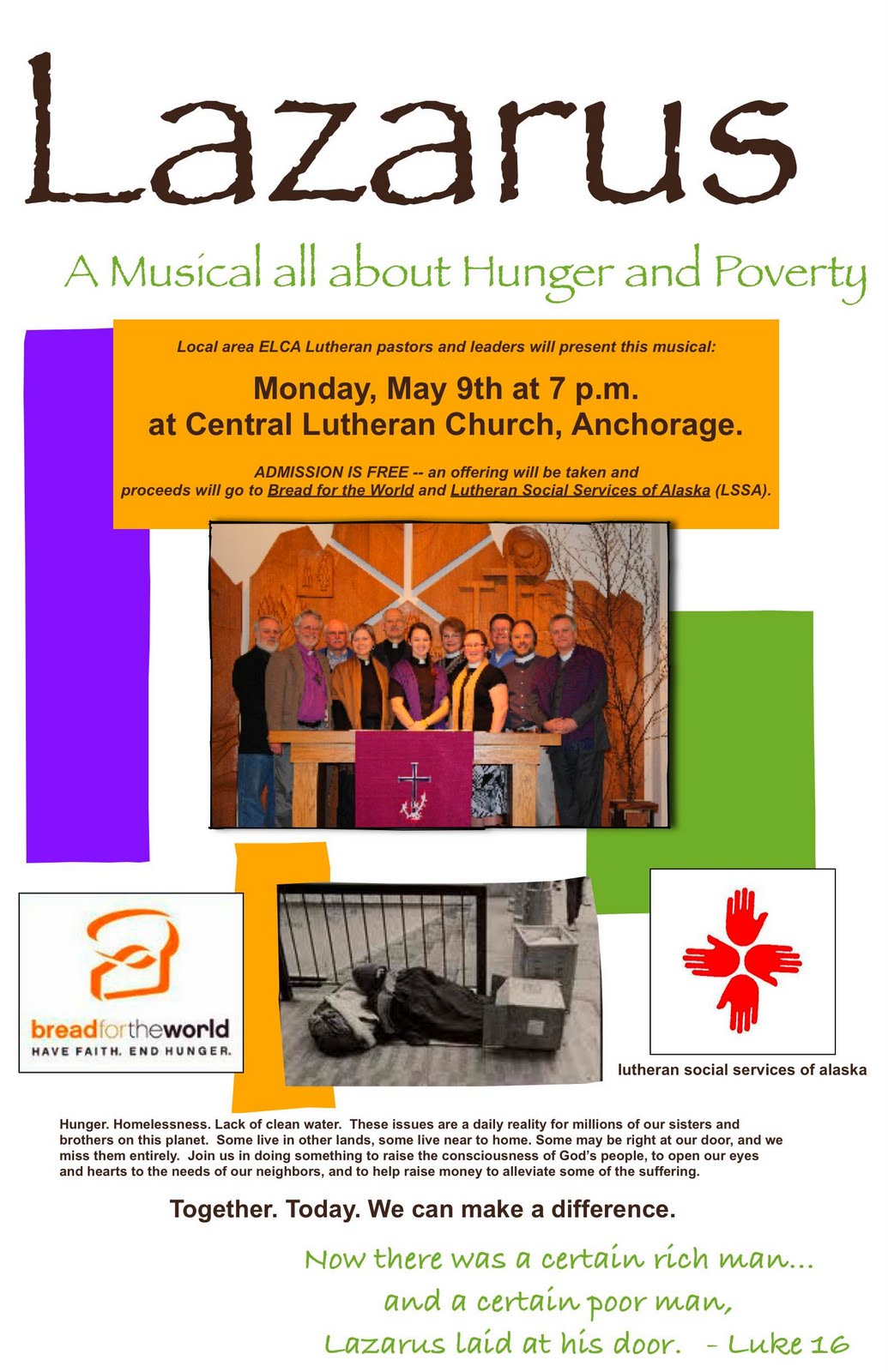
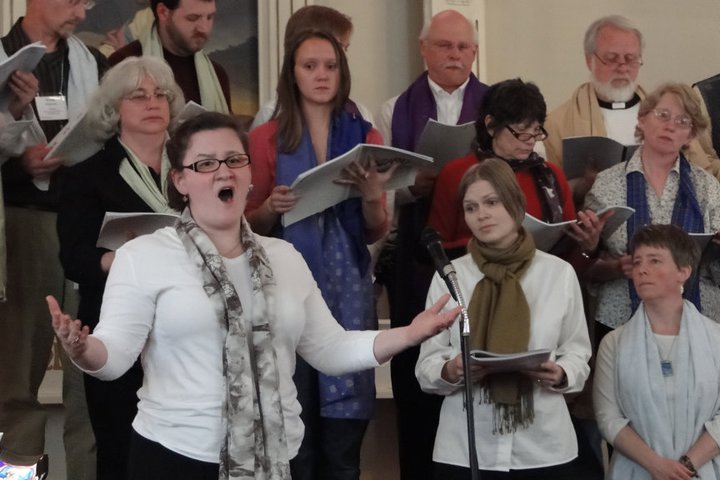
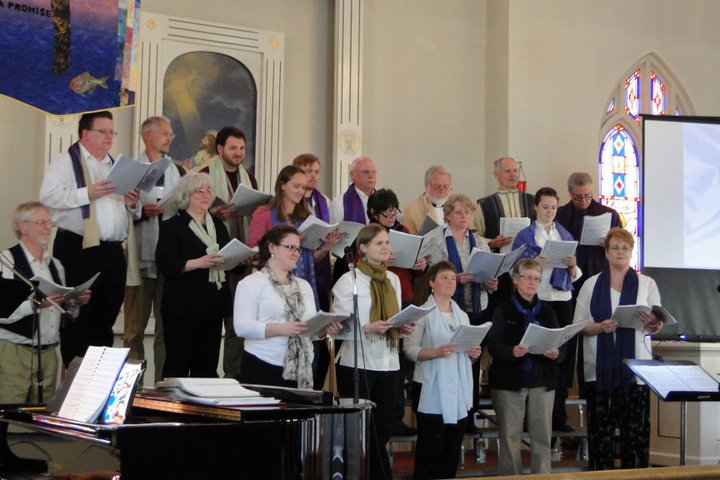
The Lutheran clergy (and a few friends) in my area recently embarked on a musical journey together. We decided to call attention to hunger issues in Alaska and around the world by staging a musical originally produced by Bread for the World. Lazarus: A Musical Call to End Hunger is based loosely on the biblical stories of Lazarus and the Rich Man. In the case of the musical, the Rich Man is offered a chance to change his ways and shares his vision of all eating and being satisfied.

The experience of singing with colleagues was both riotous in entertainment and frustration. We practiced throughout the Easter season when we were only slightly busy. (Ha!) Also, we’re all used to being in charge, but when we’re together, we eschew authority and, um, we don’t always respect it. (Just ask our bishop.) One of our accompanist’s noted, “I can’t really believe pastors are like this.” I said, “It’s our off-time. We’re like kindergartners who were taken to the zoo and then promised ice cream.”

Anyway, we performed during our Synod Assembly in Ketchikan, AK and then last night at Central Lutheran in Anchorage. We sang for about forty minutes and then the executive director of Lutheran Social Services of Alaska spoke about the food needs in Alaska, specifically Anchorage. Another pastor spoke about how to contact our senators and Congressman (we only have 1). He specifically talked about the difference between charity and effective and efficient use of dollars and legislation to change situations.

I leaned over to another pastor and said, “This is practically a revival. We have a big crowd who got charged up by the singing and now they’re hearing the preaching.” She replied, “Yes, then we’ll have an altar call.”

I said, “No, this is the altar call. It’s an alter call.” The end result of revivals in the Baptist tradition is, usually, to see how many people will come to Christ or rededicate their lives. This is well and good, but the way that plays out isn’t in what we say, but how we live.

In the end, faith-filled living either reflects Jesus’ love for neighbors in ways large and small or it doesn’t. Occasionally, we need revivals, mainly for the call to pay attention, to listen for God’s voice, to participate in how God desires to use us.

Jesus’ words that the poor are always among us aren’t an assurance that we can care for them tomorrow. Those words are our “alter call”.

Photo credits: Pastor Stan Berntson, MV Christian

A Litany for Mother’s Day

A: Loving God, You are everywhere the Lord and Giver of life. We praise You for the gift of mothers through whom You give us life.
C: We thank You for their willingness to nurture life, for their trust in You to guide them through the labor of childbirth, the uncertainties of youth, the letting go of young adulthood.
A: We thank You for all those women, who did not give us birth, but through whom You give us abundant life:
C: We thank You for school teachers, aunts, grandmothers, sisters, pastors, elders, Sunday School teachers, supervisors, co-workers, neighbors and friends who share wisdom.
A: We ask Your tender mercies on all those whose mothers now sing with the heavenly chorus, especially for those whose tears are not yet dry.
C: Grant them Your peace, which passes all our understanding.
A: We ask Your comforting presence on those mothers who have buried sons and daughters.
C: Comfort them with the knowledge of their children in Your eternal care.
A: We pray for those who are alienated from their mothers by harsh words, distance, and misunderstanding.
                                                                                           
C:  Grant both mothers and children the grace to forgive and to love again.
A: We pray for mothers whose children met a violent death.
C:   Deliver them from anguish.
A: We pray for mothers who work but cannot earn enough to feed and clothe and educate their children.
C: Wake us to our responsibility for common welfare.
A:  We pray for mothers who are sick or dying.
C: Raise up caregivers for their children, even from among us.
A: We pray for mothers who are guardians for grandchildren whose parents are unable or unwilling to care.
C:  Sustain them with the courage and strength and patience for the living of each day.
A:  We pray for mothers whose children face limitations of intelligence, emotional, or physical ability.
C: Deliver them from frustration and hopelessness. Grant them wisdom to encourage each child’s full potential with You.
A: We pray for mothers whose sons and daughters defend our way of life as firefighters, officers of the law, and in the military.
C:  Grant them confidence in Your presence with their children in life, in death, and in life beyond death.
A:  Compassionate God, be with all women on this day.
C:  Let Your light shine on them and be gracious to them. Bless them with peace and joy now and forever. Amen. 

Starting Over (Sermon for Easter 2)

Easter 2
1 May 2011

John 20:19-31
When trying to get an infant to sleep, sometimes they’re almost there and then they wake themselves up or you sneeze or a cold breeze comes by. It can be a small thing and then they’re awake again and crying and tired. And you have to start all over again, trying to get them to calm down and go back to sleep.
Parenthood, I’m finding, is often a few steps forward and then one step back. Thinking you’ve moved into a new stage, but then finding vestiges or remnants of the one you left behind.
I’m telling [the parents of the baptized] this, along with the rest of you, because that’s partially where the disciples are in today’s gospel. They’ve already heard about the resurrection from Mary Magdalene and yet they remain locked in the upper room, afraid of people who might still be angry with Jesus or about his missing body (not realizing the truth of the resurrection).
They’re afraid and their fear has fenced them into a place where they cannot act. All of them, except for one. Thomas is somewhere else during the first part of today’s story. Hearing the news of the resurrection, he’s out and about. Now he could be out because he believes that Jesus has risen. Or he could be out because he thinks it’s all over and he has to move on with his life.
When we see Thomas earlier in the gospel, he leads the rest of disciples in following Jesus back into dangerous territory, back to where they know people are plotting to kill him. Thomas encourages the other disciples by saying, “Come, let us go and die with him.”
Thomas is both pessimist and man of action. He intends to go with Jesus wherever he goes, but now that Jesus is gone, he isn’t sure what to do. However, he knows hiding isn’t the answer.
Jesus appears, then, first to the disciples in hiding and then to all of them, including Thomas. We look at how Jesus treats both the hiding disciples and Thomas, noting that he does not condemn their fear or Thomas’s unbelieving, but gives them peace and the gift of the Holy Spirit.
He gives them a chance to start over. Neither their fear nor unbelief puts them out of the range of where Jesus can get to them. They get a chance to begin again, to live into what they know to be true- that death is defeated and that the resurrected Christ meets them where they are, walks with them, offers tactile opportunities, brings them peace.
They get a chance to start over. That’s why baptism is so central for us today. It gives us a starting point, a place to go back to when we are afraid, struggling in belief or in need of a restart. We can go back to the place where we received the name, “Child of God”, where we welcomed into the family of God, where we received the sign of the cross- that marks us forever.
This is the gift we will watch [the baptized] receive from God today and that we will promise to help him understand, the gift of a new beginning and a location for starting over at any point in his life.
This is why we are encouraged to remember our baptisms daily, each time we wash our hands, each time we make the sign of the cross. We are able to start over, again and again. Not to take advantage of grace, but to take part in grace. What we are offered through baptism is the same consolation and encouragement that Jesus gives to his disciples in that room, all of them including Thomas. We receive the gift of the Holy Spirit and the understanding that there is nothing that we can do and nowhere we can go that can keep us from the love of God. With those gifts comes the peace that passes all understanding, the strength to forgive and accept forgiveness, the hope in the truth of the resurrection and God with us.
The font is our home base, the stump of our family tree, our orienting location. It gives us the coordinates for home, with water and God’s promise, a home to which we can always return. A place from which we can always, always start over.
Amen.