Author Archives: lutheranjulia

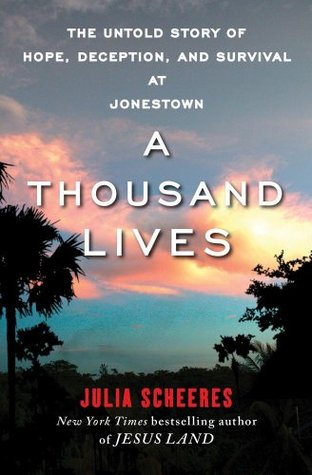
Book Review: A Thousand Lives


When I heard Julia Scheeres had a new book coming out, I jumped on it. I read  her memoir, Jesus Landseveral years ago and found it fascinating. I was even more eager to read the new book: A Thousand Lives: The Untold Story of Hope, Deception and Survival at Jonestown. I was not disappointed. Scheeres was working on a novel about a charismatic preacher from Indiana, when she looked up Jim Jones and then discovered the released, but untapped FBI archives, audio files and documents, of Jonestown.
In her introduction, Scheeres writes, “I believe that true stories are more powerful, in a meaningful, existential way, than made-up ones. Learning about other people’s lives somehow puts one’s own life into sharper relief… You won’t find the word cult in this book, unless I’m directly citing a source that uses the word… The word cult only discourages intellectual curiosity and empathy. As one survivor told me, nobody joins a cult.”
As I read this book, that last sentence came to me over and over: “Nobody joins a cult.” The book opens with a brief description of people arriving in Guyana to go to Jonestown. It quickly flashes back, then, to the early life of Jim Jones and his attraction to the church. He was drawn to the power and attention given to the man behind the pulpit and the physical aspects of devotion in Pentecostalism (speaking in tongues, slain the Spirit, dancing and prophesying). He began preaching in his late teens and proclaimed a message of God’s call to racial integration.
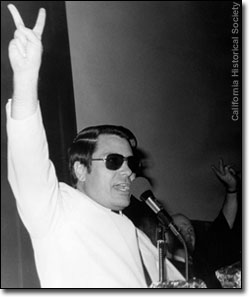
It was Jones’s push toward racial harmony that drew people to his church. In the book, many people recount how the Peoples Temple Full Gospel Church was their first encounter with black and white people worshipping together. The success of Jones’s ministry and its focus on neighborhood service drew much attention and many accolades. Many people were willing to give freely to such a mission and that initial dedication is what many of his followers would recall when they later thought Jones was straying from his message and, possibly, his sanity.
Jones later proclaims himself as “the one they call God” by denouncing the violence and segregation of the Bible (he repeatedly points to its “support” of slavery). When he moves his congregation from Indiana to California, everything becomes about loyalty to him. Even in the Indianapolis congregation, Jones presses people to lie on the floor one Sunday to test their trust in and faithfulness to him. This is one of the first signs of his maniacal behavior and the demands he will place on his followers. Even as evidence of Jones’s deceptions and pressures became evident, Scheeres writes:
True believers had an answer for everything. They excused Jones’s peculiarities with the maxim, the end justifies the means. The beatings, the swats- it was all showmanship, they said. The disciplines didn’t really hurt. Jones’s antics- like stomping on a Bible or [swearing during a sermon] – were all theater. He likes to get a rise out of people to force them to pay attention. Those members who were offended by his increasingly bizarre and cruel behavior kept quiet, and in their silence, seemed to condone it. (p. 88f)
Eventually as people move to Guyana, the book becomes like a horror movie. I could barely contain myself from screaming, “Don’t get on the plane! Escape through the jungle! Don’t eat the sandwich! Don’t drink the Kool-aid!” That last line is what most people know, if anything, about Jonestown- that nearly 1,000 people died there in November 1978 because they followed their leader, who was obviously crazy. People who are old enough to remember the story may recall a few other details- the number of children killed, the assassination of Congressman Leo Ryan, the pictures of the dead spread out in a field.
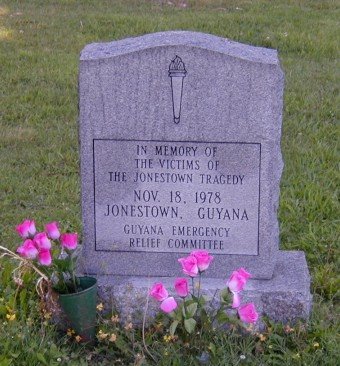
“Don’t drink the Kool-aid” is hardly the complete legacy of Jonestown, idealized to many who died there as a socialist paradise where everyone contributed and received according to their abilities and needs. Even as Jones obviously unraveled, people alternately agreed with him because they believed in the truth he had preached at one time or because they want him to leave them alone. Jones held two suicide “drills” in before the actual incident. People were routinely harassed into voting to “support revolutionary suicide” so many times that it ceased to become shocking. You know the ending to this book, but you don’t know the story.
One thing that I kept turning over in my mind as I read this book was the knowledge of the cults we have seen and that continue to exist since Jonestown. A thousand people died, manipulated to death by a drugged madman convinced he was God. And since we’ve had Branch Davidians, Heaven’s Gate, and several others (names intentionally omitted). My inability to complete the previous sentence in the way I want brings me to my point in recommending this book: just because people are clean and tidy or are technically protected under the First Amendment doesn’t mean they are not in a cult. No one joins a cult, but almost no one is able to voluntarily leave one. If you’re like me at all, names and pictures are coming to your mind of current organizations, supposedly religious in nature, that manipulate, mentally torture and extort those who join.
When we dismiss the people of Jonestown as weak-willed, we are ignoring the truth that history repeats itself and the only way to stop the cycle is to speak the truth. Loudly. Frequently. In all times and places (or close to it). Many people are still  surprised to be encouraged (or allowed) to ask questions in church and to examine the truth in which we claim to believe. Our ability to question and even doubt does not undo what is true, especially about God. The more questions are encouraged, the less anyone person can claim to have all the answers. That can be unnerving, but it can also be empowering. And it’s the only way to prevent the success of cult mind control. 
A Thousand Lives gave me the shivers… because of what’s in the past and what could easily be in the future. Probably not a book for a women’s circle, but possibly good for your book group, for fans of true crime or contemporary history, or anyone who wonders how things like this could (and do) happen.
Scheeres, Julia. A Thousand Lives: The Untold Story of Hope, Deception and Survival at Jonestown. Free Press; New York, NY. October 2011
Reviewed copy purchased by reviewer. 

A version of this review first posted at RevGalBlogPals on 10/24/11. 

Doing It Wrong

Yesterday I was in a meeting and we talking about Synod Assembly (the BIG annual joint congregations church meeting). When we were trying to figure out how to include more young people in the meeting, someone mentioned “the boring parts”.

I retorted, “You mean the part where we’re doing the work of the church?”

Someone later said, “What did you call it ‘the work of the Lord’?”

I said, “No, the work of the Lord and the work of the church sometimes overlap, but are not interchangeable.”

Work of the church: stewardship (care of) financial, spiritual, physical and emotional resources.

Work of the Lord: care of neighbor and fulfilling the Great Commission (not necessarily simultaneously).

Yes, church meetings can have slow parts. Not everyone is interested in or understands budget discussions. Not everyone comprehends the, sometimes, technical wording of resolutions or the use of shibboleths to show who’s in and who’s out.

The necessity of planning for the future and talking about details is sometimes the work of the church, on the local and national scale. Leaders must be chose and decisions must be made and dollars must be accounted for.

True enough, people who don’t have control elsewhere in their lives often bring it to a church meeting where they can yell about what we’re spending on toilet paper or whatever. Forgiving them… that’s doing the work of the Lord. Figuring out how to appease them and move on before the meeting lasts four hours… that’s the work of the church.

Often pastors find themselves groveling to people to fill church council/board/trustee spots. The prayer that goes into this is, “Pleeeeeeease, God, let So and so say yes.” People are intimidated by the title of church leadership and/or they’ve heard that the meetings are BORING!

Church leadership takes energy, vision and prayer. If you’re depending on the pastor to supply that, it won’t work. The pastor is not the Messiah. He or she can’t save the church single-handedly.

If the work or the discussion seems boring or intense, CHANGE it. Pause to sing a song or say a prayer. Encourage the judicious use of “calling the question“. Don’t allow moaning and groaning to precede a meeting.

I’m not Pollyanna enough to say that meetings are ALL GREAT, ALL the TIME. However, a church meeting shouldn’t be a sprint- covering all the ground, but no room for the Spirit. Neither should it be an ultra-marathon, where at some point everyone has zoned out and you’re only debating for the sake of debate.

Not every bit of conversation at most workplaces or in most families is fun, but some conversations have to be had. The opposite of fun isn’t boring. We can have profound, meaningful discussions on finances, vision, expectations and the future that are motivating, well-paced and well-lead.

The real question is not “Can church meetings NOT be boring?”, but “Are you willing to put the effort and challenge forward to change the culture of church meetings?”

Maybe changing how we do the work of the church IS the work of the Lord for this day.

Ten Years Later

In the summer of 2002, I worked in New York City through Lutheran Disaster Response (then Lutheran Disaster Relief) leading day camps in congregations that had experienced serious loss on 9/11/01. Not just the loss of the understanding of the world as they knew it, but loss of life.

I worked with children who had parents who came home and parents who didn’t. I talked to spouses who waited and were reunited. And some who weren’t.

All week I tried to put some order into my feelings. I never tell these stories. They are too raw, too hard, too stark. Two weeks after the camps ended, I moved to Nome, Alaska. I didn’t process when I could have and trying to do so now is like trying to rework plaster that has set.

So as I turned over the hard shape of this experience this week, I wrote this in my journal:

Anyway, I want to write a blog post about my memories, but I am not sure what to say or how to talk about the end of my memories. That I had to shut some of them away so that I could move forward. There are memories that are paralyzing in their truth. We have to dim them, fade their edges, fondly tuck them away and allow a burnished fire to peek through the keyhole of our memory trunk. We cannot live with their undimmed fullness in our lives. It is too much. This is not to say that we would ever forget. We just are incapable of remembering so intensely that it hurts. Constantly.

In order to live, in order to do service to life and to the memory of the dead, we go on and we put on foot in front of the other. We are not disrespectful. We have not forgotten. As long as we breathe, we remember, but we also want to live.

In living, we allow those who have died, both too soon and in their time, to continue in us. Through DNA and stories, through impressions and legacies, through gifts and habits.

That is all I have to say. 

Amen. 

Friday Five: Your Workspace Edition

Over at RevGalBlogPals, Revkjarla writes: I don’t know about you, but I am a notoriously messy creative worker.  My workspace at home, and at my office is always littered with books and papers and mail and pens and keys and mugs….and tchotchkes (momentos, weird things, etc.)   I am looking right now at a pair of dice that someone gave me that have “God” on each side, so that anyway you roll ’em, you end up with God.  Different, right?   
So, this Friday Five is all about YOUR tchotchkes in your workplace.  Describe five things in/on your workspace (however you define workspace–I tend to spill over onto bedside tables, end tables, coffee tables…create wherever I land) that are special to you!   Bonus points for pictures!


 Oh, honey, the disaster of my desk means my workspace usually looks like this. I’m a member of the Flat Surface Society, meaning if there’s a flat surface, I’ll stack stuff on it. And I’m not likely to change. I clean my desk post- Christmas and post-Easter, every year. 🙂 

 Here are my tchotchkes…


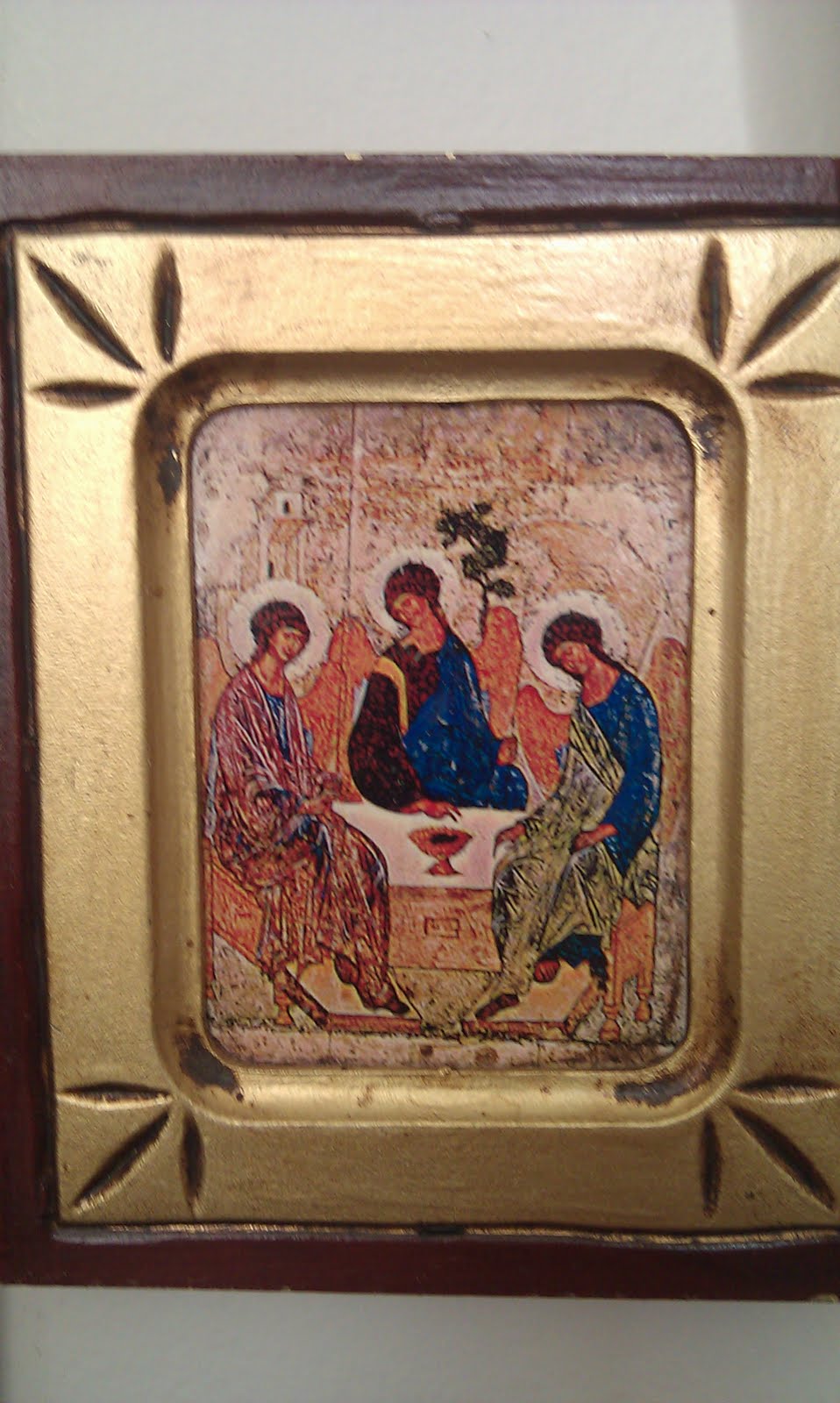
An icon of the Holy Trinity or of  Jesus and the travelers to Emmaus. It all depends on your view of it. 
A large rock given to me as a gift from a local United Methodist pastor. There are holes drilled through the rock and small dish glued to the bottom to hold lamp oil. The wicks are fed down through the holes. I love it and I don’t light it often, but I like having it on my desk. 
A little large to qualify as tchotchkes, but nevertheless- these are my Mother’s Day hats from our preschool. Every year we have a Mother’s Day tea (Grandmas, Aunts, Friends, etc) and the kids have made these great hats. I suppose I will eventually have a wall-full! 
This is a beach rock from Nome with an iconic picture of the Holy Family decoupaged onto it. I received it (along with 2 others) from the three Little Sisters of Charity who lived in Nome, Alaska during the time I lived there as well. I housesat their cats when they went out of town. The rock makes me think of the Little Sisters, the prayer room in their house which I used more than once, and my time in Nome. 
I couldn’t seem to get this picture to  load with the correct orientation. Oh, well. This glass paperweight is the only sign within my office of the school where I received my Master of Divinity. I’m proud to have to gone to Yale Divinity School and it’s not a secret, but my diploma (written in Latin) seems a bit overdone and I haven’t yet hung the sketch of the quad that was gifted me. So the paperweight lingers on my desk, often covered with papers (ironic, isn’t it). And it brings many memories when it surfaces. 

My Alternative Trinity

I’m a big fan of the Trinity: One God, Three Expressions- Father, Son and Holy SpiritCreator, Redeemer and SanctifierOur Source, Our Brother, Our Sustenance. (The links go to previous Trinitarian love blog posts.)

I believe the Trinity is how God has chosen to make Godself and power know in the world. However, there are other things I believe to be true and worthwhile. In particular, I believe in the holiness of bodies, in backing up your computer and in counseling (talking to someone). This has the potential to be a series, but I’m going to try to be brief this time.

1. The Holiness of Bodies I believe that our bodies are a gift from God and that we are unable to accomplish the work God intends us to do without them. This is why taking care of our physical being is spiritually important. If God’s work within us for Christ’s sake could be accomplished through the power of thinking alone, then we wouldn’t need a physical presence. However, God created a physical world, creatures with bodies and even came among us IN A BODY so that we might understand our call as participants in creation, shapers of this kingdom and our role as “bestowers” of God’s blessings.  You may not have a full complement of limbs or working limbs. You might not run quickly or speak well or be ruddy and handsome, but God is still able to use you. To deny that or to degrade (through action or word) the gift of the body is to doubt God’s own abilities in through the Spirit.

2. Backing up your computer: I’ve nearly lost my hard drive twice. Once in an unexpected computer expiration and once in a hard drive failure. The first time, magic computer elves rescued my files. The second time, I took my little hard drive, plugged it in to my external hard drive and the only things lost were 4 days of email (which were saved to the cloud!). I back my computer up to an external hard drive twice a week and I’m alway surprised when I hear people say that they’ve never backed up their files. It’s one of those “I know I should, but…” (If you don’t know how, go buy and external hard drive and I’ll come to your house and show you. I promise. Or I’ll show you via Skype if you don’t live in the Anchorage area.)

There are many things in that “I know I should, but…” category: exercise (see above), making a will (or dealing with other legal matters), creating a budget, talking about issues that are going unspoken… They’re all hard to do, but going ahead and doing them gives a freedom from fear that is only rivaled by the freedom we have in Christ. It does take time to review your insurance paperwork, have the conversation, plug in the external hard drive, but none of these things take as long as we think they will. Furthermore, none of them take as long as replacing files, lamenting lost items, fixing something without insurance or waiting out the probate court. Back it on up, baby!

3. Counseling. The following is a quote from the book, Rage Against the Meshugenah, by Danny Evans.

Depression= crazy. Crazy= people who mutter angrily to themselves, people who see things that aren’t really there, people who try to kill themselves. Crazy doesn’t = me. I’m married + I have a son + I have a college degree, for Pete’s sake! These things > crazy. Crazy most certainly does not = me.

When I recommend seeing a counselor more qualified than myself to someone I’ve talked to about the same issue more than 3 times, this is the response I usually get. They can’t see themselves lying on a couch talking about their mother. (You don’t do that on your first visit!) Talking to a professional is a great way to make links to situations in your life, to figure out some of your behavior patterns, to discuss thoughts or feelings or reactions around major life changes. Not every down feeling is depression. Not everyone benefits from talking things out, but many, many, many people (including me) do. Additionally, you may have to re-visit counseling more than once in your life. You don’t expect what worked for you physically or emotionally at 20 to keep working when you’re 35 or 40 or 65. You change and grow and how you think does as well. And, yes, you may have to revisit the same thing more than once. I’ve had short-term counseling (6 months to 1 year) 3 times in my life and it’s been transformative for me each time. Though some of the same issues were covered, I had changed and needed to think things through again. Each time was with a different counselor because I lived in a different location. 
I usually give myself the talk above when I start thinking I should see someone. Then I berate myself for not being able to solve my depression/ anxiety/ sadness/ frustrations on my own. And then, finally, I make some calls, go on the first visit and wonder why the heck I didn’t do this sooner. 
The Holy Trinity gets us into life, carries us through it and receives us into the next. However, there are additional blessings from God that make our present life more real, more enjoyable and more connected. Without a body, back ups, and counseling, I wouldn’t be where I am today, enjoying the life that God, +lifeboat, wind and waves+, has gifted me.  

What Am I Missing?

In the past week, I’ve been reading In the Garden of Beasts, a book set in 1933-1934 Germany. The book discusses William E. Dodd, the American ambassador to Germany as Hitler rose in power. He and his family have to sort out what is true and who is telling the truth in a critical age of shadowy figures and subterfuge. This in non-fiction.

As I read In the Garden of Beasts, I’m disheartened by the correspondence that goes back and forth between high powered American government officials and regular civilians that ignores or downplays Germany’s actions against Jews and other “unclean” races. Not only do people seem to dismiss the allegations, very often the letters reveal confessions of personal ambivalence or outright antagonism toward Jewish people. The main concern of the American government is primarily Germany’s potential default on war and reconstruction debts and, secondarily, Germany’s failure to reduce their armaments. The people who sound the trumpets about the plans toward Aryan supremacy and ethnic cleansing are dismissed as exaggerating or misunderstanding the work a few ruffians. The ambassador’s daughter, Martha, even believes that the comments are rumors directed at keeping Germany down because the wonderful country and people of her experience cannot be participating in systemic violence.

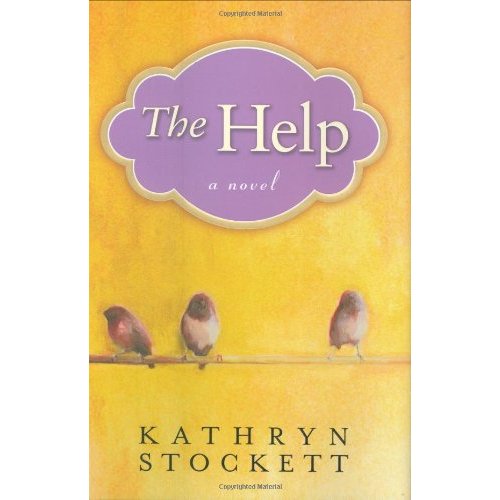
I also went with friends to The Help, a movie based on the book with the same name. My bookclub read this book last July, before there were rumors of the movie. The Help deals with the complex relationships and the power dynamics between white employers and African-American maids in Jackson, Mississippi in the early sixties. (That is a GLOSS if there ever was one.)

In The Help, a young white woman is encouraged to interview and write about the experience of as many black maids as she can before the whole “civil rights thing blows over”. In the backdrop of the story, Medgar Evers is killed and instructions for non-violent resistance are beginning to spread. Simultaneously, the Junior League is raising money for “starving children in Africa” as well as promoting a “health initiative” to encourage the help to have their own bathrooms- “for health reasons”.

All this makes me think, “What am I missing?” What’s going on today that will be obvious to my son or grandchild, but I’m missing. Which emails have I glanced past asking for my help that are the actual issues of my generation?

I know I can’t do everything. True story. Is there ethnic cleansing happening in the world today? Yes. Have we moved into a new era of racial understanding? Not so much. Are there starving children in Africa, Asia, Anchorage? Yes. Are there regimes to oppose? Yes. Is it likely that I pass by people each day who are affected by sex trafficking, drug sales, poverty, mental illness, stop-loss, wage freezes, reductions-in-force (laid off), and lack of education? Yes.

I think of the things I know I care about and they are mostly related to my own experience. Then I know there are things that cross my mind occasionally, usually because they are important to someone who is important to me. Then there are a wealth of things that I don’t notice (or that I might contribute to) because I’m not looking. Or worse, because I dismiss them, believing they are minor and will blow over soon. Is there something obvious that I’m missing?

Again, I can’t do everything. (I’m telling myself that, not you.) However, what I’m watching and reading these days has me re-evaluating what I am doing. You?

Who? What? When?

I recently read a book about Rabbi Hillel called If Not Now, When?. (I reviewed the book here.) Among his other wisdoms, Hillel was patient with people who said they were too busy to study the Torah. He listened to their well-intentioned promises to do it later, when they had more time. He replied, however, that no one ever gets more time. (Ask most retired people if they have more space in their days now.) If you aren’t making time for it now, when will you realistically do it? We all know about activity (and acquisition) creep. And we all know what it means to be busy.

If not now, when? I have many answers to that questions, but if I am honest, they are all excuses.

When I read the Epistle lesson for this week, I think Paul has a similar question to the Roman Christians: “If not you, who?” He writes,The scripture says, ‘No one who believes in him will be put to shame.’ For there is no distinction between Jew and Greek; the same Lord is Lord of all and is generous to all who call on him. For, ‘Everyone who calls on the name of the Lord shall be saved.’

 But how are they to call on one in whom they have not believed? And how are they to believe in one of whom they have never heard? And how are they to hear without someone to proclaim him? And how are they to proclaim him unless they are sent? As it is written, ‘How beautiful are the feet of those who bring good news!'” (Romans 10:11-15) If you (Roman or modern-day disciple) do not share the joy of your salvation, who will? 

Is there a better time? A better person? Not for the mission God has for you. 

I wrote an email this morning to a group of people whom I have known for several years. I pointed out that I hadn’t heard from many of them and that I was lonely for their companionship. One of the recipients called me with an hour of me sending the email. I was amazed and grateful. If I had read an email like mine, it is likely that I would have begun to compose a response. I would have planned to send it tonight from home. I would have decided to give myself a couple more days to think and then the message would have slid down the inbox and I would have forgotten. 

But, no, she felt the Spirit’s call at that minute and called me and we had a great conversation. We can all follow that example of heeding the Spirit’s urging and ignore the other voice that says, “You don’t know what to say. Maybe she’s busy. Wait until you have a few more minutes.” God does lead us through these moments that are the reality of living in faith and sharing it. We must trust the Spirit. 

If not you, who? 

If not now, when? 

Questions from the Dark

Following a recent local tragedy in which a young family (husband, wife, and two daughters) were killed in a plane crash, I’ve been talking with people affected by the tragedy. In many ways, an accident like this has a broad ripple affect beyond even secondary and tertiary relationships. People remember when they have been in similar situations or their own fears around death (their own, of their loved ones) rise to the surface.

Inevitably the question arises, “Why did God cause this to happen?” And its corollary: “How can this be a part of God’s plan?”

This is a sure-fire pastor stumper to which there is no great, comforting answer. Truthfully, I don’t believe God caused this tragedy to happen and I don’t think it was part of the plan. I think accidents happen because God allows us to use our free will and also allows the same of the people around us. The decisions we make (good, bad or neutral) can affect others just as their decisions affect us.

I think the harder question and my own question is, “Why didn’t God stop this?”

I can understand germ theory. I get that accidents happen. I understand (mostly) laws of motion and thermodynamics. I even appreciate that God allows the natural world to work in its own way, to its own consequences- some of which we can change and some of which we can’t.

Yet, I do believe that God can alter a course, if God decides to so. So why doesn’t that happen more often (or at all)?

I don’t know.

I do believe God has a plan, but mostly I think it is long-term. We are co-creators, stewards of the earth, caretakers of our neighbors, employing our free will in the details, but God has the big picture under control.

Things may well be swayed from God’s desire for us and for creation, but we cannot change the arc of salvation, judgment or grace.

I think of Elijah, demanding an answer of God (1 Kings 18:9-18), as to whether God would allow Elijah’s enemies to kill him. God comes to Elijah in silence. This makes me wonder if, when God is silent, we are either unable to hear or we are asking the wrong questions.

Nevertheless, I do not have all the answers.

This I believe: Accidents happen. Was God there? Yes. Are they with God? Yes. Did God cause this? No. Could God have stopped this? Yes, God was capable of doing so. Why didn’t God stop this? I don’t know.

I, myself, pray that preserves my faith until that time when it is no longer necessary. When I have answers, but the questions no longer matter.

Yelling in My Head

So I don’t have enough time to write and you don’t have enough time to read all that I would like say about this article from the Mat- Su Valley Frontiersman: Faith : What the Bible says about a modern controversy. To sum it up: the pastor/commentator argues, through the apostle Paul, that because wife’s body belongs to her husband and his to her- there cannot be rape in marriage. That is to say that if a man and woman have made a commitment before God and the state, there cannot be forced sex in the relationship.
Apparently, the state says there can be and the state’s against it, where it occurs. However, according to Ron Hamman, pastor of the Independent Baptist Church of Wasilla, God says there can’t be. Ron argues, even if there was forced sex (rape) in a marriage, you’d need witnesses to prove it according to the biblical standard. Well, Ron, most Christians I know stopped bringing in witnesses to prove the existence (and tearing) of the hymen on the wedding night a while ago. If I don’t have witnesses to that incident, I can continue to claim my virginity, yes? (The existence of my son would, technically, refute it.)
Ron, friend, you mention Matthew 18 with regard to the biblical injunction for witnesses. Let me point out, in all humbleness, that the passage in question is for the reproving of members of one’s own congregation, as opposed to suing them and making a show in public. This is about sin between members and pertaining to the life of faith, not about issues which actually have legal standing and bearing. Issues like, say, rape. You take two or three people with you, so that the reproof may be documented. Thus if the sin continues, you have witnesses to the fact that you encouraged it to stop. You may have to take the additional step of removing someone from the congregation, except that then Jesus goes on to say you owe your brothers and sisters forgiveness many, many times because of what you have been forgiven yourself.
Be that as it may, there is NO point where Jesus says you should continue to endure humiliation, bodily harm and subjugation. There is no point where Jesus says turn the other cheek so that your other eye may be blackened. There is no point where Jesus says the God-given gift of sexuality and sexual practice should be torn from you because someone else knows what is best for you. To return to where you are being hurt and demeaned is not forgiveness, but to give up on the promise of new life that God has for all. Freedom in Christ does not mean slavery to someone who claims to love you, but whose actions are otherwise.
Brother Ron, with the witnesses of the readership of this blog, I condemn your use of Scripture to manipulate women- half of God’s human creation. I stand against your argument to allow rape within marriage. I damn your twisting of the freeing word of God to hold people to an idea of marriage that does not promote faith, service or growth in the love of the Lord. I reprove you for putting women down, attempting to remove their joy in their bodies and for condoning violence in marriage. Shame! Shame on you!
Have you turned away from your sister in faith when you saw bruises, the origin of which you could guess, because that was “between her and her husband”? Have you sent back a quaking daughter to her father because he was her “covering”? Have you refused to intercede between a woman and her adult son because he had the “equipment” that made him right in God’s eyes and, thus, in yours?
Brother Ron, faith without works is dead and the fruit of your faith is rotten to the core. When you demean women, you dismiss God’s work in them and through them. You destroy their power to raise up strong daughters and sons. You fail completely to follow Jesus’ example of love to all whom he encounters, including those with vaginas.
You say, “The sad part is that it is this kind of Christianity that is ruining America.”
Indeed. 

Sisterhood, Rah-rah-rah!

So I was a little bit of a foot-dragger when it came to signing up for the Women of the ELCA‘s Triennial gathering this year. If I went it was my first time, I didn’t have any friends going, it IS pricey and I was doing other traveling for continuing education. The theme and the speakers looked great, but I grumbled and mumbled. Finally, a bold woman in my congregation made an offer I couldn’t refuse (she paid for a hotel room!) and I signed up to come.

Once I decided to come, I was still apprehensive. Like many introverts with verbal processing needs, I can easily be mistaken for a person who welcomes a crowd, but that’s not me. Large groups of people make me nervous and large groups where I only know a handful of the people involved are the worst.

Nevertheless, I signed up for everything. To do the Run, Walk, Roll. For the Young Women’s Chocolate Lounge. Joining in means, for me, joining in!

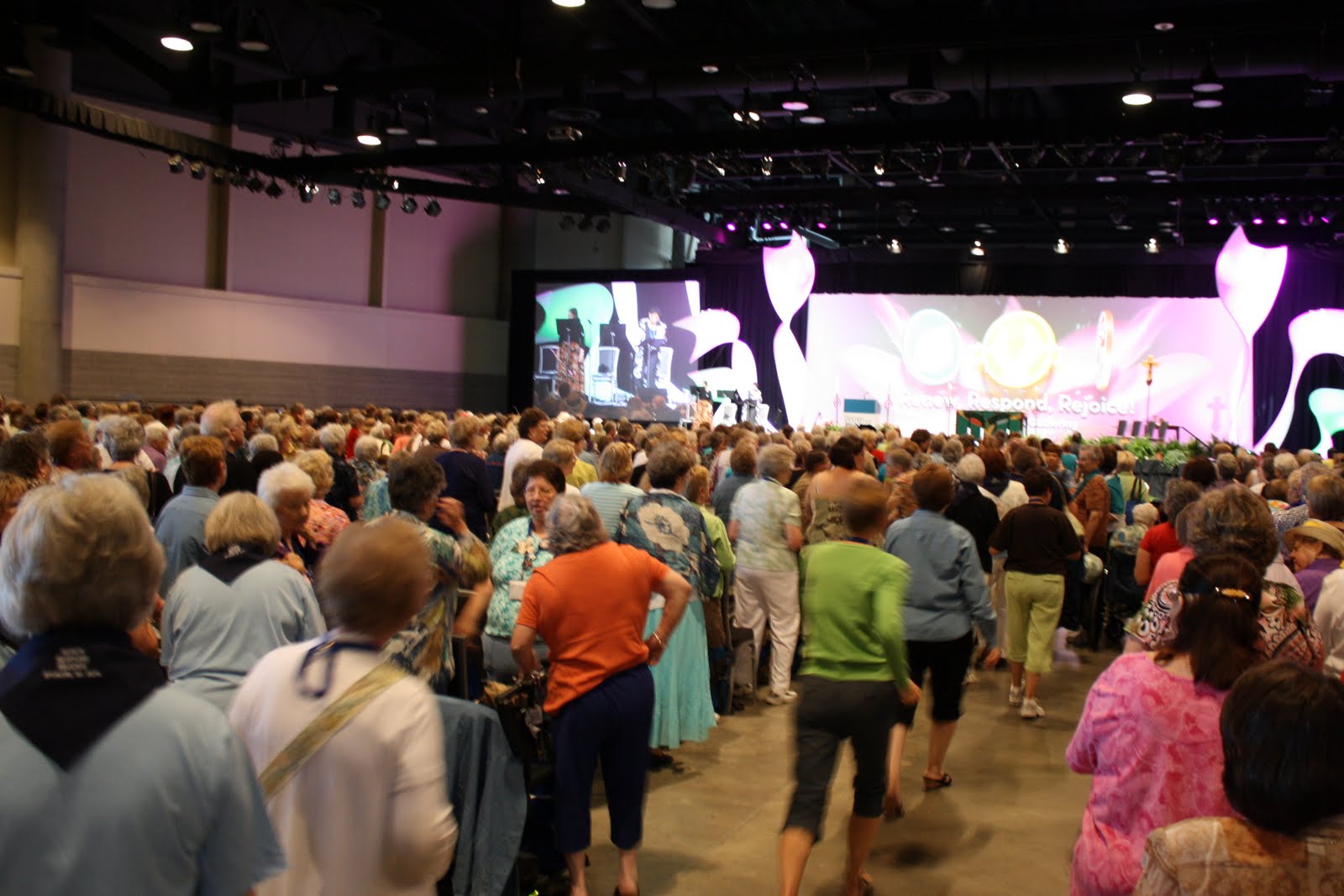
It’s a little early, yet, to reflect on all that this will come to mean, but this is a very powerful event. There are more than 2000 women here and you can hear us roaring. I had a hard time taking a non-blurry picture in worship this morning because people were dancing! Dancing, I say! Women of the ELCA!

I went on a garden tour yesterday and there were women from the Virgin Islands, the Dakotas, New York, Texas and all over (including, me, that event’s AK representative). We saw the gorgeous gardens of Manito Park in Spokane. Highly recommended! While I was considered the “baby” on the tour, I was heartened by the number of women who wanted to know about Alaska, about my congregation and about me.

I could fill pages about this morning’s speaker, Nora Gallagher, who told us that making a map of our faith (sharing our stories) is important because the coastline we describe can help someone else navigate life’s sometimes treacherous shores and shoals. I could tell you about the amazing mini-workshop I attended on how to make a picture prayer journal and the incredible leader, Esther Prabhakar, who showed us the one she’s been keeping for years. I could share my enthusiasm for the future of Joy Ranch in South Dakota, an all-accessible camp, or bubble over in anticipation of what we will hear tomorrow from Leymah Gbowee.

However I don’t think any of those things are the most amazing part of being here. The  strength of this Gathering is the truth of the power that is gathered. The hum and beat of the wings of the Spirit is practically audible as 2000 women commune together, in body, spirit and Christ. When the Real Presence seems like the Perceived Absence, here in this place- new light IS streaming.

Women have the greatest potential to hurt one another. We know exactly the power we have to wound with words, with what is left unsaid, with a glance. Yet we also know what heals, what helps, what builds hope. In the Gathering, the best comes out.

Sitting at a table together, one woman spoke to me about how much she admired Sarah Palin. Rather than launching into my criticisms, I calmly said how my opinion of her had changed and what I felt about her current circumstances. We were calm and smiling, gentle and caring. United by more than this minor division of opinion. And it IS minor.

There is power here to received and to be taken. The power to go back, loins girded, to the tasks we know are waiting. This is not Transfiguration. We are not seeing something new. What is being revealed to us is the truth about the power we have as women in the church, in this day, in our places, with Christ for us, with us, in us and through us. We are not being transformed so much as being brought into deeper understanding, through fellowship and teaching, about what is already true about us and those around us.

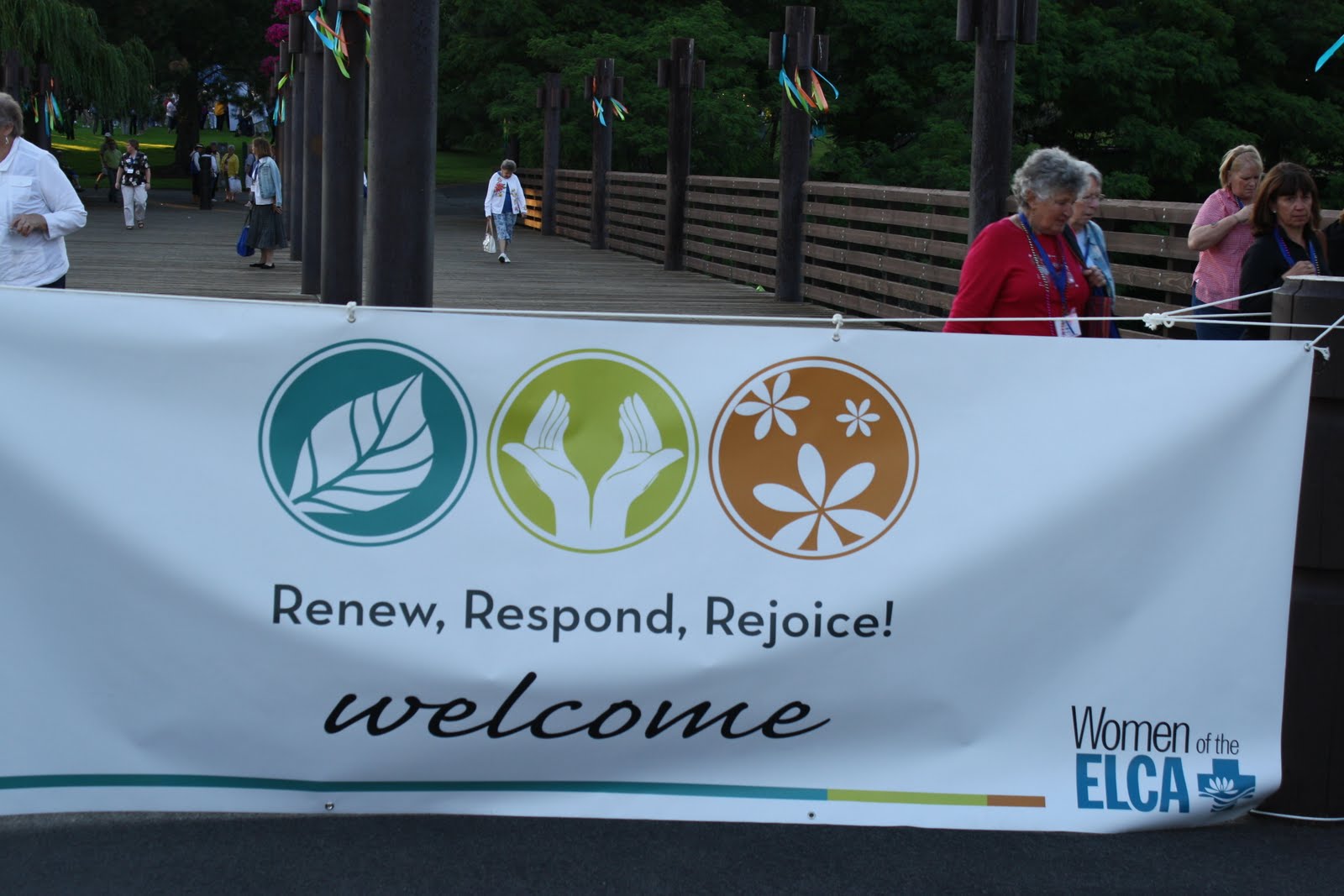
The theme is Renew, Respond, Rejoice- part of what we are experiencing here. We have a little time away, a few service opportunities and great communion, within worship and without. We are also receiving a challenge, a challenge of accountability and action. We are being challenged as half the church, half the creation, half of God’s kingdom builders to move into claiming and acclaiming the promises God has made.

Will we go back enlivened by the possibilities of God’s work in our world or will we go back to our regular to-do lists and busy-ness? The former takes focus, the latter takes nothing. The power will go out with us, available to those with whom we share these stories and mission opportunities. The Spirit goes out with us.

We are not alone. It’s not even just me and the Spirit. The power of this Gathering is the sense of “us” that is created. The understanding of the “WE” in WELCA. God is here. We are here. Renewing, responding and rejoicing… nothing can separate us.